Jandy · CV and CL
Jandy CV and CL
Jandy's four-cartridge filters: how the CV and CL differ, the clamp that closes to a gap rather than a torque, and why no store link appears here.
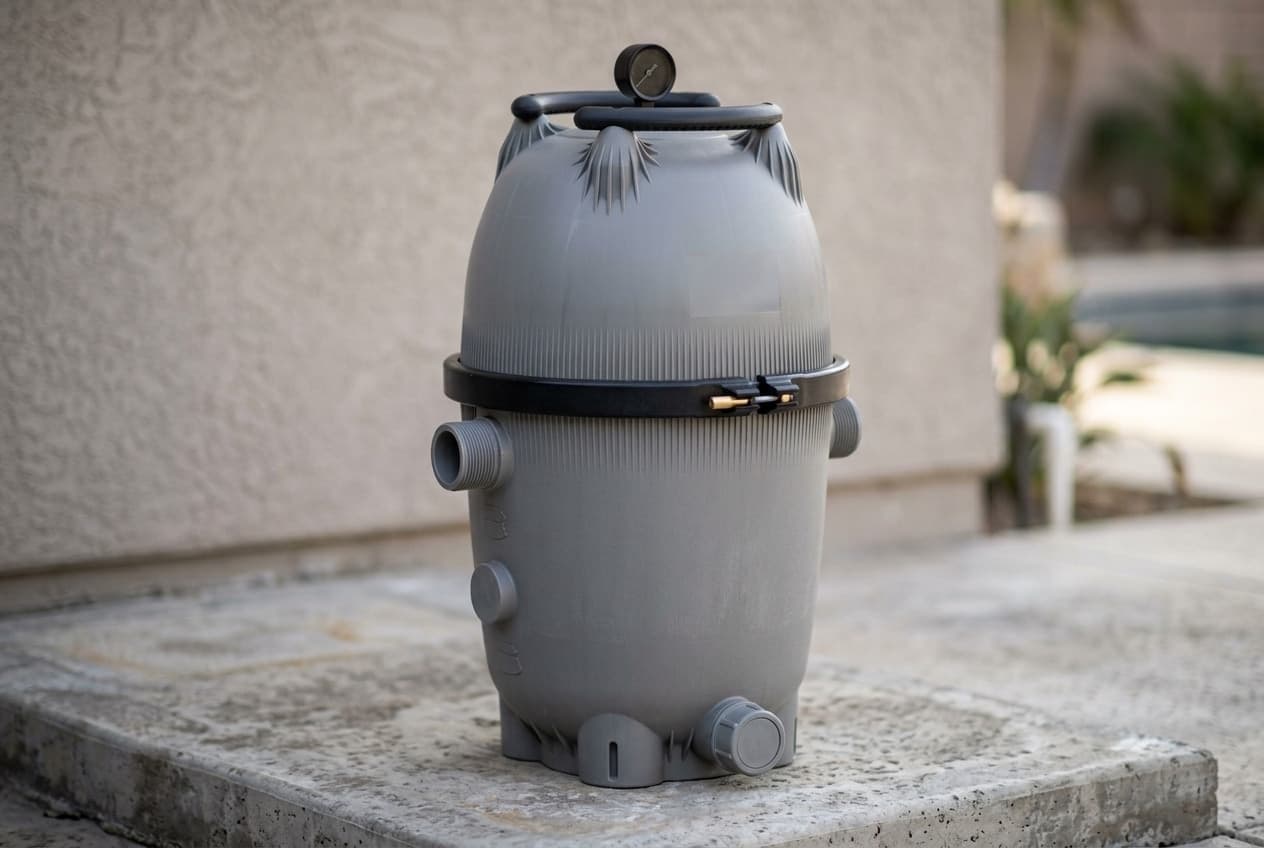
The CV and CL are Jandy's four-cartridge filters: a round two-piece tank held together by a clamp ring, with four pleated cartridges inside. They come in 340, 460 and 580 square feet, and the number is the area: a CV460 holds four 115 square foot cartridges. For a smaller pad, Jandy's one-cartridge filter is the CS, from 100 to 250 square feet.
The CV and the CL share almost every part, down to the cartridges, lid, manifold, clamp and gauge. What separates them is the bottom half of the tank.
CV or CL
- CV is the VersaPlumb version. Its inlet and outlet are at the same height on opposite sides of the tank, so it can sit in line between a Jandy pump on one side and a heater on the other. It comes with a sweep elbow for that connection and a drain cap, and its drain can be plumbed through a union and a ball valve.
- CL has its inlet and outlet on the same side, one above the other and 8 inches apart, and a drain plug.
The two tank bottoms are different parts, R0465400 for the CV and R0466500 for the CL. Everything else in the parts list is common to both.
If you are replacing a CV beside a Jandy pump, the manual wants at least 7½ inches between the center of the pump outlet and the filter's inlet bulkhead, to make room for the sweep elbow.
Size it by flow, then by headroom
Jandy's maximum flow ratings, from the 2025 sell sheet:
- 340 — 127 GPM
- 460 — 150 GPM
- 580 — 150 GPM
That works out to 0.37, 0.33 and 0.26 GPM per square foot. Past 460 square feet the flow stops rising, so a 580 doesn't handle a bigger pump. What it buys is more area to fill before it needs cleaning. The sizing guide works through pump flow against filter area. Separately, the manual's minimum for turnover is the pool's whole volume two to four times in 24 hours.
Before choosing a size, measure the height. The sell sheet gives the height you need from the pad to lift the cartridges out: 57 inches for the 41-inch 340 and 460, and 69 inches for the 47-inch 580. Under a low deck or a soffit, that is the number that decides.
Installing it
- Set it on a firm, level surface such as a concrete slab. Don't level it with sand, which washes away; the manual notes a filter system can weigh up to 800 pounds.
- Leave 6 inches of clearance around the filter so the clamp can be inspected, room above to lift the lid and cartridges, and keep electrical controls at least 5 feet away so you can stand clear at start-up.
- Up to 2½ feet above the pool's water level is fine without hurting the pump, with a check valve recommended on the suction line. Below water level, fit isolation valves on both lines.
- Jandy recommends 2-inch pipe at minimum. The unions go on dry and hand tight: no Teflon tape, no pipe dope, no glue or solvent on the coupling nuts. Lubricate o-rings with a silicone-based lubricant only.
- The gauge and air release screw into the lid, and their locknut is hand tight only.
- If local code requires a pressure test, keep the filter out of it. If it can't be, the manual limits the test to 35 psi, water no warmer than 100°F, and 24 hours.
The clamp closes to a gap, not a torque
Unlike Hayward's and Pentair's filters, Jandy gives no torque figure. With the o-ring seated in the lower half and the lid pressed down onto it, fit the clamp ring over both flanges, seat the T nut the right way round, and tighten with a 9/16-inch socket until the two halves touch or are within 1/16 inch.
Stop there. The manual warns that tightening it further can break the clamp, and if it won't close to that gap, it says not to run the filter at all. Check it again after the first week, then at least once a month.
Starting it
- Pump off at the breaker.
- Check the drain cap (CV) or plug (CL) is in and tight, and the clamp is seated.
- Fill the pump basket with water to prime.
- Open the air release fully by turning the knob on the back of the gauge counterclockwise. Don't take the knob off.
- Open any isolation valves.
- Stand at least 5 feet away and start the pump. Close the air release when a steady stream of water comes out.
- Watch the gauge. If it approaches 50 psi with clean cartridges, turn the pump off.
Normal start-up pressure is 6 to 15 psi. Once the gauge settles, turn the bezel so the "clean" arrow lines up with the needle. When the needle reaches the "dirty" arrow, it is time to clean. That is 10 to 12 psi above the starting pressure.
Cleaning the cartridges
- Pump off, breaker off, and open the air release fully so all the pressure is gone.
- Below water level, close the isolation valves first.
- Drain the tank, then put the drain plug or cap back.
- Loosen the clamp and lift the lid straight up until it clears the cartridges.
- Lift the manifold off the outlet tube, and pull the four cartridges.
- Stand them upright and hose each pleat with a nozzle.
- Hosing won't shift algae, suntan oil, calcium or body oils. For those, the manual says to soak in a degreaser, then a descaler.
- Look for holes, tears or badly worn pleats, and replace any cartridge that has them.
Going back together, seat each cartridge on the support at the bottom of the tank. Check the o-ring on top of the outlet tube and the tank o-ring for cracks or wear, set the manifold squarely over the cartridges and outlet tube, then clamp and start it as above.
Don't clean the outside of the tank with solvents. Jandy says they damage the plastic; use mild detergent and water.
What the troubleshooting table says
- Dirt returns to the pool: a hole in a cartridge, a worn o-ring seal inside the filter, or a cracked manifold. All three are listed below.
- Short filter cycles: algae, water chemistry, a pump that exceeds the filter's design flow, or cleaning that didn't get the cartridges clean.
- High pressure at start-up: small return eyeball fittings, a partly closed return valve, a pump too large for the filter, or dirty cartridges.
- Low flow: dirty strainer baskets, suction-side air leaks, blocked lines or closed valves, dirty cartridges, low water, an unprimed pump or a blocked impeller.
- Water not clear: sanitizer or chemistry, heavy use, too little run time, a dirty filter, or a hole in a cartridge.
Winterizing
Turn off the pump and breakers, open the air release, and take out the drain plug so the tank empties. Store the plug and its seal somewhere safe, and leave it out until spring. Drain the piping, and cover the equipment with a tarp or plastic sheet.
Why there is no store link
Jandy's warranty doesn't apply to a filter bought online. It exempts only small valves, parts and accessories from that rule. From a dealer, the filter gets one year, parts only, with no labor, and only when it is installed by a licensed pool contractor where one is required. The warranty covers only the first owner and ends if the filter is moved.
When this page was checked, Amazon had aftermarket cartridges for these filters but no listing for the filters themselves. Buy the filter from a Jandy dealer.
Replacement cartridges are different. Jandy's online exclusion doesn't reach parts, so genuine Jandy cartridges bought online still get the 90 days Jandy gives purchased parts. Jandy's numbers are R0554500 for the 340, R0554600 for the 460 and R0357900 for the 580.
Where Jandy's documents disagree, or are unclear
- A section that isn't there. The cleaning instructions tell you to follow steps 1 through 8 of "Section 5.1". The manual's disassembly steps are Section 5, which has no subsections.
- Plug or cap. The start-up steps separate the CL's drain plug from the CV's drain cap. The disassembly and winterizing steps only ever say drain plug.
- The phone number. The troubleshooting page prints Jandy's technical support line as 1.800.822.793, a digit short. The rest of the manual gives 1.800.822.7933.
- One sweep elbow or several. The manual says the CV comes with a sweep elbow; the sell sheet says sweep elbow fittings. The manual's own figure shows two part numbers, SEFL1002 and SEAQL1001, and its parts list gives only SEFL1002.
- What cleans a cartridge. The description says soap and water. The cleaning section says a degreaser, then a descaler.
Which model do you have?
The model number is on the filter label. Everything else in the range is shared — these are the parts that change with it.
| Model | Filter area | Max flow | Height | Height to lift cartridges | Cartridge, 4 required | Tank top | Tank bottom | Note |
|---|---|---|---|---|---|---|---|---|
| CV460, 460 sq. ft. | 460 sq. ft. | 150 GPM | 41 in. | 57 in. | R0554600 | R0554700 | R0465400 | The CV is the VersaPlumb version: its inlet and outlet sit at the same height on opposite sides of the tank, so it can line up between a Jandy pump and heater, and it comes with a sweep elbow and a drain cap. Shipping weight 106 lb. |
| CV580, 580 sq. ft. | 580 sq. ft. | 150 GPM | 47 in. | 69 in. | R0357900 | R0357300 | R0465400 | Same 150 GPM ceiling as the 460. The extra area buys longer runs between cleanings, not more flow. The only size with its own tank top. Shipping weight 112 lb. |
| CV340, 340 sq. ft. | 340 sq. ft. | 127 GPM | 41 in. | 57 in. | R0554500 | R0554700 | R0465400 | The smallest, and the only size rated below 150 GPM. Shipping weight 106 lb. |
| CL460, 460 sq. ft. | 460 sq. ft. | 150 GPM | 41 in. | 57 in. | R0554600 | R0554700 | R0466500 | The CL has its inlet and outlet on the same side, one above the other and 8 in. apart, and a drain plug instead of the CV's cap. Shipping weight 95 lb. |
| CL580, 580 sq. ft. | 580 sq. ft. | 150 GPM | 47 in. | 69 in. | R0357900 | R0357300 | R0466500 | Shipping weight 101 lb. |
| CL340, 340 sq. ft. | 340 sq. ft. | 127 GPM | 41 in. | 57 in. | R0554500 | R0554700 | R0466500 | Shipping weight 93 lb. |
Jandy CV and CL parts, and what goes wrong
Read off the manufacturer’s parts list and checked before it ships. Open a row for what a bad one actually does — or start from the symptom and work down, which is the cheaper order.
What is it doing?
One of the four cartridges in a CV460 or CL460. The 340s take R0554500 and the 580s R0357900, four each. A hole in a cartridge is the manual's cause for both dirt returning to the pool and water that won't clear. Hosing doesn't remove algae, suntan oil, calcium and body oils, so the manual soaks the cartridges in a degreaser first, then a descaler. Each time they come out, check for holes, tears and badly worn pleats, and replace any that have them.
Live pricing arrives when the retailer programs are approved.
The manifold that sits over the tops of the four cartridges and the outlet tube. A cracked one is the third cause on the manual's list for dirt returning to the pool, and its fix is a new manifold. On reassembly it has to sit squarely over both the cartridges and the outlet tube.
Live pricing arrives when the retailer programs are approved.
The tube the manifold seats on. The manual's other cause for dirt returning to the pool is a worn o-ring seal inside the filter, and its reassembly step is to inspect the o-ring at the top of this tube for cracks and wear marks every time the cartridges come out. Jandy also sells an o-ring replacement kit, R0358000, but the manual does not list what it contains.
Live pricing arrives when the retailer programs are approved.
The clamp ring that holds the lid on, with its T nut and threaded rod. Tighten it with a 9/16 in. socket until the two halves touch or are within 1/16 in., but not beyond — the manual warns the clamp can break. If it won't close that far, the manual says not to run the filter and to call a technician. Recheck it after the first week, then at least once a month. The rod, retainer and nut alone are R0357500.
Live pricing arrives when the retailer programs are approved.
The gauge and air release valve on the lid. Jandy calls the gauge the primary indicator of how the filter is running, and asks for this assembly to be checked for air or water leaks at least once a week. Its locknut goes on hand tight only — a wrench can damage the nut, gauge or air release. The gauge alone is R0359600.
Live pricing arrives when the retailer programs are approved.
If you are doing the job anyway
Cleaning or replacing the cartridges opens the tank, and the manual's reassembly checks two seals while it is open.
Cartridge change, 460 models
Four new cartridges means the lid, manifold and cartridges all come out. Before closing it, the manual checks the tank o-ring for cracks or wear marks and replaces it if needed. Jandy's warranty won't cover damage caused by a failed o-ring.
- Filter cartridge, 115 sq. ft. — four required, 460 modelsR0554600
- R0357800R0357800
Jandy CV and CL manuals and documentation
Hosted by the manufacturer. These open on Jandy’s own servers, so they stay current.
- Cartridge pool filters installation and operation manual, CL and CV VersaPlumb (H0291800 Rev. J, 2024)manual
- Parts list and exploded view, in the Rev. J manualdiagram
- CV/CL series sell sheet (94314_SL, 2025) — flow, heights and the clearance to lift the cartridgesspec
- Jandy limited warranty (H0333803 Rev. Y)spec
Jandy CV and CL warranty
1 year parts, None labor
One year from the date of retail purchase, which is Jandy's standard term — its warranty lists no exception for filters. It pays for the replacement product or part only: labor and transportation are excluded. It does not apply to a filter bought through the Internet or any e-commerce platform; Jandy excepts only valves under 3 in., parts and accessories from that rule, so a replacement cartridge bought online is still covered. The product has to be installed and serviced by a licensed pool contractor where the jurisdiction requires one, or otherwise by an experienced pool professional. The warranty covers only the first retail purchaser, does not transfer, and ends if the filter is moved from where it was installed. Purchased replacement parts get 90 days. Among the exclusions: dirty or clogged filter elements and breather tubes, damage caused by a failed o-ring or cartridge element, flow outside the rated range, freezing and improper winterizing, and water chemistry outside Jandy's limits. The manual adds that running water above 105°F voids it. Commercial use is one year too.
Manufacturer’s termsJandy CV and CL complete parts list
Every part on the manufacturer’s exploded diagram, in their numbering. Marked rows are the ones covered above with a symptom and a diagnosis.
30 parts
| No. | Part | Description | Note |
|---|---|---|---|
| 1 | R0357100 | Handle assembly with hardware | Set of two |
| 2 | R0359900 | Handle hardware | Set of four |
| 3 | R0357200 | Gauge and air release assembly what goes wrong | |
| 4 | R0359600 | Pressure gauge | |
| 5 | R0552000 | Tank adapter with o-ring and union nut | |
| 6 | R0554700 | Tank top | 340 and 460 |
| 6 | R0357300 | Tank top | 580 |
| 7 | R0357700 | Top spacer | |
| 8 | R0358700 | Breather tube assembly | |
| 9 | R0357600 | Manifold assembly what goes wrong | |
| 10 | R0554500 | Filter cartridge, 85 sq. ft. | 340 models, four required |
| 10 | R0554600 | Filter cartridge, 115 sq. ft. what goes wrong | 460 models, four required |
| 10 | R0357900 | Filter cartridge, 145 sq. ft. | 580 models, four required |
| 11 | R0357400 | Tank clamp ring with rod assembly what goes wrong | |
| 12 | R0357500 | Threaded rod, retainer and nut | |
| 13 | R0357800 | Tank o-ring | |
| 14 | R0555100 | Outlet tube and elbow assembly with o-rings what goes wrong | |
| 15 | R0358400 | Inlet elbow with o-ring | |
| 16 | R0358500 | Filter cartridge support | |
| 17 | R0358000 | O-ring replacement kit | Not shown on the exploded view |
| 18 | R0405200 | Retaining ring | |
| 19 | R0465600 | Bulkhead assembly with o-ring | The parts list labels it CV filter |
| 20 | R0465500 | Anchor bracket | Set of four |
| 21 | R0465400 | Tank bottom assembly, CV | |
| 22 | R0466500 | Tank bottom assembly, CL | |
| 23 | R0461800 | Universal half unions and drain plug cap | Set of three unions |
| 24 | SEFL1002 | Sweep elbow | Not shown on the exploded view. The manual's figure puts it between a CV filter and a Jandy pump |
| 25 | R0522900 | Universal half union | Set of one. Added since the 2009 Rev. C manual |
| 26 | R0523000 | Drain cap assembly | Added since the 2009 Rev. C manual |
| — | SEAQL1001 | Sweep elbow | Shown in the manual's figure between a Jandy LXi heater and a CV filter; not in the parts list |