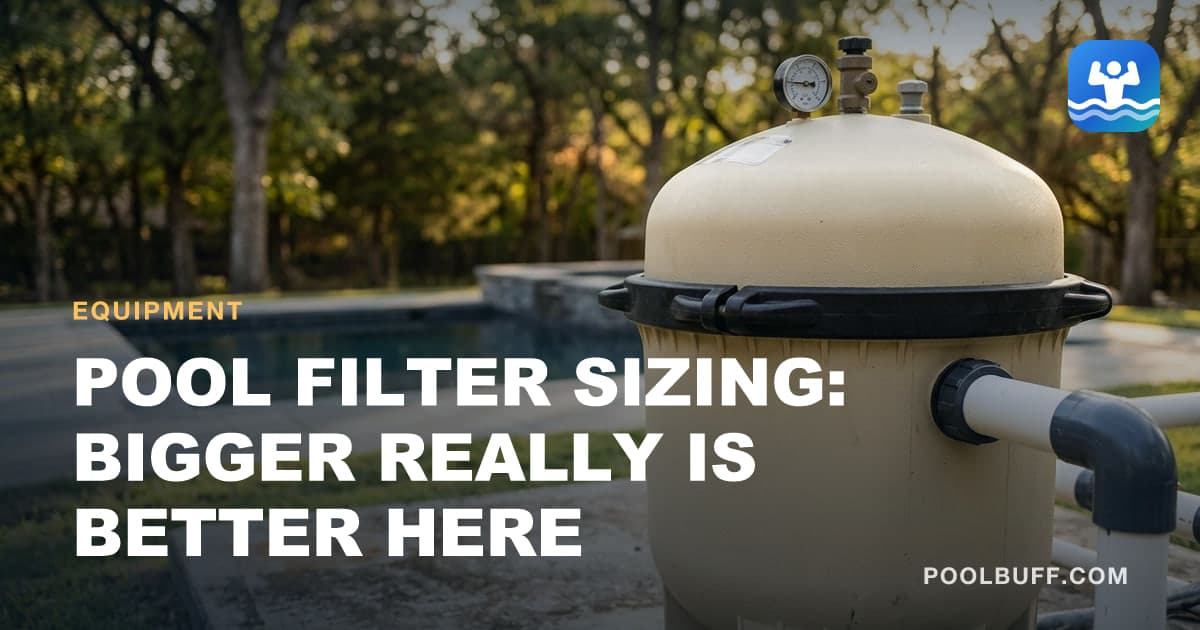
Pump sizing and filter sizing work in opposite directions, and that trips people up constantly.
Too much pump is a real problem — wasted power, wrecked suction, noise. Too much filter is barely a problem at all. It costs more on day one and takes more room on the pad, and in exchange it runs at lower pressure and goes weeks longer between cleanings.
So the honest advice on filters is: work out the minimum, then go a size up.
Key takeaways
- Filters are sized to flow, not to pool volume. A big pool with a small pump needs a smaller filter than people assume.
- Oversizing a filter is the opposite of oversizing a pump. Go one size up and you will not regret it.
- The number that matters is square feet of media area, and the design flow rate per square foot differs by filter type.
- A bigger filter means longer between cleanings, lower pressure, and a pump that works less to push the same water.
- If your filter pressure climbs fast every week, the filter is probably undersized for the pump in front of it.
Size to the pump, not the pool
The filter never sees your pool. It sees whatever the pump pushes through it.
Two identical 20,000 gallon pools, one with a small variable-speed pump run long and slow, one with an old 1.5 horsepower single-speed, need different filters. The pool volume is the same. The flow is not.
Pool volume matters only because it's what led you to a pump size in the first place.
Find your actual flow rate
Not the number on the pump label. The flow it makes on your plumbing.
- 1
Work out your pool volume
Length times width times average depth times 7.5 for a rectangle. Our volume calculator does the odd shapes.
- 2
Pick a turnover target
Most residential pools turn the water over once in eight to ten hours of running. Divide your volume by the hours, then divide by 60 to get gallons per minute.
- 3
Sanity check against the pump
A 20,000 gallon pool over 8 hours is about 42 gallons per minute. That is a modest number, and it is what most residential pools actually need.
What square footage means
Every filter has a media area in square feet and a design flow rate per square foot. Multiply them and you get the flow the filter is built for.
The catch is that the design rate is wildly different per type, so the square footage numbers are not comparable across them.
| Typical design flow | Rough size for 40-60 GPM | |
|---|---|---|
| Sand | 15-20 GPM per sq ft | About 3 sq ft (a 24-30 inch tank) |
| DE | Around 2 GPM per sq ft | About 48-60 sq ft of grid |
| Cartridge | Often under 1 GPM per sq ft | About 150-200 sq ft of element |
That's why a 200 square foot cartridge and a 3 square foot sand filter can do the same job. A cartridge presents far more surface at a far gentler rate.
Specific models, with their real filter areas and the parts that go in them, are on the equipment pages by brand.
Size yoursPump and filter sizing calculatorWorks out the flow from your volume and turnover, checks it against your pipes, and gives the filter area for sand, D.E. and cartridge.Why oversizing works in your favor
Four things get better, and nothing gets worse except the price.
Lower pressure. More area means less resistance. The pump moves the same water against less head, which uses slightly less power and is easier on the seal.
Longer between cleanings. A filter clogs when the dirt it holds starts to restrict flow. Double the area and you roughly double the dirt it can hold first. On a cartridge, that's the difference between stripping it monthly and stripping it twice a season.
At residential scale that usually means something like a 325 sq ft cartridge or a 320 sq ft equivalent, and a 60 sq ft DE filter if you want the finest filtration available.
More headroom on bad days. After a storm, or a pool party, or an algae treatment, the filter takes a beating. A big one absorbs that. A marginal one blinds off and you're cleaning it at 9pm.
Kinder to a variable-speed pump. Low speed only works if the system doesn't need much pressure to move water. A generous filter is part of what makes running at 1,400 RPM realistic.
How to tell yours is undersized
Pressure climbs fast. If you're going from a clean 10 psi to 18 or 20 in a week or two, during normal conditions, the filter is small for the flow.
You clean it constantly. More than about once a month on a cartridge, in a pool that isn't under trees, is a sizing signal rather than a dirt signal.
Pressure sits high even after cleaning. A clean filter should settle to a stable baseline. If a freshly cleaned filter starts at 18 psi, the flow through it is too high for its area.
The pump can't run slow. If dropping to low speed makes the skimmer stop pulling, part of that is system resistance, and the filter is often a chunk of it.
Go deeperPressure reading strangely?Work out whether it is the filter, a valve, or something on the suction side.Picking one, in practice
Take your flow number. Find the filters rated above it. Then go one size up from the smallest that qualifies.
Cartridge ranges make that easy, because the residential rating usually tracks the area almost exactly. Pentair's Clean & Clear runs 50 GPM on 50 square feet and 75 on 75; Jandy's CS does the same until it meets a 125 GPM ceiling that three of its four sizes share. Hayward's single-cartridge SwimClear is the one to read twice, because its largest size carries a 200 GPM rating that runs past Hayward's own flow limit for it. Hayward's older StarClear Plus goes the other way: its 175 sq. ft. C17502 is rated at the same 120 GPM as the 120 sq. ft. C12002.
The same plates carry a second, much lower commercial figure — 38 GPM where the residential number is 100, on the same filter. A public pool is held to a slower rate through the same media. At home the residential number is the one to size against.
The price gap between filter sizes is usually modest — often $100 to $250 between adjacent models in a range — and it buys you years of longer cleaning intervals. Compared with almost anything else on the pad, that's a cheap upgrade.
Where to stop: when the filter no longer fits the pad, when the plumbing would need reworking to connect it, or when you've gone so far up a range that you're paying commercial money for a residential pool. Two sizes up is generous. Four is just spending.
The one place this reverses
If you have a sand filter, backwashing sets a ceiling. A very large tank needs a lot of water to backwash properly. Your pump also has to move enough flow to lift and tumble the whole bed, and a low speed may not do it. An enormous sand filter on a small variable-speed pump can be hard to backwash effectively at any speed you'd normally run.
That's the one real argument against going wild on size, and it applies to sand only. Cartridge and DE don't care.
Go deeperNot sure which type yet?Sand, cartridge and DE compared on filtration, water use and how much work each one is. Go deeperBuilding new?Get the filter size and pipe diameter written into the contract. Neither is cheap to change later.Frequently asked questions
What size pool filter do I need?
Work out your pump's actual flow in gallons per minute, then choose a filter rated comfortably above it. For a typical residential pool moving 40 to 60 gallons per minute, that usually means roughly a 3 square foot sand filter, a 150 to 200 square foot cartridge, or a 48 to 60 square foot DE filter. Going a size larger than the minimum is a good idea.
Can a pool filter be too big?
Practically, no. An oversized filter runs at lower pressure, holds more dirt before it needs cleaning, and makes the pump's job easier. The only real cost is the up-front price and the space it takes on the pad. This is the opposite of pump sizing, where too big is a genuine problem.
Do I size a pool filter to the pool or to the pump?
To the pump. The filter only ever sees the water the pump sends it, so pool volume matters only because it influenced what pump you chose. Two identical pools with different pumps need different filters.
How many square feet of filter do I need per gallon per minute?
It depends entirely on the type. Sand is usually designed around 15 to 20 gallons per minute per square foot. DE sits around 2, and residential cartridges lower still, often under 1. That is why a cartridge is rated in hundreds of square feet and a sand filter in single digits. The numbers are not comparable across types.
Will a bigger filter save me money?
A little, in two ways. Lower pressure drop means the pump uses slightly less power to move the same water, and longer intervals between cleanings means less water down the backwash line and fewer cartridge replacements over time. It will not noticeably change your bill, but it costs you nothing either.