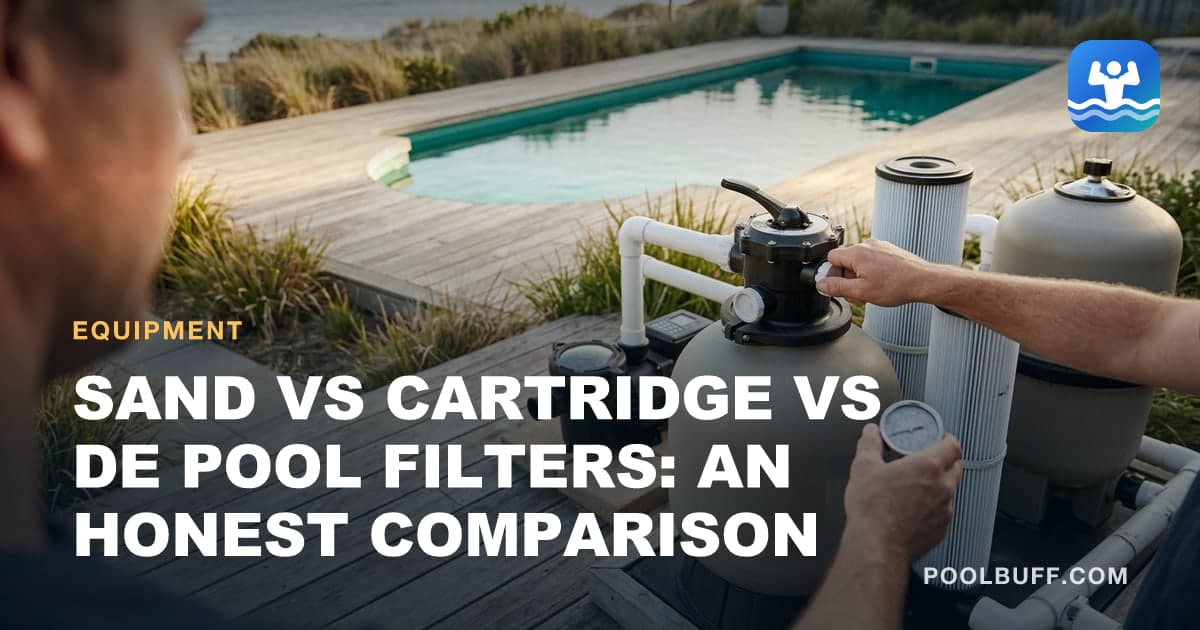
Everyone in this industry has a favorite filter type and most of them will give you a slightly defensive answer about why. (Micron ratings, backwashing, DE grids — all defined in the glossary.)
Here's the version without the loyalty.
Key takeaways
- Cartridge is the right answer for most backyard pools, and increasingly the only sensible one in drought regions.
- Jandy says a backwash sends 100 gallons or more to waste. That adds up in a metered, restricted market.
- DE genuinely filters finer than the other two, and genuinely asks more of you every season.
- Filter size matters more than filter type. Oversize it and everything gets easier.
- A dirty cartridge filters better than a clean one, right up until pressure climbs. That's not a reason to neglect it.

Side by side
| Sand | CartridgeMy default | DE | |
|---|---|---|---|
| Filters down to | 50-100 microns, per Pentair | 20 microns, per Pentair | 5 microns or finer |
| Purchase price | $400-$900 | $500-$1,300 | $700-$1,600 |
| Routine cleaning | Backwash, 5 min | Hose rinse, 30-60 min | Backwash + recharge, 15 min |
| Cleaning frequency | Every 4-8 weeks | Every 3-6 months | Every 4-8 weeks |
| Water used per clean | 100+ gal, per Jandy | A few gallons | 100+ gal, per Jandy |
| Consumables | None | Cleaner, ~$20/yr | DE powder, ~$40/yr |
| Media replacement | $60-$150, when backwashing stops working | $80-$300, every 2-4 yrs | $200-$400 grids, when cleaning stops working |
| Ease of use | Easiest | Easy but hands-on | Most involved |
| Best for | Hands-off owners, plenty of water | Most residential pools | People who want glass-clear water |
Sand
How it works. Water passes down through a bed of graded silica sand. Dirt gets trapped between the grains. Backwashing reverses the flow and flushes it out.
What's good. It's the most forgiving filter you can own. Backwashing takes a few minutes and requires nothing but turning a valve. The sand is replaced only when backwashing stops bringing the pressure down, and costs under $150. Nothing about it is fiddly.
What isn't. It's the coarsest of the three. Fine particulate, dead algae and some silt pass straight through. And every backwash sends water down the drain — Jandy puts it at 100 gallons or more, and a big filter run longer sends more — which in a metered, drought-restricted market is a genuine ongoing cost.
The upgrade sometimes worth making. Recycled glass media is sold as a straight swap for sand at replacement time, and its makers claim finer filtration, longer life and less weight for the same tank. Check your filter's maker allows it before you buy: answering owners on its own product pages, Hayward says it recommends only No. 20 silica pool sand in its sand filters.
A quirk worth knowing. A freshly backwashed sand filter is at its worst. A clean bed is at its coarsest, and as debris loads into the sand it narrows the gaps and starts catching finer material. So a sand filter genuinely does clean better a few weeks after a backwash than the day after one. That's not a reason to neglect it, but it is a reason not to backwash on a calendar.
Watch for. Channeling in a worn bed — water finding a path straight through without contacting media. A hard calcified crust on top. Sand appearing on the pool floor, which usually means a cracked lateral or standpipe.
Cartridge
How it works. Pleated fabric elements, sometimes one large one, sometimes four smaller. Water passes through the fabric, dirt stays on the outside.
What's good. Finer filtration than sand. No backwashing at all, so essentially no water wasted — which matters more every year in the southwest. Simple mechanically: no multiport valve, nothing to misoperate, one fewer thing to break. Big surface area means long intervals between cleanings, often three to six months.
What isn't. Cleaning is a hands-on job. You open the tank, pull the elements, and hose every pleat properly, which takes real time if you do it right. And elements are a consumable — $80–$300 every two to four years.
The thing that makes it easy. Buy a second set of cartridges. Swap dirty for clean in fifteen minutes, put the pool back in service, clean the dirty set whenever. It doubles the effective life of both sets because neither gets rushed, and it's the single best quality-of-life upgrade on a cartridge system.
Watch for. Oils and sunscreen, which are what actually clog a cartridge. A hose rinse won't touch them — you need an annual overnight soak in filter cleaner.
DE
How it works. Grids coated with diatomaceous earth, a fine powder of fossilized algae skeletons. The powder is the actual filter medium. Pentair says it catches particles as small as 5 microns, and Hayward says 1 to 3. Pentair's Quad D.E. coats four pleated cartridges instead of grids, so it backwashes like a DE filter and cleans by hand like a cartridge one.
What's good. The clearest water you can get. Genuinely noticeable — a well-maintained DE pool has a depth and sparkle the others don't quite match. It's also the best filter for clearing a serious algae bloom, because it can catch the dead cells the others pass.
What isn't. Most work. Backwash, then recharge with fresh DE powder through the skimmer, every time. Grids need pulling and hosing once or twice a season. And DE powder is a respiratory hazard — you want a mask when handling it dry.
Regulatory note. Some municipalities restrict discharging DE into storm drains, and a few areas effectively prohibit DE filters on new installs. Check locally before committing.
Watch for. DE coming back into the pool as a fine white dust on the floor. Hayward's list of causes is short: too much DE, a torn grid, a cracked top manifold, or a bad o-ring on the standpipe the grids sit on. The ProGrid page has the part numbers for each.
Sizing matters more than type
The most common filter mistake isn't picking the wrong type. It's buying one too small. Our pool filter picks list sizes worth having in each type.
Match the filter's rated flow to your pump's actual flow, then go up a size if you can afford to. An oversized filter:
- Runs longer between cleanings
- Holds lower pressure, so the pump works less
- Handles a heavy debris load without choking
- Costs maybe $150–$250 more once
That's one of the better $200 you can spend on a pool.
Go deeperPool pump sizing, properlyFlow rate, head and why the pump you have is probably too big.What I'd actually put on a pool
Standard backyard pool, no unusual demands: cartridge, oversized, with a spare set of elements. This is the right answer for most people and it's what I'd install on my own house.
You want the least possible involvement, water is cheap and plentiful: sand with glass media. Backwash and forget.
You've fought algae repeatedly, or you want show-pool clarity: DE, and accept the seasonal work.
Above-ground pool: sand, almost always. Simple, cheap, and matched to the pump.
Drought-restricted region: cartridge. Backwashing hundreds of gallons several times a season is increasingly hard to justify and in some places is restricted outright.
Every filter with a page here is grouped the same way, by sand, cartridge and DE, with its parts and manuals.
Where the DE actually goes
The practical objection to DE filters, and the one worth understanding before choosing one.
Diatomaceous earth is a powder, and every backwash sends some of it out with the water. That means a DE filter discharges a solid, not just chlorinated water, and a good many jurisdictions regulate where that solid may go. Discharging DE to a storm drain is commonly prohibited outright, and discharging it to a sanitary sewer is sometimes restricted too, because it settles in the line.
The usual answer is a separation tank — a small vessel plumbed into the waste line that catches the powder so only water leaves. It costs a few hundred dollars, needs emptying periodically, and in some areas it is not optional.
That is the honest asterisk on the filtration-quality argument. DE genuinely filters finer than anything else here, and it comes with a disposal question the other two do not have. On a property with easy sewer access and no local restriction, it is a non-issue. On a lot draining to a storm system, it is worth resolving before you buy the tank rather than after.
What doesn't matter as much as people think
Brand. The major manufacturers all make competent filters. Pick on size, type and local parts availability rather than badge.
A slightly dirty filter actually filters better than a spotless one — trapped debris helps catch finer particles. That's not a license to neglect it; once pressure climbs 8–10 psi over baseline, restriction outweighs the benefit. But don't feel you need to clean it the moment it stops looking new.
Go deeperThe valve on top of that filterWhat each multiport position does, and the move that shreds a spider gasket. Go deeperWhat size, once you have picked a typeSize to your pump's flow, not your pool, and why one size up is always right.Filter consumables
- Check price
filter cleaner
A hose rinse leaves the oils behind. This is what gets the greasy film.
- Check price
DE powder
For DE filters, recharged through the skimmer after every backwash.
Frequently asked questions
Which pool filter is best?
Cartridge for most residential pools. It filters finer than sand, wastes no water, and servicing it is a hose and a soak rather than a valve procedure. Sand if you want the least involvement and don't mind the water use. DE if you want the clearest possible water and accept the extra work.
How many microns does each pool filter type catch?
Going by the makers' own figures: Pentair says traditional sand removes particles in the 50 to 100 micron range, and rates its Clean & Clear cartridges to 20 microns. DE goes finer than both — Pentair says as small as 5 microns, Jandy says the same for its DEV, and Hayward says 1 to 3. For reference, Pentair puts an average grain of sand at 1,000 microns.
Do cartridge filters really use no water?
Correct — there's no backwash cycle, so the only water you lose is what drains from the tank when you open it, typically a few gallons. Jandy says any backwash or drain sends 100 gallons or more out the waste line, and a bigger filter run longer sends more.
Is a sand filter good enough for a pool?
For most pools, yes. It's the most forgiving filter to own and the cheapest to buy. You'll run slightly less polished water than a cartridge or DE system, and you'll use more water backwashing. Adding glass media instead of sand improves filtration noticeably for a modest extra cost.
What size pool filter do I need?
Bigger than the minimum. Match filter flow capacity to your pump's flow, then go up a size if the budget allows. An oversized filter runs longer between cleanings, holds lower pressure, and is easier on the pump. Undersizing is the most common filter mistake I see.