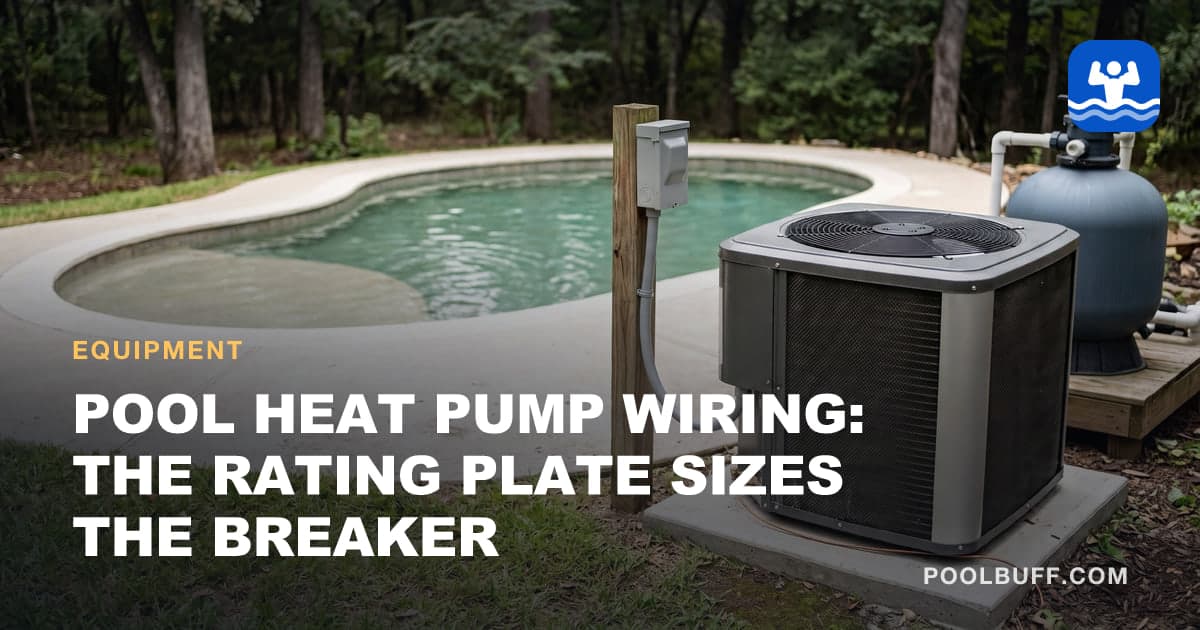
By the Department of Energy's figures, a heat pump costs less to run over a season than a gas heater. It's also the one that surprises people at the panel. A gas heater runs on a few amps. A heat pump needs a 40 to 70 amp breaker, because it's built like an air conditioner: a compressor, a fan and refrigerant. Hayward's manuals even point the electrician to the code article for air conditioning equipment.
In service and repair work I've seen heat pumps where the unit was fine and the wiring wasn't. Breakers tripping at startup or on hot afternoons, traced to a breaker or wire that was too small. Units struggling or throwing faults on long wire runs or on 208 volts. Bonding wires missing, broken or corroded. Here's what the manuals and the code ask for, so the quote you get makes sense.
Key takeaways
- Size the wire from the minimum circuit ampacity on the rating plate, and keep the breaker at or under the plate's maximum.
- Below 208 volts, Hayward and Pentair say the heat pump can be damaged and the warranty voided.
- Hayward's HeatPro 100K manual doesn't recommend a GFCI. But the code's GFCI exemption for air conditioning equipment expired on September 1, 2026, so a heat pump on a 50 amp or smaller circuit may need one.
- An hour of heating costs about 66 cents to $1.44 at the 2025 average U.S. electricity price.
- A gas heater runs on about 2 to 5.5 amps. A heat pump needs a 40 to 70 amp breaker.
Two numbers on the rating plate
Every heat pump has a rating plate, and the electrical work starts there. Two numbers matter most.
- Minimum circuit ampacity (MCA). The smallest wire capacity the circuit can have. Hayward's manuals say it plainly: "Minimum wire size to be selected per NEC based on unit MCA."
- Maximum fuse or breaker. The largest breaker allowed on that circuit. Some makers also give a recommended size below it.
Here's what Hayward, Pentair and Jandy publish for the heat pumps in our catalog.
| MCA | Recommended | Maximum | Power in | |
|---|---|---|---|---|
| Hayward HeatPro 100K (HP31005T) | 42 A | 45 A | 70 A | 4.68 kW |
| Hayward HeatPro VS HP51202T | 45 A | None given | 60 A | 6.1 kW |
| Hayward MCHX 110K and 120K | 38.9 A | 40 A | 65 A | 5,600 or 6,100 W |
| Hayward MCHX 140K | 42.5 A | 50 A | 70 A | 8,300 W |
| Pentair UltraTemp 70 to 140 | 33 to 43 A | 40 to 50 A fuse | 50 to 70 A | 3.8 to 7.3 kW |
| Jandy VersaTemp JRT | 38 to 40 A | None given | 40 or 50 A | Not checked |
MCA is the minimum circuit ampacity. The recommended and maximum columns are breaker or fuse sizes, and the UltraTemp and VersaTemp rows are the single-phase models. Hayward and Pentair give power input at 80°F air, 80% humidity and 80°F water. Hayward's MCHX table doesn't say what conditions its watt figures are for.
Notice what isn't in that table: BTUs. Two heat pumps with the same heating rating can need different circuits. Size the electrical from the plate, not from the brochure headline.
The code works the same way. Since its 2023 edition, the National Electrical Code has a section for pool heat pumps and chillers, and it sizes the wire and the breaker to the nameplate. As IAEI Magazine, the electrical inspectors' journal, puts it, that's "not the 125% rule used for resistive heaters."
The maximum is a ceiling, not a target. North Carolina's state electrical office says so in a written interpretation for heat pumps, and adds that a smaller breaker is allowed. A maker's recommended size isn't enforceable unless it's marked as a required minimum. But a breaker much smaller than the recommendation is the one that trips.
The wire: sized from the plate, by the electrician
None of these manuals names a wire gauge. Hayward's say to size it "per NEC based on unit MCA." Pentair gives the MCA and says the supply runs through watertight conduit to the compressor contactor. Hayward's troubleshooting guides add one thing the manuals don't: use copper supply wires.
That leaves the gauge to the electrician, and that's the right call. It depends on the MCA, the length of the run and the wire's temperature rating, and the code's tables decide it. One thing surprises people: the breaker can be bigger than the wire's own rating. IAEI's worked example puts 12 AWG copper, rated 25 amps, on a 40 amp maximum breaker, because the code's air conditioning article allows it for compressor equipment. The wire has to meet the MCA, and the breaker has to stay at or under the plate's maximum.
Hayward also says to route the conduit where lawn mowers and hedge trimmers can't damage it.
Voltage: 208 is the floor
Hayward's HeatPro models and Pentair's UltraTemp are rated 208 to 230 volts. Hayward's MCHX is rated 230, and Jandy's VersaTemp comes wired for 230. Hayward and Pentair both say voltage below 208 can damage the heat pump and void the warranty, and both tell installers to make sure the voltage holds while it runs.
Hayward's troubleshooting guides go a step further. They say its heat pumps are "designed to operate on 230/240VAC supply only." That contradicts the 208 to 230 volt rating in the HeatPro manuals. If your supply is 208 volts, have the voltage checked under load before you choose a model.
A long run makes it worse. Voltage drops along the wire, and it drops most when the compressor starts. Pentair's troubleshooting page says the supply should be between 208 and 260 volts, and that "a boost transformer may be needed closer to the heat pump" to get it there. That matches what I've seen: heat pumps struggling and throwing faults at the end of long runs.
Startup current and tripped breakers
A compressor draws far more current for the moment it starts than it does running. The plates call that locked rotor amps. Pentair's UltraTemp models list 138 to 196 amps for the whole unit, against 27 to 35 running. Hayward's MCHX compressors list 185 starting and about 29 to 32 running.
That surge is part of why a heat pump's breaker is bigger than its running current. A breaker that's too small, or wire too thin for the run, trips. I've seen it at startup and on the hottest afternoons, traced back to an undersized breaker or wire. Pentair's troubleshooting chart puts its answer for a breaker that trips continuously in three words: "Contact certified electrician."
Hayward's HeatPro VS uses an inverter compressor with soft start, which eases the surge. Its manual lists 90 locked rotor amps, while the rating plate in Hayward's own troubleshooting guide shows 50. The plate on the unit is the one to trust.
The disconnect
Every manual requires a disconnect switch that cuts all power to the heat pump, within line of sight of it. Pentair adds "Check local codes for requirements."
The code asks for two things. The air conditioning article wants the disconnect within sight of the unit, which the code defines as visible and no more than 50 feet away, and readily accessible, meaning you can reach it without a ladder or tools. The pool article adds a maintenance disconnect for pool equipment, and that one has to be at least 5 feet horizontally from the inside wall of the pool, unless a permanent barrier is in the way. Inspection handouts from Dover, New Hampshire, and West Bend, Wisconsin, both spell that rule out, and Pentair prints the same 5 feet on its automation wiring diagram. A single switch can do both jobs if it's placed to meet both rules.
Bonding
The heat pump has a bonding lug on the side, separate from the ground inside the control box. All three makers call for No. 8 AWG solid copper from that lug to the pool's bonding grid, or No. 6 in Canada. Hayward adds that the wire connects to the metal parts of the pool and to the equipment, metal piping and conduit within 5 feet of the pool's inside walls, but not to gas piping.
Bonding ties everything metal around the pool together. Pentair's gas heater manual gives the reason in a phrase: "to reduce voltage gradients in the pool area." I've found bonding wires missing, broken and corroded on heat pumps, so it's worth a look on any pad.
The code agrees with the makers here. Its pool bonding rule calls for solid copper no smaller than 8 AWG, as Connecticut's pool inspection checklist puts it, and pool heaters are on the list of equipment to bond.
GFCI: the makers and the code don't agree
This is the part that confuses people, because the answers point in different directions.
- Hayward's HeatPro 100K manual says Hayward "does not recommend the use of ground fault protective devices in conjunction with heat pumps." It says most service calls about them tripping turn out to be nuisance trips, and those aren't covered by the warranty.
- Where code requires one, Hayward's troubleshooting guides name a Siemens second-generation GFCI breaker, QFxxxA, as tested and found not to nuisance trip. The HeatPro VS manual names the Siemens QF250A.
- Pentair's UltraTemp guide and Hayward's MCHX manual say nothing about GFCIs.
- Hayward's own gas heaters are the opposite. The H-Series manual says it must be connected only to a circuit protected by a GFCI.
I've seen GFCI breakers trip heat pumps with no real fault anywhere. And on a Hayward, the warranty won't pay for chasing it. Hot tubs have their own version of this problem, covered in hot tub GFCI tripping.
Now the code side, which changed this fall. Since the 2020 edition, the code has required GFCI protection for outdoor outlets at homes on single-phase circuits of 150 volts to ground or less and 50 amps or less. The 2026 edition raises that to 60 amps. An outlet includes equipment wired in directly, and IAEI counts outdoor air conditioners. Listed air conditioning equipment had an exemption, but NFPA's published text says it expired on September 1, 2026. An industry request to extend it to 2028 was turned down by the code panel, according to the Air Conditioning Contractors of America, a trade group that's appealing the decision.
The pool article itself doesn't name heat pumps for GFCI protection. But at least one inspector reads the outdoor rule as covering them: Pinellas County, Florida's pool heat pump inspection checks for a GFCI if the circuit is 50 amps or less.
Read as written, that catches a heat pump at a home on a 40, 45 or 50 amp breaker, which covers most of the recommended sizes in the table above. It's exactly where the code and the makers collide. Hayward's answer, where code requires one, is the Siemens breaker it tested. Whether your area requires it depends on the code edition it enforces and any state changes to this rule, and the contractors' group says states and cities have treated it differently. NFPA's map shows 20 states on the 2023 edition, 15 on 2020 and six on 2026, as of August 2026. Your electrician or building department will know which applies.
What it costs to run
Multiply the power input by your electricity price. At 17.30 cents a kWh, the 2025 U.S. residential average, an hour of heating costs:
| Power input | Per hour at 17.30¢ | |
|---|---|---|
| Pentair UltraTemp 70 | 3.8 kW | About 66¢ |
| Hayward HeatPro HP31005T | 4.68 kW | About 81¢ |
| Hayward HeatPro VS HP51202T | 6.1 kW | About $1.06 |
| Pentair UltraTemp 140 | 7.2 kW | About $1.25 |
| Hayward MCHX 140K | 8,300 W | About $1.44 |
The hours are the hard part to guess. They depend on your climate, your target temperature and above all on whether the pool is covered. The pool heating costs page has the Department of Energy's season figures, and the heater sizing calculator works out the size for your pool.
Gas heaters need almost nothing
If you're weighing gas against a heat pump, the electrical side is a real difference. The gas does the heating, and the electricity only runs the controls and the blower.
- Pentair ETi 250: about 5 amps at 120 volts or 2.5 at 240, on a 15 amp circuit.
- Hayward Universal H-Series: 5.5 amps at most, with 15 amp protection recommended.
- Raypak Digital 206A to 406A: 4 amps at 120 volts, 2 at 240.
Pentair and Raypak both say not to run those heaters on 208 volts. A gas heater needs a gas line sized for it instead, which is its own job.
Before you buy
- Check the panel first. I've seen panels with no room for the breaker, where adding the heat pump meant a subpanel or a panel upgrade. Find that out before you order.
- Get the electrician's quote with the heat pump's. I've seen owners caught off guard by what the new circuit cost. It's part of the price of the heat pump.
- Set it up so it can't run without the pump. Pentair says the water pressure switch should shut the heater off when the pump is off, and if it can't be set that way, to add an external flow switch. Hayward says the pump must be running when the heat pump is on remote control. I've seen heat pumps set up to try running without the pump, throwing flow faults until someone sorted it out.
- Plan on a licensed electrician. Hayward's manuals say the wiring must meet the National Electrical Code, "in particular" Article 680 for pools and Article 440 for air conditioning and refrigeration equipment. Pentair's says the supply must be installed by "a licensed, certified electrician or qualified personnel" to the code and local rules.
- Expect a permit and an inspection. The rules are local, but they exist. Pinellas County, Florida, has an inspection just for pool heat pumps. It wants photos of the rating label, the disconnect, the breakers and panel schedule and the bonding, plus a letter confirming the wire size suits the breaker. Dover, New Hampshire, requires a separate electrical permit for permanent pools. Ask your building department before the work starts.
Frequently asked questions
What size breaker does a pool heat pump need?
Whatever its rating plate allows. The plate gives a minimum circuit ampacity and a maximum fuse or breaker size. On the Hayward, Pentair and Jandy models checked here, the maximum runs from 40 to 70 amps, and the recommended breaker, where one is given, from 40 to 50. The electrician sizes the breaker from the plate, not from the BTU rating.
How many watts does a pool heat pump use?
About 3.8 to 8.3 kilowatts while it runs, on the models checked here. Pentair's UltraTemp 70 draws 3.8 kW and the 140 draws 7.2 kW at 80°F air. Hayward's MCHX 140K is rated at 8,300 watts. At the 2025 U.S. average of 17.30 cents a kWh, that's about 66 cents to $1.44 an hour.
Can a pool heat pump run on 208 volts?
Hayward's HeatPro models and Pentair's UltraTemp are rated for 208 to 230 volts, and Hayward and Pentair both say voltage below 208 can damage the unit and void the warranty. Hayward's troubleshooting guides go further and say its heat pumps are designed for 230 or 240 volts only. If your supply is 208, have the voltage checked while the compressor runs.
Does a pool heat pump need a GFCI?
The makers don't ask for one, but the code may. Hayward's HeatPro 100K manual doesn't recommend ground-fault devices on heat pumps, and nuisance trips aren't covered by the warranty. The code's rule for outdoor outlets at homes covers circuits of 50 amps or less, and its exemption for air conditioning equipment expired on September 1, 2026. Pinellas County, Florida, checks pool heat pumps for one. Where it's required, Hayward names a Siemens GFCI breaker it has tested. Ask your electrician which code edition applies where you live.
Does a gas pool heater need a big circuit too?
No. Pentair's ETi 250 draws about 5 amps at 120 volts or 2.5 at 240, on a 15 amp circuit. Hayward's H-Series draws 5.5 amps at most, and Raypak's digital heaters 4 amps at 120 volts. The gas does the heating; the electricity only runs the controls and the blower.