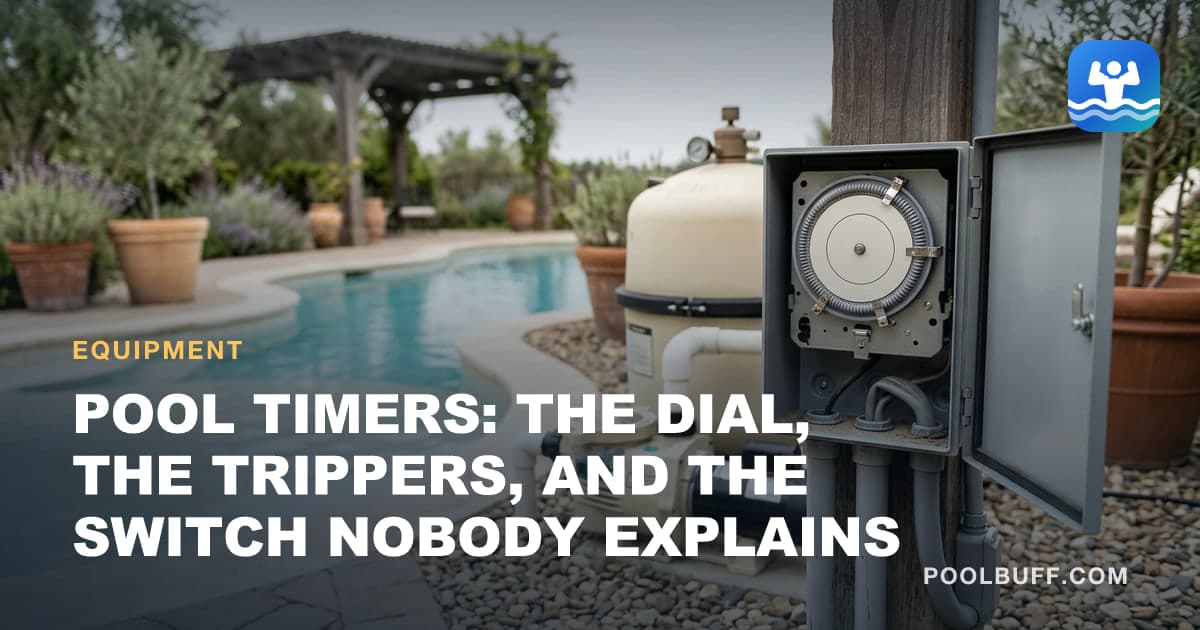
The gray box on the wall with a clock face in it is the least glamorous thing on the pad and one of the easiest to get wrong.
Not because it's complicated. Because two details go unexplained — which way the dial is supposed to be set, and what that extra switch at the bottom does — and both cause real problems.
Key takeaways
- Set the dial to the actual time first. Trippers mean nothing if the clock is wrong.
- The fireman's switch shuts the heater down before the pump, so residual heat clears the exchanger.
- A dial that stops turning is a dead timer motor. It is a cheap part, not a new timer.
- A variable-speed pump wants constant power and its own schedule. A timer fights it.
- Mechanical timers cannot do freeze protection. That is the one job they genuinely cannot cover.
What is actually in there
A small motor turns a dial once every 24 hours. Clipped to the outside of that dial are trippers: little tabs that push a lever as they come around.
One tripper closes the switch. The pump starts. The other opens it. The pump stops. That's the whole mechanism, and it's why these things last decades.
The manual lever overrides it. Push it and the switch flips regardless of where the dial is, which is how you run the pump off-schedule — and it's also the fastest diagnostic you have.
Setting it
The step people skip is the first one.
- 1
Set the dial to the current time
Turn the outer dial until the actual time of day lines up with the fixed pointer or arrow on the timer body. Not the trippers — the dial. If this is wrong, everything runs at the wrong hour no matter how carefully you place the tabs.
- 2
Position the ON tripper
Loosen its screw, slide it to the hour you want the pump to start, tighten it. Most trippers are marked so you can tell on from off.
- 3
Position the OFF tripper
Same again, at your stop time. Leave a sensible gap — the trippers physically cannot sit closer than about fifteen to thirty minutes apart depending on the model.
- 4
Test with the manual lever
Flip it on and off. If the pump responds, the switch and wiring are good, and anything odd afterward is the clock or the trippers.
After a power cut, the dial stops while the power is out and then carries on from where it stopped. So it does not lose the schedule — it loses the offset. A three-hour outage means everything now happens three hours late until you reset the dial. That's usually the answer when someone says their timer "went wrong" after a storm.
Digital timers, and where they win
Everything above describes a mechanical timer — the dial with trippers, which is still what is on most pads and still the most repairable thing in the category.
Digital timers replace the dial with a keypad and a small screen. What they buy you:
- More than one on-off pair a day, which mechanical dials manage awkwardly if at all
- Different schedules for different days, useful if weekend use differs from weekday
- Seasonal adjustment without re-setting trippers, since you edit a number rather than move a physical tab
- No drift, because there is no motor slowly losing time against the clock
What they cost you is repairability and power-cut behavior. A mechanical timer with a dead motor is a twenty-dollar part anyone can fit. A digital timer with a failed board is a new timer. And a long outage on a digital unit without battery backup can lose the schedule entirely, where a mechanical dial simply resumes a few hours behind.
For most pools either is fine and the mechanical one will outlive the digital. Choose digital if you genuinely need multiple daily cycles or day-of-week scheduling — and if you want more than that, you are describing automation rather than a timer.
The smallest step up is a box like Pentair's IntelliConnect, which Pentair sells as a timer replacement for a pool with no spa: two relays and a phone app in place of the dial. Jandy's AquaLink TCX goes a step further with a conversion kit that fits inside an Intermatic timer box, in place of the clock mechanism.
The fireman's switch
This is the part almost nobody has explained to them, and it protects an expensive piece of equipment.
A heater's heat exchanger stays hot after the burner shuts off. If the pump stops at the same moment, that residual heat sits in a stationary column of water with nowhere to go, and over time it damages the exchanger and can scale it badly.
A fireman's switch is an extra set of contacts on the timer with its own tripper, wired to the heater. It cuts the heater before the pump, typically by fifteen to twenty minutes, so the pump keeps circulating and carries that heat away.
Go deeperHeater faulting or not firing?Work through flow, gas and sensors in the order that actually finds it.What breaks
Mechanical timers fail in a small number of predictable ways.
The dial stops turning. The timer motor has died. The switch usually still works — you can flip the manual lever and the pump runs — but nothing happens on schedule. The motor is a $25 to $50 part and a genuinely easy swap: two screws, two wires. Replacing the entire timer because the dial stopped is a common and unnecessary expense.
The dial turns but the pump does not start. Trippers have slipped, or they are set too close together to actuate cleanly, or the contacts inside are burned.
Burned or pitted contacts. Every switch-on arcs a little, and after enough years the contacts pit. Symptoms are intermittent starting, or a buzz and heat from the timer. That's a mechanism replacement, and it's worth doing promptly — a failing contact runs hot.
Trippers that will not stay put. The screws strip or the tabs wear. Cheap to replace and worth doing rather than nudging them back every month.
When you should not use a timer
Here's the one that costs people real money.
A variable-speed pump generally should not be on a mechanical timer. These pumps have their own onboard scheduling, and to run it they need constant power. Feed one through a timer and you break the model: the pump can only run inside the window the timer allows, and it often defaults to a single speed rather than the low-RPM schedule you bought it for.
The result is a pump that cost a lot specifically to run long and slow, running short and fast instead. The savings quietly disappear and the owner never connects it to the gray box on the wall.
If you fit a variable-speed pump to a pool that had a mechanical timer, the usual answer is to give the pump permanent power and let its own schedule take over. The timer either comes out or gets repurposed for something dumb, like a light circuit.
Go deeperWhat schedule to actually setLonger and slower beats shorter and faster, and here is why.Time-of-use rates
If your utility charges more at peak hours, a timer is how you avoid them — and on a pool pump the savings are meaningful, because it's one of the larger loads in the house.
Look up your peak window and put the run time outside it. Late evening and early morning are typically cheapest. The one thing to keep in mind is that the pool still needs its turnover, so shifting hours is fine but cutting them to dodge a rate is a false economy that shows up as green water.
The job a timer cannot do
Freeze protection.
A mechanical timer has no idea what the temperature is. It runs when the tripper says and stops when the other tripper says, and if that stop lands at 3am on the night it drops below freezing, the water sits still in the pipes and equipment.
Moving water is much harder to freeze than still water, which is why freeze protection means running the pump when temperature drops near freezing — exactly the decision a dial cannot make.
If you're in a climate that freezes and you rely on a mechanical timer, that gap is worth knowing about. A freeze sensor, or automation with a temperature input, is the fix.
Go deeperWhen automation is worth the moneyWhat is worth wiring in, and what a simple timer already does well enough.Frequently asked questions
How do you set a pool pump timer?
Turn the outer dial until the current time of day lines up with the fixed pointer or arrow. Then slide the ON tripper to the hour you want it to start and the OFF tripper to the hour you want it to stop, and tighten their screws. The dial rotates once every 24 hours, so the schedule repeats daily.
What is the fireman's switch on a pool timer?
An extra set of contacts that cuts power to the heater a set time before the pump shuts off, usually fifteen to twenty minutes. That lets the pump keep circulating water through a hot heat exchanger so residual heat dissipates instead of cooking the unit. If your heater is on a timer, it should be through a fireman's switch.
Why is my pool timer not turning the pump on?
In order: the dial has lost time so it is firing at the wrong hour, the trippers have slipped or are set too close together, the timer motor has died so the dial no longer turns, or the contacts inside are burned. Move the manual lever — if the pump runs, the switch is fine and the problem is the clock or the trippers.
Do I need a timer with a variable-speed pump?
Usually not, and often you should not have one. Variable-speed pumps have their own onboard scheduling and need constant power to run it. Cutting that power at a mechanical timer means the pump only knows what the timer allows, and you lose the low-speed running that the pump was bought for.
How much does a pool timer motor cost?
Typically $25 to $50 for the motor itself, and it is a straightforward swap on the common mechanical timers — a couple of screws and two wires. Replacing the whole timer because the dial stopped turning is a common and unnecessary expense.