Nobody buys a booster pump. It arrives as a line on a quote, or it is already bolted to the pad when you buy the house, and most owners never find out what it is for.
Then it fails, and they discover they own two pumps.
Key takeaways
- It runs only the cleaner. It does nothing for filtration and nothing for your water.
- Not self-priming. Running it without the filter pump destroys the seal, usually within minutes.
- Around a kilowatt while it runs, on top of your filter pump — the real cost of a pressure cleaner.
- Run it once a day for the cleaning cycle, not for the whole filtration run.
- A screech at startup is the bearings. Water under the middle is the seal. Both are cheaper than a motor.
What it actually does
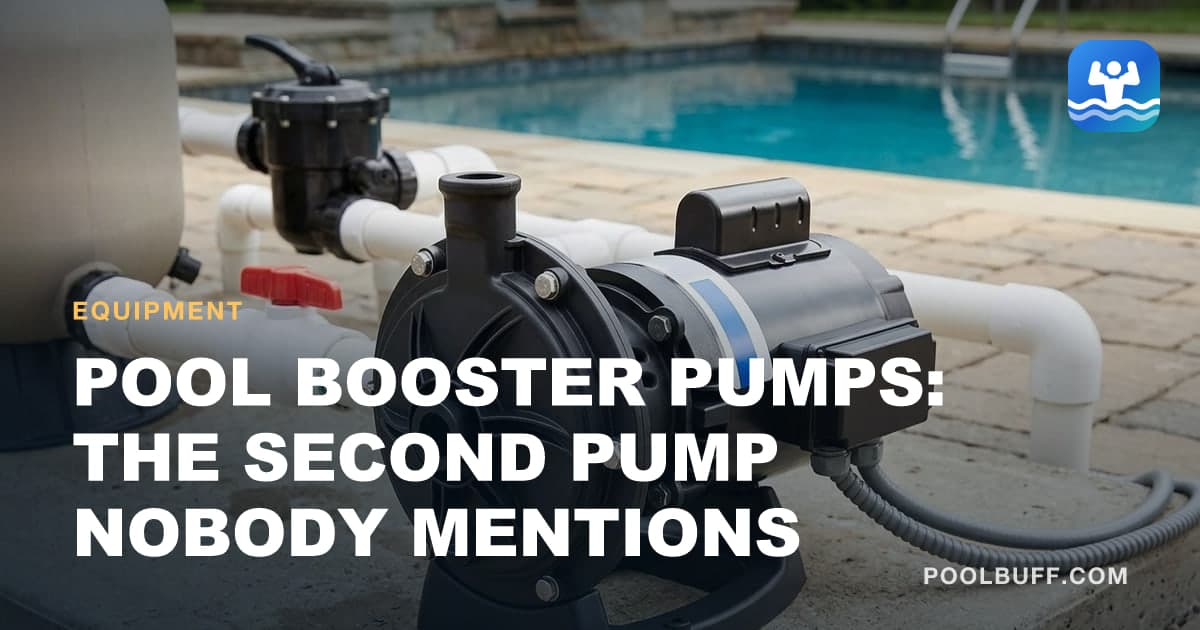
Your filter pump moves the whole pool through the filter. The booster pump does nothing of the kind. It takes water that has already been filtered and pushes it, at much higher pressure, down one dedicated line to a wall fitting that drives a pressure-side cleaner.
That is its entire job. It does not filter, it does not help circulation, and it contributes nothing to your water chemistry. When the cleaner is not running, it should not be running either.
This is worth being blunt about because it reframes the cost. A pressure cleaner is not a device you plug in. It is a device that comes with a second pump.
Whether you need one at all
Only pressure-side cleaners use a booster, and not even all of those.
Pressure cleaners that need one include the common Polaris Vac-Sweep models. The 280 is the one most people have, and its manual is unambiguous — no booster, no cleaner. The 380 is the same requirement with a sharper edge on the paperwork: its printed warranty states outright that the booster pump is excluded and carries its own separate warranty, so the setup is two machines with two clocks running.
Pressure cleaners that do not run on the pressure your filter pump already produces at the returns. They are gentler, generally slower, and they exist precisely to avoid this problem. Pentair's Kreepy Krauly Platinum sits on the other side of that line — a ¾ HP booster and a dedicated cleaner line, neither included with the cleaner.
Suction cleaners and robots never need one. A suction cleaner runs off your filter pump. A robot has its own motor and a wall socket, which is most of why robots cost so much less to run despite costing more to buy.
If your pool has no dedicated cleaner line already plumbed to a wall fitting, adding a pressure cleaner means new plumbing as well as a new pump. That changes the arithmetic considerably.
The running cost nobody puts on the quote
A typical booster is 3/4 horsepower, drawing around 12.8 amps at 115V or 6.4 at 230V. Running, it pulls close to a kilowatt.
The number that matters is not the kilowatt, though. It is that this runs on top of your filter pump rather than instead of it. For those two or three hours, your pad is drawing both.
Set against a robot at 150 to 200 watts doing the same job, the gap is not subtle. Across a season it is the difference that decides which cleaner was actually cheaper, and it never appears next to the purchase price.
The rule that decides how long it lasts
Here is the part that matters more than anything else on this page.
A booster pump is not self-priming. It cannot pull water to itself. It depends entirely on the filter pump pushing water to its inlet, and if it runs without that, it runs dry.
All three makers put a number on the offset. Pentair says the cleaner should start half an hour to forty-five minutes after the filter pump starts, and stop the same margin before it stops. Hayward, and Polaris in the PB4-60 manual, say at least half an hour either side. All four pumps have their own page here — the Polaris PB4-60, the Pentair LA01N and its five-stage sibling the Boost-Rite, and the Hayward Booster Pump 300 — with the parts each is made of and what each manufacturer says voids the warranty.
Dry running destroys the mechanical seal, and it does not take long — minutes, not hours. Once the seal is gone, water weeps out along the shaft, and the place it weeps into is the motor bearings. A cheap failure becomes an expensive one on a timescale of weeks.
Polaris puts the sequence plainly in the 280 manual: start the pool filtration pump, let it prime, and only then turn on the booster pump.
How they fail, in order of cost
Boosters are simple machines and they announce themselves before they quit.
A screech or grind at startup is the bearings. They are the most common wear item, they get louder over weeks, and a bearing replacement is far cheaper than the motor it eventually takes with it. What each pump noise means applies here in exactly the same way it does to your filter pump.
Water dripping from between the motor and the pump body is the mechanical seal. Act on this one quickly. The water is running toward the bearings, and the sequence from here is seal, then bearings, then motor.
A hum with no rotation means the motor is getting power but cannot turn. Hayward's troubleshooting gives the cause as an impeller jammed with debris, and says to have a professional open the pump. On a motor with a start capacitor, a failed capacitor produces the same hum, and it is a small, cheap part.
Nothing at all is worth checking at the breaker and the interlock relay before you condemn the pump. A booster that is wired to only run alongside the filter pump has more ways to be switched off than a pump on a simple timer.
Before you blame the pump
A cleaner that has gone slow or stopped climbing is more often the cleaner than the booster.
The 280's own wear parts — tires, the sweep hose, the scrubber, the bag — are named in its warranty as items Polaris does not cover, precisely because they are expected to wear out. A blocked in-line filter screen will starve the cleaner while the booster is working perfectly. A pool cleaner that won't move goes through the rest, starting with the wheel count each manual gives.
Check pressure at the wall fitting with the cleaner disconnected. Good pressure there means the booster is fine and the problem is downstream, which saves you replacing a working pump.
Go deeperWhether a pressure cleaner is the right type at allWhere the debris ends up, what each type does to your filter, and the running costs that decide it.Frequently asked questions
Do I need a booster pump for my pool cleaner?
Only for a pressure-side cleaner, and not for all of those. Models like the Polaris 280 and 380 are built to run on a dedicated booster, while some pressure cleaners work on return pressure alone. Suction cleaners and robots never need one — a suction cleaner runs off your filter pump, and a robot has its own motor and plugs into a wall socket.
How much does a booster pump add to my electricity bill?
It is the biggest running cost of a pressure cleaner setup. A 3/4 HP booster draws close to a kilowatt while running, and it runs on top of your filter pump rather than instead of it. Two or three hours a day through a season adds up to real money, which is why the cleaning cycle should be as short as the pool actually needs.
Can a booster pump run without the filter pump?
No, and this is the single most expensive mistake with one. A booster pump is not self-priming — it relies on the filter pump to push water to it. Run it dry and the mechanical seal fails, often in minutes, and the leak that follows runs into the motor bearings. Polaris instructs you to start the filter pump and let it prime before the booster comes on.
How long should a booster pump run each day?
Long enough for one cleaning cycle, which on most pools is two to three hours. It does not need to match your filtration run, because it is doing nothing for the water when the cleaner has finished. Running it for the full filtration window is the most common way people double the cost of owning a pressure cleaner.
How do I know if my booster pump is failing?
Listen and look. A screech or grinding at startup is bearings. Water dripping from between the motor and the pump body is the mechanical seal, and it needs acting on quickly because that water reaches the bearings next. A pump that hums but does not start has a jammed impeller or, on a motor that has one, a failed start capacitor. Hayward's troubleshooting names the impeller. A cleaner that has simply gone slow is more often the cleaner than the pump.