Polaris · Vac-Sweep 280
Polaris Vac-Sweep 280
The pressure-side cleaner that needs a booster pump — its full parts list, the wear items Polaris does not warrant, and the one thing that voids it outright.
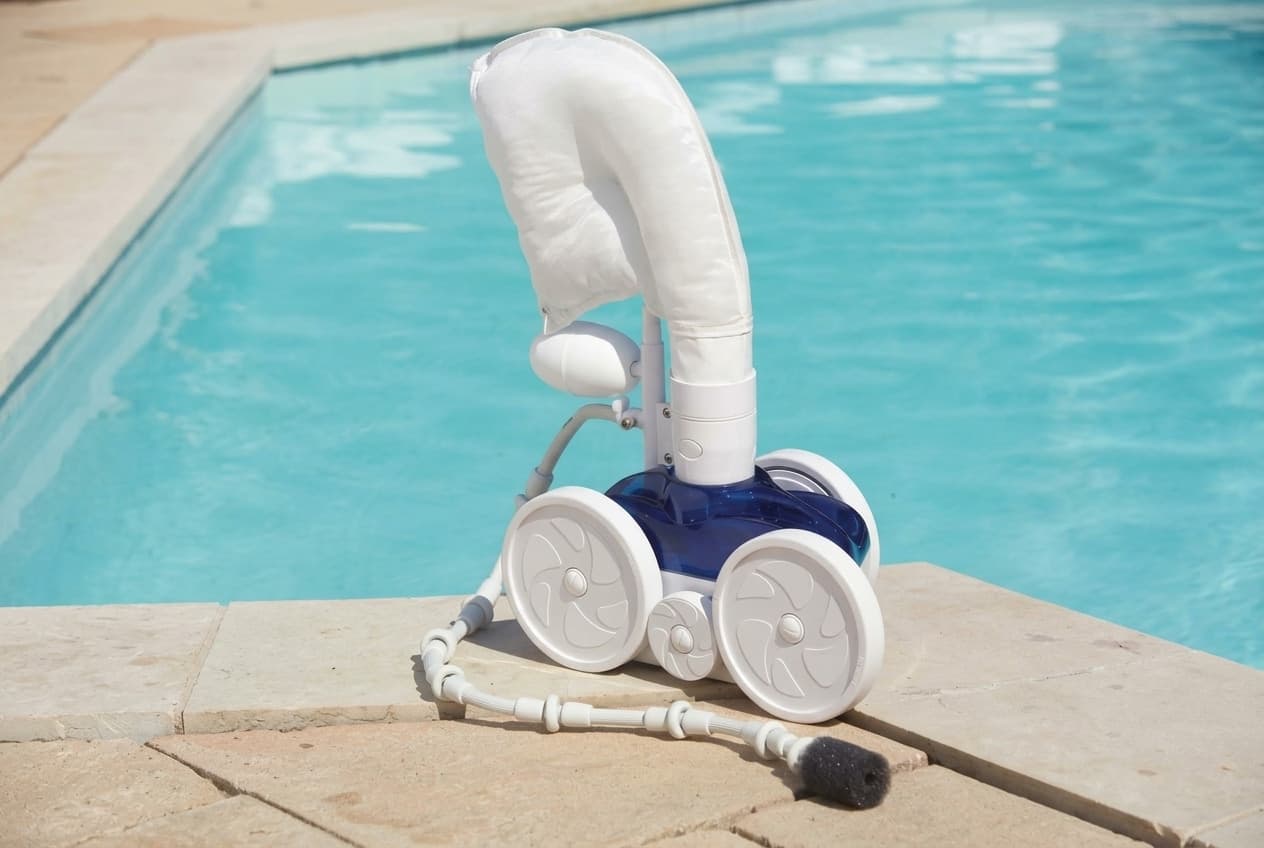
The 280 is the cleaner people either love or have quietly unplugged, and which one you get depends almost entirely on whether the wear parts have been kept up.
It is a pressure-side cleaner, which means it does not run off your filter pump. It needs a separate booster pump, and that is the first thing to establish before anything else on this page is relevant — no booster, no 280.
What it is actually good at
Debris goes into its own bag, not into your pump basket and not into your filter. On a pool under trees that is the whole argument for a pressure-side cleaner: the leaves that would otherwise clog your skimmer and shorten filter runs get collected and thrown away instead.
Double jets, three hours or less for a cycle, and it sweeps and scrubs walls rather than only vacuuming the floor. How that compares to suction-side and robotic cleaners is worth reading before buying, because the booster pump requirement is a real cost that does not show up on the price tag.
The warranty tells you what will break
This is the most useful thing Polaris publishes about the 280, and it is buried in the manual.
The cleaner carries one year — measured from manufacture or from purchase with proof, whichever is later, in the printed warranty, and from the date of retail purchase in Polaris's current statement — and the frame five years. What the warranty will not cover is the interesting part. The printed one names bags, tires, sweep hoses and sweep hose scrubbers as normal replacement items worn out by use. It says "such as", not "only", and the parts diagram asterisks a fifth: the wear rings. Polaris's current statement spells the list out at length and adds track tires, belts, rollers and brushes to it.
That is not Polaris dodging. It is Polaris telling you exactly which parts are consumable — and it happens to be a precise list of why most 280s stop performing. A cleaner that no longer climbs the wall has almost always worn its tires and wear rings, not broken.
The one thing that voids it
Removing the in-line filter screen voids the warranty outright, and it is named in the manual alongside freezing and abuse.
People pull it out because the cleaner seems slow and the screen looks like a restriction. It is the opposite: the screen is what stops grit reaching the turbine and wheel bearings. Take it out and the cleaner speeds up briefly, then destroys the bearings that make it work.
If yours is sluggish, clean the screen. Do not remove it.
Count the wheel revolutions before you diagnose anything
The manual gives one measurement that settles most "it is not cleaning properly" arguments, and almost nobody takes it. Mark the tire on the single-wheel side, run the cleaner below the water line, and count the revolutions for a minute. It should turn 28 to 32 RPM.
Under 28 and the cleaner is starved of water. Check the in-line filter screen first, then the skimmer, filter and pump basket, then the hoses, connections and swivels for leaks. If a blue restrictor disk is fitted at the wall, take it out. If there is a gate valve on the booster line, open it fully.
Over 32 and it is being fed too hard, which wears the tires and wear rings faster than they should go. Fit the red restrictor disk in place of the blue one at the wall fitting. Only if that is not enough should you touch the pressure relief valve — and Polaris is explicit that the valve is adjusted only with a restrictor already installed.
A cleaner inside that range and still leaving dirt has a mechanical problem worth chasing. One outside it has a flow problem, and replacing parts will not fix it.
One warning if your pool is vinyl
Polaris prints a specific caution about vinyl liners, and it is easy to miss because it sits away from the warranty text. Some liner patterns abrade or lose their pattern from contact with anything — brushes, floats, toys, cleaners — and Polaris states that pattern removal, abrasion and marking on vinyl liners are not covered.
That is not a reason to rule the 280 out of a vinyl pool. It is a reason to find out how your particular liner behaves before you run a wheeled cleaner on it for three hours a day, and to keep liner condition in mind when you decide how long to run it.
Three variants, one parts list
The 280 on MaxTrax tires is the standard cleaner. The Black Max is the same machine in black for dark-bottom pools — same parts list, same numbers.
The 280 TankTrax is the only one that genuinely differs, and it differs less than the name suggests. The conversion takes the two tires off the double-wheel side and runs a track over them instead: C18 is the track, and it needs its own bottom housing (K29), a pair of axle blocks (K26), an idler wheel (K27) and a swing axle kit (K28) in place of the standard base, small idler wheel and swing axle. The single-wheel side keeps its C10 MaxTrax tire, so a TankTrax uses one of those rather than three. After the conversion Polaris asks for the track tension to be set to 6-3/4 inches from the ground line to the inside lip of the upper track.
Everything else — bag, sweep hose, back-up valve, turbine, bearings, hoses, frame — is common across all three. The table below marks the parts that change.
Which model do you have?
The model number is on the cleaner label. Everything else in the range is shared — these are the parts that change with it.
| Model | Tire | Wheel | Axle block | Idler wheel | Swing axle | Base | Note |
|---|---|---|---|---|---|---|---|
| Vac-Sweep 280 | C10 | C6 | — | — | — | — | The standard cleaner, on MaxTrax tires. |
| Vac-Sweep 280 TankTrax | C18 track, plus one C10 | C6 | K26 | K27 | K28 | K29 | Tracked conversion. The two double-wheel-side tires come off and a track goes on in their place; the single-wheel side keeps its MaxTrax tire. |
| Vac-Sweep 280 Black Max | C10 | C6 | — | — | — | — | The same cleaner in black, for dark-bottom pools. |
Polaris Vac-Sweep 280 parts, and what goes wrong
Read off the manufacturer’s parts list and checked before it ships. Open a row for what a bad one actually does — or start from the symptom and work down, which is the cheaper order.
What is it doing?
The cheapest part on the cleaner and the only one whose removal voids the warranty outright. It catches grit before it reaches the turbine bearings, so people who pull it out to 'get more pressure' are trading a five-dollar screen for a rebuild. If the cleaner has gone sluggish, look here first — a blocked screen starves it.
Live pricing arrives when the retailer programs are approved.
The small nub on the end of the sweep hose that does the actual scrubbing. It is consumable by design and disappears long before the hose does. Cheap, and worth replacing before the hose end starts wearing in its place.
Live pricing arrives when the retailer programs are approved.
Eight small rings on the sweep hose that keep it weighted and behaving. They abrade away against the plaster, the hose starts whipping instead of sweeping, and the cleaner loses its wall-climbing behavior. The warranty's list of normal replacement items is open rather than closed — it reads 'such as bags, tires, sweep hoses' — and rings that abrade against plaster sit squarely inside it. One of the first things to go.
Live pricing arrives when the retailer programs are approved.
Two bearings that carry the turbine, and the part that grit destroys when the in-line filter screen is missing or blocked. A cleaner that has become noisy and slow, with good pressure at the wall fitting, is usually here.
Live pricing arrives when the retailer programs are approved.
Eight of them, and they seize gradually rather than suddenly. Spin each wheel by hand with the cleaner out of the water: anything gritty or stiff is a bearing, and a dragging wheel costs the cleaner far more speed than its price suggests.
Live pricing arrives when the retailer programs are approved.
Two ball-bearing swivels let the feed hose untwist as the cleaner works. Seized swivels wind the hose into a coil, which shortens its effective reach and drags the cleaner back toward the wall fitting — easily mistaken for a back-up valve fault.
Live pricing arrives when the retailer programs are approved.
Three MaxTrax tires. When the tread rounds off, the cleaner stops gripping the wall and starts sliding back down — the classic symptom of a 280 that used to climb and no longer does. Named in the warranty as a normal replacement item, so budget for them rather than claiming.
Live pricing arrives when the retailer programs are approved.
The tail that whips around behind the cleaner and knocks debris off the walls and steps. It splits at the end with age and UV, at which point it stops sweeping and starts flailing. Trim-and-carry-on works for a while; past a point it needs the whole hose. Another named wear item.
Live pricing arrives when the retailer programs are approved.
Transfers the turbine's rotation to the wheels. If the turbine is clearly spinning but the wheels are not driving, the fault sits between them and this is it. Less common than bearings, and worth checking after them.
Live pricing arrives when the retailer programs are approved.
The bag is the whole point of a pressure-side cleaner — it collects debris instead of sending it to your pump basket. A split seam or a worn mesh puts everything straight back in the water, and it looks exactly like the cleaner not picking up. A wear item, not warranted.
Live pricing arrives when the retailer programs are approved.
Every few minutes the back-up valve interrupts the feed and reverses the cleaner, which is how it escapes corners and steps. When the valve stops cycling, the cleaner parks itself in one place and stays there. If yours has taken up residence in a corner, this is almost always why rather than anything wrong with the drive.
Live pricing arrives when the retailer programs are approved.
If you are doing the job anyway
Most of these come off without tools, and they wear at roughly the same rate. Replacing one worn part on a cleaner whose others are equally worn buys you very little.
The wear kit
The four parts Polaris names in its own warranty as items it does not cover. They will all need replacing eventually, and they are the reason a 280 that 'stopped working' usually has not broken at all.
- TiresC10
- Wear ringsB10
- Sweep hose, completeB5
- Sweep hose scrubber9-100-3105
Sluggish cleaner
Grit kills bearings, and the screen is what keeps grit out. Doing the screen without the bearings leaves the damage in place; doing the bearings without the screen means doing them again.
- In-line filter screen48-222
- Turbine bearingsC80
- Wheel bearingsC60
Stuck in a corner
The back-up valve and the swivels both cause a cleaner to stop covering the pool, and they present identically. The kit is cheap enough to do together rather than diagnose twice.
- Back-up valve kitG52
- Hose swivelsD20
Polaris Vac-Sweep 280 manuals and documentation
Hosted by the manufacturer. These open on Polaris’s own servers, so they stay current.
Polaris Vac-Sweep 280 warranty
1 year parts, 5 years on the frame labor
Two documents cover this cleaner and they measure the year differently. The warranty printed in the manual runs one year from the date of manufacture as established by the serial number, or one year from purchase with proof, whichever is later. Polaris's current warranty statement runs one year from the date of retail purchase. Both give the frame five years. The exclusions are what matter either way: bags, tires, sweep hoses and sweep hose scrubbers are named as normal replacement items and are not covered at all, and the printed warranty names removal of the in-line filter screen among the things that void it outright. The current statement adds three terms the manual does not — purchased replacement parts carry ninety days where a Factory Rebuild Kit carries a year, and coverage is limited to the first retail purchaser and is not transferable.
Manufacturer’s termsPolaris Vac-Sweep 280 complete parts list
Every part on the manufacturer’s exploded diagram, in their numbering. Marked rows are the ones covered above with a symptom and a diagnosis.
63 parts
| No. | Part | Description | Note |
|---|---|---|---|
| 1 | K13 | All-purpose zippered bag what goes wrong | Wear item, not covered by warranty |
| 2 | C40 | Screw, 10-32 x 3/8 SS pan | 20 required |
| 3 | K5 | Top | |
| 4 | A20 | Float, head | |
| 5 | 9-100-3105 | Sweep hose scrubber what goes wrong | Wear item, not covered by warranty |
| 6 | B25 | Orifice tip with guard | |
| 7 | B5 | Sweep hose, complete what goes wrong | Wear item, not covered by warranty |
| 8 | B10 | Wear rings what goes wrong | 8 required; wear item, not covered by warranty |
| 9 | B15 | Sweep hose attach clamp | |
| 10 | B20 | Adjusting screw, sweep hose | |
| 11 | K30 | Feed pipe with elbow | |
| 12 | K20 | Vacuum tube | |
| 13 | C66 | Axle, large, with sand and gravel guard | 2 required |
| 14 | C76 | Screw, 10-32 x 7/8 SS pan | 10 required |
| 15 | C45 | Lock washer for C36 | 7 required |
| 16 | C70 | Axle plate for C65 / C66 | 3 required |
| 17 | C60 | Ball bearings, wheels what goes wrong | 8 required |
| 18 | C55 | Wheel screw, plastic | 4 required |
| 19 | C64 | Wheel washer, plastic | 4 required |
| 20 | C10 | Tire, MaxTrax what goes wrong | 3 required; wear item, not covered by warranty |
| 21 | C6 | Wheel, large | 3 required; bearings not included |
| 22 | C65 | Axle, large | Rear wheel only |
| 23 | C131 | Thrust jet kit | |
| 24 | C16 | Idler wheel, small | |
| 25 | C30 | Screw, 4-40 x 3/16 SS pan | |
| 26 | C32 | Screw, 6-32 x 1/2 SS pan head | |
| 27 | C25 | Spring for C36 | |
| 28 | C36 | Swing axle kit | |
| 29 | K10 | Base with bracket | |
| 30 | K25 | Water management system | |
| 31 | K145 | Frame | |
| 32 | C80 | Ball bearings, turbine what goes wrong | 2 required |
| 33 | C83 | Turbine shaft tubes | |
| 34 | 9-100-7170 | Hose clamp for the water management system | 2 required |
| 35 | A40 | Turbine shaft shield | |
| 36 | C86 | Drive shaft assembly what goes wrong | |
| 37 | C120 | Hose for C110, 7-1/2 in. | |
| 38 | C110 | Turbine cover with elbow | |
| 39 | 9-100-1018 | Bag collar | |
| 40 | 10-112-00 | Restrictor disks, red and blue | 2 required |
| 41 | 6-500-00 | Universal wall fitting | |
| 42 | 9-100-9001 | UWF connector assembly | |
| 43 | 10-108-00 | UWF restrictor kit | |
| 44 | 6-505-00 | O-ring, UWF / quick disconnect | |
| 45 | 9-100-9002 | Pressure relief valve, black | |
| 46 | D29 | Quick disconnect, UWF | |
| 47 | D15 | Nut, feed hose | 10 required |
| 48 | — | Adapter hose, 8-1/2 in. | |
| 49 | 48-080 | In-line filter assembly | |
| 50 | 48-222 | Screen, in-line filter what goes wrong | Removing it voids the warranty |
| 51 | D10 | Float, feed hose | 9 required |
| 52 | D45 | Feed hose, 10 ft | 2 required |
| 53 | D20 | Swivel, ball bearing what goes wrong | 2 required |
| 54 | D50 | Feed hose, leader, 10 ft | |
| 55 | G52 | Back-up valve kit what goes wrong | |
| 56 | G54 | Case kit for G52 | |
| 57 | G57 | Collar, back-up valve | |
| 58 | G53 | Mechanism for G52 | |
| 22 | K26 | Axle block, TankTrax | TankTrax models only; 2 required |
| 24 | K27 | Idler wheel, TankTrax | TankTrax models only |
| 25 | K28 | Swing axle kit, TankTrax | TankTrax models only |
| 26 | C18 | Tire, TankTrax | TankTrax models only; wear item, not covered by warranty |
| 27 | K29 | Base, TankTrax | TankTrax models only |
Buy the cleaner
One retailer for now. More get added here as their programs are approved, and this becomes a comparison rather than a link.