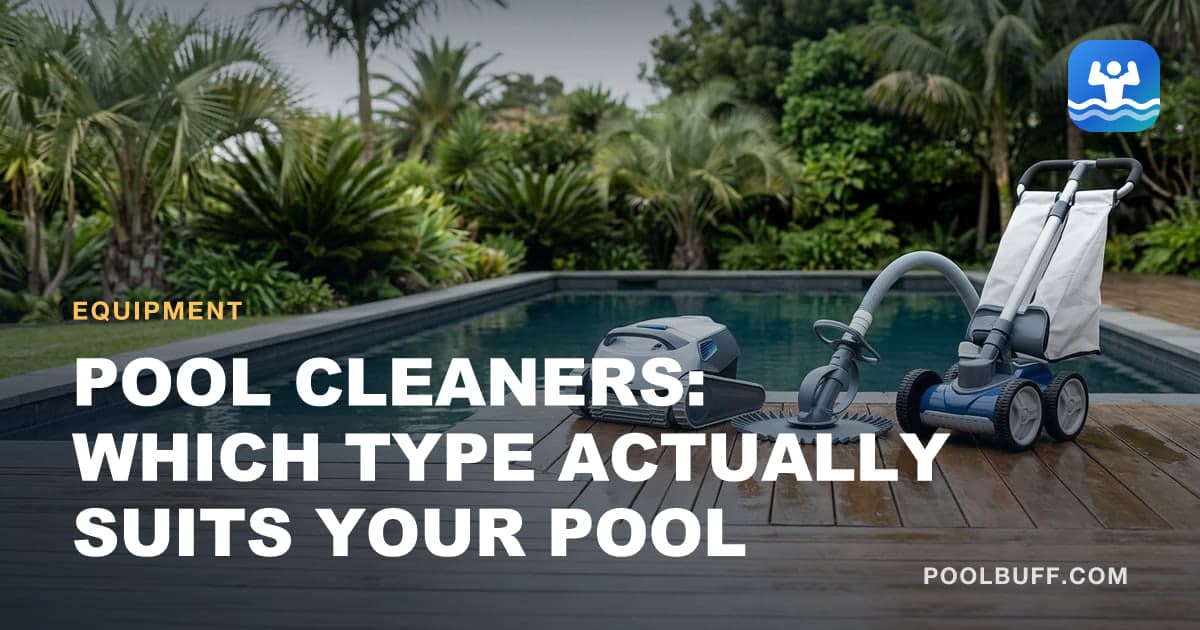
Robotic cleaners get the attention, and on cleaning quality they deserve it. But they cost several times what the machines on this page cost, and when one fails out of warranty the repair bill is often most of a new unit.
Suction and pressure cleaners are the older, dumber, cheaper answer. They wander a pool semi-randomly and they get it clean by running long enough. For a great many pools that is entirely sufficient, and it is why both are still on every service truck.
Key takeaways
- Suction-side cleaners are cheapest to buy and run, and they push everything into your filter.
- Pressure-side cleaners keep debris out of the filter, but most need a booster pump you may not have.
- Neither type has a brain. They cover a pool by wandering, so coverage is a matter of time, not intelligence.
- Every pool should own a manual vacuum head regardless. Nothing else clears a specific mess on demand.
- If your only line is the skimmer, a suction cleaner steals it, and your surface skimming stops while it runs.
- The Navigator Pro comes in gunite and vinyl versions with different shoes. Buying the wrong one is a common and avoidable mistake.
My picks at a glance
- 1
Zodiac Baracuda G3
Best overall · most in-ground pools with ordinary debris
- 2
Hayward Navigator Pro
Best coverage pattern · larger gunite pools where random coverage leaves gaps
- 3
Polaris Vac-Sweep 280
Best for heavy debris · pools under trees, where leaf fall is the whole problem
- 4
Manual vacuum head and pole
Best value · every pool, as a companion to whatever else you own
Beyond these picks, every cleaner with a page here — robotic, pressure-side and suction-side — is listed with its parts and manuals.
The decision is about debris, not brand
Before comparing models, work out which family you belong to. It narrows the field faster than any spec.
| Suction-sideMy default | Pressure-side | |
|---|---|---|
| Where debris goes | Your pump basket and filter | The cleaner's own bag |
| Extra equipment | None | Usually a booster pump |
| Running cost | Nothing beyond your pump | A second motor running |
| Handles leaves | Poorly — it clogs | Well, and this is the point |
| Filter workload | Noticeably higher | Unchanged |
| Typical repair | Cheap rebuild kit | More parts, more cost |
If your pool sits under deciduous trees, stop here and buy pressure-side. Everyone else should start with suction.
What "no brain" actually means
Neither type navigates. There is no map and no memory of where it has been. The steering is mechanical: some change direction when they hit something, and others reverse or turn on a built-in cycle, like the tracks on a Polaris ATLAS or the programmed turns of a Hayward TracJet. None of them knows which parts of the pool it has already cleaned.
That has one honest consequence: coverage is a function of time. A two-hour run on a large pool leaves patches. Four hours usually does not. It is why the marketing language around coverage patterns is worth so little, and why the practical advice is simply to run it for the length of your filter cycle.
It also means neither will clean a step, a bench or a tight corner reliably. That is not a defect to be fixed by buying a better one; it is the category.
Zodiac Baracuda G3
Best for most in-ground pools with ordinary debris
The default suction-side cleaner, and the one most service techs will suggest if you ask. A single moving part in the diaphragm, no gears, no wheels to seize. Zodiac rates it for tile, vinyl, gunite and fiberglass, it needs no extra equipment, and the parts that wear, the diaphragm, foot pad and finned disc, are each sold on their own. Mind the warranty: the G3 sold online gets ninety days, and the G3 PRO from a pool store gets a year.
Strengths
- One moving part, so very little to go wrong
- Rated for tile, vinyl, gunite and fiberglass
- Diaphragm, foot pad and finned disc sold separately
- No booster pump, no extra plumbing, no extra electricity
Trade-offs
- Everything it picks up goes into your pump basket and filter
- Occupies a suction line while it runs
- Struggles with heavy leaf fall — it will clog
- Ninety-day warranty on the online G3; the pool-store G3 PRO gets a year
Hayward Navigator Pro
Best for larger gunite pools where random coverage leaves gaps
Hayward's answer to the wandering problem. Its turbine drives a steering mechanism that produces a more deliberate path than a pure random walk, which matters more the bigger the pool gets. Rated for pools up to around 20 by 40 feet, and it earns that on a large rectangle where a G3 can take all afternoon to find a corner.
Strengths
- More systematic coverage than a random-walk cleaner
- Good on large rectangular gunite pools
- Same no-extra-equipment simplicity as any suction cleaner
Trade-offs
- More internal parts than a G3, so more to service
- Fussier about flow rate being in its window
- Same filter loading as any suction-side cleaner
Polaris Vac-Sweep 280
Best for pools under trees, where leaf fall is the whole problem
A pressure-side cleaner with its own filter bag, which is the entire argument for it. Leaves, acorns and gravel go into the bag and never reach your pump basket or filter, so you clean a bag instead of stripping a filter. It also returns filtered water to the pool while it works. The catch is that it wants a dedicated booster pump.
Strengths
- Debris collects in its own bag, not in your filter
- Handles leaves and larger debris that jam suction cleaners
- Adds circulation rather than stealing suction
Trade-offs
- Needs a booster pump — a real cost if you do not have the line
- That booster is another motor running, and another electricity bill
- More parts, more wear items, more expensive to keep going
Manual vacuum head and pole
Best for every pool, as a companion to whatever else you own
Not a competitor to the others so much as a prerequisite. When a storm drops a branch, when you need to vacuum to waste after an algae bloom, when a specific corner needs clearing now, no automatic cleaner helps and a head on a pole does. It costs a fraction of anything else here and it never breaks.
Strengths
- Cheapest tool on this page by an order of magnitude
- The only way to vacuum to waste, which algae recovery needs
- Nothing to service, nothing to fail
Trade-offs
- It is work, and it takes twenty minutes
- Needs a decent pole — a flexible one makes the job miserable
Where to buy: the Baracuda G3 (its page has the flow setup and the G3 PRO's terms), the Navigator Pro in gunite or vinyl trim (its page has the flow setup and the full parts list), and the Vac-Sweep 280. Check the model prefix first, per the note above. Hayward's PoolVac XL is the same cleaner in a different shell: Hayward Support says there's little functional difference between the two, and Hayward's parts lists differ only in the shell parts and the screen kit's number. Budget for the booster pump too, which is the running cost that decides whether a pressure cleaner was cheap. For the 280, specs, warranty terms and the full parts list are worth reading first — the parts that wear out are named in the warranty as ones Polaris does not cover.
Setting one up so it actually works
A suction cleaner that wanders in circles, climbs out at the steps, or parks in one corner for an hour is nearly always set up wrong rather than faulty. Three adjustments cover almost all of it.
Hose length. The rule is the distance from the connection point to the furthest corner of the pool, plus one section. Too short and the cleaner physically cannot reach part of the pool; too long and it loops back on itself and tangles. Measure once, add or remove sections, and stop guessing.
Flow. Both types have a regulator — a valve, or a spring-loaded relief on the hose — and this setting matters more than anything else on the machine. Too much flow and the cleaner sprints, skips ground and climbs out of the water. Too little and it stalls. Manufacturers publish a target, and several give it as a wheel speed you can count by hand. Dialing to that specification turns a bad cleaner into a good one. Pentair's Rebel manual gives both a travel speed and a wheel speed, and the Polaris ATLAS wants ten turns of its rear wheel in 20 to 25 seconds. Zodiac asks the same ten turns in 20 to 25 seconds of the MX6 and the MX8, counted on the rear right wheel, and Hayward's TracVac wants 33 to 40 RPM on its large right wheel.
Hose set. A hose stored coiled takes a curl, and a curled hose steers the cleaner in circles all afternoon. Lay it out straight in the sun before the first run of the season; Hayward's TracJet manual gives its hose three hours. Store it straight or in flat sections, never coiled.
Then check the wear parts twice a season: the diaphragm or turbine on a suction unit, the tires and bag on a pressure unit. These are inexpensive, and they are what actually degrades. A cleaner that has "slowed down" over three years usually wants a $30 rebuild kit rather than a replacement.
The one everybody skips
Whatever automatic cleaner you land on, own a manual vacuum head and a pole that does not flex.
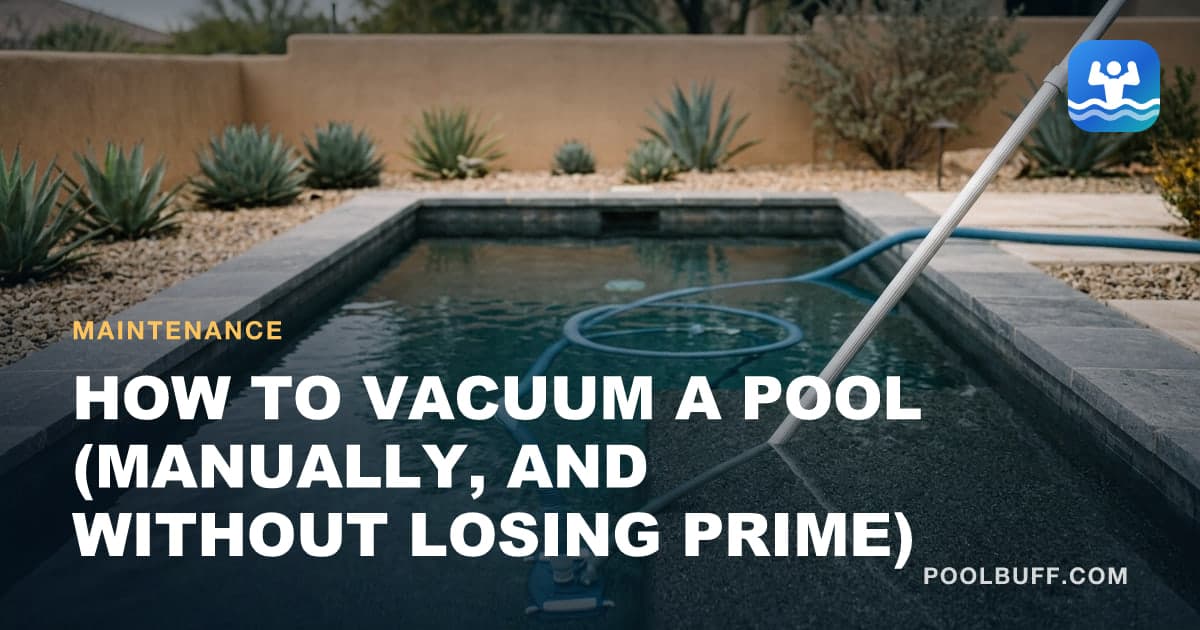
An automatic cleaner is a maintenance device. It keeps an already-clean pool clean. It is useless when a storm drops half a tree in the deep end, and it is worse than useless after an algae bloom, where you want to vacuum dead algae to waste rather than push it through a filter you will then have to strip.
A decent telescopic pole is the part worth spending on — a flexible one turns a twenty-minute job into an hour of fighting it. Add a leaf net and an 18-inch nylon brush and you have the kit that handles everything the machine cannot. Manual vacuuming properly is a skill worth twenty minutes to learn.
What this costs you downstream
The purchase price is the smaller number. What separates these over five years is what they do to the rest of your equipment.
A suction cleaner adds load to your filter, so you clean it more often and your pump works against higher pressure sooner. That is real money in electricity and in filter maintenance, though nothing like the gap in sticker price.
A pressure cleaner spares the filter entirely and charges you for a second motor instead. On a booster running three hours a day through a season, that is not trivial either.
Neither is wrong. But comparing them on purchase price alone will mislead you, which is the usual reason people end up disappointed with whichever one they bought.
Go deeperAll four types comparedSuction, pressure, robotic and manual side by side, with the plumbing each one needs.Frequently asked questions
Is a suction or pressure pool cleaner better?
Suction is better for most pools: cheaper to buy, nothing extra to install, and simpler to keep running. Pressure is better if you get heavy leaf fall, because debris goes into the cleaner's own bag rather than into your filter. If you do not already have a booster pump line, though, the installed cost of going pressure-side roughly doubles.
Will a suction cleaner hurt my pump or filter?
Not directly, but it does change the workload. Everything the cleaner picks up ends up in your pump basket and filter, so both fill faster and filter pressure climbs sooner between cleanings. On a pool with a lot of debris that means noticeably more filter maintenance, which is the real argument for a pressure-side cleaner or a robot.
Do I need a booster pump for a Polaris?
For the 280 and most classic Polaris models, yes. There are pressure-side models designed to run off a dedicated return line without a booster, but they need adequate pressure to work properly. Adding a booster pump and its plumbing to a pool that has neither is not a small job, so check what you already have before choosing this route.
Are these better than a robotic cleaner?
Generally no, on cleaning quality. A robot filters independently of your pool system, climbs walls properly and scrubs. Suction and pressure cleaners are cheaper to buy and much cheaper to repair, which is why they remain popular. If your budget stretches and you want the pool clean with least thought, a robot wins.
How long should a pool cleaner run each day?
Two to four hours for most pools, during the filter cycle rather than in addition to it. These cleaners cover ground by wandering rather than by planning, so coverage is a function of running time. Running one around the clock does not clean better, it just wears the parts out sooner.