Hayward · TracVac
Hayward TracVac Suction Cleaner
Hayward's tracked TracVac suction cleaner: the 33 to 40 RPM speed check, setting flow on a variable-speed pump, where the floats go, and clearing the turbine.
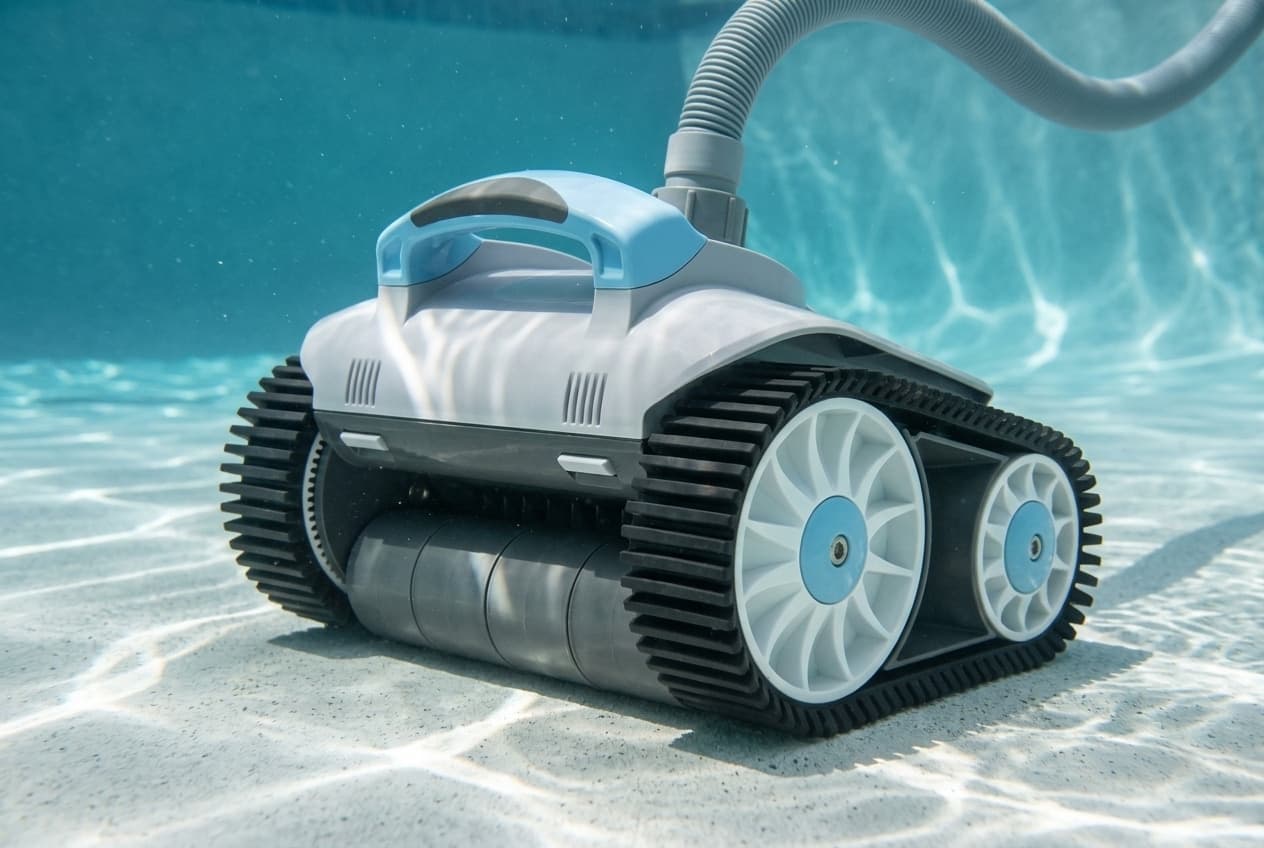
The TracVac is Hayward's tracked suction cleaner: a compact in-ground cleaner that runs on your pump's suction, with a turbine inside driving a pair of tracks. Hayward rates it for pools up to 20 by 40 feet, and its sell sheet lists concrete, gunite, vinyl, fiberglass, tile and pebble surfaces. It measures 8.9 by 11.3 by 7.9 inches and weighs 5.76 pounds.
HSCTRACCU is the Expert Line version, sold through pool professionals and stores. W3HSCTRACCU is the Open Line version, sold online. Hayward's product pages give them the same specifications.
It isn't Hayward's TracJet, which is a pressure-side cleaner. Hayward's other suction cleaners include The PoolCleaner and the Navigator Pro. Like any suction cleaner, it sends debris to your pump basket and filter, which the cleaner type comparison covers.
How it gets around
From Hayward's manual:
- The turbine is hollow, so if large debris jams its blades, water can still flow past, which Hayward says keeps your pool system supplied.
- Programmed steering has 6 turn settings at different angles, to cover the whole pool.
- The tracks and underside handle main drains, uneven surfaces, odd shapes and steep corners, in the deep and shallow ends.
- It climbs walls only where the pool has a sufficient radius between floor and wall. Adjustable skirts lift over obstacles while keeping suction under the cleaner.
Two things to set up before you start
On a variable-speed pump, Hayward says to set the cleaner's flow at the pump's highest programmed speed. Adjust the regulator valve and the pump speed until the flow gauge reads correctly at that top speed; then no other speed setting will exceed the maximum flow.
With solar heating, Hayward says the solar must be off whenever the TracVac is in use. Run them on alternating schedules, and take the TracVac out when it isn't in use on a solar-heated pool.
Preparing the pool
- Remove very large debris by hand, after a storm or at spring opening. Hayward says not to use the cleaner to remove large debris in new pools.
- Backwash or clean the filter, and empty the skimmer and pump baskets.
- Balance the water. If you shock the pool, wait one to two days before running the cleaner.
- Point the returns downward to help it cover the pool.
Connecting it
Turn the pump off first.
With a dedicated suction port: the port needs a safety vac-lock fitting, which Hayward says isn't included; if yours doesn't have one, get one from a pool store and have it installed first. Put the flow regulator valve, with its cap on, into the skimmer, using the hose cone adapter for a proper seal if needed. Push the first hose section into the vac-lock fitting.
With a skimmer only: put the first hose section into the skimmer together with the flow regulator valve, without the cap, using the hose cone adapter if needed.
The hose: check the two floats are on the leader hose, 20 inches and 14 inches from the cleaner end. Connect enough sections from the suction point to reach the farthest point of the pool, then add the leader hose. Don't connect the cleaner yet.
Setting the flow
- Submerge the whole hose to get all the air out.
- Push the flow gauge into the end of the leader hose.
- Clip the leader hose to the first hose section with the double hose clip, so the hose forms a loop in the pool.
- Turn the pump on, with the leader hose and gauge underwater, and turn the regulator knob Faster or Slower until the gauge's disc settles between Maximum and Minimum. With an extraordinarily strong pump, Hayward says you may need to open the main drain slightly.
- Turn the pump off, remove the clip and gauge, submerge the TracVac to get the air out of it, and connect it to the leader hose.
Checking its speed
Without the gauge, Hayward's quick check is the cleaner's speed:
- Lift the TracVac off the floor by its handle and hold it just under the surface, so it doesn't draw air, keeping clear of moving parts.
- Count the full turns of the large right wheel over 30 seconds, and double it. The left wheel's speed varies for steering, so it can't be used.
The normal range is 33 to 40 RPM. Below 33, turn the regulator knob clockwise and check again; above 40, turn it counterclockwise.
A dirty filter slows it down. Hayward says a cleaner that slows during a heavy clean is most often a filter that needs cleaning, so watch the filter gauge and the cleaner's speed together.
Clearing the turbine
Hayward says to check the turbine turns freely before every use.
- Turn off the pump and take the TracVac out of the pool.
- Look into the turbine from where the leader hose connects. If you can't see a clog, face the buckle toward you and roll the left track forward: smooth means it's probably clear, locked means there's a blockage.
- Open the lid: press the buckle, lift the front of the lid, pull it firmly forward and lift it off.
- Lift the turbine cover straight off, check it for debris, and clear the turbine.
- Check the gears, drive shafts and swivel for debris.
- Put the turbine cover back, roll the left track again to check it runs smoothly, and refit the lid: tabs at the back into the slots, push down and back, then lock the buckle.
Safety and storage
Hayward's rules:
- Stop the pump before cleaning or servicing the cleaner.
- Take it out before shocking the pool and before backwashing.
- No swimmers while it's running.
- Store it in the shade, away from children and pets.
- Store the hose straight. Never coil it.
What the troubleshooting table says
- Not moving, or too slow: check flow with the gauge; check for debris inside the cleaner; make sure the pump is at the right speed and fully primed; clean or backwash the filter; close the main drain and other suction lines; look for leaks or blockages in the filter, pump basket or impeller.
- Left track won't turn by hand: something is blocking the inside of the cleaner.
- Stays at one end: remove loops or coils in the hose, check its length and the flow, redirect a return that's in its path, check the float positions, and make sure the swivel turns smoothly.
- Climbs too far or climbs out: reduce the flow, and check the tracks aren't excessively worn.
- Won't climb the walls: increase the flow without passing the gauge's maximum, and check the floats.
- Stays on the main drain: make sure the main drain is closed and has a grate.
- Falls on its side and is slow to recover: check the floats, the hose length and the returns.
- Turns in circles: a worn or damaged wheel hub, long drive shaft gear, steering slide assembly or left drive gear.
- Hose loops won't come out: don't store it coiled, lay it straight in the sun, clean the swivel, and check the hose isn't too long for your pool.
- Doesn't clean the whole pool: the hose is too short, the floats are misplaced, the swivel needs cleaning, or a return is in its path.
- Erratic on a solar-heated pool: run the cleaner and solar on alternating schedules.
Buying one
The Expert Line HSCTRACCU carries two years of parts and one year of in-store labor. The Open Line W3HSCTRACCU carries two years of parts and no labor, a year more than most Open Line products: Hayward's 2026 terms name TracVac cleaners as an exception. The Amazon listing on this page is the W3HSCTRACCU with Hayward as the maker.
Where Hayward's documents disagree
- The online model number. The 2025 sell sheet gives the Open Line version's number without the HSC in the middle; Hayward's product page, the manual's cover and Amazon all use W3HSCTRACCU.
- The internal screw kit. HSXTV116 in the manual and among the related parts on Hayward's page; HSXTV125 in Hayward's parts lookup.
- The vac-lock fitting. The manual's safety instructions refer to "the cover provided" for a dedicated suction port; its installation section and Hayward's product page say it isn't included.
- The missing warranty section. The manual's contents list a warranty section on page 10; the manual has none.
- The traction system. Hayward's product pages describe the tracked TracVac's traction system as 4-wheel drive.
Which model do you have?
The model number is on the cleaner label. Everything else in the range is shared — these are the parts that change with it.
| Model | SKU | Channel | Warranty | Online version | Note |
|---|---|---|---|---|---|
| TracVac | HSCTRACCU | Expert Line, pool professionals and stores | 2 years parts, 1 year in-store labor | W3HSCTRACCU, 2 years parts only | HSCTRACCU is the Expert Line version sold through pool professionals and stores; W3HSCTRACCU is the Open Line version for online sale. Hayward's product pages give both the same specifications. |
Hayward TracVac Suction Cleaner parts, and what goes wrong
Read off the manufacturer’s parts list and checked before it ships. Open a row for what a bad one actually does — or start from the symptom and work down, which is the cheaper order.
What is it doing?
Water flowing through the turbine drives the tracks. Hayward says to check before every use that it turns freely, and that a TracVac moving slowly or stalling may have a partly or fully blocked turbine. It's hollow, so flow can pass the blades if large debris jams it, which Hayward says keeps the pool system supplied with water. To check it, with the pump off and the cleaner out of the pool, look into the turbine from the hose connection, then face the buckle toward you and roll the left track forward: smooth means probably clear, locked means a blockage.
Live pricing arrives when the retailer programs are approved.
The tracks do the climbing. Hayward's troubleshooting says excessively worn tracks won't give the grip the cleaner needs to climb walls. For a cleaner that climbs too far or climbs out, it lists too much flow first, then worn tracks. The front small wheels are HSXTV104 and the rear large wheels HSXTV105, each a set of two with bearings and inserts.
Live pricing arrives when the retailer programs are approved.
The swivel on top lets the cleaner turn without the hose winding up or catching on debris. Hayward's troubleshooting says to make sure it rotates smoothly, and to clean it, for a cleaner that stays at one end, for hose loops that won't come out, and for a cleaner that doesn't clean the whole pool. The turbine cover lifts straight off the chassis once the lid is off.
Live pricing arrives when the retailer programs are approved.
The two floats go on the leader hose, one 20 inches and one 14 inches from the cleaner end. Hayward's troubleshooting blames floats in the wrong position for a cleaner that stays at one end, won't climb walls, falls on its side and is slow to recover, or misses parts of the pool.
Live pricing arrives when the retailer programs are approved.
The buckle on the front locks the top cover to the chassis. To open it, press the buckle, lift the front of the lid, pull it firmly forward and lift it off. To close, line up the tabs on the back of the top cover with the slots on the chassis, push down, push the cover firmly backward to engage the tabs, and lock the buckle.
Live pricing arrives when the retailer programs are approved.
Hayward's troubleshooting blames a cleaner that goes round in circles on a worn or damaged wheel hub, long drive shaft gear, steering slide assembly or left drive gear. The right drive kit, with the short drive shaft and two bearings, is HSXTV109, and the drive gear kit, three drive-side gears, is HSXTV113.
Live pricing arrives when the retailer programs are approved.
Hayward's parts lookup says it includes the flow regulator valve, regulator cap, flow gauge, hose float, hose cone adapter and hose clip: the pieces that set up the flow. The regulator knob turns Faster or Slower until the gauge's disc sits between Maximum and Minimum.
Live pricing arrives when the retailer programs are approved.
Listed among the related parts on Hayward's TracVac page. The TracVac itself comes with 11 connector sections and a leader hose. Hayward's rules: connect enough sections to reach the farthest point of the pool, then add the leader hose; store the hose straight, never coiled; and if loops won't come out, lay it straight in the sun. A hose that's too long for your pool can also leave loops, and one that's too short limits coverage.
Live pricing arrives when the retailer programs are approved.
Hayward TracVac Suction Cleaner manuals and documentation
Hosted by the manufacturer. These open on Hayward’s own servers, so they stay current.
- TracVac suction-side pool cleaner owner's manual (ISSCTV100 Rev B, 2023)manual
- TracVac quick start guide (QRGTV100 Rev C)guide
- TracVac suction cleaner sell sheet (LITTRVACSS25)spec
- TracVac dimension drawingspec
- TracVac Expert Line product page, with Hayward's parts diagramdiagram
- TracVac Open Line product pagespec
- Hayward 2026 Expert Line residential warranty terms, including Open Lineguide
Hayward TracVac Suction Cleaner warranty
2 years parts, 1 year in-store labor
The Expert Line HSCTRACCU gets two years of parts and one year of in-store labor, per its product page and Hayward's 2026 Expert Line terms for suction cleaners. The Open Line W3HSCTRACCU gets two years of parts with no labor. That's longer than most Open Line products: Hayward's 2026 terms give Open Line one year and name TracVac cleaners, with salt cells, as the exceptions. Hayward's terms treat bottom skirts and similar cleaner parts as normal wear items, covered only for manufacturing defects, which it says normally appear within 30 days of installation. The warranty covers only products bought from Hayward or an authorized seller.
Manufacturer’s termsHayward TracVac Suction Cleaner complete parts list
Every part on the manufacturer’s exploded diagram, in their numbering. Marked rows are the ones covered above with a symptom and a diagnosis.
27 parts
| No. | Part | Description | Note |
|---|---|---|---|
| 1 | HSXTV100 | Top cover kit, with handle and balancing weights | |
| 2 | HSXTV101 | Turbine cover and swivel kit what goes wrong | |
| 3 | HSXTV102 | Buckle and latch kit what goes wrong | |
| 4 | HSXTV103 | Track kit, set of 2 what goes wrong | |
| 5 | HSXTV104 | Front small wheel kit, set of 2, with bearings and insert | |
| 6 | HSXTV105 | Rear large wheel kit, set of 2, with bearings and insert | |
| 7 | HSXTV106 | Roller kit, set of 4 | |
| 8 | HSXTV107 | Roller bar kit, set of 2 | |
| 9 | HSXTV108 | Left drive kit, long drive shaft and bearing housing what goes wrong | |
| 10 | HSXTV109 | Right drive kit, short drive shaft and 2 bearings | |
| 11 | HSXTV110 | Cam kit, cam and 1 reduction gear | |
| 12 | HSXTV111 | Cam reduction gear kit, 5 reduction gears and stainless shaft | |
| 13 | HSXTV112 | Turbine kit what goes wrong | |
| 14 | HSXTV113 | Drive gear kit, 3 drive-side gears | |
| 15 | HSXTV114 | Bearing kit, set of 8 | |
| 16 | HSXTV115 | Stainless shaft kit, 5 | |
| 17 | HSXTV116 | Stainless screw kit, 6 internal shaft screws | Manual; Hayward's parts lookup lists HSXTV125 |
| 17 | HSXTV125 | Stainless screw kit, 6 internal shaft screws | Hayward's parts lookup |
| 18 | HSXTV117 | Wheel screw kit, 4 stainless screws | |
| 19 | HSXTV118 | Chassis kit, with balancing weights and latch spring | |
| 20 | HSXTV119 | Side covers, left and right | |
| 21 | HSXTV120 | Accessory kit what goes wrong | |
| - | HSXTV121 | Float kit, 2 floats what goes wrong | |
| - | PVCHK1900GR | Hose kit, 1 leader and 9 connector hoses, 33 ft, dark gray what goes wrong | Related part on Hayward's page |
| - | PVCHP1900GRPK10 | Connector hose, 1 m, 10-pack, dark gray | Related part on Hayward's page |
| - | PVCHP1900GRPK24 | Connector hose, 1 m, 24-pack, dark gray | Related part on Hayward's page |
| - | PVLHP1900GRPK10 | Leader hose, 1 m, 10-pack, dark gray | Related part on Hayward's page |
Buy the cleaner
One retailer for now. More get added here as their programs are approved, and this becomes a comparison rather than a link.