Hayward · The PoolCleaner
Hayward The PoolCleaner Suction Cleaner
Hayward's The PoolCleaner in 2-wheel and 4-wheel versions: setting wheel speed to 11 to 14 RPM, choosing the inlet for your pump, and the parts that wear.
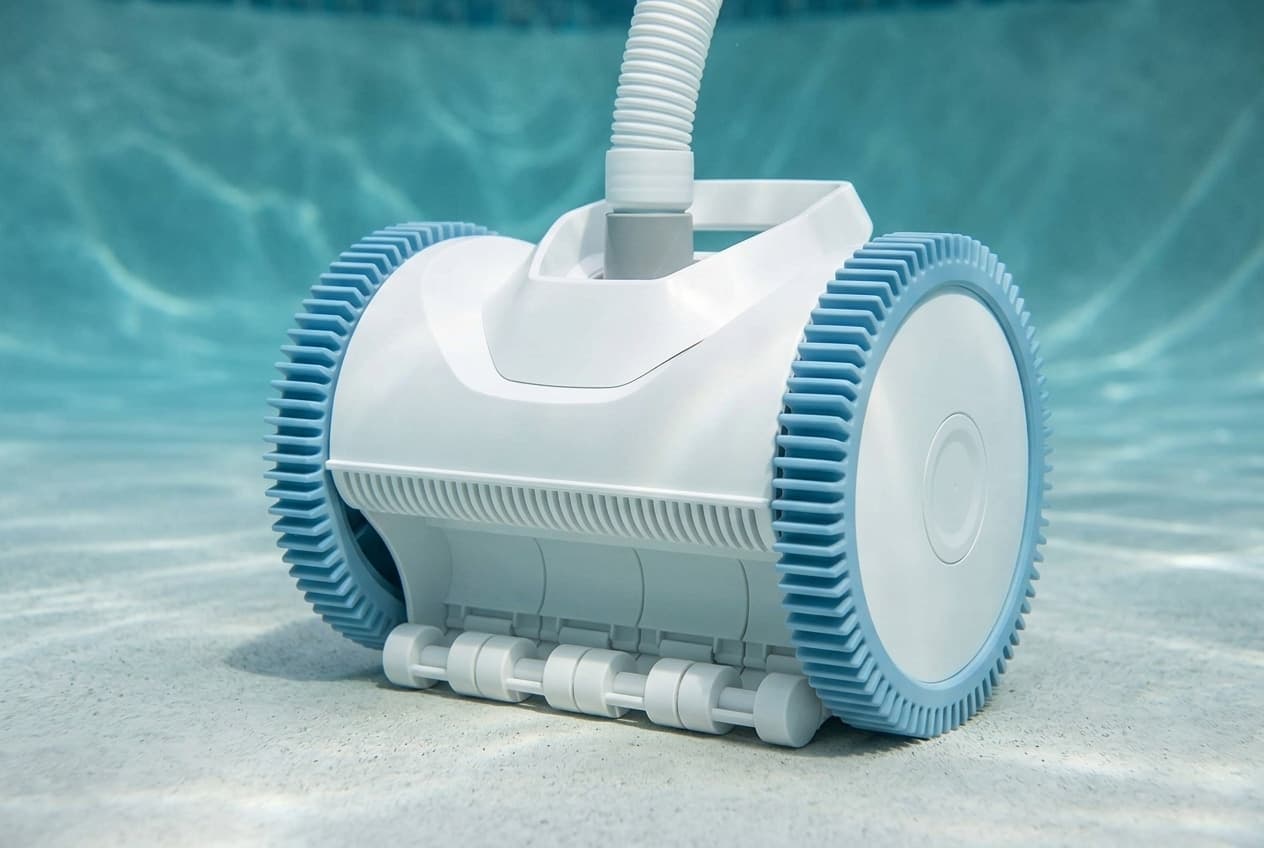
The PoolCleaner is Hayward's suction-side cleaner: it plugs into the skimmer or a dedicated suction port and runs on your pump's suction, driving its wheels with an internal turbine. Hayward sells it in two sizes, the 2-Wheel and the 4-Wheel, each in white or a limited edition gray.
At pool stores the dealer models are PBS20JST and PBS40JST, white, and PBS20GST and PBS40GST, gray. Online, the Open Line versions are W3PVS20JST, W3PVS40JST, W3PVS20GST and W3PVS40GST, and Amazon lists them under the name Poolvergnuegen.
It isn't Hayward's robotic R110 and R130, which also carry The PoolCleaner name. Like any suction cleaner, it sends what it picks up to your pump basket and filter; the cleaner type comparison covers what that means.
2-Wheel or 4-Wheel
From Hayward's sell sheet and manual:
- 2-Wheel: pools up to 16 by 32 feet, 33 feet of hose, 5.76 pounds. It travels 8 to 10 feet before turning, with five programmed turns from 90 to 450 degrees.
- 4-Wheel: pools up to 20 by 40 feet, 40 feet of hose, 6.6 pounds. It travels 11 to 14 feet before turning, with three programmed turns from 90 to 540 degrees.
Hayward's sell sheet puts the 4-Wheel on larger and deeper pools. Both clean floors and walls on in-ground pools, and Hayward's manual adds that the cleaner will only climb walls where the pool has a sufficient radius between floor and wall.
The steering works by periodically reversing the left wheel so the cleaner turns and heads off in a new direction.
Before the first run
From Hayward's manual:
- Clear very large debris by hand first, after a storm or at spring opening. Hayward says not to use the cleaner to remove large debris in new pools.
- Backwash or clean the filter, and empty the skimmer and pump baskets.
- Balance the water. If you shock the pool, wait a day or two before putting the cleaner in.
- Point all the return fittings downward, so they don't push the cleaner and hose around.
Setting up the hose
- The leader hose is the section with the gray cuff, which goes on the cleaner. The floats go on it 20 to 25 inches from the cleaner end.
- Join the rest male to female, wetting the ends if they're hard to join, then add the leader hose last.
- Length: Hayward says the connected hose should be one to two sections longer than the distance to the farthest point of the pool.
Getting the air out and connecting it
Air in the hose and cleaner is the thing to avoid. Hayward gives two ways to purge it:
- With the pump running, lower the cleaner in and hold the far end of the hose against a return fitting until the air stops coming out.
- With the pump off, lower the cleaner and push the hose down vertically into the water until it's completely full.
Then turn the pump off before connecting, which Hayward underlines because suction can be very dangerous:
- Into a skimmer: press the regulator valve and hose cone firmly into the bottom of the skimmer.
- Into a dedicated suction port: screw in the vac lock and insert the regulator valve, or push the hose straight into the vac lock and use your 3-way or ball valve to set the flow instead.
Turn the pump back on.
Setting the speed: 11 to 14 RPM
Hayward's target is 11 to 14 revolutions per minute on the right front wheel. It will still clean as low as 8 RPM, but it won't climb walls. Hayward says that range is equivalent to 7 to 10 inches of mercury on a vacuum gauge, which isn't included.
To count it: hold the cleaner by the leader hose just below the water, keeping it under so it doesn't suck air, and count the right front wheel's turns for a minute, using the hump on the tire as your marker.
To adjust it, use the regulator valve on the skimmer or suction line, which bypasses water so the cleaner doesn't run too fast:
- Screw the top in to bypass less water and speed it up. If it's all the way in and still under 11 RPM, open your 3-way valve for more suction, clean the filter, or take the regulator valve out.
- Screw the top out to bypass more water and slow it down. If it's all the way out and still over 14 RPM, turn the 3-way valve down for less suction.
Choosing the inlet matters too. The cleaner comes with interchangeable inlets: small for a small or variable-speed pump, medium for an average pump, and large for a large pump. Hayward notes that low-flow setups may affect the cleaner's ability to climb walls. Sizing a pool pump covers flow if you're unsure what yours moves.
Safety and storage
Hayward's rules:
- Take the cleaner out before shocking the pool, and before backwashing.
- Don't swim with the cleaner in the pool.
- Store it in the shade, away from children and pets.
- Store the hose straight. Don't coil it. If loops won't come out, Hayward says to lay the hose straight in the sun.
Servicing it
Clearing a blockage: the manual shows removing the screws on top, lifting off the upper body, and clearing the turbine and gears underneath. Before taking it apart, turn the right wheel by hand from behind: if it won't turn, something is stuck inside.
Turbine vanes only go in one way. Hayward's reminder is that they look like a wave breaking toward the front of the cleaner: convex at the front, concave at the back.
Tires come off and go back on by hand, as the manual's pictures show. Replace them once they're worn to the tread wear markers; if you can't see the markers, they're past it. Worn tires may damage the pool surface or trim.
Skirts and inlet: turn the cleaner upside down, press both sides of the inlet and pull it out, then clear any debris in the turbine chamber. One of the middle skirt assemblies pulls out, and the rest slide out after it. The inlet only goes back one way, marked L and R, and should click in on both sides.
What the troubleshooting table says
- Doesn't move, or moves too slowly: check wheel RPM; look for a blockage in the cleaner or the system; the pump may be off, on low speed or not primed, and bubbles at the returns point to a leak; clean the pump basket, skimmers and filter; check the turbine vanes aren't backward.
- Doesn't clean the whole pool: the hose is too short, the floats are in the wrong place, the hose swivel is dirty, or the returns are pushing the hose away.
- Climbs too far or climbs out: worn tire treads and skirts, too much suction, not using the regulator valve on a skimmer connection, or an auto skim or vac plate that needs adjusting.
- Won't climb the wall: too little suction, or the floats in the wrong place.
- Falls on its side and is slow to recover: floats misplaced or missing, hose too short, returns pushing the hose, or wheel RPM off.
- Turns in circles: worn wheel hub, large drive gear, steering slide or right drive gear.
- Hose pops out of the skimmer when the pump stops: make sure the hose cone is seated, and look for an air leak in the system.
- Wheels wobble: worn bearings.
- Hose loops won't come out: it was stored coiled. Lay it straight in the sun, and clean the swivel under a tap.
Air bubbles in the returns covers finding the air leak Hayward's table points to.
Buying one
Hayward's Expert Line PBS models are sold only through pool professionals and stores, with two years of parts and one year of in-store labor. The Open Line W3PVS models are sold online with one year of parts and no labor. Either way, tires and skirts are wear items, covered only for manufacturing defects.
The four Amazon listings on this page show Hayward as the manufacturer with the matching W3PVS model numbers. When checked, other sellers' listings titled "Replacement for Hayward W3PVS40JST" cost $958 to $1,058, far more than the $529 genuine white 4-Wheel, and the one checked listed another brand as its maker. Check the manufacturer and model number before buying.
Where Hayward's documents disagree, or fall short
- The skirt color. Hayward's parts lookup describes PVX043042BKPK4 as white on the 2-Wheel lists and black on the 4-Wheel list; the BK in the part number matches black.
- The Open Line 2-Wheel's weight. Hayward's product pages give the white W3PVS20JST a 19 lb shipping weight, the same as the 4-Wheels, while the other 2-Wheels show 16 lb.
- What the parts lookup leaves out. It lists no part numbers for the hose, leader hose, regulator valve or hose cone, all of which the manual shows in the box.
Which model do you have?
The model number is on the cleaner label. Everything else in the range is shared — these are the parts that change with it.
| Model | SKU | Pool size | Hose | Dimensions | Weight | Travel before turning | Programmed turns | Steering cam | Lower body | Rear skirts, white | Rear skirts, black | Gear shaft | Note |
|---|---|---|---|---|---|---|---|---|---|---|---|---|---|
| The PoolCleaner 2-Wheel | PBS20JST | Up to 16 x 32 ft | 33 ft, nine sections plus a leader hose | 11.1 x 7.9 x 8.3 in. | 5.76 lb | 8 to 10 ft | Five, from 90 to 450 degrees | PVXH036009 | PVX2LB1900GR | 896584000-099 | PVXH013BKPK4 | None listed | White is PBS20JST and the limited edition gray is PBS20GST, both Expert Line. The Open Line versions for online sale are W3PVS20JST and W3PVS20GST. |
| The PoolCleaner 4-Wheel | PBS40JST | Up to 20 x 40 ft | 40 ft, eleven sections plus a leader hose | 11.1 x 13.4 x 8.3 in. | 6.6 lb | 11 to 14 ft | Three, from 90 to 540 degrees | PVXH010009 | PVX4LB1900GR | 896584000-105 | PVX013028BK | PVXH020SA | White is PBS40JST and gray is PBS40GST at dealers; online, W3PVS40JST and W3PVS40GST. Hayward's sell sheet puts it on larger and deeper pools. |
Hayward The PoolCleaner Suction Cleaner parts, and what goes wrong
Read off the manufacturer’s parts list and checked before it ships. Open a row for what a bad one actually does — or start from the symptom and work down, which is the cheaper order.
What is it doing?
The front tires carry humps, raised treads that Hayward says get the cleaner over the main drain and uneven surfaces. The tires have tread wear markers, and Hayward's rule is to replace them once they're worn down to the markers: if you can't see the markers, they're already past it. Its warning is that running on worn tires may damage the pool surface or trim. Hayward's parts list also has plain back tires without humps (896584000-082 light blue, 896584000-563 black), super super hump tires for big obstacles (PVX679PK2 light blue, 896584000-723 black), a three-finger hump tire (896584000-075), and this standard tire in black, 896584000-594. Tires are wear items under Hayward's warranty.
Live pricing arrives when the retailer programs are approved.
The self-adjusting vanes fold to let larger debris pass. They only work one way around: Hayward's reminder is that they're like a wave breaking toward the front of the cleaner, convex at the front and concave at the back. Its troubleshooting table lists vanes in the wrong direction or on the wrong side as a cause of a cleaner that won't move, and says vanes that pop out of the turbine usually mean a worn turbine hub.
Live pricing arrives when the retailer programs are approved.
When the cleaner meets an obstacle, one or more of the skirts lift over it while holding suction under the cleaner. Hayward's troubleshooting puts worn tire treads and skirts first among the reasons a cleaner climbs too far or climbs out. To change them, turn the cleaner upside down, pull the inlet, slide one of the middle skirt and bracket assemblies out, and the rest follow. The white version is 896584000-259, and both sizes use them. Skirts are wear items under Hayward's warranty.
Live pricing arrives when the retailer programs are approved.
The interchangeable inlet, or throat, matches the cleaner to the pump: small for a small or variable-speed pump at low flow, medium for an average pump, large for a large pump at high flow. Hayward notes that low-flow setups may affect the cleaner's ability to climb walls. To swap it, turn the cleaner over, press both sides of the inlet and pull it up. It only fits one way, marked L and R, and it should click in on both sides. The large blue inlet is PVX990L-244.
Live pricing arrives when the retailer programs are approved.
The floats go on the leader hose, the section with the gray cuff that attaches to the cleaner, 20 to 25 inches from the cleaner end. Hayward's troubleshooting table blames a float in the wrong position, or a missing one, for a cleaner that falls over and is slow to recover, one that won't climb the wall, and one that misses parts of the pool. The white floats are PVX280PK2.
Live pricing arrives when the retailer programs are approved.
Hayward's fix for wobbly wheels is new bearings. The manual shows prying off the wheel center, removing the retainer and lifting the wheel, then clicking the bearing and wheel back in. When it's back together, turn the right front wheel, looking from behind, and make sure everything turns smoothly.
Live pricing arrives when the retailer programs are approved.
Hayward's troubleshooting says a right wheel that skips teeth when you turn it forward by hand means a worn or damaged wheel hub or right drive gear, and a cleaner that goes round in circles means a worn wheel hub, large drive gear, steering slide assembly or right drive gear. A right wheel that won't turn at all by hand means something is stuck inside the cleaner. The small gear drives are PVXH008PK2.
Live pricing arrives when the retailer programs are approved.
If you are doing the job anyway
The skirts and inlet come out together: pulling the inlet is the first step to changing skirts.
Worn-out underside, either size
Hayward's troubleshooting blames worn tire treads and skirts together for a cleaner that climbs too far or climbs out, and its warranty treats both as wear items.
- Standard tires with super hump, light blue, 2-pack896584000-143
- Front skirts with rollers, black, 4-packPVX043042BKPK4
Hayward The PoolCleaner Suction Cleaner manuals and documentation
Hosted by the manufacturer. These open on Hayward’s own servers, so they stay current.
- 2 and 4 wheel suction-side pool cleaners owner's manual (ISSC100 Rev F)manual
- The PoolCleaner suction cleaner sell sheet, with pool size, hose length and dimensions (LITPLCLNRSS25)spec
- The PoolCleaner 4-Wheel dimension drawingspec
- The PoolCleaner 2-Wheel product page, with Hayward's parts diagramdiagram
- The PoolCleaner 4-Wheel product page, with Hayward's parts diagramdiagram
- Hayward 2026 Expert Line residential warranty termsguide
Hayward The PoolCleaner Suction Cleaner warranty
2 years parts, 1 year in-store labor
Hayward's product pages give the Expert Line PBS models two years of parts and one year of in-store labor, which matches Hayward's 2026 Expert Line terms for suction cleaners on in-ground pools. The W3PVS versions are Open Line, sold online, with one year of parts and no labor. Either way, Hayward's terms treat tires, bottom skirts and similar parts as normal wear items, covered only for manufacturing defects, which Hayward says normally appear within 30 days of installation. The warranty covers only products bought from Hayward or an authorized seller.
Manufacturer’s termsHayward The PoolCleaner Suction Cleaner complete parts list
Every part on the manufacturer’s exploded diagram, in their numbering. Marked rows are the ones covered above with a symptom and a diagnosis.
41 parts
| No. | Part | Description | Note |
|---|---|---|---|
| 1 | 896584000-181 | Upper body assembly with 3 screws, white | |
| 2 | PVXH038SA | Turbine kit, 6 vanes what goes wrong | |
| 3 | PVXH009PK5 | Gear reduction, 5-pack | |
| 4 | PVXH036009 | Steering cam | 2-Wheel |
| 4 | PVXH010009 | Steering cam | 4-Wheel |
| 5 | PVXH008PK2 | Small gear drive, 2-pack | |
| 6 | 896584000-051 | Wheel hub, white | |
| 6 | 896584000-532 | Wheel hub, gray, limited edition | |
| 7 | PVXH007 | Large gear drive what goes wrong | |
| 8 | PVXH019SA | Shaft bearing | |
| 9 | 896584000-143 | Standard tires with super hump, light blue, 2-pack what goes wrong | |
| 9 | 896584000-594 | Standard tires with super hump, black, 2-pack | |
| 9 | 896584000-082 | No hump back tires, light blue, 2-pack | |
| 9 | 896584000-563 | No hump back tires, black, 2-pack | |
| 9 | PVX679PK2 | Super super hump tires for big obstacles, light blue, 2-pack | |
| 9 | 896584000-723 | Super super hump tires for big obstacles, black, 2-pack | |
| 9 | 896584000-075 | Three-finger hump tires, light blue, 2-pack | |
| 10 | PVX2LB1900GR | Lower body, gray, empty | 2-Wheel |
| 10 | PVX4LB1900GR | Lower body, gray, empty | 4-Wheel |
| 11 | PVX976PK2 | Wheel bearing, 2-pack what goes wrong | |
| 12 | PVXH011SA | Steering bracket roller | |
| 14 | PVXWLC1900BLK | Wheel retainer clip, black | |
| 14 | PVXWLC1900WH | Wheel retainer clip, white | |
| 15 | 896584000-259 | Front skirts with rollers, white, 4-pack | Both sizes |
| 15 | PVX043042BKPK4 | Front skirts with rollers, black, 4-pack what goes wrong | Both sizes |
| 15 | PVXH014BKPK4 | Skirt brackets, black, 4-pack | Both sizes |
| 16 | 896584000-099 | Rear skirts, white, 4-pack | 2-Wheel |
| 16 | PVXH013BKPK4 | Rear skirts, black, 4-pack | 2-Wheel |
| 16 | 896584000-105 | Rear skirt kit, white, 2 hinged and 2 non-hinged | 4-Wheel |
| 16 | PVX013028BK | Rear skirt kit, black, 2 hinged and 2 non-hinged | 4-Wheel |
| 17 | PVX990S-244 | Suction inlet, small, blue what goes wrong | |
| 17 | PVX990L-244 | Suction inlet, large, blue | |
| 17 | PVX990S-207 | Suction inlet, small, gray, limited edition | |
| 17 | PVX990M-236 | Suction inlet, medium, black metallic, limited edition | |
| 17 | PVX990L-207 | Suction inlet, large, gray, limited edition | |
| 18 | 896584000-204 | Upper body screw kit, 3 screws | |
| 19 | PVXH020SA | Gear shaft | 4-Wheel |
| 20 | 896584000-419 | Skirt brackets, white, 4-pack | Both sizes |
| - | 896584000-068 | Turbine shroud hose swivel | |
| - | PVX280PK2 | Hose float, white, 2-pack | |
| - | PVX631PK2 | Hose float, black, 2-pack what goes wrong |
Where to buy
- AmazonThe W3PVS20JST, the white 2-wheel Open Line model, listed with Hayward as the manufacturer under the name Poolvergnuegen. It was $479 from Pool Supplies Superstore. Open Line carries one year of parts and no labor, and Hayward's warranty covers only products bought from authorized sellers.
- AmazonThe W3PVS20GST, the gray 2-wheel Open Line model, at $509 from the same seller, on the same Open Line terms.
- AmazonThe W3PVS40JST, the white 4-wheel Open Line model, listed with Hayward as the manufacturer. It was $529 from Pool Supplies Superstore, on Open Line terms.
- AmazonThe W3PVS40GST, the gray 4-wheel Open Line model, at $599 from the same seller.