A replacement salt cell is one of the larger single bills in pool ownership, and a good share of them are avoidable.
The failure mode that drives most purchases is not a worn-out cell. It is a scaled one, throwing exactly the same warnings a dying cell throws, on a controller that cannot tell the difference because it is inferring everything from conductivity.
Key takeaways
- Cells are controller-specific. The single most expensive mistake here is buying the wrong brand.
- A scaled cell and a dead cell throw the same errors. Clean it first — it costs nothing.
- Rated life is about 10,000 hours, which is roughly three to five seasons of normal running.
- Genuine from a dealer carries three years. The same cell bought online carries one.
- Aftermarket cells often quote longer warranties than the genuine part. Who backs it matters more than the number.
My picks at a glance
- 1
Hayward W3T-CELL-15 TurboCell
Best for AquaRite systems · anyone running a Hayward AquaRite, AquaPlus, ProLogic or OmniLogic
- 2
Pentair IntelliChlor IC40
Best for IntelliChlor systems · Pentair systems, where nothing else fits
- 3
Jandy AquaPure PLC1400 cell kit
Best for AquaPure systems · Jandy AquaPure and PureLink controllers
- 4
R0452400 aftermarket cell
Best value, with caveats · an older AquaPure system where the genuine part costs more than the pool is worth
Beyond these picks, every salt system with a page here is listed with its cell sizes, parts and manuals.
Before you replace a salt cell
- 1
Take the cell out and look at it
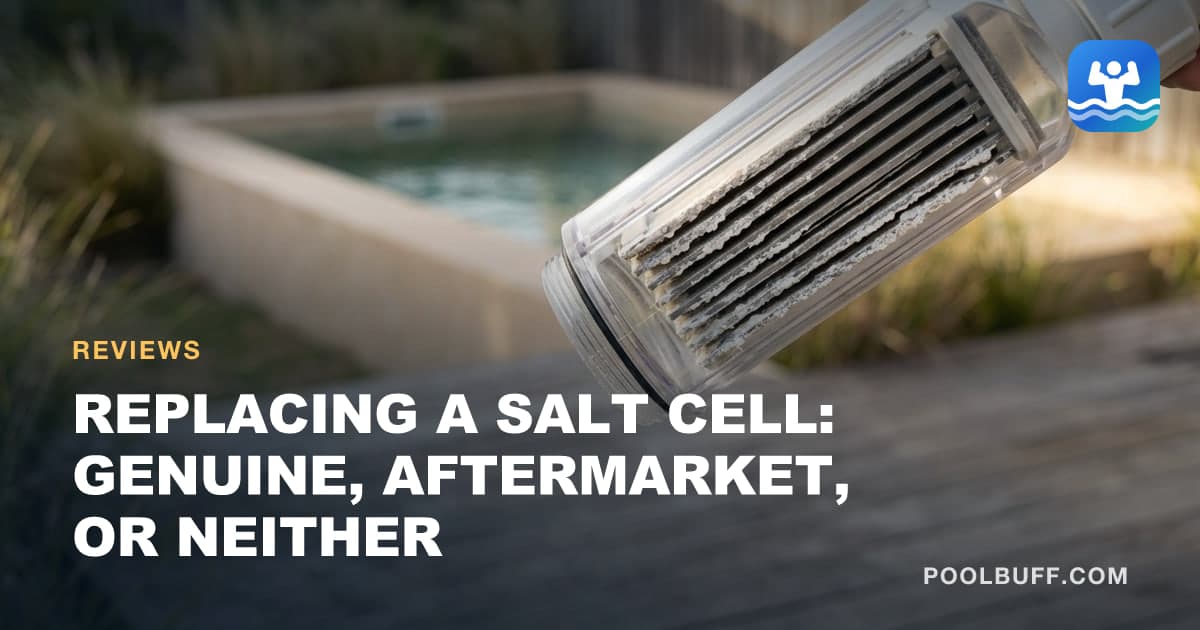
10 minutesWhite or gray crust bridging the plates is scale. That is not a dead cell, that is a dirty one, and an acid wash brings it back.
Plates that look clean but thin, pitted, or where the dark coating has visibly worn off the metal underneath — that cell is finished. The coating is the part that does the work, and once it is gone nothing restores it.
- 2
Verify the salt independently
5 minutesYour controller does not measure salt. It measures conductivity across the cell and converts, which means a scaled or worn cell reports low salt when the water is correct.
Test with strips or a drop test before adding a single bag. Adding salt to a pool that does not need it can only be undone by draining water, and it is a genuinely common way to make a small problem expensive.
- 3
Ask whether it is scaling for a reason
—A cell that scales heavily every few months is telling you about your water, not about itself. It is the same calcium story as scale on waterline tile, arriving somewhere more expensive. Chronic scaling means your saturation index is running positive, and the next cell will do exactly the same thing.
Fix the balance or buy a cell every other year. Those are the options.
- 4
Rule out the power center
—On both Hayward and Pentair systems, a failing power supply or control board presents very much like a failing cell — no output, intermittent output, nonsense readings.
This is worth establishing before spending, because they are separate parts with separate prices, and replacing the cell to fix a board problem leaves you exactly where you started, minus the money.
Hayward W3T-CELL-15 TurboCell
Best for anyone running a Hayward AquaRite, AquaPlus, ProLogic or OmniLogic
The genuine 40,000-gallon cell, and the safe answer if your controller is Hayward. Rated around 10,000 hours, which lands most owners at three to five seasons depending on runtime and how well the water was kept. Note the W3 prefix: that is Hayward's Open Line, sold online with a shorter warranty than the same cell bought through a dealer.
Strengths
- Guaranteed fit and correct output for the controller it was designed for
- Known, predictable service life rather than a claim
- Widely stocked, so replacement is never a hunt
Trade-offs
- The most expensive option by a clear margin
- Open Line units carry a year of warranty, not the dealer's three
- Sized for 40k gallons — buying a larger cell than your controller expects does not help
The TurboCell page has all three sizes with their part numbers, and the step that gets missed on every cell swap: the controller has to be told which cell you fitted. Hayward warns that getting it wrong causes inaccurate salt readings and can shut the system down.
All three major brands now have a page here, and their salt targets do not agree: Jandy's TruClear asks 3,000 ppm, Hayward 3,200 and Pentair 3,600. Use the figure for the cell you own rather than a general one.
Pentair IntelliChlor IC40
Best for Pentair systems, where nothing else fits
The Pentair equivalent, and if you have an IntelliChlor power center this is what goes on the end of it. There is no cross-shopping to do here: the connector, the communication with the power center and the output calibration are all Pentair-specific. The choice is genuine or aftermarket, not Pentair or Hayward.
Strengths
- Only cell that talks to an IntelliChlor power center properly
- Integrates with Pentair automation without workarounds
- Same predictable service life story as the Hayward
Trade-offs
- Premium pricing with no genuine substitute
- Same channel-dependent warranty question as any big-ticket equipment
- A failing power center presents like a failing cell, and is a separate bill
The IntelliChlor page has the whole line side by side with the part numbers, and the two things that stop a healthy cell working — the flow and temperature switch, and scale on the blades — both of which cost a fraction of a cell and are worth ruling out before you buy one.
Jandy AquaPure PLC1400 cell kit
Best for Jandy AquaPure and PureLink controllers
The third major system, and the one people forget exists when they read a two-brand comparison. Three-port cell for AquaPure and PureLink controllers, rated to around 40,000 gallons. Same rule as the others: it fits Jandy systems and nothing else, so the controller on your wall decides this rather than any preference of yours.
Strengths
- Genuine kit for AquaPure and PureLink, which nothing else replaces
- AquaPure reads out salinity, flow and temperature, and talks to AquaLink
- Rated for large pools, so most residential installs are covered
Trade-offs
- Premium price with no genuine alternative
- Smaller installed base than Hayward or Pentair, so fewer local techs
- No Jandy warranty if bought online; three years only as a complete system
The AquaPure page has both cells with both kinds of union — four part numbers for two cells — and the step that catches replacement boards: they leave the factory set for the PLC1400, and running a PLC700 means cutting a jumper that cannot be uncut. It also explains why a new cell on an old power center gets one year of Jandy warranty rather than three.
R0452400 aftermarket cell
Best for an older AquaPure system where the genuine part costs more than the pool is worth
A concrete example of the aftermarket category rather than a hand-wave at it: fourteen titanium blades, three-port, rated to 40,000 gallons, and it ships with the cord and o-rings. Roughly half the genuine price. Equivalents exist for the Hayward and Pentair fittings too, and everything below applies to all of them.
Strengths
- Roughly half the cost of the genuine cell
- Ships complete with power cord and o-rings
- Reasonable bet on an older system you do not plan to keep forever
Trade-offs
- Output calibration can be off, so the controller misreports
- Build quality varies between sellers and between batches
- A long stated warranty is worth whoever is still there to honor it
The warranty math is not what you expect
This is the part nobody explains, and it changes the decision.
The genuine Hayward cell carries three years bought through an authorized dealer. The identical cell bought online is the W3 Open Line version, and it carries about one. Same part, same box, different channel, a third of the coverage.
Meanwhile aftermarket sellers routinely advertise three to five years on a cell costing half as much.
Read that quickly and the aftermarket cell looks like the obvious buy. The thing to weigh is who is standing behind the number. Hayward will exist in year four. A marketplace seller might not, and a warranty is only a promise from whoever made it.
The honest reading is this: if you want maximum coverage, buy genuine from a pool dealer and pay for it. If you want the best price and accept the risk, aftermarket is a reasonable bet on an older system. Buying genuine online sits in the middle — full quality, reduced coverage — and it is the option most people choose without realizing the trade they made.
When the pool decides for you
Two situations settle it without much analysis.
A newer system you intend to keep. Buy genuine. The output calibration matters, the automation integration matters, and you will be living with this for a decade.
An older pool, an old controller, or a system you are likely to replace wholesale in a few years. An aftermarket cell is a sensible way to keep it running without putting premium money into equipment on its way out.
Everything else is a judgment about how much certainty you want to pay for. What is not a judgment is the order of operations: clean it, test the salt properly, rule out the board, and only then buy. Half the cells sold as replacements were replacing something that was not broken.
How long a cell should last, and why yours did not
Cells are rated in operating hours rather than years — commonly around 10,000 for a residential unit. What that converts to on a calendar depends entirely on how hard you make it work.
A cell sized generously for the pool spends its life at a low output percentage and lasts. A cell sized exactly to the pool runs near full output all summer just to keep up, and spends the same 10,000 hours in three or four seasons instead of six or seven. This is the reasoning behind buying a cell rated for roughly twice your pool's volume: a 40,000-gallon cell on a 20,000-gallon pool is not overkill, it is the cheapest life extension on offer, and it costs very little more up front.
Two other things shorten cell life, and both are yours to control. Running the generator hard to compensate for low cyanuric acid means the cell works constantly to replace chlorine that sunlight is destroying as fast as it is made. And letting the water sit scale-forming costs you a little coating every time you clean it, because an acid wash never removes only calcium.
Acid washing without shortening its life
Worth doing properly, because the cleaning is itself a wear item.
Try water first. A strong hose jet directed between the plates removes loose scale and costs the cell nothing at all. A good share of cells written off as dirty come clean this way.
If acid is genuinely needed, use a 4:1 mix — four parts water to one part muriatic acid, and the acid always poured into the water rather than the reverse. Soak for no more than about fifteen minutes, and stop as soon as the fizzing does. Fizzing that has stopped means the calcium is gone and the acid has moved on to the coating.
Never use full strength, never leave a cell soaking overnight, and never do it more often than the scale actually demands. A cell acid washed monthly out of habit will not reach its rated hours whatever the plates started as.
Go deeperHow salt chlorination actually worksWhat the cell is doing, why the water is not really salty, and where the chlorine comes from.Frequently asked questions
How long should a salt cell last?
Rated life is usually around 10,000 operating hours, which works out at roughly three to five seasons for most pools. Runtime is the main variable, and so is water balance — a cell run in scale-forming water dies considerably sooner, because every cleaning cycle takes a little plate coating with it.
Can I use a Hayward cell on a Pentair system?
No. The connector, the way the cell communicates with the power center and the output calibration are all specific to the manufacturer. There is no adapter that makes this work properly, and this is the most expensive mistake people make when buying a replacement. Match the cell to the controller you already own.
How do I know if my salt cell is dead or just dirty?
You often cannot tell from the error, because a scaled cell and a worn cell throw the same warnings. Take it out and look: white crust on the plates is scale, and an acid wash usually restores it. Plates that look clean but thin, pitted, or with the coating visibly gone are genuinely finished. Always clean and re-test before buying.
Are aftermarket salt cells any good?
Some are, and the price gap is real. The problem is variance — quality differs between sellers and between production batches, and output calibration can be off enough that your controller misreports. On a newer system it is worth buying genuine. On an older pool you do not plan to keep, an aftermarket cell is a reasonable gamble.
Why does my controller say low salt when the salt is fine?
Because the controller infers salt from conductivity across the cell, so a scaled or worn cell reads as low salt even when the water is correct. Verify with an independent salt test before adding anything. Adding salt to a pool that does not need it is a problem you can only fix by draining.