Hayward · TurboCell
Hayward TurboCell
Hayward's salt cell — the controller setting you have to change when you fit one, and the warranty term Hayward's own sheet gives two answers to.
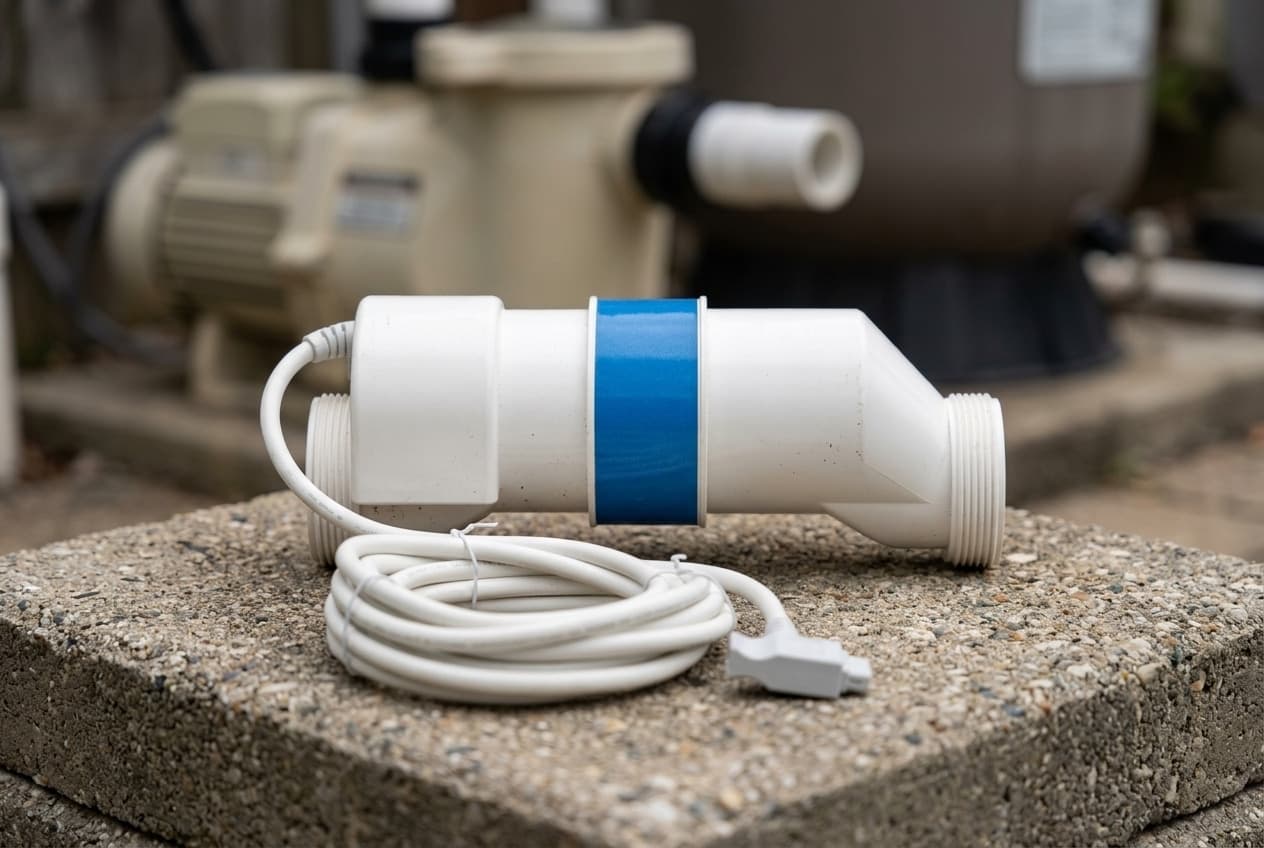
TurboCell is the cell on the end of a Hayward AquaRite, AquaRite Pro, AquaLogic or ProLogic system. The one most people mean is the original three: T-CELL-3 for 15,000 gallons, T-CELL-9 for 25,000, and T-CELL-15 for 40,000.
Those are still sold, but they are no longer the whole range, and a quote written today may well name something else. Hayward's current sell sheet also lists TurboCell Extended Life (TCELL925 and TCELL940) and TurboCell S3 (TCELLS315, TCELLS325 and TCELLS340), the S3 being the one with the clear body you can inspect without taking it out of the plumbing. The AquaRite S3 runs only on those S3 cells. The table below has all of them.
The cell does not know which one it is. The controller has to be told, and that is the single most important thing on this page.
Set the cell type, or the system will misread the salt
When you fit a TurboCell, the controller needs a cell-type setting that matches it:
- t-3 — T-CELL-3 or GLX-CELL-3-W, and all AQR3 systems
- t-9 — T-CELL-9 or GLX-CELL-9-W, and all AQR9 systems
- t-15 — T-CELL-15 or GLX-CELL-15-W, and AQR15, AQR15-LL and AQR15-120
- t-5 — GLX-CELL-5 or GLX-CELL-5-W
Hayward's own words for getting this wrong: "Incorrect configuration will cause inaccurate salt readings, improper operation, and possible system shut-down."
On an AquaRite the sequence is: slide the main switch to Auto, press Diagnostic until `t-xx` shows, then slide the switch from Auto to Super Chlorinate and back to change it, and press Diagnostic to exit. `t-15` is the factory default, which is why a T-CELL-15 going into a new AquaRite usually needs nothing — and why a T-CELL-3 going into that same box needs changing and often does not get it.
One exception worth knowing: configuration is not required on AquaRite units from 2008 and earlier with firmware before 1.5, or on the AquaRite XL. Everything newer needs it.
The AquaTrol, Hayward's above-ground system, is another: the GLX-CELL-5 sheet says it needs no setting for that cell.
Hayward wants 3,200 ppm of salt. Pentair wants 3,600
Both numbers are correct, and they are for different equipment.
Hayward's AquaRite manual is unambiguous: "The ideal salt level is between 2700-3400 ppm with 3200 ppm being optimal." Below 2,700 the CHECK SALT light flashes and, by the manual, the unit generates at reduced efficiency; Hayward's troubleshooting guide says instead that the flashing range, 2,400 to 2,700, does not affect production. When it goes steady, the system has shut down. Too high and the HIGH SALT light shuts it down as well.
Pentair's IntelliChlor asks for 3,600 ppm in the English section of its manual — 400 ppm above Hayward's optimum and above the top of Hayward's whole range.
So there is no single right salt level for a salt pool. There is a right salt level for your cell, and using the other brand's number will either underfeed a Pentair or push a Hayward toward its high-salt shutdown. The salt calculator takes whichever target you enter.
Two practical notes from the manual. The salt display can take 24 hours to respond after an addition, so testing sooner is how people overshoot. And the only way to lower salt is to partially drain and refill — nothing removes it.
If you run a variable-speed pump, read this
Hayward publishes the fix for a problem most owners never diagnose, and it is buried in a configuration leaflet rather than the manual.
On low speed, a variable or two-speed pump may not push enough water through the cell. The cell ends up partly full of air rather than flooded, and a cell that is not fully wetted produces less chlorine regardless of what the output dial says.
Hayward's remedy is physical: install the cell vertically, or inverted, so it stays flooded at low flow. Its leaflet calls these "the desired installation configurations when using 2 speed or variable speed pumps."
This is the same collision that shows up on the MasterTemp heater, where the pump speed that saves money is below the speed the equipment needs. On a heater it fails loudly. On a salt cell it fails quietly, as chlorine that never quite holds.
Match the output setting to your pump hours
The cell only generates while water is moving through it, so the output percentage and the pump schedule are one setting, not two. Hayward spells out the arithmetic:
Double the run time, halve the output setting. Triple it, cut the setting to a third. Go the other way — 12 hours down to 8 — and multiply the setting by 1.5.
Then watch it. Hayward asks for 1 to 3 ppm of free chlorine and says to monitor closely for one to two weeks after any change before adjusting again.
The reason this matters beyond chlorine levels: running at 100% is what wears a cell out. More hours at a lower percentage produces the same chlorine and costs less cell life, which is the same argument as fitting a cell rated above your pool.
Inspect every three months, and acid wash properly
The AquaRite flashes INSPECT CELL after roughly 500 hours of operation. Hayward asks for an inspection every three months, or whenever you clean the filter. After inspecting, hold Diagnostic for three seconds to clear the light and restart the 500-hour timer.
Most inspections need nothing more than flushing with a hose and scraping deposits off the plates. Acid washing is for severe cases only, and the method has one detail that ruins cells when it is missed:
Mix 4 parts water to 1 part muriatic acid — a gallon of water to a quart of acid, acid into water and never the reverse. Gloves and eye protection. Then the important part: the solution should just reach the top of the cell so that the wire harness compartment is not submerged. Coil the wiring up out of the way. Soak a few minutes, rinse with a hose, repeat if deposits remain.
That is what the cleaning stand is for, and why it is worth having rather than balancing the cell in a bucket.
Scale coming back quickly is telling you something separate: calcium is high, usually because the water is old. Fix the chemistry and the cleaning interval takes care of itself.
The rest of the numbers
Cold water stops it. Below 50°F the AquaRite stops generating and the GENERATING light flashes. That is protection, not a fault — but it means a salt pool needs liquid chlorine in the shoulder season, the same as any other.
Stabilizer at 30 ppm, in a 30 to 50 ppm range — and check which manual you are reading, because Hayward changed this. The current AquaRite manual, 092540 Rev G, gives US: 30 to 50 ppm outdoor, 0 indoor in its chemistry table and tells you to use the chart to reach 30 ppm. The older Rev D said 40. Copies of Rev D are still in circulation and still quoted, this page included until it was checked.
That lands Hayward on the same range as Pentair's IntelliChlor, which also asks for 30 to 50 — so on stabilizer, unlike salt, the two brands now agree. This site's general salt guidance argues for 60 to 80 on cell-life grounds, which is the one position here that is not a manufacturer's. The manufacturer's number is the one in writing if a warranty conversation ever happens.
Check the prefix. A W3T-CELL-15 and a T-CELL-15 are the same cell sold down different channels — W3 is Hayward's Open Line for online sale, the bare number is Expert Line through dealers. On this product the channel turns out not to change the term: both come to three years, parts only. One row of Hayward's Expert Line sheet says otherwise for "W" cells, and the warranty note above sets out why three other Hayward documents outrank it. The Hayward brand page has the full explanation of the two channels.
Which model do you have?
The model number is on the salt cell label. Everything else in the range is shared — these are the parts that change with it.
| Model | SKU | Rated pool size | Controller setting | Also sold as | Note |
|---|---|---|---|---|---|
| T-CELL-3 | W3T-CELL-3 | 15,000 gal | t-3 on the controller | GLX-CELL-3-W | Rated to 15,000 gallons. Pairs with an AQR3 system. Set the controller to t-3. |
| T-CELL-9 | W3T-CELL-9 | 25,000 gal | t-9 on the controller | GLX-CELL-9-W | Rated to 25,000 gallons. Pairs with an AQR9. Set the controller to t-9. |
| T-CELL-15 | W3T-CELL-15 | 40,000 gal | t-15 on the controller | GLX-CELL-15-W | Rated to 40,000 gallons, and the one most often fitted. Pairs with AQR15, AQR15-LL and AQR15-120, and t-15 is the factory default on an AquaRite. |
Hayward TurboCell parts, and what goes wrong
Read off the manufacturer’s parts list and checked before it ships. Open a row for what a bad one actually does — or start from the symptom and work down, which is the cheaper order.
What is it doing?
The consumable. Before replacing it, clean it and check the flow switch — and after replacing it, check the controller is set to t-15, because a new cell on the wrong setting reads salt wrong and can shut the system down.
Live pricing arrives when the retailer programs are approved.
The switch that proves water is moving before the cell is allowed to generate. It is the most common thing that stops a healthy Hayward cell working, and it is a fraction of a cell. GLX-FLO-RP-25 is the same switch on a 25-foot cable; neither includes the tee.
Live pricing arrives when the retailer programs are approved.
The 2 x 2 x ½ inch tee the flow switch screws into. Sold separately from the switch, which catches people out when the old tee is cracked or the threads are gone.
Live pricing arrives when the retailer programs are approved.
Two-inch slip with a buttress thread. The cell comes out of the plumbing every time it is inspected, which on Hayward's own schedule is every three months, so these get handled far more than a normal union.
Live pricing arrives when the retailer programs are approved.
A dummy pipe that fills the cell's place in the plumbing. Useful on a new pool while plaster dust settles, and useful every time the cell is out for an acid wash — it means the pool can circulate while the cell soaks rather than the whole system standing still.
Live pricing arrives when the retailer programs are approved.
Holds the cell upright while it soaks. That matters more than it sounds: Hayward's instruction is that the acid solution must reach the top of the cell but leave the wire harness compartment dry, and standing it in a bucket by hand is how that goes wrong.
Live pricing arrives when the retailer programs are approved.
A failing control unit presents very like a failing cell, and it is a separate bill. The display board is GLX-PCB-DSP and the whole control unit is GLX-CTL-RITE if the housing is going too.
Live pricing arrives when the retailer programs are approved.
Shared across AquaLogic, AquaRite and AquaTrol. Worth checking before condemning a board, because the symptom is the same and the part is cheaper.
Live pricing arrives when the retailer programs are approved.
If you are doing the job anyway
These get replaced together. Doing them in one pass costs a few dollars more and saves taking the same thing apart twice.
Before you buy a cell
The two things that stop a healthy cell working, and they cost a fraction of one. The flow switch is the usual answer; the stand is here because the other usual answer is scale, and the cleaning has to be done without drowning the wire harness.
- Flow switch, 15 ft cableGLX-FLO-RP
- Cleaning standGLX-CELLSTAND
Cell replacement, 40,000 gal
The unions have been handled every three months since the cell was installed, and the o-ring surfaces are what weep afterward. Fit the cell and the unions together, then set the controller to t-15 before walking away.
- TurboCell, 40,000 gallonsT-CELL-15
- Union nut and tail, 2 in.GLX-CELL-UNION
Cleaning without shutting the pool down
The placeholder pipe goes in while the cell soaks, so the pool keeps circulating instead of standing still for an afternoon. The stand keeps the acid off the wiring.
- Straight pipe placeholderGLX-CELL-PIPE
- Cleaning standGLX-CELLSTAND
Hayward TurboCell manuals and documentation
Hosted by the manufacturer. These open on Hayward’s own servers, so they stay current.
- AquaRite owner's manual (092540 Rev G) — current, and the source of the parts listmanual
- Replacement parts and accessories, in the AquaRite owner's manualdiagram
- TurboCell sell sheet (eLITCELL23C) — the current cell line-upspec
- AquaRite owner's manual (092538 Rev D) — the superseded revisionmanual
- T-CELL-15 and GLX-CELL-15-W configuration note (092409A Rev D)guide
Hayward TurboCell warranty
3 years parts
Three years, parts only — no field labor on a salt cell in either channel. Hayward's paperwork does contradict itself once, and it is worth knowing which document wins. A W3T-CELL is an Open Line SKU: Hayward's own product listing titles it "TurboCell Salt Cell, 40,000 gallons (Open Line)", and the 2026 Open Line sheet says in its own definitions that Open Line covers W3 SKUs. That sheet gives one year parts, with a footnote raising salt chlorination cells to three years parts only. The Expert Line sheet's Open Line section carries the same footnote, and Hayward's TurboCell sell sheet prints three years against every cell it lists. One row disagrees: the Expert Line sheet's automation and sanitization table reads "'W' Salt Cells — one year parts only". That row sits in the table for the Expert channel, which by Hayward's own definition is not where W3 SKUs are sold, and three other Hayward statements outrank it. Three years is the answer, and the row to quote if anyone offers you one. Two conditions apply regardless: the warranty covers only products bought from Hayward or an authorized seller, and coverage cannot start before the delivery date. Note that the system is not the cell — the AquaRite manual warrants a W3AQR3, W3AQR9 or W3AQR15 box for one year, against three for the older XLCUL versions.
Manufacturer’s termsHayward TurboCell complete parts list
Every part on the manufacturer’s exploded diagram, in their numbering. Marked rows are the ones covered above with a symptom and a diagnosis.
34 parts
| No. | Part | Description | Note |
|---|---|---|---|
| Cell | T-CELL-3 | TurboCell, 15,000 gallons — controller setting t-3 | Sold online as W3T-CELL-3 |
| Cell | T-CELL-9 | TurboCell, 25,000 gallons — controller setting t-9 | Sold online as W3T-CELL-9 |
| Cell | T-CELL-15 | TurboCell, 40,000 gallons — controller setting t-15 what goes wrong | Sold online as W3T-CELL-15 |
| Cell | GLX-CELL-3-W | TurboCell, 15,000 gallons, alternate number | Takes the same t-3 setting |
| Cell | GLX-CELL-9-W | TurboCell, 25,000 gallons, alternate number | Takes the same t-9 setting |
| Cell | GLX-CELL-15-W | TurboCell, 40,000 gallons, alternate number | Takes the same t-15 setting |
| Cell | GLX-CELL-5 | TurboCell, 18,000 gallons — controller setting t-5 | AquaTrol, above ground |
| Cell | GLX-CELL-5-W | TurboCell, 18,000 gallons, alternate number | AquaTrol, above ground |
| Cell | TCELL925 | TurboCell Extended Life, 25,000 gallons | Current line-up, 15 ft cord |
| Cell | TCELL940 | TurboCell Extended Life, 40,000 gallons | Current line-up, 15 ft cord |
| Cell | TCELL94025 | TurboCell Extended Life, 40,000 gallons | Current line-up, 25 ft cord |
| Cell | TCELLS315 | TurboCell S3, 15,000 gallons | Current line-up, clear body |
| Cell | TCELLS325 | TurboCell S3, 25,000 gallons | Current line-up, clear body |
| Cell | TCELLS340 | TurboCell S3, 40,000 gallons | Current line-up, clear body |
| Cell | TCELLS340X25 | TurboCell S3, 40,000 gallons | Current line-up, clear body, 25 ft cord |
| Cell | TCELLS318 | TurboCell S3, 18,000 gallons | AquaTrol, above ground |
| Cell | CCELL | Salt cell for the AquaRite 100, 30,000 gallons | AquaRite 100 and Salt & Swim 3C |
| System | GLX-CTL-RITE | Control unit, AquaRite | |
| System | GLX-PCB-RITE | Main PCB, AquaRite what goes wrong | |
| System | GLX-PCB-DSP | Display PCB, AquaRite | |
| System | GLX-FLO-RPPAK10 | Replacement flow switch, 10 pack | |
| System | GLX-FLO-RP | Replacement flow switch, 15 ft cable what goes wrong | |
| System | GLX-FLO-RP-25 | Replacement flow switch, 25 ft cable | |
| System | GLX-FLO-T | Flow switch tee fitting what goes wrong | |
| System | GLX-XFMR | Transformer what goes wrong | |
| System | GLX-R-10PK | Rectifier, 10 pack | |
| System | GLX-F20-10PK | Fuse, 20 A glass, 10 pack | |
| System | GLX-F20A-10PK | Fuse, 20 A yellow, 10 pack | |
| System | GLX-FUSE-20 | Fuse holder kit | |
| System | GLX-CELLSTAND | Salt cell cleaning stand what goes wrong | |
| System | GLX-CELL-UNION | Salt cell union — tailpiece, nut and o-ring what goes wrong | |
| System | GLX-CELL-PIPE | Salt cell placeholder what goes wrong | |
| System | GLX-SALTMETER | Handheld digital salt meter | |
| System | GLX-STDOFFPAK20 | Display standoff, 20 pack |
Buy the salt cell
One retailer for now. More get added here as their programs are approved, and this becomes a comparison rather than a link.