Hayward · AquaTrol
Hayward AquaTrol
Hayward's salt system for above-ground pools to 18,000 gallons, with the pump timer built in: its four models, its lights, and the cells that fit.
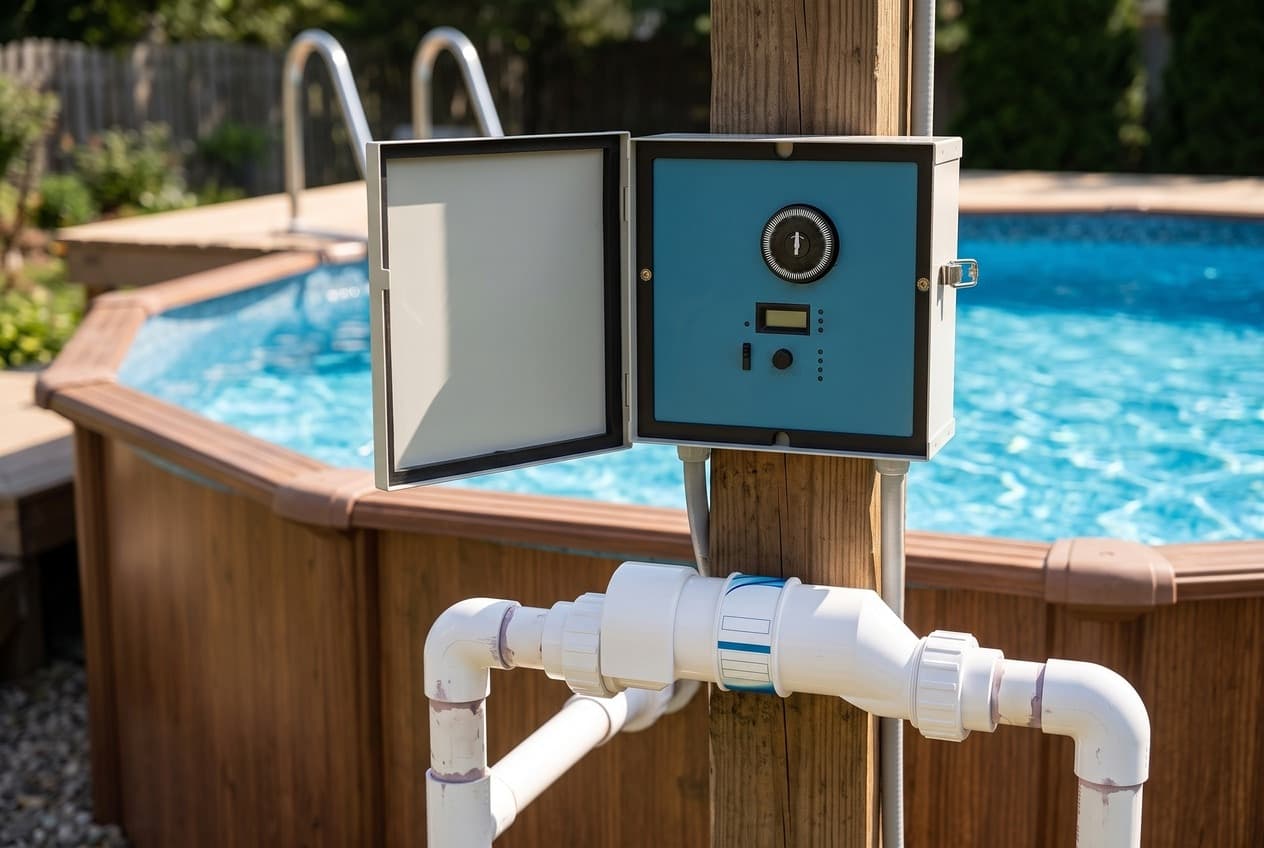
The AquaTrol is Hayward's salt chlorine generator for above-ground pools, rated for up to 18,000 gallons. What sets it apart from an in-ground system is the timer. The filter pump plugs into the AquaTrol, and the AquaTrol plugs into the outlet the pump used to. Its own 24-hour timer then runs the pump, and the cell makes chlorine whenever the pump is running.
That suits the usual above-ground pad, one outlet and one pump. It also means the pump's hours and the chlorine output are the same setting.
Four models, two choices
Every AquaTrol is the same control box. The model number says how the cell connects and what the plug is.
- RJ mounts the cell on the pool's return jet with a right-angle adapter. The cell hangs straight down below the jet, so the gas it makes rises into the pool, and there's no flow switch.
- HP puts the cell and a flow switch in the return line, after the filter and anything else. The fittings take 1½ to 1¼ inch hose or 2 inch PVC.
- No suffix means a standard 120 volt, 15 amp plug and receptacle.
- TL means a 120 volt, 20 amp twist lock, which needs a twist-lock receptacle on a GFCI breaker.
A W3 in front, as in W3AQ-TROL-RJ, is the same unit sold as Hayward's Open Line, online and in stores. Its manual is the same apart from the model numbers. The warranty is shorter.
To tell which one you have, press the Diagnostic button six times. The display shows AL-6 on the standard AquaTrol and AL-7 on the return-jet one.
The pump outlet is the timer
The pump outlet on the bottom of the box is rated 120 volts, 15 amps. Hayward says to check the rating on the pump motor, because a pump that draws more can permanently damage the AquaTrol.
The timer is a mechanical dial:
- Set the time by turning the dial clockwise until the arrow at about 2 o'clock points to it. Check AM against PM on the 24-hour mark.
- Set the run time with the small trippers around the edge. Each one is 15 minutes. Pull a tripper out for on, push it in for off.
- The switch at about 4 o'clock overrides it: up for on, center for the timer, down for off.
Because the cell only works while the pump runs, a short schedule is one of the causes the manual lists for low chlorine. It gives 8 hours for an average pool, more for a large one. How long to run a pool pump has the turnover arithmetic.
Salt, stabilizer and water temperature
Hayward's targets for the AquaTrol:
- Salt: 2,700 to 3,400 ppm, with 3,200 ideal
- Stabilizer: 60 to 80 ppm, with 80 best
- Free chlorine: 1 to 3 ppm
- pH: 7.2 to 7.6
- Total alkalinity: 80 to 120 ppm
- Calcium hardness: 200 to 400 ppm
That stabilizer target is higher than this site's general advice for above-ground pools, 30 to 50 ppm in the maintenance guide. On an AquaTrol, go by Hayward's number.
The manual's chart gives the salt to add. Starting from none, an 18,000-gallon pool needs 480 lb to reach 3,200 ppm, and a 12,000-gallon pool needs 320. Each 200 ppm short at 18,000 gallons is another 30 lb. Use plain sodium chloride at least 99% pure, never rock salt or iodized salt. Brush it around rather than letting it sit in a pile, and run the pump for 24 hours. The display can take that long to catch up. The only way to lower salt is to drain some water and refill.
Below 50°F, the AquaTrol makes no chlorine and flashes its Generating light, so chlorinate by hand. Hayward also discourages dry acid (sodium bisulfate) for lowering pH, especially in dry climates, because its by-products can build up and damage the cell.
What the lights mean
- Power: on means the box has power
- Generating: steady is normal. Flashing means the water is too hot or cold
- Super Chlorinate: on for 24 hours of full output after you flip the switch, or until the power goes off. Then set it back to Auto
- No Flow (HP only): the flow switch sees no flow. Flashing is what the manual calls a 15/60 second time delay
- Test Salt Level: flashing means salt below 2,700 ppm and low output. Steady means it has shut down
- High Salt: salt too high, and it has shut down
- Inspect Cell: flashing is a reminder every 500 hours or so, or lower efficiency. Steady means output has stopped
For No Flow, check that the flow switch is plugged in and its wire isn't damaged. The manual wants at least 12 inches of straight pipe before it and its arrows pointing the way the water flows.
The Diagnostic button steps through more. Cell voltage runs 22 to 26 volts while it's making chlorine, and cell current 2.5 to 4.0 amps. -Pcb- on the display with all four red and yellow lights on means a possible board fault.
Looking after the cell
Hayward says to open and look at the cell every three months, or after cleaning the filter. The Inspect Cell light reminds you at about 500 hours. Hold Diagnostic for three seconds afterward to reset it.
If there's scale, flush it with a hard spray from a hose, then scrape with plastic or wood, never metal, which damages the plate coating. For bad cases the manual allows a mild acid wash: 4 parts water to 1 part muriatic acid, acid poured into water, with the cell in only up to its top so the wiring compartment stays dry. Cleaning a salt cell covers the rest.
Scale on the cell usually means the calcium is too high. Fix the water, or the cell will keep needing it.
Which cells fit, and the 18,000 or 20,000 question
Hayward's AquaTrol pages list three cells: the T-CELL-5 it ships with, the GLX-CELL-5 and the TCELLS318. Hayward's GLX-CELL-5 sheet says the AquaTrol needs no cell-type setting for that cell, where an AquaRite does. The TurboCell page has the whole family.
Two numbers don't match. Hayward's GLX-CELL-5 sheet rates that cell for 20,000 gallons, and its product pages say the same. The AquaTrol manual and product pages rate the system at 18,000, and the TCELLS318 is the 18,000-gallon cell. Go by 18,000: the manual's warranty excludes installing the system on a pool bigger than its rating.
Output has three figures. The AquaTrol pages give 0.75 lb of chlorine a day, the TCELLS318 page gives 0.6, and the AquaRite S3 manual gives that cell 0.73.
Installing it
The control box goes at least 5 feet from the pool, mounted upright on a flat surface. Keep all four sides clear, because the box is also its heat sink, and don't mount it in a panel or a tight enclosed space.
On HP models, the flow switch goes downstream of the cell. When using the hose adapters, move the o-rings from the pipe tailpieces to the hose ones, and tighten every union nut by hand. There's a bonding lug on the bottom of the box, to connect with 8 AWG copper where the code requires it.
Hayward says to balance the water before turning it on. If the water isn't new, it says to add a quart of metal remover and a quart of non-copper algaecide first. It also recommends consulting a stone specialist before using any salt system beside a natural stone patio.
Winter
The cell and the flow switch freeze like any plumbing. In a hard winter, drain the pump, filter and lines. The control box can stay where it is; Hayward says it withstands winter weather and shouldn't be removed. In spring, balance the water before switching it back on.
The warranty depends on where you bought it
Bought through a pool professional, Hayward's Expert Line terms give the AquaTrol two years of parts, three with extended coverage, and never labor. That's Hayward's standard for above-ground equipment. The W3 Open Line models get one year of parts.
The product pages disagree with themselves. A banner advertises three-plus years of parts and labor through a Hayward Rewards partner, while the same pages' specifications say labor: none. The 2026 terms side with the specifications for above-ground equipment.
The warranty printed in the manual is older, from 2012, and gives one year. It also voids the warranty if the system runs with a salt cell that isn't genuine Hayward.
Which model do you have?
The model number is on the salt cell label. Everything else in the range is shared — these are the parts that change with it.
| Model | SKU | Cell mount | Plug | Note |
|---|---|---|---|---|
| Return jet, straight-blade plug | AQ-TROL-RJ | On the return jet | 120 V, 15 A straight blade | The cell mounts on the pool's return jet with a right-angle adapter, so there's no flow switch. W3AQ-TROL-RJ is the same unit sold as Open Line, online and in stores. |
| Return jet, twist-lock plug | AQ-TROL-RJ-TL | On the return jet | 120 V, 20 A twist lock | Needs a twist-lock receptacle wired to a GFCI breaker. The Open Line version is W3AQ-TROL-RJ-TL. |
| Hose or pipe, straight-blade plug | AQ-TROL-HP | In the return hose or pipe | 120 V, 15 A straight blade | The cell and a flow switch go in the return line, with fittings for 1½ to 1¼ in. hose or 2 in. PVC. Hayward says 1½ in. pipe needs standard adapters it doesn't supply. The Open Line version is W3AQ-TROL-HP. |
| Hose or pipe, twist-lock plug | AQ-TROL-HP-TL | In the return hose or pipe | 120 V, 20 A twist lock | The Open Line version is W3AQ-TROL-HP-TL. |
Hayward AquaTrol parts, and what goes wrong
Read off the manufacturer’s parts list and checked before it ships. Open a row for what a bad one actually does — or start from the symptom and work down, which is the cheaper order.
What is it doing?
Hayward's manual says that if the Inspect Cell light stays on after a thorough cleaning, with the salt where it should be, the cell may be worn out. The AquaTrol's product pages list three cells that fit: the T-CELL-5 it ships with, the GLX-CELL-5 and this one. The TurboCell S3 insert cross-references it to T-CELL-5 for 18,000 gallons. Hayward's warranty is void on a system run with a cell that isn't genuine Hayward.
Live pricing arrives when the retailer programs are approved.
Check the settings before the timer. The manual's list: the manual switch at about 4 o'clock should be in the center for the timer or up for on. The time should be right, which means checking AM against PM on the 24-hour mark near 2 o'clock. And the trippers for the run time should be pulled out. Each tripper is 15 minutes.
Live pricing arrives when the retailer programs are approved.
The manual says to confirm 120 volts is reaching the AquaTrol with a voltmeter first. If it is, the fuse may have blown. It's a 20 A mini ATO fuse on the circuit board, above the cell connector. Hayward lists two 20 A packs, this one labeled for units after 1104 and GLX-F20-10PK, a glass slow-blow type, so check which your board takes.
Live pricing arrives when the retailer programs are approved.
That combination is the manual's sign of a possible circuit board fault. The HP board is GLX-PCB-TROL-HP and the RJ board is GLX-PCB-TROL-RJ. Hayward's related parts also list the whole control unit, in straight-blade versions only: GLX-CTL-TR-HP and GLX-CTL-TR-RJ.
Live pricing arrives when the retailer programs are approved.
The right-angle adapter that screws into the return jet in place of the hose adapter. The manual says this mount needs no flow switch, but the cell must hang vertically, directly below the jet, so the gas it makes can escape into the pool. Tighten the union nuts by hand.
Live pricing arrives when the retailer programs are approved.
Hayward AquaTrol manuals and documentation
Hosted by the manufacturer. These open on Hayward’s own servers, so they stay current.
- AquaTrol owner's manual, AQ-TROL models (092016K Rev O)manual
- AquaTrol owner's manual, W3AQ-TROL Open Line models (092745 Rev B)manual
- AquaTrol product page, AQ-TROL-RJ, with its service partsspec
- GLX-CELL-5 and GLX-CELL-5-W cell sheet (092410A Rev C)spec
- TurboCell S3 insert, with the TCELLS318 cross-reference (092666 Rev B)spec
- TCELLS318 product pagespec
- AquaRite S3 manual, with output by cell (1011728 Rev B)spec
- Hayward 2026 Expert Line residential warranty termsspec
- Hayward 2026 Open Line residential warranty termsspec
Hayward AquaTrol warranty
2 years parts, None labor
Hayward's product pages give the AquaTrol two years of parts and no labor, and its 2026 Expert Line terms set the same for above-ground equipment: two years of parts, three on extended coverage, and no field labor either way. A banner on the same product pages advertises three-plus years of parts and labor through a Hayward Rewards partner, which the terms don't give above-ground equipment. The W3 Open Line models get one year of parts. A salt cell bought on its own gets three years of parts, and a 'W' cell one. The warranty printed in the owner's manual is older, effective March 2012, and gives the AquaTrol one year. Two exclusions in it matter here: installing the system on a pool larger than its rating, and using a salt cell that isn't genuine Hayward, which voids the warranty on the system.
Manufacturer’s termsHayward AquaTrol complete parts list
Every part number the manufacturer lists for this equipment, from its own documents. Marked rows are the ones covered above with a symptom and a diagnosis.
| Part | Description | Note |
|---|---|---|
| T-CELL-5 | TurboCell salt cell, the one in the box | |
| GLX-CELL-5 | TurboCell salt cell | Hayward's cell sheet rates it for 20,000 gallons |
| GLX-CELL-5-W | TurboCell salt cell, the one-year warranty version | |
| W3GLX-CELL-5 | TurboCell salt cell, Open Line | |
| TCELLS318 | TurboCell S3 salt cell, 18,000 gallons what goes wrong | |
| TCELLS318W | TurboCell S3 salt cell, 18,000 gallons, the W version | Listed in the S3 insert |
| GLX-CTL-TR-HP | Control unit, HP, straight blade | |
| GLX-CTL-TR-RJ | Control unit, RJ, straight blade | |
| GLX-PCB-TROL-HP | Main circuit board, HP what goes wrong | |
| GLX-PCB-TROL-RJ | Main circuit board, RJ | |
| GLX-TROL-TIMER | Timer, 24-hour, 120 V, 60 Hz what goes wrong | |
| GLX-XFMR | Transformer, shared with the AquaLogic and AquaRite | |
| GLX-F20A-10PK | Fuses, 20 A, yellow, 10 pack what goes wrong | Labeled for units after 1104 |
| GLX-F20-10PK | Fuses, 20 A, glass, slow blow, 10 pack | Labeled AQ RITE/1104 |
| GLX-RJ-ELBOW | Return jet fitting, RJ models what goes wrong |