A salt cell is an expensive part with a lot of cheap things in front of it, and almost every "the cell has died" call turns out to be one of the cheap things.
That is not optimism. It is what the manufacturers' own troubleshooting sections say, and the order below is roughly theirs.
Key takeaways
- The panel tells you what the cell is doing. Only a test kit tells you what is in the water.
- The flow and temperature switch is the most common single part that stops a healthy cell.
- Cold water shutdown is normal, and the cutoff differs by ten degrees across brands — 50°F Hayward, 52°F Pentair, 60°F Jandy.
- The panel's salt number is inferred from conductivity. It reads low in cold water and low as plates age, so 'add salt' is often the wrong move.
- Salt only leaves with water. A salt level that keeps falling is a leak signal, not a dosing problem.
- Turning output up to compensate for low chlorine wears the cell out faster and fixes nothing.
First, establish there is actually a problem
The control panel and the pool are two different questions.
The panel tells you what the cell is doing. It knows its duty cycle, it knows whether flow and temperature let it run, and on most units it shows an inferred salt number. What it cannot know is what is in your water, because that depends on sunlight, bather load, stabilizer and whatever fell in the pool this week.
So test free chlorine with a kit. Two different problems look identical from the deck:
- Free chlorine at zero, cell reporting normal — a production problem, and the rest of this page applies.
- Free chlorine low but present, cell reporting normal — often a demand problem instead. Low cyanuric acid letting sunlight burn chlorine off as fast as the cell makes it is the usual cause, and a pool that will not hold chlorine is its own diagnosis.
The four things to check before touching the cell
- 1
Flow
10 minutesA salt cell will not generate without water moving through it, and that is a safety interlock rather than a quirk — generating chlorine gas in a static pipe is what it exists to prevent.
So a no-flow condition and a dead cell present identically. Check, in this order:
- Is the pump actually running, and at a speed that meets the cell's minimum flow? Cells have a floor. The Jandy TruClear asks for 20 GPM and Pentair's IntelliChlor Plus LT for 25, and Hayward's troubleshooting guide says the AquaRite's flow switch needs 11 GPM to engage. A variable-speed pump turned down to save money is a common way to drop below it.
- Skimmer basket, pump basket, filter pressure. Anything restricting flow reaches the cell last.
- The flow switch itself. On Pentair systems the flow switch and the temperature sensor are a single assembly, and it is the most common thing that stops a working cell. It is a fraction of the price of a cell and worth replacing on suspicion.
On a Jandy AquaPure the equivalent part is the Tri-Sensor, one sensor reading flow, temperature and salinity together. That matters for diagnosis: a single failed sensor can present as no flow, as no salinity reading, or as a salt number that is simply wrong — three complaints that look unrelated and share one cheap cause.
- 2
Water temperature
2 minutesCells stop generating in cold water on purpose. Producing chlorine at low temperature damages the plates, so the controller shuts the cell off and lights an indicator.
The threshold is not the same across brands, and the spread is wider than most owners expect:
- Hayward AquaRite — stops below 50°F, and the GENERATING light flashes
- Pentair IntelliChlor — stops below 52°F, plus or minus 3, and lights COLD WATER
- Jandy TruClear — above 60°F is listed among the conditions under which the unit is warranted to operate properly
Ten degrees between the extremes, which in most climates is several weeks at each end of the season. A Jandy owner needs liquid chlorine for a noticeably longer stretch than a Hayward owner in the same town.
- 3
Salt — the number that lies
20 minutesThis is where money gets wasted, because the obvious response to a low salt reading is to add salt, and it is frequently wrong.
The panel does not measure salt. It measures conductivity and infers salinity from it. Two things move conductivity that have nothing to do with how much salt is in the pool:
- Cold water conducts less. The reading falls in spring and fall while the salt level has not changed.
- Aging plates conduct less. A cell in its fifth year reads low on a pool at the correct salt level, which is why "low salt" and "worn cell" are so easily confused.
Pentair rates its own display as accurate to ±500 ppm and says so in the manual, and Hayward's troubleshooting guide allows the AquaRite the same 500 ppm against a proper test. That is a guide, not a measurement.
So test before adding. Strips or a pool store, either is better than the display. And after adding, the reading takes up to 24 hours to catch up — testing sooner and dosing again is exactly how pools end up overshot.
Overshooting matters because it is a one-way trip. The only way to lower salt is to drain water and replace it with fresh. There is no chemical that removes it.
Then the target itself, which is not universal:
- Hayward AquaRite — 2,700 to 3,400 ppm, 3,200 optimal; below 2,700 the CHECK SALT light flashes. The manual says output drops there, and Hayward's troubleshooting guide says the flashing range does not affect production. Production stops somewhere around 2,300 to 2,400
- Pentair IntelliChlor — 3,600 ppm ideal in the English section of its manual; the cell's own LEDs go red below 2,800 and it shuts off entirely below 2,600
- Jandy TruClear — 3,000 ppm
A 600 ppm spread across the three biggest names. The salt calculator takes whichever target you enter, which is the point — there is no right salt level for a salt pool, only a right one for your cell.
One more thing the reading can tell you. Salt does not evaporate and the cell does not consume it. It leaves with water and nothing else: splash-out, backwashing, rain overflow, filter cleaning, partial drains. If none of those explain a level that keeps dropping, that is a leak signal — the bucket test costs nothing and settles it.
- 4
The controller's cell setting
5 minutesThe quietest of the four, and the one most likely to follow a repair.
Hayward controllers have a cell type setting that has to match the cell plumbed in. Hayward's own wording for getting it wrong: incorrect configuration will cause inaccurate salt readings, improper operation and possible system shutdown.
So a system that started misbehaving shortly after a cell replacement, or shortly after somebody was in the control box, is worth checking here before anywhere else. It costs nothing and takes a minute.
Chlorine is low but the cell says it is generating
A separate branch, and the answer is usually arithmetic rather than a fault.
Output percentage is a duty cycle, not a strength. At 50%, the cell runs flat out for half the time the pump is running and produces nothing for the other half. It is not making weaker chlorine; it is making the same chlorine for less of the day.
Which means output and pump hours multiply. A cell at 60% running eight hours produces roughly what the same cell produces at 40% running twelve. Trim the pump schedule to save electricity without touching output, and chlorine production falls by the same proportion — one of the most common ways a salt pool slips behind in midsummer without anything breaking.
Change one variable at a time. Work out whether you are short on hours or short on output before adjusting either, or you will not know which one helped.
Now pull the cell and look at it
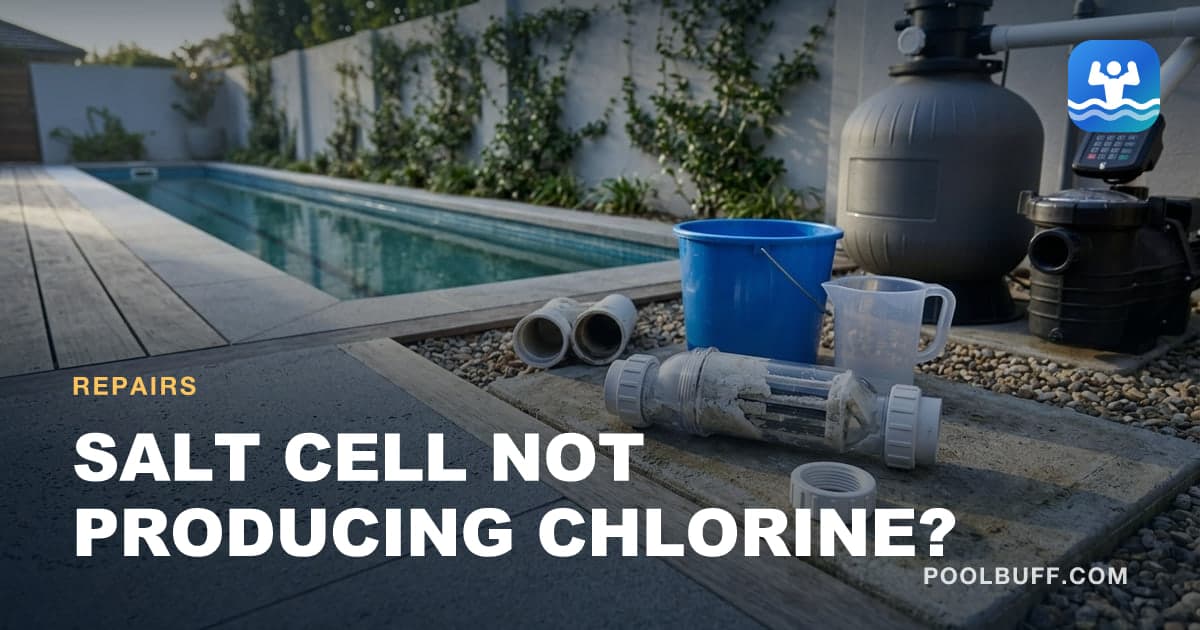
Power off at the breaker, unplug the cell, undo the unions and take it out. Shine a light through the plates in daylight.
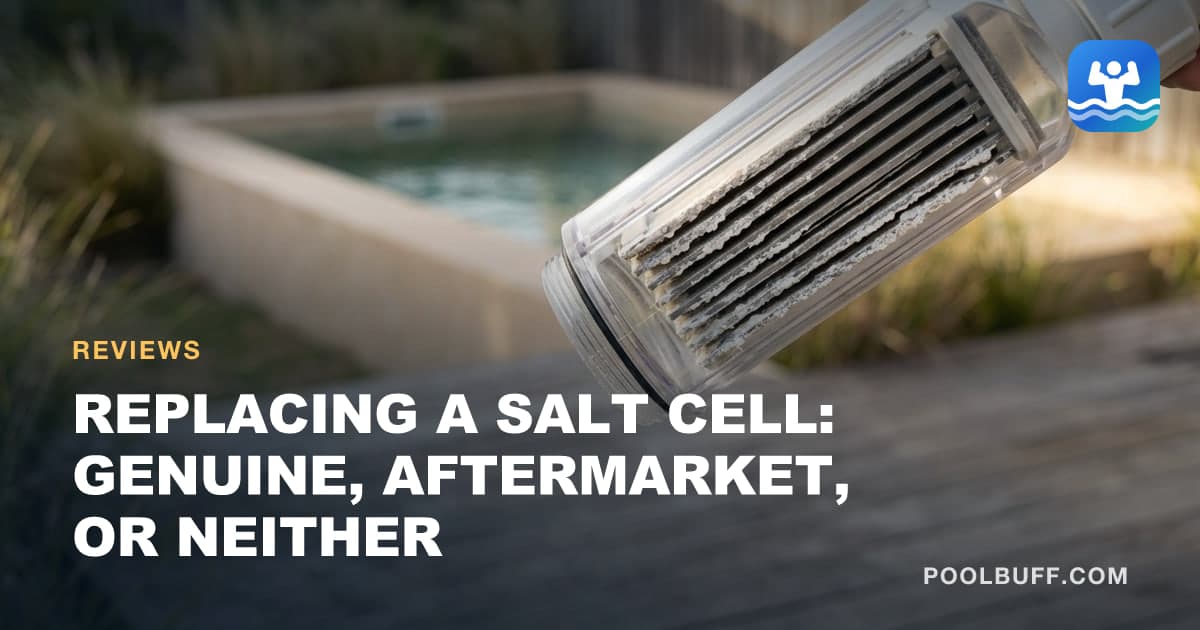
Dark gray is healthy. That is what a working plate coating looks like.
White crust is calcium scale, and it is the most common thing you will find. Scale reduces the surface area doing the work, so output falls gradually — which reads exactly like a cell wearing out. It is cleanable, and worth cleaning before concluding anything.
Clean plates that still will not produce are the real end-of-life signal, particularly on a cell past its third year.
Cleaning it without shortening its life
The procedure is simple and the discipline matters more than the technique, because a badly cleaned cell dies faster than a scaled one.
Four parts water to one part muriatic acid, in a cell cleaning stand or a bucket. Acid into water, never the reverse — pool chemical safety covers why.
Ten to fifteen minutes maximum. Then rinse thoroughly with fresh water.
Never neat acid, and never longer than it takes. You are dissolving calcium carbonate. Given the opportunity the acid will start on the plate coating too, and that coating is the cell. Aggressive cleaning is the single fastest way to kill one early.
If it is not badly scaled, a rinse with a hose may be enough. Self-cleaning cells reverse polarity to shed scale, which limits buildup rather than preventing it — on hard water they still need an acid clean by hand eventually.
And the real fix is upstream: scale on the cell starts as scale in the water. Keep pH in range and calcium hardness sensible and many cells go their whole life needing nothing but the occasional rinse. The LSI is the number that predicts it, and the pH and alkalinity calculator handles the dose — salt pools drift upward in pH on their own, because the cell aerates the water constantly.
When it really is the cell
Three to seven years is the normal life, and it depends more on water chemistry and run hours than on brand.
The honest signals that a cell is finished:
- Plates are clean and dark gray, and output is still down
- Cleaning restored it once and did nothing the second time
- The salt reading runs low on a pool that tests correct at the store
- It is past its third year and none of the four checks above found anything
Track the install date. Write it on the cell with a paint pen when it goes in. The single most useful fact in this diagnosis is how old the thing is, and nobody ever remembers.
If it is genuinely finished, the salt cell comparison covers what to replace it with — and the first thing to settle is whether you are buying the same brand, because the controller and the cell have to agree.
One cost note worth knowing before you order: on a Jandy TruClear the electrode pack and the housing are separate part numbers, so a worn cell does not mean replacing the plumbed assembly. On most brands it does. That difference is invisible on a first-purchase price comparison and shows up two or three cell replacements later.
Where to stop
Two things on this list are not yours.
A cell or controller that trips the breaker is an electrical fault on a device in contact with pool water. Stop.
Visible damage to the cell housing — a crack, a bulge, a scorched terminal — means it comes out and does not go back in. A cracked housing is usually freeze damage from a cell left plumbed over winter, and it is not repairable.
Everything else on this page is a test, a setting or a rinse.
Go deeperHow salt chlorine generators actually workWhat the cell does, what ownership is really like, and the corrosion question — the background behind everything on this page.Frequently asked questions
Why is my salt cell not producing chlorine?
In rough order of likelihood: no flow through the cell or a failed flow switch, water too cold for the cell to run, a salt level genuinely below the cell's cutoff, a controller set to the wrong cell type, scale on the plates, and finally a cell at the end of its life. The first four are not the cell and cost little or nothing to check, which is why they come first.
How do I know if my salt cell is bad or just needs cleaning?
Look at the plates. White crusty deposits are calcium scale and cleaning will restore output. Plates that look clean and dark gray but still will not produce, on a cell that is more than three years old, are worn out — the coating is spent and acid does not bring it back. Cleaning a cell twice and getting no improvement the second time is the practical signal.
Why does my salt system say low salt when I just added salt?
Three reasons, and only one of them means add more. The display takes up to 24 hours to respond after an addition, so testing too soon reads the old water. The reading is inferred from conductivity, so it drops in cold water even when salt has not changed. And an aging cell reads low because worn plates conduct less. Test the water with strips or at a pool store before adding a second time — salt is easy to add and can only be removed by draining and refilling.
What salt level should a salt pool be?
Whatever your cell asks for, and the brands genuinely disagree. Hayward's AquaRite wants 2,700 to 3,400 ppm with 3,200 optimal. Pentair's IntelliChlor manual gives 3,600 ppm as ideal in its English section. Jandy's TruClear asks for 3,000. That is a 600 ppm spread across three major brands, so running one manufacturer's number in another's cell either underfeeds it or wastes salt you cannot easily remove.
Does a salt cell stop working in cold water?
Yes, and it is meant to. Generating in cold water damages the cell, so the controller shuts it off and lights an indicator. The threshold differs by brand — Hayward stops below 50°F, Pentair below 52°F give or take 3, and Jandy lists above 60°F among its warranty conditions. In shoulder seasons a salt pool needs liquid chlorine, and Jandy's higher floor makes that stretch noticeably longer.
Should I turn the output percentage up if chlorine is low?
Usually not. The output percentage is a duty cycle, not a strength — it sets what share of the running time the cell is energized. Output and pump hours multiply, so a cell at 60% for eight hours makes about what the same cell makes at 40% for twelve. If you are pushing past 80% to keep up, the real problem is pump run time, stabilizer, a scaled cell or an undersized one, and running at high output just wears the plates faster.
Why does my salt level keep dropping?
Salt does not evaporate and the cell does not consume it. It leaves only with water — splash-out, backwashing, rain overflow, filter cleaning and partial drains. Account for those and a salt level should barely move for months. A reading that keeps falling with none of them to explain it is worth treating as a leak signal rather than a dosing problem.