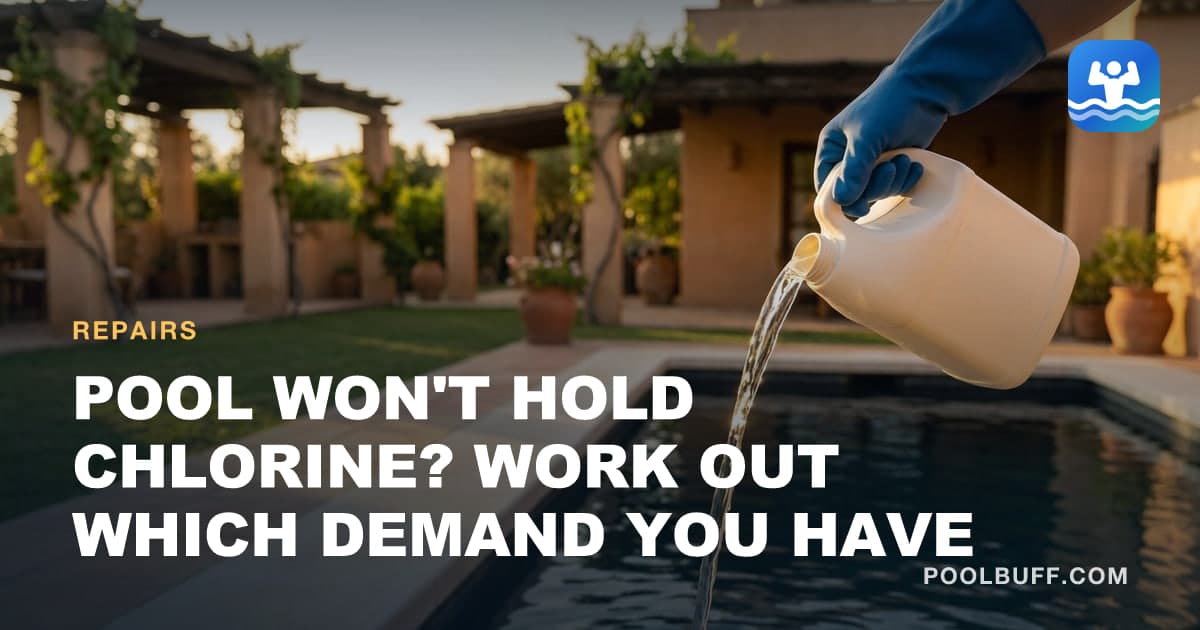
"My pool won't hold chlorine" covers three completely different problems, and treating the wrong one is why people spend two weeks adding chlorine into what feels like a hole in the ground.
The three are sunlight, organic demand, and ammonia. They need different responses, and a single test separates them.
Key takeaways
- Losing chlorine in daylight with no stabilizer is sunlight, not demand. Check CYA first.
- The overnight loss test removes sunlight from the equation and isolates real demand.
- More than 1 ppm lost overnight means something is eating it.
- Chlorine that vanishes within hours, repeatedly, is the ammonia signature.
- Ammonia takes an enormous dose to break through, and stopping early wastes all of it.
First, rule out sunlight
Unstabilized chlorine in direct sun has a half-life measured in tens of minutes. A pool with little or no cyanuric acid will lose most of its chlorine across a sunny afternoon, every afternoon, and there is nothing wrong with it beyond a missing number.
So test CYA before anything else. Below 20 ppm on an outdoor pool, you have found your answer and the fix is stabilizer rather than diagnosis.
At the other end, high CYA produces a different illusion. Chlorine is present on the test and largely locked up, so algae grows while your reading looks fine. That is not chlorine disappearing — that is chlorine not working, and it needs dilution rather than more chlorine.
Two answers that are not demand at all
Before committing a weekend to breakpoint arithmetic, rule out the cases where the chlorine was never actually gone.
The test is wrong. DPD reagent that has spent two summers in a hot shed reads low, sometimes dramatically. So does a sample skimmed off the surface in bright sun, or one left on the deck for ten minutes before testing. The quickest check is a fresh sample through a second kit, or a trip to a store the same morning. A pool that "will not hold chlorine" and turns out to be holding it perfectly well is a common and entirely happy outcome.
Metals are consuming it. Copper and iron react with chlorine, and a pool filled from a well — or one that has had a copper-based algaecide poured into it — can carry enough to produce a steady demand that looks organic. The tell is usually staining, or a faint tint to the water, and testing for metals settles it in one reading. Sequestrant holds metals in solution rather than removing them, so the demand persists until the water is diluted.
There is a gentler version of the first case worth naming too: a pool where nothing is wrong and the owner is testing at four in the afternoon. Chlorine on an outdoor pool is supposed to read lower at the end of a sunny day than it did at breakfast. That is stabilizer doing its job imperfectly, which is what stabilizer does, rather than a fault to chase.
The overnight loss test
- 1
Test at dusk
5 minutesOnce the sun is off the water. Record free chlorine precisely — this test depends on the difference between two numbers, so a drop kit rather than strips.
Bring it to a normal level for your CYA if it is low. You need something there to lose.
- 2
Leave the pump running
overnightCirculation matters, because you want the whole pool represented rather than the top foot. Do not add anything else.
- 3
Test at first light
5 minutesBefore the sun reaches the water. Same kit, same technique.
- 4
Read the difference
—- Under 1 ppm lost — normal. Your pool is fine and whatever you were chasing is elsewhere.
- 1 to 3 ppm — real organic demand. Usually early algae, often somewhere you have not looked.
- More than 3 ppm, or everything gone — a serious demand. Read on.
Organic demand
A loss of 1 to 3 ppm overnight means something is being oxidized. Almost always algae, and usually somewhere you are not looking — behind a ladder, under the steps, in a light niche, on the shaded wall.
The response is ordinary: brush everything including the places you normally skip, shock to a level appropriate for your CYA, and hold it until the overnight loss drops below 1 ppm. Holding it is the part people abandon early.
Filter cleanliness matters here too. A filter that cannot clear what you kill leaves organic material circulating, and the demand persists after the algae is dead.
Ammonia, and why it is different
The distinctive pattern is speed. You add a normal dose, test an hour later, and there is nothing there. Not reduced — gone. Repeat, same result.
That is ammonia. It forms when a pool sits with no sanitizer long enough for organic material to break down completely, which is why it shows up on pools that were closed badly, left through a winter with no chlorine, or stood empty of care while a house sold.
Two things make it different from ordinary demand:
The dose required is enormous. Chlorine reacts with ammonia before it does anything else, and the reaction has to be driven all the way through before any free chlorine can exist. Depending on how much ammonia is present, that can take many times a routine shock.
Stopping partway wastes everything. Chlorine added below the breakpoint is consumed with no lasting effect. Adding half of what is needed, twice, over two weekends, achieves less than adding all of it once.
The method is unglamorous: add a heavy dose, wait an hour, test. If it is gone, add more. Keep going until a reading finally holds. Then continue holding until overnight loss is normal.
The unglamorous alternative
Sometimes the arithmetic says otherwise.
If a pool has serious ammonia, high stabilizer, and water that has been standing for months, the chemical cost of breaking through can exceed the cost of replacing a large part of the water. That is not a defeat — it is the cheaper answer, and it resets stabilizer and hardness at the same time.
Work out roughly what the chlorine will cost before committing to the chemical route. A partial drain and refill is often faster and less frustrating, and there is no prize for treating your way out of something.
Go deeperShocking properlyThe level that works for your stabilizer, and why holding it is the part that matters.Frequently asked questions
Why does my pool lose chlorine so fast?
Three broad causes. Sunlight destroys unstabilized chlorine within hours, so a pool with little or no cyanuric acid loses it in daylight regardless of anything else. Organic load — algae, leaves, bather waste — consumes it around the clock. And ammonia, which forms in water left unchlorinated, creates a demand so large that normal doses disappear almost immediately.
What is the overnight chlorine loss test?
Test free chlorine at dusk, note it, and retest at first light before the sun is on the water. Sunlight is removed from the equation, so anything lost was consumed by something in the pool. Under 1 ppm lost is normal. More than that means a genuine demand, and the size of the loss tells you how serious.
Why does chlorine disappear immediately in my pool?
That pattern — add a normal dose, test an hour later, find nothing — is the signature of ammonia. It forms when a pool sits with no sanitizer long enough for organics to break down, which is why it turns up most often after a badly closed winter or a foreclosed pool. It is not a small problem and it does not respond to small doses.
How much chlorine does it take to clear ammonia?
Far more than a normal shock, and the exact amount depends on how much ammonia is present. The practical approach is to add a heavy dose, test after an hour, and keep adding until the level finally holds instead of vanishing. That breakpoint can take many times a routine shock. Stopping partway is the common failure, because everything spent before the breakpoint achieves nothing.
Can a high CYA level make chlorine seem to disappear?
Not disappear, but appear ineffective, which people read as the same thing. Chlorine bound to a high stabilizer level is present on the test and barely working in the water, so algae grows while your reading looks reasonable. The test tells you the chlorine is there; the pool tells you it is not doing anything.