A leaking filter is almost always one seal, and where the water comes out tells you which. The filter itself rarely needs replacing.
I fixed every leak on this page on cartridge, sand and DE filters: spider gaskets, valve lid and handle o-rings, tank o-rings and clamps, and drain plugs, gauges and air relief valves. When a multiport valve leaked, sometimes a new gasket or o-rings did it, sometimes it needed a new valve top, and sometimes the whole valve. The last section says how to tell which.
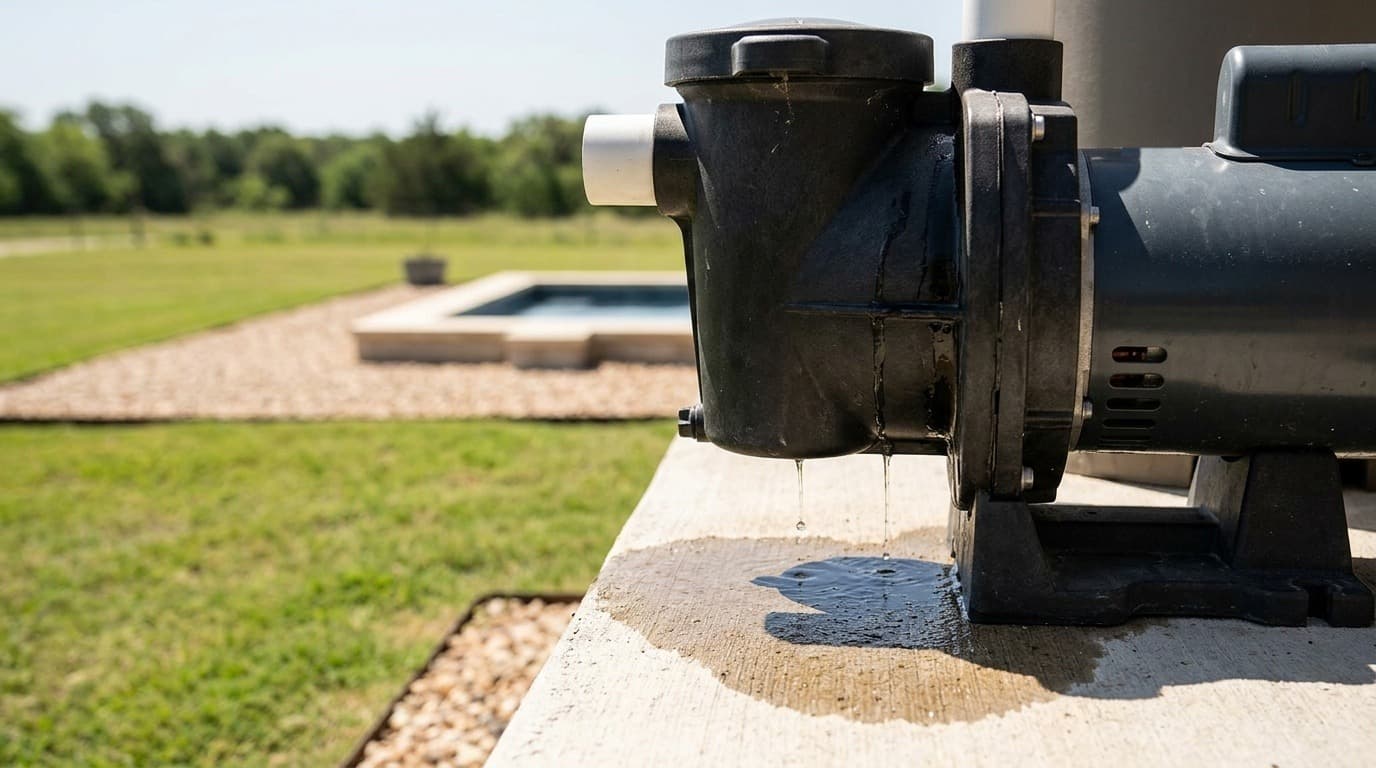
If the water is coming from the pump instead, the pump leak guide covers its five leak points.
Key takeaways
- Pump off and pressure at zero before anything else. Pentair warns trapped air can launch a filter lid with deadly force, and Hayward warns of violent separation.
- Water out of the waste line with the valve on Filter is the valve's seal: dirt under it, a worn spider gasket, or damage to the valve body where it seals.
- A leak at the tank seam is a pinched or worn tank o-ring or a clamp that isn't on right. Pentair's cast clamp takes 16 to 18 ft-lbs, Hayward's metal one 150 in-lbs.
- Silicone or PTFE lubricant on o-rings, never petroleum. Hayward's metal-reinforced tank seal takes no lubricant at all.
- Rebuild a valve when only the seals are worn. Pentair's list price for a HiFlow diverter with its gasket is $84.05, against $257.37 for the whole valve top.
Pressure first
A filter is a pressure vessel, and every leak on this page sits on a joint that's holding that pressure. So the order matters.
Pentair's Clean & Clear Plus manual gives the routine: power off at the breaker, open the air relief valve a quarter turn, and stand clear until the gauge reads 0 psi. A filter below the pool's water level can hold pressure with the pump off, which is why the valve gets opened first.
Find where the water comes from
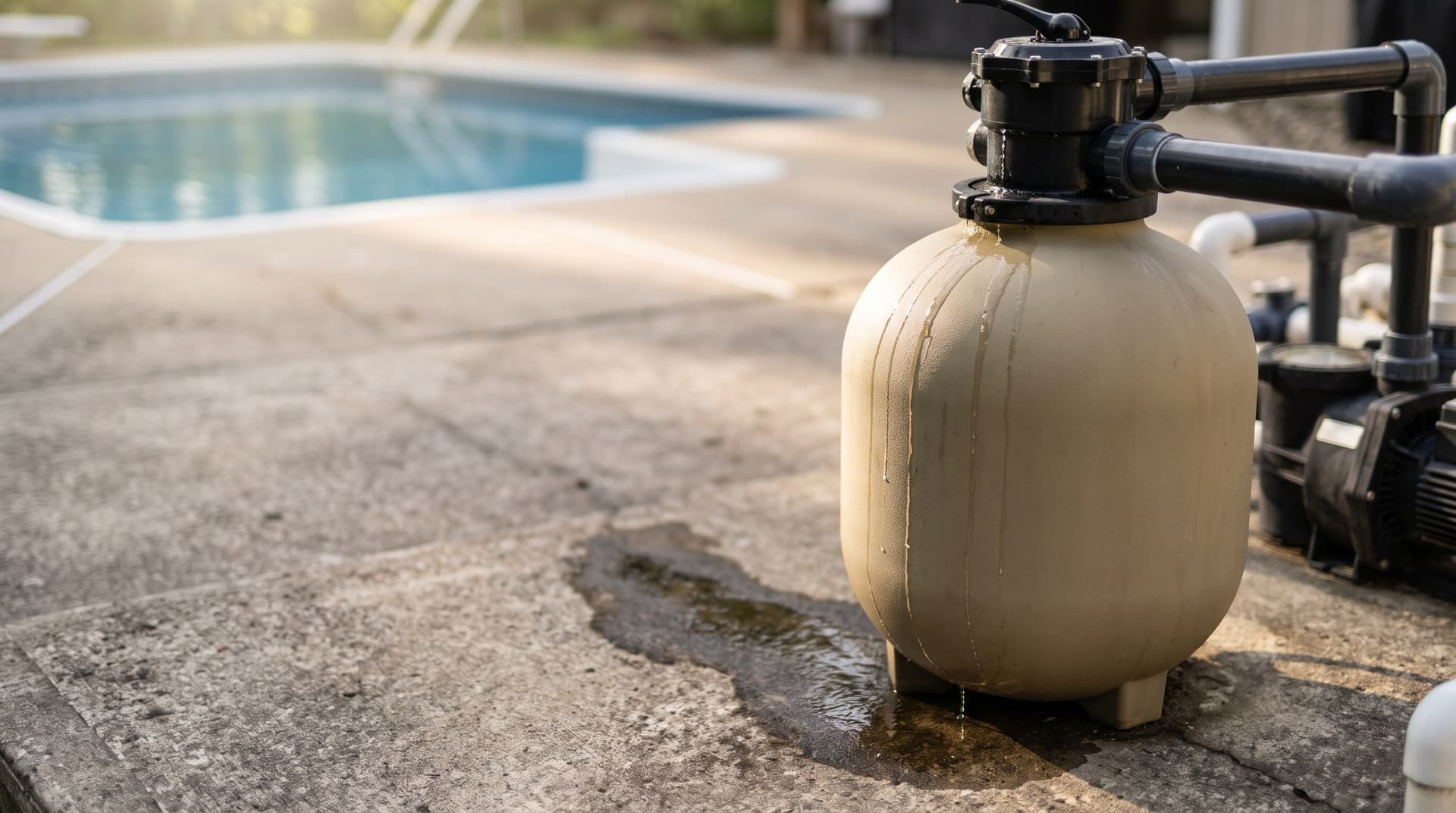
Water runs down the tank and pools at the bottom, so the puddle is rarely under the leak.
- 1
Dry it off
5 minutesWith the pump off, wipe the valve, the tank, the clamp, the fittings and the pad under the filter dry with an old towel.
- 2
Run it and watch
10 minutesBleed the air as your manual says, then start the pump and stand clear. Get down level with the filter with a flashlight. The first wet spot is your leak. Check the end of the waste line too, with the valve on Filter.
- 3
Check it with the pump off
10 minutesA filter below the pool's water level has the pool's weight on it even with the pump off. A leak that keeps going after shutdown is on a joint the pool is pushing on, and a waste line that only runs while the pump does is the valve's seal.
Rule out the neighbors while you're down there. A pump, a heater or a union next to the filter can drip onto the same patch of pad. How pool plumbing works covers the pressure side and the suction side, and why a leak on each looks different.
What each leak point means
| Where it leaks | What has failed | The fix |
|---|---|---|
| Out the waste line, valve on Filter | Dirt under the valve seal, a worn spider gasket, or a damaged seat in the valve body | Clean the seal, then a new gasket, valve top or body |
| Around the valve handle | Diverter shaft o-ring | A new valve top, per Pentair |
| Between the valve top and its body | Valve top o-ring | Inspect it and the sealing surface |
| Where the valve meets the tank | Valve-to-tank o-ring, or the clamp | Inspect the o-ring and its seat, then the clamp |
| The tank seam (cartridge, DE) | Tank o-ring pinched or worn, or the clamp not on right | Reassemble with the o-ring seated, clamp to spec |
| Drain plug or cap | Its o-ring or gasket | Replace it |
| Gauge or air relief valve | Thread tape, or the relief valve’s o-ring | Re-tape the gauge, new o-ring |
| A port or bulkhead | Thread sealant, a bulkhead seal, or a cracked port | Reseal, or a new valve body |
| A crack in the tank or valve body | The part itself, often from a freeze | Replace the part |
Water out the waste line: the spider gasket
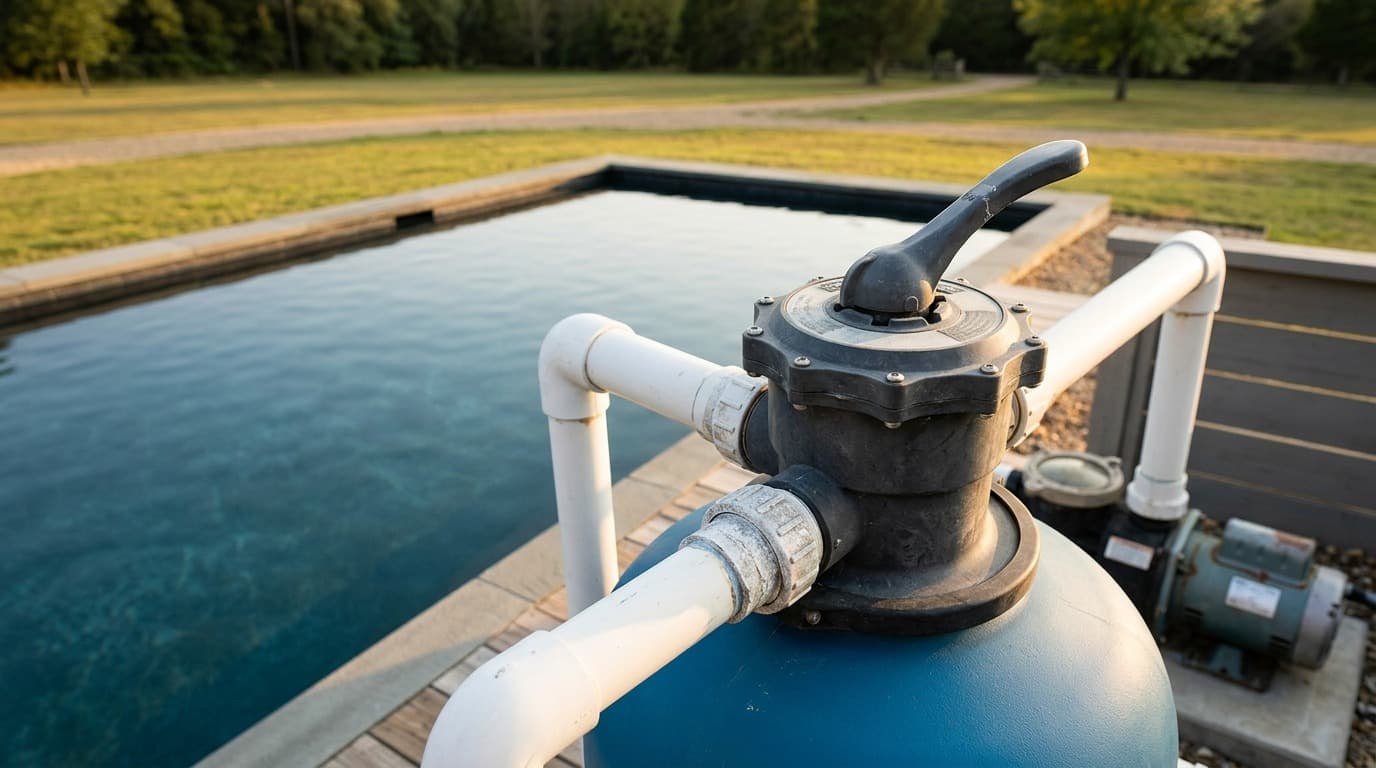
This one doesn't drip on the pad, so it hides. With the valve on Filter, water dribbles or runs out of the waste or backwash line, the returns get weaker, and the pool loses water only while the pump runs.
Inside a multiport valve, a rubber seal on the rotor, the spider gasket, presses against the ports in the valve body. When it can't seal, some of the water heading for the filter slips straight to waste. Pentair's troubleshooting table for its HiFlow valve gives three causes, cheapest first:
- Dirt or sand under the seal. Take the valve top off and clean the seal area.
- A damaged seal. Pentair's fix is a new valve top assembly.
- Damage to the valve body where the seal sits. That means a new valve body. Pentair adds that scratches or nicks on the body's sealing surface mean the same.
Hayward's answer is a worn or loose gasket, and its repair glues a new one in. Pump off, take out the cover screws, and mark the top and bottom of the valve first, because the cover goes back the way it came off. Clean the old gasket and glue out of the channels, lay a bead of Hayward's adhesive in the channel, press the new gasket in flat side first, and leave it 24 hours.
Pentair sells spider gaskets for its American clamp-on top mount valves at $41.61 list for the 1½ inch and $50.44 for the 2 inch. On its HiFlow valve the seal comes on the diverter, at $84.05 list.
What tears them. Hayward and Pentair both say never to move the handle with the pump running. Hayward's ProSeries manual adds that you press the handle down before you turn it, to protect the valve seal. And Pentair's Sand Dollar manual says to leave the valve on Winterize over the off-season, so the diverter seal has no pressure on it, or the seal can be damaged and leak. How pool valves work explains what the pressure does to a gasket that's dragged across the ports.
A push-pull valve has no spider gasket, but its plunger o-rings do the same job, and when they wear the waste line runs while you filter.
At the top of the valve: the handle and lid o-rings
Water seeping around the handle is the diverter shaft o-ring. Pentair's troubleshooting table says a leak at the handle means a new valve top assembly, though the shaft o-ring is a $2.48 part on its own.
Water between the valve top and the valve body is the valve top o-ring. Pentair's fix is to inspect the o-ring and the sealing surface it presses on, and replace whichever is damaged.
Lubricate valve o-rings with the right stuff. Pentair's HiFlow manual says silicone only, and warns that other lubricants or sealants can make the valve separate from the filter. Hayward recommends Jack's 327 on its valve o-ring. A silicone lubricant covers both. Never petroleum: Pentair says it damages the parts.
Where the valve meets the tank
On a top mount sand filter, the valve sits in the tank's neck on an o-ring and is held there by a clamp. A leak at that joint is the valve-to-tank o-ring or the clamp. Pentair says to remove the valve, inspect the o-ring and its sealing surface, and replace what's damaged. Its part, the valve body o-ring 272541, lists at $12.79. Hayward's ProSeries uses GMX600F.
The clamps differ, so follow your manual:
- Hayward ProSeries: tighten the flange clamp with a screwdriver, tapping around the clamp with the screwdriver's handle as you go.
- Pentair HiFlow: a screwdriver and a rubber mallet, tapping around the clamp and tightening until the ends touch, and no further, or the screws and clamp can be damaged.
- Pentair Sand Dollar: tighten the clamp screws firmly. No torque is given.
A side mount valve connects through bulkheads in the side of the tank instead, each with its own seal. Pentair's side mount valve manual says to tighten the bulkhead nuts by hand only, and Hayward says not to overtighten its locknuts.
The tank seam: the o-ring and the clamp
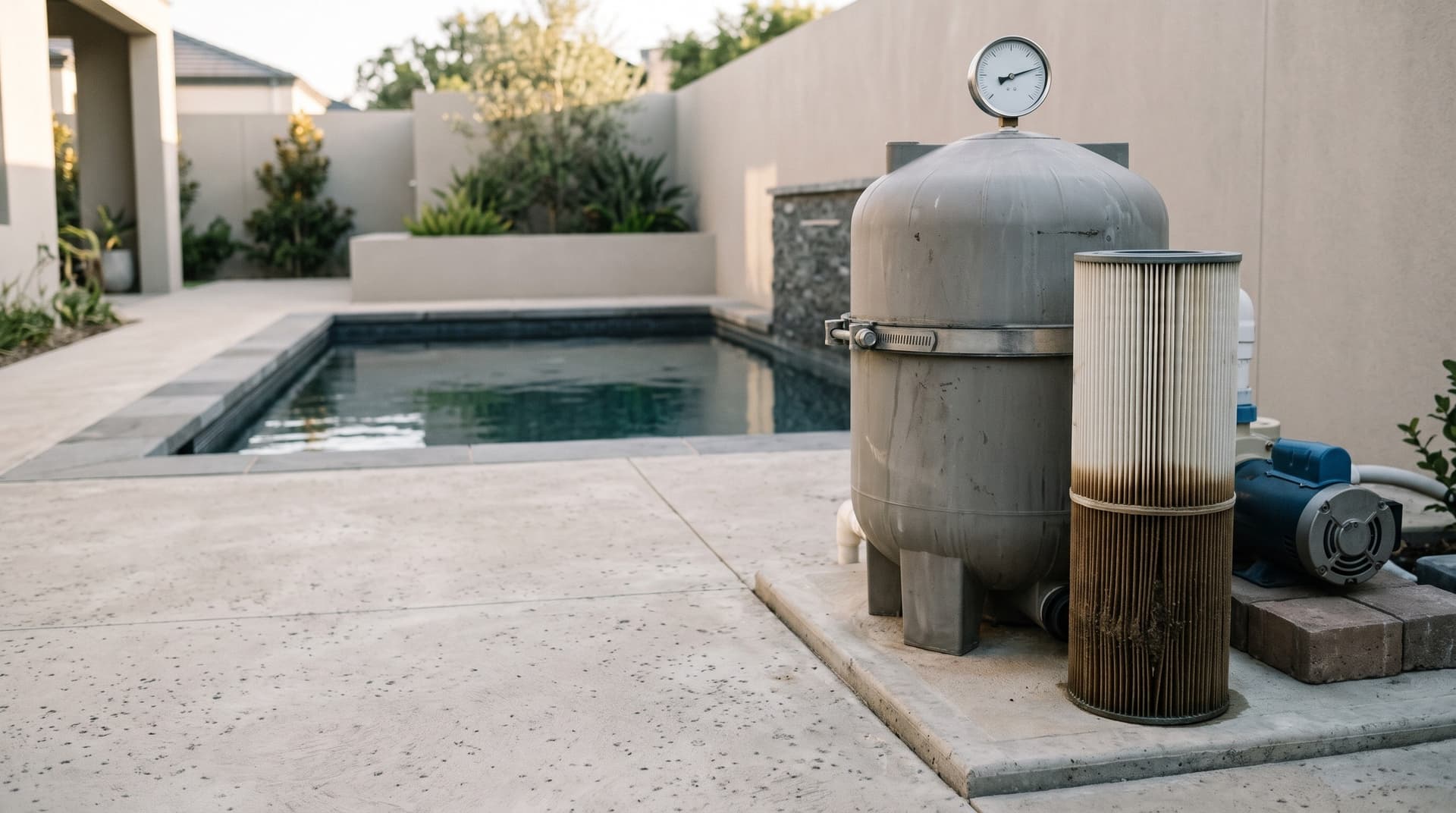
On cartridge and DE filters, the lid sits on the base with a big o-ring between them and a clamp around the seam. Pentair's troubleshooting gives exactly two causes for a filter that leaks at start-up: a tank o-ring pinched between the lid and the base, and a clamp that isn't installed correctly. The fix is to take it apart and put it back together properly.
With the lid off, clean the o-ring and its groove and check it for cracks, flat spots and nicks. Pentair says it has to be clean, undamaged, seated and not pinched. Don't pry the lid off with a tool: Pentair warns that can damage the o-ring. Lubricate it with PTFE or silicone, as Pentair specifies, except on Hayward's SwimClear and ProGrid. Their DEX2422Z2 metal-reinforced seal takes no lubricant, and both manuals say so.
Then the clamp, to the figure for your filter:
| Filter | Clamp | Tighten to |
|---|---|---|
| Pentair Clean & Clear Plus, FNS Plus (built from August 2025) | Cast clamp, ¾ in. socket | 16 to 18 ft-lbs, leaving a ½ to ¾ in. gap between the ends |
| Hayward SwimClear, ProGrid | Metal clamp, ¾ in. socket on a torque wrench | 150 in-lbs, never by hand alone |
| Jandy CV, CL, DEV | Clamp ring, 9/16 in. socket | Until the halves touch or are within 1/16 in. |
Hayward's SwimClear manual adds that you must never hit its clamp with a hammer or metal tools, and warns that non-Hayward clamp parts can fail and separate. Pentair's spring clamp parts fit only its filters built before August 2025.
If water shows under the clamp at start-up, Pentair says to cut the power immediately. Hayward's order is the same: pumps and power off, wait for the water to stop, then reassemble. Never chase a seam leak by tightening a clamp on a running filter.
Drain plug, gauge and air relief
The small fittings leak for small reasons.
The drain plug. Every one seals on an o-ring or gasket, and that's the part that gets lost over winter. Hayward's SwimClear and ProGrid manuals both say the drain plug needs its o-ring, and Hayward's ProSeries manual says to keep the drain cap secure to prevent leaks. On Pentair's Sand Dollar, take off only the drain cap, not the whole fitting.
The gauge. It threads into the air relief valve. Pentair says two full rounds of thread tape and hand tight. Hayward says Teflon tape and not too tight. A weep at the gauge threads is usually tape that's gone.
The air relief valve. It seals on o-rings too, at its base and on its stem. Pentair says to put silicone lubricant on the stem o-rings, and Hayward sells an o-ring kit for its valve. Jandy asks for the gauge and air release assembly to be checked for leaks at least once a week, and says its locknut goes on hand tight only, because a wrench can damage the nut, the gauge or the air release.
A crack in the tank or the valve body
Freezing is the cause the manuals name. Hayward's SwimClear and ProGrid manuals say to leave the drain plug out over winter to avoid cracking the filter body, and Pentair's Sand Dollar manual says freezing will damage the system. Hayward's warranties exclude freeze damage.
A crack in a port or the valve body means a new body. Pentair's troubleshooting table adds a warning for cracked ports: don't overtighten the port connections on the new one. A crack in the tank means a new tank. It holds the same pressure the warnings above are about.
Rebuild, a new valve top, or a new valve
I've done all three. Which one depends on what's worn.
Rebuild when only the seals are worn: a spider gasket, or the o-rings. It's the cheapest fix, and on a valve that's otherwise sound it's the right one.
A new valve top when the leak is at the handle, or the seal is damaged on a valve whose top comes as one assembly. That's Pentair's own fix for both. On its 1½ inch HiFlow, the top assembly lists at $257.37, against $84.05 for the diverter and its gasket.
A new valve when the body is cracked, a port is cracked, or the face the seal presses on is scratched. Pentair's table calls for a new body in all three, and Hayward's ProSeries manuals list only complete valves for their filters.
Whichever you do, lubricate the o-rings with silicone as you put it together, and check the pressure on the gauge once it's running. Write down the clean reading while you're at it.
Before you start it again
Open the air relief valve, stand clear of the filter, and start the pump. Close the valve when water comes out of it in a steady stream, as Hayward's manuals say. Pentair's HiFlow manual adds that you never run the pump with the valve on Closed, because the air relief stops working and parts can separate.
Then watch the joint you fixed for a few minutes. If water shows at a clamp, cut the power before you do anything else.
Frequently asked questions
Why is water coming out of my pool filter's backwash line?
With the valve on Filter, that's the seal inside the multiport valve. Pentair's troubleshooting table gives three causes: dirt or sand under the seal, a damaged seal, or damage to the valve body where the seal sits. Hayward's answer is a worn or loose gasket. A push-pull valve does the same thing when its plunger o-rings wear.
Why is my pool filter leaking at the clamp?
Pentair's manuals give two causes for a filter that leaks at start-up: a tank o-ring pinched between the lid and the base, and a clamp that isn't installed correctly. Shut the pump off, open the air relief valve, take it apart and reassemble it with the o-ring clean and seated. Then tighten the clamp to your manual's figure.
Can I tighten a filter clamp while the pump is running?
No. Pentair and Hayward both say to turn the pump off and relieve the pressure before touching the clamp. Pentair warns trapped air can launch the lid with deadly force, and in 2004 CPSC and Sta-Rite recalled about 8,500 filters whose top shells could blow off.
What lubricant should I use on pool filter o-rings?
Pentair says PTFE or silicone based lubricant only, and its HiFlow valve manual says silicone only. Hayward recommends Jack's 327 on its valve o-ring. Never petroleum: Pentair says it damages the parts. And don't lubricate Hayward's DEX2422Z2 metal-reinforced tank seal at all.
Should I rebuild or replace a leaking multiport valve?
Rebuild it when only the seals are worn: a spider gasket or the o-rings. Pentair says a leak at the handle means a new valve top. A crack in the body, cracked ports or a scratched seal face means a new valve body, which in practice is a new valve.