Well water is not a problem in itself. Plenty of pools run on it perfectly well. What catches people out is the sequence — fill the pool, look at clear water, add chlorine, and watch the whole floor go brown overnight.
Nothing went wrong at that point. The metal was already in the water, invisible, and the chlorine simply made it visible.
Key takeaways
- Test the fill water, not just the pool. The pool test is downstream of the problem.
- Metals are invisible until they oxidize, which is what chlorine does to them.
- A hose pre-filter at fill is the cheapest intervention available.
- Sequestrants hold metals in solution; they do not remove them, and they break down.
- Copper more often comes from a corroding heater than from the well.
Test the water going in
The single most useful thing you can do costs almost nothing: test the fill water before it becomes pool water.
Run the hose for a minute to clear standing water from the line, catch a sample, and test it for iron, copper and manganese. A metals test kit or a strip that covers iron and copper is enough to tell you whether you have a problem and roughly how big.
Test calcium hardness at the same time. Well water is often hard, and knowing that before you fill is worth more than discovering it later, because the fill is the one moment when your hardness is entirely a matter of what you put in.
What the colors mean
Metals announce themselves differently, and the color is a reasonable first guess at which one you have.
| Stain color | Likely metal | Usual source |
|---|---|---|
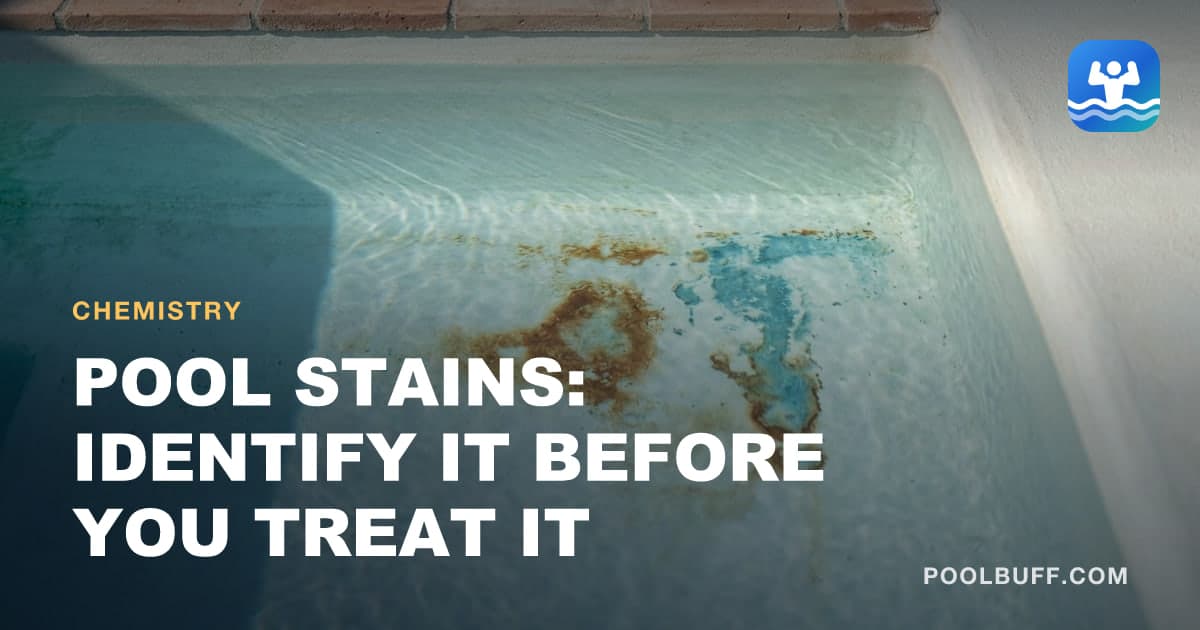
| Rust brown, orange | Iron | Well water, corroding steel |
| Blue-green, teal | Copper | Heater corrosion, copper algaecide |
| Purple, brown-black | Manganese | Well water |
| Gray, dull black | Manganese or organic | Either — test before treating |
That is a starting point rather than a diagnosis. Confirming which stain you have is its own exercise, and the stain identification guide covers the test that separates a metal stain from an organic one in about thirty seconds.
Filling without staining
- 1
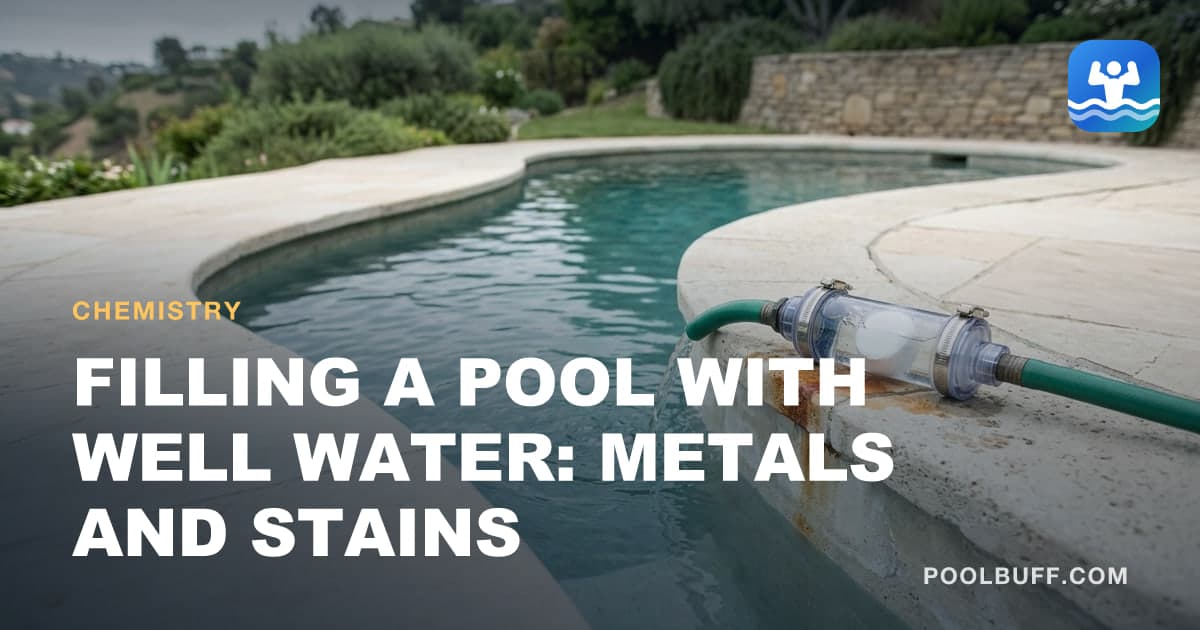
Fit a hose pre-filter
10 minutesAn inline cartridge on the fill hose catches sediment and a useful share of the iron. Cartridges are consumable and a full pool will exhaust one, so buy more than you think you need.
This is the cheapest single intervention available, and it works on the metal that has not entered the pool yet — which is the only metal that is easy to deal with.
- 2
Add sequestrant as it fills
5 minutesDose according to the volume you are actually adding, and get it in early rather than at the end. You want it present while the water arrives, not introduced to water that has already been sitting.
- 3
Hold off on chlorine
—Give the sequestrant time to work — a few hours of circulation with the pump running. Chlorine is the trigger that converts dissolved metal into a stain, so it goes in last.
- 4
Then balance normally
—Chlorine, then pH and alkalinity, then the rest of the normal balance. Bring pH up gently rather than in one dose; a sharp swing can drop metal out of solution even with sequestrant present.
Sequestrants are maintenance, not a fix
This is the part that gets misunderstood, and it is worth being blunt about.
A sequestrant does not remove metal. It binds it so chlorine cannot act on it, holding it in solution where it does no visible harm. The metal is still in your pool, and it stays there until you dilute it out.
It also does not last. Sequestrants break down in sunlight and are consumed by chlorine, which means a pool on well water needs a maintenance dose on a schedule — typically monthly through the season, more often if you shock hard or run a salt system.
Stop dosing and the metal comes back out. Usually on the sunniest wall, usually within a week of a shock.
Removing stains that are already there
Everything above is prevention. This is what to do when the staining has already happened.
Identify it first. A metal stain lifts when you hold a vitamin C tablet against it for thirty seconds. An organic stain does not — but it will lift under a chlorine tablet held the same way. That five-minute test decides everything downstream, because the two treatments are opposites and the wrong one sets the stain.
Ascorbic acid is the standard treatment for iron and most metal staining. It reduces the metal back into solution, and the stain frequently disappears within an hour of the pool being dosed, which is one of the more satisfying things to watch in pool care.
The critical part is what comes next. The metal is now dissolved in your water rather than removed from it, and it re-deposits the moment chlorine comes back up. So sequestrant goes in immediately, chlorine stays low for a day or two, then returns slowly. Skip that step and the pool re-stains within a week, wasting the entire exercise.
If the staining is extensive, or the surface is old plaster, this is a job worth having done rather than learned on.
Copper is usually your own equipment
If your fill water tests clean for copper but the pool does not, the well is not the culprit.
The common source is the heat exchanger in a gas heater. Water running low on pH and alkalinity is aggressive toward copper, and it takes the metal straight out of the exchanger and puts it into the pool. The blue-green staining is the visible symptom; the expensive symptom is what the same water is doing to the heater.
Copper-based algaecides do the same thing on purpose, which is why they are worth avoiding in a pool you would rather not stain.
Either way, the fix is upstream: get pH and alkalinity into range and keep them there. Sequestering copper while the water is still eating your heater treats the stain and ignores the cause.
Go deeperWhich stain is it?The thirty-second test that tells a metal stain from an organic one, before you buy anything.Frequently asked questions
Can I fill a pool with well water?
Yes, and plenty of pools run on it. The issue is what the water carries. Well water often contains dissolved iron, manganese or copper picked up from the ground, along with higher hardness. None of that stops you filling, but adding chlorine to untreated metal-laden water will stain the surface within a day or two, so the sequence matters more than the source.
Why did my pool turn brown after I added chlorine?
Dissolved iron. It is colorless in solution and turns rust brown when oxidized, which is exactly what chlorine does to it. Nothing was added and nothing went wrong — the metal was already there and the chlorine made it visible. The same mechanism turns manganese purple-black and copper blue-green.
Does a hose filter actually work for filling a pool?
For iron and sediment, meaningfully yes, and it is inexpensive relative to what stain removal costs. Cartridges are consumable and a large fill will exhaust one, so plan for more than a single cartridge on a full refill. It reduces the load rather than guaranteeing zero metal, which is why a sequestrant still earns its place alongside it.
What does a sequestrant do?
It binds dissolved metal so chlorine cannot oxidize it, keeping the metal in solution and out of the surface. It does not remove anything from the water. It also degrades over time and is consumed by chlorine, so a pool on well water needs it topped up on a schedule rather than dosed once at fill and forgotten.
Where does copper in pool water come from?
Most often from inside the pool rather than the fill. Water with low pH and low alkalinity corrodes the copper heat exchanger in a gas heater and puts copper straight into the pool, and copper-based algaecides do the same deliberately. If your fill water tests clean for copper but the pool does not, look at your heater and your pH history before blaming the well.