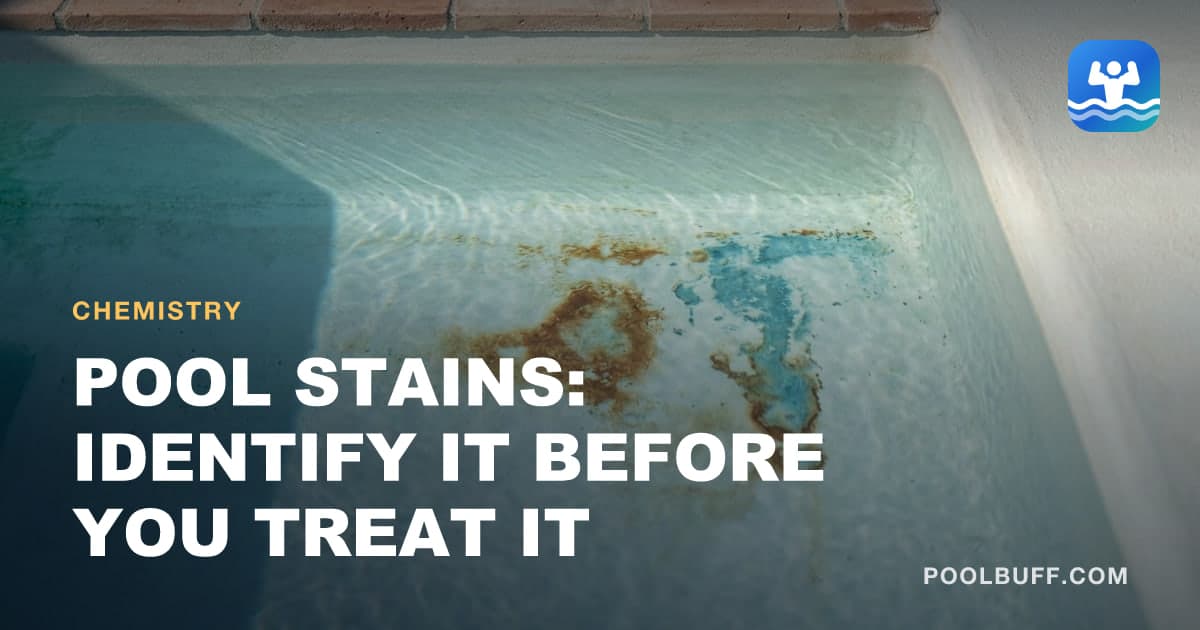
Stain treatment is the one area of pool chemistry where guessing can make things permanently worse.
Organic stains and metal stains look similar and respond to opposite treatments. Throw chlorine at a metal stain and you can oxidize it into the surface for good.
Two minutes of testing first. Every time.
Key takeaways
- Two tests, two minutes, and you'll know which family of stain you're dealing with.
- Treating a metal stain with chlorine can set it permanently. This is the expensive mistake.
- Removing a metal stain without adding sequestrant afterward just means it comes back.
- Well water and copper heat exchangers are the usual metal sources.
- Some stains are actually scale or etching, and no chemical will remove those.
The two tests
Test 1 — the chlorine tablet. Hold a trichlor tab directly against the stain for about 30 seconds. Wear a glove.
- Stain lightens: organic. Chlorine is your treatment.
- No change: not organic. Go to test 2.
(Do this on a small spot. On plaster a tab held too long will bleach a light patch, which is its own problem.)
Test 2 — vitamin C. Crush a plain vitamin C tablet (ascorbic acid) and hold it against the stain, or press it with a sock.
- Stain lightens: metal. Ascorbic acid treatment.
- No change: probably scale or etching, and no chemical will remove it.
That's the whole diagnostic, and it saves people hundreds of dollars in wrong products.
Organic stains
What causes them: leaves, acorns, berries, worms, algae that sat in one place, anything that decomposed against the surface.
What they look like: brown, green, reddish-brown, roughly the shape of whatever caused them. Often a leaf outline, which is a strong clue.
Treatment:
- Brush the area hard.
- Balance pH to about 7.2.
- Shock to your CYA-appropriate level and hold it.
- Brush daily.
Most organic stains lift within a day or two of sustained shock level. Stubborn ones respond to a chlorine tab held against them, or an enzyme product.
Prevention: get debris out promptly. A leaf that sits for a week stains. A leaf that gets skimmed doesn't.
Metal stains
What causes them: iron, copper or manganese dissolved in the water, then oxidized onto the surface.
Sources:
- Well water used to fill or top up
- Corroding copper in a heat exchanger, usually because of chronically aggressive water
- Copper-based algaecides used too enthusiastically
- Corroding metal fittings, ladder anchors, light rings
- Municipal water during a mains disturbance
What they look like:
| Color | Likely metal |
|---|---|
| Rust brown, orange-brown | Iron |
| Blue-green, teal | Copper |
| Purple-black, dark brown/black | Manganese |
| Gray-black patches | Manganese or, sometimes, cobalt from fiberglass gelcoat |
Treatment:
- Test for metals. Take a sample to a pool store and ask specifically for a metals test.
- Drop chlorine as low as you can. Chlorine works against ascorbic acid. Stop chlorinating and let it fall, or wait for it to drop naturally.
- Lower pH to around 7.2.
- Add ascorbic acid — commercial stain removers are mostly this. Broadcast over the stained area, brush, and it often lifts within an hour on a bad stain.
- Add sequestrant immediately. This is the critical step. The metal is now dissolved in the water, not on the wall, and as chlorine comes back it will re-deposit. Sequestrant holds it in solution.
- Bring chlorine back up slowly over a few days.
- Consider a partial drain to actually remove the metal from the water. Sequestrant manages it; it doesn't remove it, and it degrades.
Scale and etching
Neither is a stain, and no stain remover touches either.
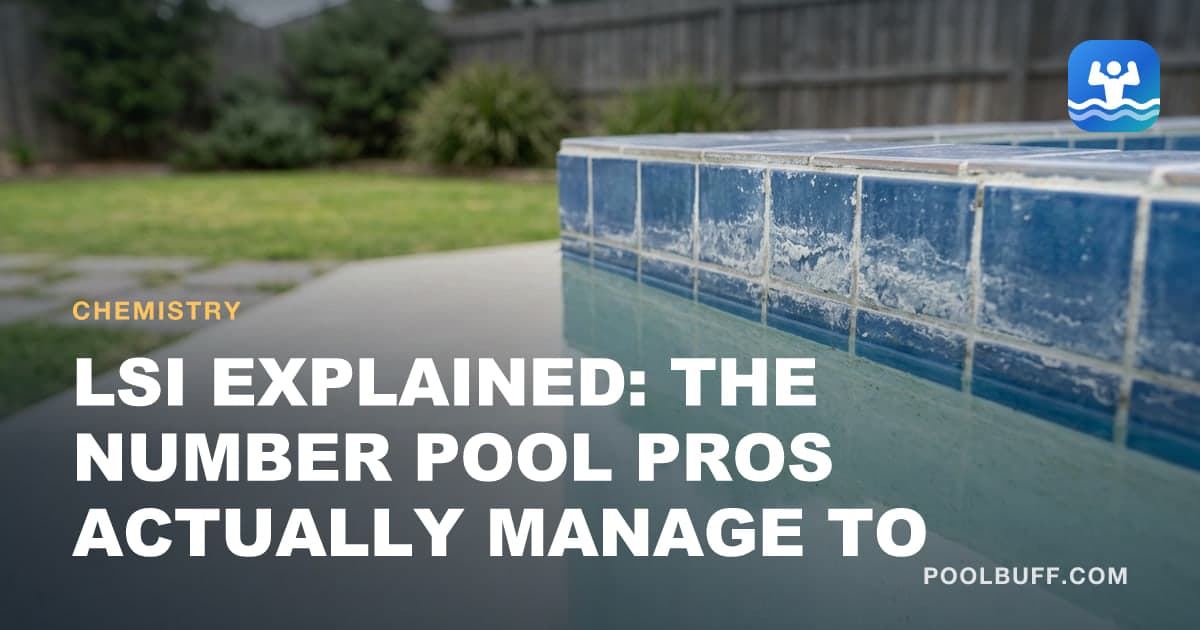
Scale is calcium carbonate deposited on the surface — usually a white or gray crust, often at the waterline. It's a positive LSI problem. Treatment is a scale remover or, for heavy deposits, mechanical removal (bead blasting) by a specialist. Prevention is managing LSI.
Etching is the surface itself being dissolved by aggressive water. It feels rough rather than looking discolored, though it can look mottled. It isn't reversible — the plaster is gone. Prevention is the only cure, and it's an LSI problem in the other direction.
Go deeperLSI: why in-range water can still cause damageThe number that explains scale and etching when every individual reading looks fine.Where the stain is tells you something
Location narrows the diagnosis before either test does, because most stains appear where something specific was happening.
Under the ladder or handrail is almost always metal — the anchor is steel or brass in a socket, and it corrodes into the surface directly below it. A stain in that shape is not a water chemistry problem so much as a hardware one.
Directly below a return points at whatever came out of the pipe. Copper from a heat exchanger, or iron from fill water, deposits first where the water arrives.
On a step or a bench is usually organic. Leaves and debris settle on flat surfaces and sit there long enough to leave a mark.
A single sharp-edged spot anywhere is something that was dropped and left — a hair clip, a coin, a can. Metal objects stain in their own outline.
An even overall tint across the whole surface is dissolved metal in the water rather than deposited debris, and it usually arrived with a fill or a top-up.
Only at the waterline is scale or scum rather than a stain, and it wants a different approach entirely.
When to call a specialist
- You've tried both treatments and neither worked. You may have a mixed stain or an unusual metal.
- Extensive staining across the whole surface, which is often a fill water problem needing a different approach.
- Stains on a fiberglass gelcoat, which is more delicate than plaster and easier to damage.
- You're considering an acid wash. It removes a layer of plaster along with the stain. It works, and each one shortens the life of your finish, so it's a last resort not a first one.
Prevention
- Test fill water for metals if you're on a well, before it goes in the pool.
- Sequestrant on a schedule if you have an ongoing metal source.
- Keep pH in range. Metals stay in solution more readily and aggressive water stops corroding your own equipment.
- Skim promptly. Organic stains are entirely preventable.
- Go easy on copper algaecides. They work and they're a common cause of blue-green staining.
- Check your heat exchanger if you've had a period of aggressive water. Copper leaching into the pool is both a stain source and a sign the heater is dying.
For metal stains
- Check price
metal sequestrant
Holds iron and copper in solution so they cannot stain the surface.
- Check price
Taylor K-2006C test kit
Drop-count titration rather than color matching, and it tests CYA properly.
Frequently asked questions
How do I identify a pool stain?
Two tests. Hold a chlorine tablet against the stain for 30 seconds — if it lightens, it's organic. If not, rub a crushed vitamin C tablet on it; if that lightens it, it's a metal stain. If neither does anything, you're likely looking at scale or surface etching rather than a stain.
What causes brown stains in a pool?
Usually iron, from well water, corroding metal fittings or an old heat exchanger. Organic staining from leaves and acorns also produces brown, which is why the tablet test matters — the treatments are opposites.
How do you remove metal stains from a pool?
Ascorbic acid, usually with the chlorine level dropped low first because chlorine works against the treatment. Once the stain lifts, add a sequestrant immediately or the metal will simply re-deposit as chlorine comes back up. This is the step people skip and then wonder why the stain returned.
Will chlorine remove pool stains?
It removes organic stains — leaves, algae, acorns, worms — often just by holding shock level and brushing. It does the opposite for metal stains: chlorine oxidizes dissolved metal and can set the stain permanently. Identify first.
How do I stop pool stains coming back?
Deal with the source. Sequestrant on a schedule if you're on well water or have metal in the system, prompt removal of leaves and debris, keeping pH in range so metals stay in solution, and checking a copper heat exchanger if you've had aggressive water.