Two white powders sit on the pool shelf and they are not interchangeable, which is the entire subject of this page.
One raises alkalinity and barely touches pH. The other raises pH hard and drags alkalinity along behind it. People reach for whichever they have, get a result they did not want, and add more of it.
Key takeaways
- Baking soda raises alkalinity strongly and pH barely. Soda ash does the reverse.
- Pool-store alkalinity increaser and grocery baking soda are the same compound.
- Roughly 1.5 lb per 10,000 gallons raises alkalinity about 10 ppm.
- Adding it when alkalinity is already high is what starts the acid treadmill.
- Never add it at the same time as acid. They cancel, and you learn nothing.
What it actually does
Baking soda is sodium bicarbonate, and in solution it sits at a pH of about 8.3.
That number explains its whole behavior. A chemical can only pull water toward its own pH, so bicarbonate can lift a pool from 7.0 up toward the mid 7s and then it runs out of push. It physically cannot drive a pool to 8.2, no matter how much goes in.
What it does do strongly is raise total alkalinity — the buffer that resists pH change. That is the job it is for.
Soda ash, sodium carbonate, sits around pH 11.4. It raises pH hard and fast, and raises alkalinity as a side effect rather than as the point.
So the two products answer two different questions:
| Your problem | The product |
|---|---|
| Alkalinity low, pH acceptable | Baking soda |
| pH low, alkalinity acceptable | Soda ash |
| Both low | Baking soda first, then reassess |
| Alkalinity high, pH high | Neither — you want acid |
That last row is where the damage happens. Somebody sees a low-ish pH, adds baking soda because it is the white powder they have, and pushes alkalinity from 120 to 160. Now pH climbs on its own, they add acid, alkalinity comes down slightly, pH rebounds, and they are on a weekly cycle that has no end. The relationship between the two is worth understanding once rather than fighting all season.
How much
The working figure: about 1.5 pounds per 10,000 gallons raises total alkalinity roughly 10 ppm.
So a 20,000 gallon pool reading 60 ppm, aiming for 90, needs about 9 pounds.
Two habits keep this from going wrong:
Add half, then wait. Alkalinity is slow to read accurately while the pool is still mixing, and it is far easier to add the rest tomorrow than to remove an overshoot — bringing alkalinity down means acid, which drags pH down with it, and now you are correcting two numbers instead of one.
Use the pH and alkalinity calculator rather than the bag, since the bag does not know your volume.
Target is 80 to 120 ppm for most pools, and toward the higher end of that on a salt pool or anywhere the water runs aggressive in winter.
Grocery aisle or pool store?
Chemically identical. Both are sodium bicarbonate, and pool-store "alkalinity increaser" is the same compound in a bigger bag, occasionally ground finer so it dissolves faster.
Buy whichever is cheaper per pound. The one thing worth checking is that the label says sodium bicarbonate and nothing else — some kitchen products are baking powder, which is bicarbonate cut with acid salts and cornstarch, and the cornstarch is organic material you are feeding to your chlorine.
Baking soda also stores indefinitely if it stays dry, which makes it one of the few pool chemicals worth buying in bulk.
Adding it
Simpler than most pool chemicals, and forgiving.
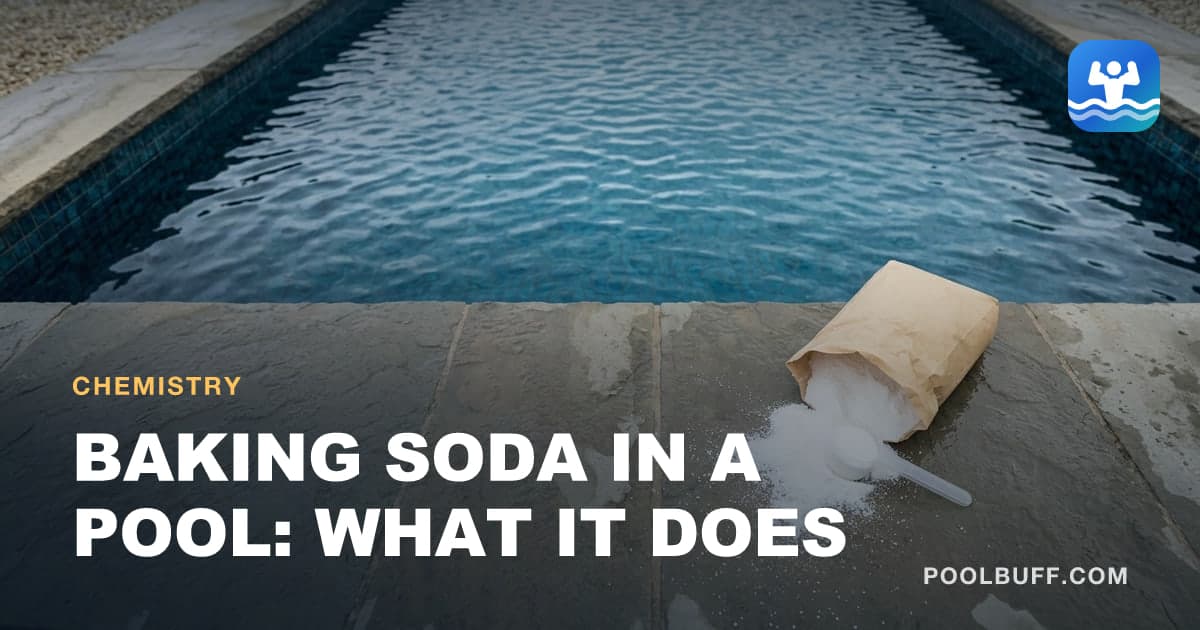
Broadcast it across the surface with the pump running, walking the perimeter. It dissolves readily and needs no pre-mixing in a bucket.
Do not dump it in one spot. A pile on a dark plaster floor leaves a temporary white patch. Brushing clears it, but there is no reason to create the job.
Give it a full turnover before retesting. Alkalinity readings taken from partly mixed water are the usual reason someone concludes it "did nothing" and adds a second dose.
What it will not do
Three things get attributed to baking soda that it does not do.
It does not clear cloudy water. Cloudiness is suspended particles or a sanitizer failure. Baking soda addresses neither. It can prevent the pH swings that contribute to cloudiness over time, which is a real but indirect benefit — the immediate cause needs finding on its own.
It does not sanitize. It kills nothing. A pool with perfect alkalinity and no chlorine is still an unsafe pool.
It does not soften water or reduce hardness. Calcium hardness is a separate number with a separate product, and adding bicarbonate does not touch it.
When you actually need it
Realistically, three situations.
After heavy rain. Rain is mildly acidic and dilutes what is dissolved in the water, so alkalinity drifts down across a wet spell. This is the most common reason a pool needs it, and it is the reason to test after a storm rather than on schedule.
On a fresh fill, particularly from a soft municipal supply or a well. New water is rarely balanced and alkalinity is usually the first thing short.
On a pool that gets acid regularly — a salt pool, or one with a waterfall running all day. Acid lowers alkalinity every time it lowers pH, so alkalinity needs topping back up periodically or it drifts below the band and pH starts bouncing.
That third case is the one that catches people out, because it feels contradictory: you are adding acid to bring pH down and bicarbonate to bring alkalinity up, in the same pool, in the same month. That is not a mistake. It is what managing an aerated pool actually looks like.
Go deeperWhy these two numbers move togetherWhich to set first, and why a pH problem is usually an alkalinity problem in disguise.Frequently asked questions
Does baking soda raise pH or alkalinity in a pool?
Mainly alkalinity. Sodium bicarbonate sits at a pH of around 8.3 in solution, so it pulls pH gently toward that figure and no further — it will lift a pool from 7.0 toward the mid 7s but it cannot push a pool to 8.0. Its real effect is on total alkalinity, which it raises strongly. If you need pH up and alkalinity is already fine, soda ash is the product.
How much baking soda do I add to my pool?
About 1.5 pounds per 10,000 gallons raises total alkalinity roughly 10 ppm. So a 20,000 gallon pool sitting at 60 ppm and aiming for 90 needs somewhere near 9 pounds. Add no more than half at once, run the pump for a full turnover, and retest before adding the rest.
Is pool alkalinity increaser the same as baking soda?
Chemically, yes — both are sodium bicarbonate. The pool-store version is sometimes a finer grind that dissolves a little faster, and it is sold in larger bags. Grocery baking soda works identically. Buy on price per pound and check the label says sodium bicarbonate and nothing else.
Can you swim after adding baking soda?
Yes, once it has dissolved and circulated — typically within an hour of the pump running. It is one of the mildest things you can put in a pool. The only caution is that undissolved granules sitting on a dark plaster floor can leave a temporary white patch, which brushing clears.
Will baking soda clear a cloudy pool?
Not directly, and this is a common misunderstanding. Cloudiness is particles or low sanitizer, neither of which baking soda addresses. What it can do is stop the pH swings that make water cloudy in the first place, by giving pH something to hold onto. Fix the cloudiness at its cause and use baking soda for the buffer.