A pool store carries perhaps sixty products. A working pool needs about eight of them, and two of those are ordinary household chemicals with a markup attached.
This is not a conspiracy. It is what happens when a category sells to people who have a problem, do not know the cause, and want to leave with a solution. Most of the shelf exists to treat a symptom, and almost every symptom traces back to one of five numbers being wrong.
Key takeaways
- Alkalinity increaser is sodium bicarbonate. It is baking soda, at several times the price.
- pH increaser is sodium carbonate — soda ash, sold as washing soda in the laundry aisle.
- Most of the pool aisle treats symptoms of a number being wrong. Fix the number instead.
- Buy dry chemicals in bulk and liquid chlorine in small amounts, because only one of them keeps.
- A test kit is the prerequisite. Without numbers you are buying products at random.
The prerequisite
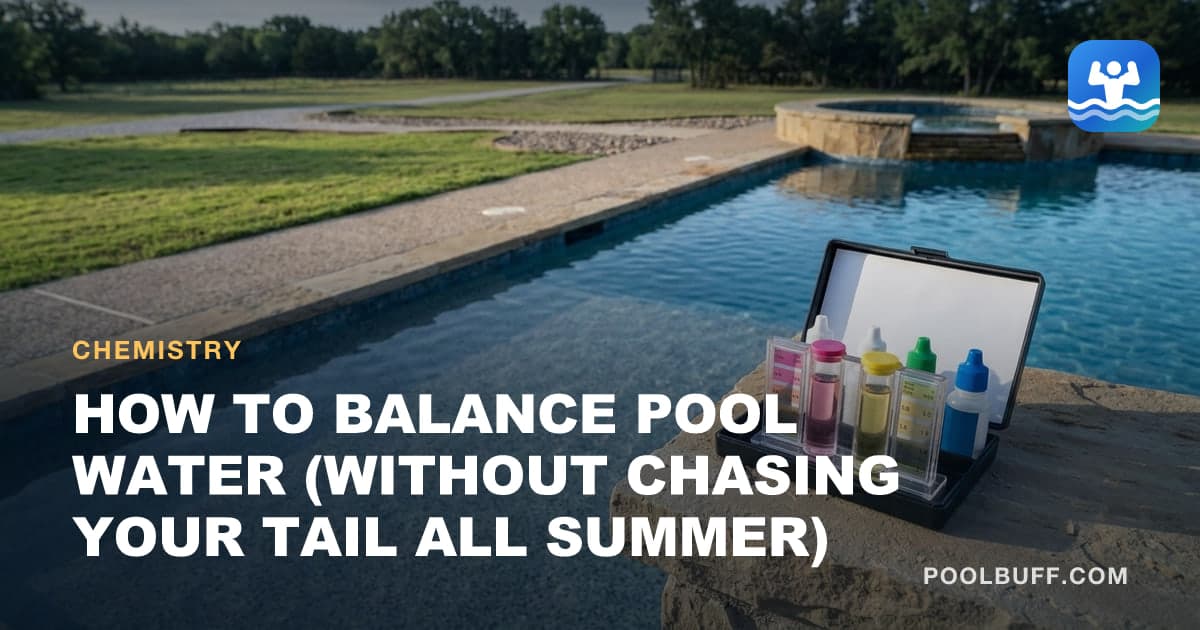
Before any of it: a drop-based test kit. Without numbers you are buying products because a bottle described your symptom, which is exactly the purchasing pattern the aisle is designed around.
A kit that reads free chlorine, pH, alkalinity, calcium hardness and cyanuric acid tells you which of the eight things below you actually need, and usually tells you that you need fewer of them than you thought.
The eight worth stocking
Chlorine. Tablets for daily work while your stabilizer has room, cal hypo for shocking. Which type when is its own decision, and it is the one that most affects everything else in your water.
Acid, to bring pH down. Muriatic acid is cheapest and works fastest; dry acid — sodium bisulfate — is far more pleasant to handle and adds sulfates that accumulate. Most owners are better off with dry acid unless they are adding acid constantly, or run a salt cell whose manual rules it out, as Pentair's IntelliChlor Plus and LT manual does. Neither ships easily, so both are local purchases.
Sodium bicarbonate, to raise alkalinity. See below. This is baking soda, and like most of the dry balancers it keeps more or less indefinitely as long as it stays dry.
Sodium carbonate, to raise pH. Soda ash. Also see below.
Cyanuric acid, to stabilize chlorine. Only if you are not already getting it from tablets, which most people are. Test before adding — this is the one chemical you cannot take back out without draining.
Calcium chloride, if your fill water is soft. Plaster pools need calcium in the water or the water takes it from the plaster. Vinyl and fiberglass pools are more relaxed about it, but not indifferent.
Filter cleaner. A hose leaves the oils behind, and oil is what eventually blinds a cartridge for good. Twice a season.
Silicone o-ring lubricant. Not petroleum grease, which swells rubber and destroys it. A single tube lasts years and prevents the most common air leak on a pool.
Add pool salt if you run a chlorine generator, and DE powder if you have a DE filter. Both are consumables rather than problem-solvers.
The two you are overpaying for
| Sold asMy default | Actually | Buy it as | |
|---|---|---|---|
| Alkalinity increaser | Pool chemical | Sodium bicarbonate | Baking soda, any size bag |
| pH increaser | Pool chemical | Sodium carbonate | Washing soda, laundry aisle |
These are the same compounds at the same purity. The dosing math is identical, because the chemistry is identical. Check that the label says the compound and nothing else — some laundry products add fragrance or surfactant, and those you do not want in a pool.
The saving is not trivial. Raising alkalinity across a 20,000-gallon pool takes several pounds, and doing it with a pool-labeled bag costs several times what a supermarket bag of the same powder does.
What the rest of the aisle is for
Not nothing. But almost all of it treats a symptom whose cause is a number.
Clarifiers and flocculants gather fine particles so a filter can catch them. Genuinely useful after a heavy shock or a dust storm. Useless as a recurring purchase, because cloudy water that keeps returning is a filtration or chemistry problem and a clarifier just clears it temporarily.
Algaecides are insurance, not maintenance. Chlorine at the right level kills algae. A pool needing algaecide every month has a chlorine problem being masked. There is a reasonable case for a dose before a two-week holiday, or as part of closing.
Phosphate removers have a real but narrow use — worth reading about before spending, because they are frequently sold to people whose actual problem is stabilizer.
Metal sequestrants matter if you have iron or copper in your fill water. They do nothing otherwise. A mineral system is a separate case: check its own directions before adding one, because PoolRx, for one, says its minerals need no sequestrant or stain control product.
Enzyme products break down oils and are pleasant on a heavily used pool or a spa. Optional in every sense.
Stain removers, scale removers, "shock enhancers", weekly conditioners. Each solves something. None of them belongs on a maintenance list, and buying them routinely is a sign that a number somewhere is not being managed.
How long each one keeps
Buying for a season rather than for a trip gets easy once you know which of these degrades on a shelf.
Keeps essentially forever, sealed and dry: sodium bicarbonate, soda ash, calcium chloride, cyanuric acid. Stable salts, all of them. Buy the large bag; it will still be good in three years.
Keeps for years if it stays dry: cal hypo and trichlor tablets. Both are ruined by moisture rather than by time, so the container matters more than any date on it. A bucket opened and resealed properly outlasts one sitting under a cracked lid.
Degrades on the shelf: liquid chlorine, faster than anything else here — losing a third of its strength across a hot month is entirely realistic. Muriatic acid keeps well, but the fumes work on everything stored near it, so buy what you will use in a season rather than a drum.
Degrades faster than people expect: test reagents. Annually, and kept indoors.
The rule that follows is simple. The cheap stable powders are worth buying in bulk and the concentrated liquids are not. A shed holding six months of bicarbonate and two weeks of liquid chlorine is stocked correctly.
The honest summary
The eight above, a test kit, and the balancing order will run a pool for a season without drama.
The reason the aisle is sixty products deep is that it is easier to sell a bottle for a symptom than a habit for a cause. A pool that gets tested weekly and adjusted properly needs remarkably little, and the shed stays remarkably empty.
Go deeperStoring all of this safelyWhat must never share a shelf, and the storage mistakes that start fires.Frequently asked questions
What chemicals do I need for a pool?
Chlorine, an acid to bring pH down, sodium bicarbonate to raise alkalinity, sodium carbonate to raise pH, cyanuric acid to stabilize your chlorine, and calcium chloride if your water is soft. Add filter cleaner and silicone o-ring lubricant and you have covered nearly everything a normal season asks for.
Is pool alkalinity increaser just baking soda?
Yes. Alkalinity increaser is sodium bicarbonate, which is exactly what baking soda is. The pool-labeled version is typically several times the price for the same compound at the same purity. Buy the largest bag of plain sodium bicarbonate you can find and use the same dosing math.
Is pH increaser the same as soda ash?
Yes — sodium carbonate. It is sold in laundry aisles as washing soda, which is the same chemical. Check the label says 100% sodium carbonate with nothing added, and the dosing is identical to the pool-branded product.
Do I need algaecide?
Usually not. Chlorine at the level your stabilizer requires kills algae on its own, and a pool that needs algaecide routinely has a chlorine problem that algaecide is masking. It has a place as short-term insurance when you are away, or as part of a closing routine, but it is not a staple.
Should I buy pool chemicals in bulk?
Dry chemicals, yes — bicarbonate, soda ash, calcium chloride and stabilizer all keep for years if they stay dry and sealed. Liquid chlorine, no. It degrades on its own and heat accelerates it, so a jug bought in bulk and stored through summer can lose a third of its strength before you use it.