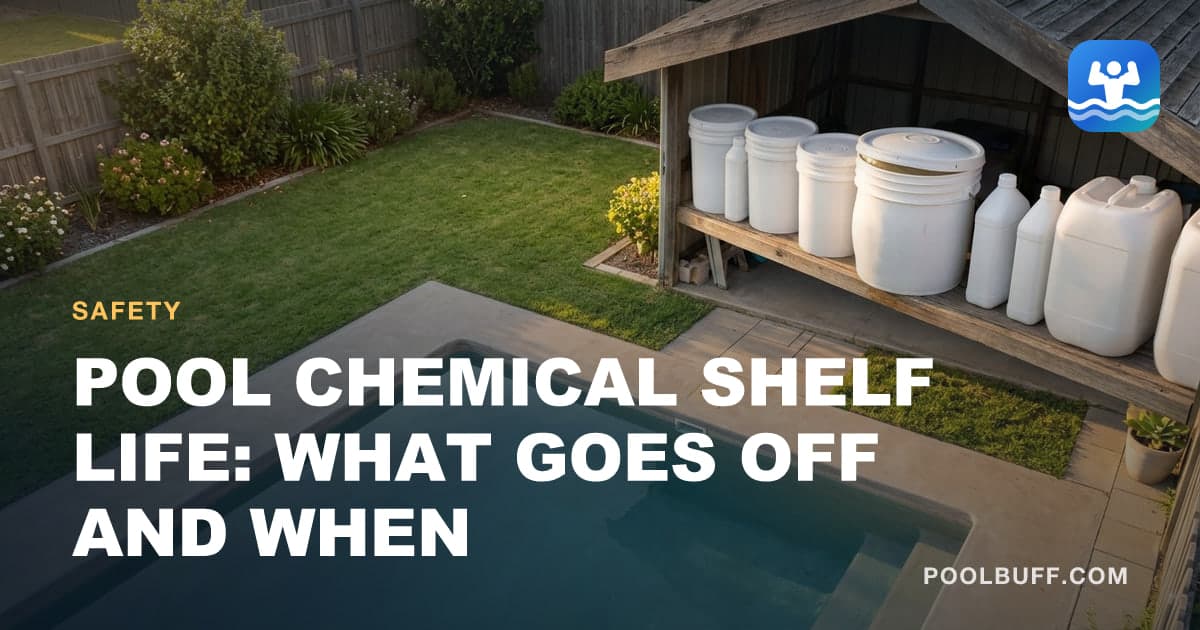
Most pool chemicals do not have a use-by date on them, which leaves people assuming either that everything lasts forever or that everything expires annually. Neither is right, and the difference matters twice — once for your wallet and once for safety.
Key takeaways
- Liquid chlorine is a perishable. Buy small, buy fresh, store cool and dark.
- Moisture is what ruins tablets, not time. Keep the lid sealed.
- A bulging tablet bucket is pressurized. Open it slowly, away from your face.
- Caked cal hypo is still a strong oxidizer. Degraded does not mean safe.
- Test reagents expire too, and bad readings cause bad decisions.
How long each one actually lasts
| Product | Sealed and stored well | What ends it |
|---|---|---|
| Liquid chlorine | Weeks | Heat and light. It is perishable |
| Trichlor tablets | Years | Moisture getting in |
| Dichlor granular | Years | Moisture getting in |
| Cal hypo | 2–3 years | Moisture, then caking |
| Muriatic acid | Indefinite | The container fails first |
| Soda ash, baking soda | Indefinite | Caking, which is cosmetic |
| Calcium chloride | Indefinite | Absorbs water aggressively |
| Cyanuric acid | Indefinite | Caking |
| Algaecide, clarifier | 1–3 years | Time and heat |
| Test reagents | About a year | Time, light, opening |
The pattern: liquids degrade, dry products are ruined by getting wet. Almost everything on that list keeps for years if it stays sealed and dry, and the two exceptions are liquid chlorine and your test reagents.
Liquid chlorine is a perishable
Treat it like milk, not like bleach in a cupboard.
Sodium hypochlorite breaks down continuously from the day it is made, and heat and sunlight accelerate it sharply. A jug sitting in a hot shed through summer can lose a large share of its strength inside a month. The 12.5% you bought is not the 12.5% you are pouring.
Practical consequences:
- Buy what you will use, not what is on offer. Three jugs used this month beats a case that spends August in a shed.
- Store it cool, dark and upright. A shaded corner of a garage beats anywhere with sun on it.
- Expect to dose more as it ages, and know that is what is happening rather than assuming your pool has developed a problem.
That last point is the quiet cost. People chase a chlorine reading with progressively bigger doses of progressively weaker product, conclude something is wrong with the water, and buy something else to fix it.
Moisture is what kills the dry products
Trichlor and dichlor are chemically stable for years. What ends them is humid air getting into the container.
Once it does, tablets soften, clump together and begin off-gassing chlorine inside a sealed bucket. That is a product problem and a pressure problem at the same time.
A bulging bucket is telling you something. Move it outdoors if you can do so safely, stand upwind, and open it slowly with your face well clear so the pressure vents rather than releasing into your face. Then find out how water got in — almost always a lid that was not fully seated, or a container kept somewhere humid.
Cal hypo behaves similarly and cakes into a solid mass. The important thing here is what caking does not mean:
The dry balancers barely age
Soda ash, sodium bicarbonate, calcium chloride and cyanuric acid are, for practical purposes, indefinite. They cake, and caking is cosmetic — break it up and it works.
Calcium chloride is the one worth watching, because it is aggressively hygroscopic. Left open in a humid garage it will pull enough water out of the air to turn to slush in the bag. That is a mess rather than a hazard, and it is still worth a properly sealed container.
Test reagents expire and nobody notices
This is the expiry that causes the most downstream trouble, because it fails silently.
Most reagents are good for around a year, and some are shorter once opened. Degraded reagents do not announce themselves — they read low, or fail to develop color at all. The result is dosing a pool that was already correct, chasing a number that was never real.
Date the bottles when you open them. Replace the set annually, keep them out of the sun and out of the car, and if a reading ever looks impossible, test the reagents against a known sample before you act on it.
Reading the container
Pool chemicals rarely carry a plain expiration date, which is why so much of this has to be judged by condition. What they do carry is worth learning to read.
Lot or batch codes usually encode a manufacturing date, and the format varies by manufacturer — often a two-digit year followed by the day of the year, so 24135 is the 135th day of 2024. If you cannot decode it, the manufacturer's customer line will, in about a minute.
Liquid chlorine is often dated at the point of fill rather than by the maker, particularly where a distributor bottles it locally. Ask the store when the delivery arrived, since that is the number that matters and it is one they generally know.
Sealed weight is a clue on dry products. A bucket of cal hypo that has taken on moisture is measurably heavier and often feels lumpy through the container.
The habit worth building is simpler than any of that: write the purchase date on the container in marker as you put it away. Ten seconds, and it turns every future decision from a guess into a subtraction.
What to keep, and how much
The honest answer for most pools is less than people keep. A smaller, fresher stock is cheaper, safer and easier to store properly — and every jug you are not storing is one that cannot leak onto something it should not meet.
Which chemicals are actually worth keeping on the shelf goes through the short list, and the storage and handling rules cover keeping them apart once they are there.
Go deeperKeeping them apartThe specific combinations that cause fires and gas, and the ordinary moments they happen in.Frequently asked questions
How long does liquid chlorine last?
Weeks rather than months in practical terms. Sodium hypochlorite breaks down continuously, and heat and sunlight accelerate it sharply — a jug left in a hot shed or in sun can lose a large share of its strength within a month. Buy it in quantities you will use, check the date on the bottle where there is one, and store it cool and dark.
Do chlorine tablets expire?
Not really from age, but very much from moisture. Sealed and dry, trichlor tablets stay usable for years. Once humid air gets in they soften, clump and off-gas chlorine, which is both a loss of product and the reason a closed bucket can build pressure. The lid being properly sealed matters more than the purchase date.
Is caked or clumped cal hypo still safe to use?
It is still a strong oxidizer, which means it is still hazardous even though it has lost potency. Do not assume degraded means harmless, do not break it up with anything that has oil on it, and keep it away from organic material exactly as you would fresh product. If it is badly deteriorated, dispose of it per the label rather than trying to use it up.
Why is my bucket of chlorine tablets bulging?
It has taken on moisture and the tablets are off-gassing, so the container is holding pressure. Move it outdoors if it is safe to do so, open it slowly with your face well away and standing upwind, and let it vent. Then work out how water got in — usually a lid not fully seated, or a container stored somewhere humid.
Do pool test reagents expire?
Yes, and this is the expiry people ignore. Most reagents are good for about a year, and some are shorter once opened. Degraded reagents do not fail obviously — they just read low or read nothing, which leads to over-dosing a pool that was already fine. Date them when you open them and replace the set annually.