Phosphate testing arrived in retail pool stores about fifteen years ago and has been quietly profitable ever since.
The pitch is straightforward and not untrue: phosphates are what algae eats, your water has some, and here is a bottle that removes them. Every part of that is accurate. What it leaves out is that food is not the limiting factor in a pool that is working.
Key takeaways
- A pool with correct chlorine does not grow algae, whatever the phosphate reading says.
- Phosphate removers are sold hardest to people whose actual problem is stabilizer or chlorine.
- They are genuinely useful in a narrow case: recurring algae you cannot explain otherwise.
- Removers are lanthanum salts. They cloud the water and the cloud is the product working.
- Sources are mostly outside the pool — lawn fertilizer, leaves, fill water, some pool chemicals.
Why a high reading is not a diagnosis
Algae needs three things: light, food, and the absence of something killing it. A pool provides light no matter what you do, and phosphates supply food in almost any pool that sits outdoors.
The third one is the variable you control. Chlorine at a level appropriate to your stabilizer kills algae faster than it can reproduce — and it does that at 300 ppb of phosphate or at 3000. Take the chlorine away and algae grows at either level, just faster at the higher one.
So a high phosphate reading tells you your pool would grow algae quickly if chlorine failed. It does not tell you chlorine has failed, and it is not why the pool went green.
When it genuinely helps
There is a real case, and it is worth taking seriously because dismissing phosphates entirely is as wrong as blaming them.
You have it when all of the following are true:
- Your free chlorine is genuinely at target for your stabilizer level, tested with a drop kit rather than strips
- You have shocked properly and held it, and brushed the surfaces
- The filter is clean and the pool turns over adequately
- And algae still returns within days
At that point you are fighting something, and an unusually high phosphate load is one of the few explanations left. A pool under heavy leaf fall, or one downhill from a fertilized lawn, can carry phosphate levels high enough that any brief chlorine dip becomes a bloom. Removing the food buys margin.
That is a narrow case. It is also a real one, and the people in it are usually the ones who have already tried everything else.
What the removers actually are
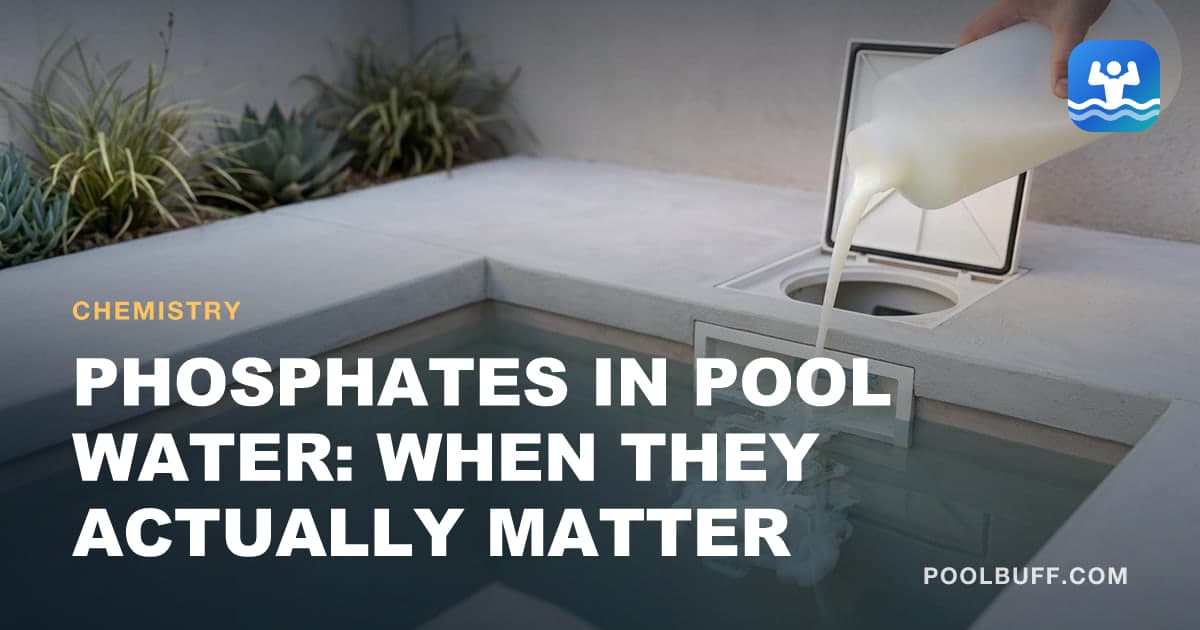
Phosphate removers are lanthanum salts — lanthanum chloride or carbonate. Lanthanum binds phosphate into an insoluble compound that your filter can catch.
Two practical consequences follow, and both surprise people:
The water goes cloudy. That cloud is the product working. It is the precipitate, and it has to be filtered out, so run the pump continuously and plan to clean the filter afterward.
Dose in stages. On a genuinely high reading, adding the full amount at once produces enough precipitate to blind the filter completely. Half now, run and clean, half later.
Where they come from
Mostly from outside the pool, which is why they come back.
Lawn fertilizer is the big one — carried in on feet, blown in as dust, washed in as runoff after rain. A pool downhill from a fertilized lawn will keep repopulating no matter how often you treat it, and the durable fix is drainage rather than chemistry.
Organic debris contributes as it decomposes. Leaves, pollen, grass clippings, anything that sits on the floor rather than being lifted out. It is one more argument for netting debris rather than waiting to vacuum it.
Fill water varies by municipality and can be meaningful. If your reading climbs after a big top-up, test the hose.
Some pool chemicals, including certain sequestrants and clarifiers, are phosphate-based. It is worth reading labels if you are treating for phosphates while also dosing something that adds them.
Testing it, and why two readings disagree
Phosphate testing is less settled than the confidence of a printed result suggests.
Most store tests and home kits measure orthophosphate, the form algae can use directly. Some laboratory methods measure total phosphate, which also counts organically bound and polyphosphate forms that have to break down before anything can eat them. The two numbers can differ substantially on the same sample, and a high total with a low ortho is not the same problem as a high ortho.
That matters more than it sounds, because several pool products contain phosphonates — most sequestrants used for metal staining among them — and phosphonates break down into phosphate over weeks. A pool dosed monthly with sequestrant is being fed phosphate by its own treatment, which is one of the more common reasons a level climbs back after removal with no visible source outside the pool.
Two practical notes follow.
Salt pools feel it sooner. A cell produces chlorine steadily rather than in weekly spikes, which is normally an advantage and does mean a narrower working band. Less headroom on the days the cell falls behind is exactly when a heavy phosphate load turns a small dip into a bloom.
Do not test straight after a removal treatment. The precipitate is still in suspension and readings in that window are unreliable. Wait until the water is clear and the filter has been cleaned.
What to do with the number
Test it once a season, and treat it as context rather than as an instruction.
- Under 500 ppb — ignore it. Genuinely.
- 500 to 1000 ppb — worth knowing, not worth treating on its own. Keep chlorine where it should be.
- Over 1000 ppb with recurring algae you cannot otherwise explain — this is the case removers exist for.
- Over 1000 ppb and the pool is clear — your chlorine is doing its job. Leave it alone.
The last line is the one that matters most, because it is the one nobody selling you a bottle will say out loud.
Go deeperActually getting rid of algaeThe shock level that works, and why most people stop a day too early.Frequently asked questions
Do phosphates cause algae in a pool?
No. Phosphates feed algae, but food alone does not cause a bloom. Chlorine at the right level kills algae faster than it can multiply regardless of how much phosphate is present. A pool that goes green has a chlorine problem first; phosphates only determine how fast the algae grows once chlorine has already failed.
What is a high phosphate level in a pool?
Most guidance treats anything under about 300 ppb as unremarkable and anything over 1000 ppb as worth acting on. Those numbers matter far less than people expect, because a pool holding proper chlorine stays clear at levels well above 1000. Treat the reading as context, not as a verdict.
Are phosphate removers worth the money?
In one situation, yes: algae that keeps returning even though your chlorine and stabilizer are genuinely correct and you have brushed and shocked properly. Then removing the food supply helps. Bought as a first response to a green pool, it is money spent on the wrong problem, which is why it gets sold that way so often.
Where do phosphates come from?
Mostly from outside the pool. Lawn fertilizer carried in on feet or by runoff, decomposing leaves and pollen, soil, some municipal fill water, and bather waste. A few pool chemicals contribute too, including certain sequestrants and some clarifiers, which is a mild irony given who tends to be using them.
Why did my water go cloudy after adding a phosphate remover?
That is the product working. Lanthanum binds phosphate into a fine precipitate, and that precipitate is what you are seeing. It needs to be filtered out, so run the pump continuously and expect to clean the filter afterward. Dose in stages on a high reading rather than all at once, or you will blind the filter.