Algae is easy to kill and hard to keep away, and most people get that backward.
They throw a lot of money at killing it — algaecide, shock, "green pool treatment," a service call — and then put zero thought into why it showed up. Three weeks later it's back and they conclude their pool is cursed.
It isn't cursed. Your free chlorine spent time below where it needed to be. That's the whole story, and until that's fixed you're just paying to reset the clock.
Key takeaways
- Algae is a symptom of chlorine sitting too low for your CYA level. Fix that or it comes back.
- Green algae dies in a day or two. Mustard and black algae take a week and much higher chlorine.
- Brushing isn't optional. Chlorine can't kill what's under a layer of dead cells or a protective coating.
- Algaecide won't clear an existing bloom. Save your money and buy chlorine.
- Pink slime and white water mold aren't algae at all, and they need a different approach.
Work out what you've got
Four things get called algae. They behave differently. If this is a pool you have just taken the cover off, the spring opening version covers the same fight on an opening-day clock, where the filter is cold and the CYA reading is the first thing to establish.
Green algae
The common one. Free-floating or clinging to surfaces, turns the water anywhere from faintly hazy-green to opaque swamp. Walls feel slippery.
Easiest to kill. Responds fast to proper chlorine levels.
Mustard algae (yellow algae)
Looks like sand or pollen collected on shaded walls and steps. Brushes away easily and then comes straight back in the same spot. Often mistaken for dirt.
Chlorine-tolerant, which is what makes it a genuine pain. It survives levels that would wipe out green algae, and it hides on anything that's been in the pool.
Black algae
Not actually algae — it's cyanobacteria. Dark raised spots, usually in plaster, often in shaded areas and around fittings. It has a protective layer over the top and a root structure that digs into the surface.
The hardest to remove. You have to break it open mechanically before chemistry does anything — the full black algae protocol covers the brushing schedule and why a pool that keeps getting it is usually telling you about its surface.
Pink slime and white water mold
Also not algae. Pink slime is bacterial, and white water mold is closer to a fungus. You get pink or gray slime in low-flow areas, or white growth that looks like wet tissue paper. Both often live inside the plumbing and behind fittings, where nothing reaches.
Needs a different approach: very high chlorine held for longer, plus attention to the plumbing itself.
| Chlorine neededMy default | Time to kill | The bit that matters | |
|---|---|---|---|
| Green | Shock level (40% CYA) | 24-48 hrs | Brush daily, filter continuously |
| Mustard / yellow | Shock level, held 2-3 days | 3-5 days | Disinfect every item that touched the water |
| Black | Shock level, held 4-7 days | 1-2 weeks | Mechanical brushing first, every day |
| Pink slime / white mold | Above shock level | 3-7 days | Treat the plumbing, not just the pool |
The kill
Same core process for all of them, with different intensity and duration.
- 1
Test CYA and set your target
10 minShock level is about 40% of your CYA reading. Without that number you're guessing, and guessing low is exactly why people shock a green pool three times and it stays green.
If your CYA is over 80, seriously consider a partial drain first. Holding 32+ ppm of chlorine for a week costs more than replacing some water.
- 2
Drop pH to 7.2
15 minChlorine works substantially better at lower pH. Get to 7.2 before you start and the whole job goes faster and cheaper.
- 3
Clean the filter and empty the baskets
45 minYou're about to ask the filter to catch an enormous amount of dead algae. Start it clean.
On a bad green bloom you'll clean it again in a day, and probably again after that.
- 4
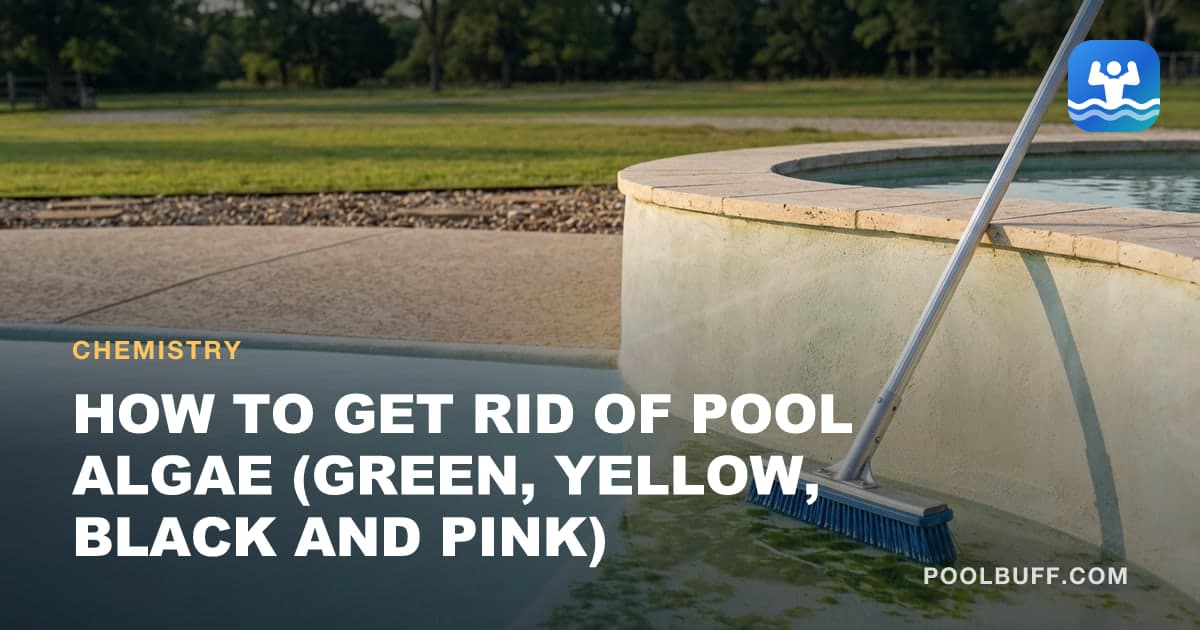
Brush everything, then brush it again
30 min dailyThis is the step that separates people who clear a pool in three days from people who fight it for three weeks.
Chlorine can't kill what it can't touch. A layer of dead algae shields the live algae underneath. Brushing breaks that up and exposes fresh cells.
Get into the step corners, the underside of step lips, behind ladder rails, around the light niche, and the shaded side of the pool. Every day until it's clear.
For black algae, use a stainless brush on plaster — you're physically breaking a protective coating, and a soft brush just polishes it.
- 5
Shock at dusk and hold it
24 hrs to 1 weekLiquid chlorine. Add at dusk so UV doesn't waste it. Retest every few hours and top back up to shock level.
Holding the level is the job. In a heavy bloom your chlorine will drop fast — that's the algae dying and consuming it. That's good, but it means you have to keep feeding it.
- 6
Use the overnight test to know when you're done
OvernightFree chlorine at sunset, free chlorine at sunrise, no sun in between.
Lose under 1 ppm and you've killed it. Lose more and something is still alive, no matter how clear the water looks.
This test is the only reliable finish line. Water clarity lies — it can look great while mustard algae is still hiding on the shaded steps.
- 7
Filter it out
2-4 daysPump running around the clock. Clean the filter whenever pressure climbs 8-10 psi. A clarifier at the very end helps grab the last of the fine haze.
Mustard algae: the extra step everyone skips
If you've got mustard algae, killing what's in the pool isn't enough. It survives on surfaces outside the water and reintroduces itself.
While chlorine is at shock level, put everything in the pool:
- Pool toys, floats, noodles, anything that lives poolside
- The pole, the brush, the leaf net, the vacuum head and hose
- Swimsuits and towels that have been in the water — or wash them hot
- The robotic cleaner, if it's rated for it, or wipe it down with chlorinated water
- Ladder steps and handrails, and the underside of the diving board if there is one
Miss one item and you're doing this again in two weeks. I've seen a single pool noodle in a shed restart a mustard bloom three times before anyone worked it out.
Why algaecide isn't the answer
I'm not saying algaecide is useless. I'm saying it's sold for the wrong job.
Polyquat 60 is a decent preventative. Add it before closing, or before a two-week vacation when nobody's testing. It buys you a margin.
Copper-based algaecides work but they put copper in your water, and copper stains. Blue-green staining on plaster from an over-enthusiastic copper algaecide is a specialist removal job. Use them sparingly if at all.
Quat algaecides foam. A lot. Enough that the pool looks like a bubble bath for days and people think something's gone badly wrong.
None of them will clear an established bloom at any sane dose. Chlorine does that. Buy chlorine.
Stopping it coming back
Here's the actual prevention list, and it's short:
- Test CYA monthly. Set free chlorine at 10–15% of it — around 11–12% is a good working target. This one habit prevents most blooms.
- Test free chlorine twice a week in season. Not once. The second test is the one that catches a drop before it becomes a bloom.
- Brush the shaded areas weekly. Steps, corners, behind rails. Algae starts where water sits still.
- Run the pump long enough. Under-circulated water has dead zones, and dead zones grow things.
- After heavy rain or a party, test everything. Both events drop chlorine hard.
- Going away? Shock before you leave and add polyquat, or get someone to test midweek.
Do those and you'll probably never fight algae again. Skip the CYA test and you'll be back here next August.
What clears it
- Check price
18-inch stainless pool brush
Stainless bristles for gunite and concrete only. It will damage a vinyl liner.
- Check price
cal-hypo shock
68% calcium hypochlorite in 1 lb bags, so you dose a bag rather than guess at a scoop.
- Check price
polyquat algaecide
Polyquat 60 does not foam and does not add copper the way cheaper algaecides do.
- Check price
Taylor K-2006C test kit
Drop-count titration rather than color matching, and it tests CYA properly.
Frequently asked questions
How do I get rid of green algae in my pool fast?
Balance pH to about 7.2, brush every surface, then shock to roughly 40% of your CYA reading and hold that level, retesting and topping up every few hours. Run the pump continuously. Most green blooms are dead within 24 to 48 hours, then it's two more days of filtering to clear the water.
What kills mustard algae in a pool?
Sustained high chlorine plus mechanical work. Mustard algae is chlorine-tolerant, so hold shock level for two to three days rather than one, brush constantly, and disinfect anything that's been in the water — pool toys, floats, brushes, swimsuits, and the cleaner itself. Miss one and it's back within two weeks.
Does algaecide actually work?
As a preventative, yes — a polyquat algaecide used before closing or during a stretch you can't test regularly is genuinely useful. As a cure for an established bloom, no. It's far too slow and far too expensive at the doses required. Chlorine is what kills algae.
Why does my pool keep getting algae?
Free chlorine spending time below the level your CYA demands. That's it, nine times out of ten. Either CYA crept up from tablets and nobody raised the chlorine target, or the pool goes untested for stretches during hot weather. Test CYA monthly and set free chlorine at 10-15% of it, never below 7.5%.
How do I get rid of black algae?
Break the protective layer first with a stainless steel brush on plaster, or a stiff nylon brush on vinyl and fiberglass. Then hold shock level for several days. Some people apply a trichlor tab directly to a stubborn spot, which works but will bleach plaster, so weigh that up. Black algae roots into the surface, so expect a fight.
Is pool algae dangerous to swim in?
The algae itself mostly isn't. But water supporting an algae bloom has essentially no working sanitizer, which means whatever else is in there is also thriving. It also hides the bottom, which is a genuine drowning hazard. Keep people out until it's cleared.