Walk into an indoor pool that reeks of chlorine and someone will say "wow, they really dumped the chlorine in here."
They've got it exactly backward. That smell means the pool needs more chlorine, and it's one of my favorite things to explain to people because the look on their face is always the same.
Key takeaways
- Free chlorine is the only number worth managing day to day.
- Combined chlorine over 0.5 ppm means shock. That's the smell, and that's what stings eyes.
- The 'too much chlorine' smell at a public pool is the opposite — it's a pool that needs more.
- Total chlorine minus free chlorine equals combined. That subtraction is the whole reason to test total.
- Test strips that only read total chlorine are close to useless for actually running a pool.
The three numbers
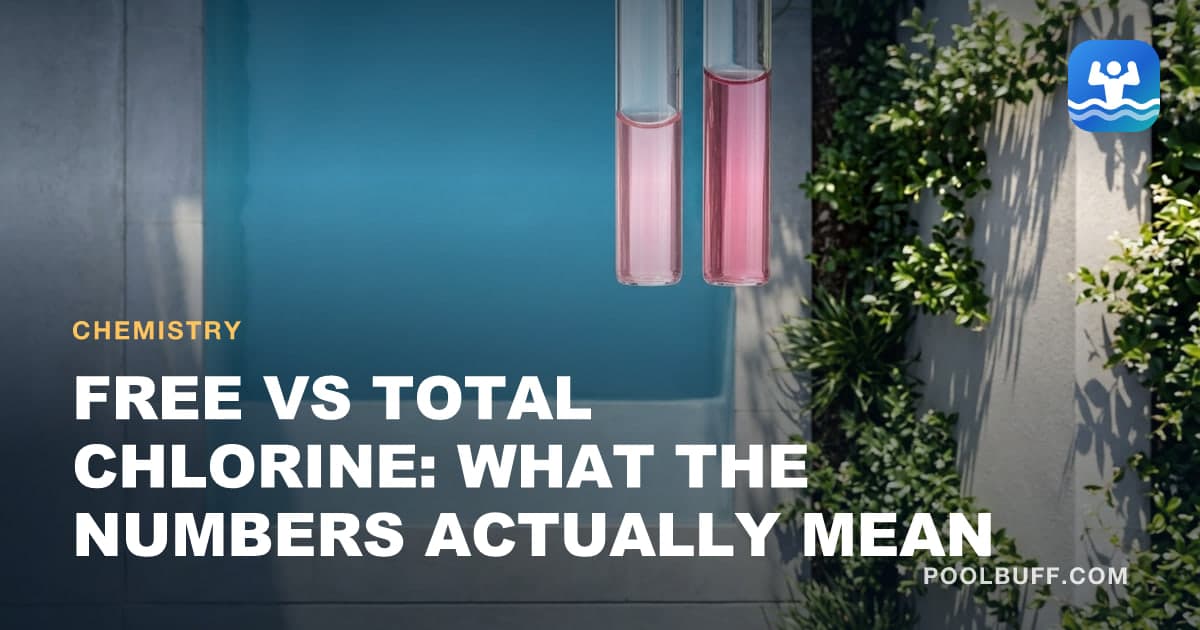
Free chlorine (FC) is chlorine that hasn't reacted with anything yet. It's on duty. This is the number in your target range, the number you dose against, the number that matters.
Combined chlorine (CC) is chlorine that's already found something to react with — sweat, urine, sunscreen, skin cells, leaves breaking down in a corner. It's mostly spent. It's a weak, slow sanitizer at best, and it's what produces the smell and the eye sting.
Total chlorine (TC) is free plus combined. On its own it tells you nothing useful. Its whole purpose is that you subtract free from it to get combined.
Total chlorine − Free chlorine = Combined chlorineThat subtraction is the only reason to test total chlorine at all.
Why the smell is backward from what everyone thinks
Chlorine reacts with nitrogen compounds — mostly from swimmers — to form chloramines. Monochloramine, dichloramine, trichloramine, in increasing order of unpleasantness.
Trichloramine is volatile. It comes off the water and into the air. That's the smell.
So a pool that smells strongly of chlorine is a pool full of chloramines, which is a pool where chlorine got consumed faster than it was replaced. The fix is to add enough chlorine to break the chloramines apart — breakpoint chlorination — which destroys them and, once the level comes back down, leaves you with a pool that smells like nothing.
A properly chlorinated pool has almost no smell. If you can smell your pool from the deck, test combined chlorine.
Why outdoor pools rarely see it
Combined chlorine is largely an indoor problem, and the reason is sunlight.
UV breaks chloramines apart on its own. An outdoor pool is effectively running a free breakpoint treatment across its entire surface every sunny day, which is why most residential outdoor pools test at zero combined chlorine most of the time without anybody doing anything deliberate about it.
The same sunlight is what destroys free chlorine and creates the need for stabilizer in the first place, so the two effects are linked: the UV that costs you chlorine is also cleaning up after it. It is one of the few genuinely free things in pool care.
The practical read is that a persistent combined chlorine reading on an outdoor pool means something unusual is happening. Either the reading is wrong, or there is a nitrogen source large enough and steady enough to outpace both the chlorine and the sun.
What to do about combined chlorine
Target: below 0.5 ppm. Ideally zero.
Above 0.5, you shock. And not just a bit — you need to reach breakpoint, which is roughly ten times your combined chlorine reading in additional free chlorine.
So combined chlorine at 0.8 ppm means you need to add about 8 ppm of free chlorine on top of what's already there. Get close but not all the way and you actually make things worse — you form more chloramines rather than destroying them, and the smell gets stronger. That's the trap.
Compare that to your normal shock level (about 40% of CYA) and use whichever number is higher.
Go deeperHow to shock a pool properlyWorking out the right level, holding it, and knowing when you're actually done.Testing it properly
This is where a lot of people get let down by their equipment.
OTO test kits (the yellow drops) only read total chlorine. They can't distinguish free from combined at all. Fine for a rough "is there chlorine," useless for actually running a pool.
DPD test kits read free and total separately by matching a shade of pink. Taylor's K-2005 matches against standards of 1, 2, 3, 5, 7.5 and 10 ppm, and above 10 ppm Taylor says the sample can bleach out and read falsely low, so its card dilutes the sample and calls the result approximate. Combined chlorine is total minus free, so it's only as fine as those color steps.
FAS-DPD is the one to own. It's a drop-count titration — you add drops until pink turns clear, and count. Reads in 0.2 ppm steps up to 20 ppm, enough for a shock at up to 50 ppm of stabilizer, and gives you combined chlorine cleanly. Around $90 to $100 for a kit that lasts years on refill reagents.
Test strips read total chlorine on most brands, and badly. If your strip has one chlorine pad, it's total. That's not enough information to make a decision with.
When combined chlorine will not come down
Occasionally somebody shocks to breakpoint, waits, tests, and the combined chlorine is still sitting there. Three explanations cover nearly all of it.
The shock never reached breakpoint. This is the common one. Ten times the combined reading is a great deal of chlorine, and people add what feels like a lot rather than what the arithmetic actually says. Falling short forms more chloramines instead of fewer, so the reading can genuinely rise. Work out the number, add it in one dose, and hold the level — rather than adding a bit each evening and never crossing the line.
The reagent is reporting something else. MPS reads as combined chlorine, as the note above says. So does an old or contaminated DPD reagent, and so does a sample scooped beside a return that has just had liquid chlorine poured near it. Retest from elbow depth, away from returns, with fresh reagent, before believing a stubborn number.
There is a continuous nitrogen source. A heavy bather load, an animal getting in at night, or fill water carrying nitrates. Well water is worth testing for nitrate directly if a pool refuses to clear — it is uncommon, but it makes the problem unsolvable by chlorine alone, because you are dosing against a supply rather than against a quantity.
The everyday version
For a normal residential pool:
- Test free chlorine twice a week. Adjust against your CYA-scaled target.
- Test total chlorine once a week. Subtract to get combined.
- Combined above 0.5? Shock to breakpoint.
- Big party, heavy use, or a hot week? Test both the next morning.
- Indoor pool? Test combined chlorine more often. Without UV to help break chloramines down and with limited air exchange, they build up much faster.
That's the whole discipline. Two numbers, one subtraction, and you'll never wonder why your pool smells.
Go deeperChlorine or bromine in a spa?Why hot water changes the answer, and why pool tablets do not belong in a tub.Frequently asked questions
What is the difference between free and total chlorine?
Free chlorine is the portion still available to kill things. Total chlorine is free chlorine plus combined chlorine, which is chlorine that has already reacted with organic waste and is largely spent. Subtract free from total and you get combined, which is the number that tells you whether it's time to shock.
What should combined chlorine be in a pool?
Below 0.5 ppm, and ideally at or near zero. Above 0.5 ppm you get the sharp chlorine smell, stinging eyes and irritated skin, and it means the water needs shocking to breakpoint to destroy the chloramines.
Why does my pool smell strongly of chlorine?
Because it doesn't have enough free chlorine. That smell is chloramines — spent chlorine bonded to organic waste. A well-chlorinated pool has almost no smell at all. Adding more chlorine, not less, is what fixes it.
Can free chlorine be higher than total chlorine?
No. Total is free plus combined, so total is always equal to or greater than free. If your test says otherwise, you've either got old reagents, a reading error, or interference from a recent non-chlorine shock addition, which reads as combined chlorine for a day or two.
Do I need to test total chlorine every week?
Free chlorine twice a week is the priority. Total chlorine weekly is plenty for most pools, more often if you have a lot of swimmers or an indoor pool where chloramines build up faster and hang around in the air.