Taylor · Complete
Taylor K-2005
Taylor's K-2005 color-match kit: the DPD chlorine and bromine scale and where it stops, how it differs from the K-2006, and every reagent number.
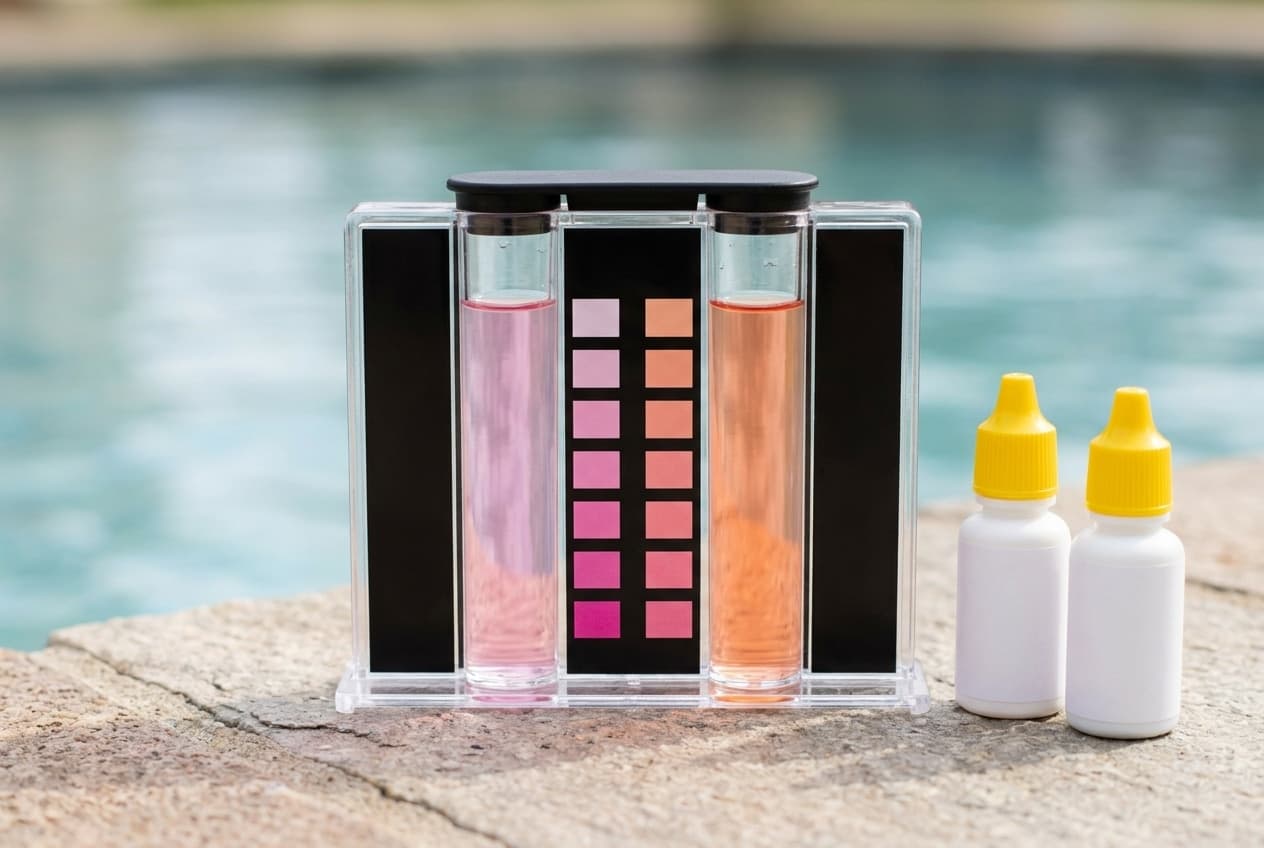
The K-2005 is Taylor's color-match test kit for pools and spas, and its product page calls it Taylor's best-selling kit. It runs the same tests as the K-2006C except one: chlorine is read by matching a DPD color rather than counting drops, and it adds a bromine test. Taylor sells it in two sizes. The K-2005 has .75 oz reagent bottles and lists at $114.47 on Taylor's store. The K-2005C Service Complete has 2 oz bottles and lists at $205.22.
What it tests
From Taylor's product page and its instruction card, number 5165:
- Free and total chlorine: DPD, matched against standards of 1, 2, 3, 5, 7.5 and 10 ppm. Combined chlorine is total minus free.
- Total bromine: DPD, against 2, 4, 6, 10, 15 and 20 ppm, in a second column of the same color blocks.
- pH: phenol red, matched from 7.0 to 8.0 in steps of 0.2, with acid demand and base demand tests that count drops toward the pH you want.
- Total alkalinity: titration, 1 drop = 10 ppm with a 25 mL sample, or 25 ppm with 10 mL when high alkalinity is expected.
- Calcium hardness: EDTA titration, 1 drop = 10 ppm, or 25 ppm with a 10 mL sample.
- Cyanuric acid: a turbidity test that reads 30 to 100 ppm.
Taylor's photograph of the K-2005 shows fourteen .75 oz dropper bottles: R-0001 through R-0012, R-0011L among them, and two of the cyanuric acid reagent R-0013. With them come the comparator, a calibrated bottle for the CYA test and Taylor's Watergram water balance wheel. The K-2005C photograph shows fifteen 2 oz bottles, with a third R-0013, and a dropper.
The chlorine and bromine tests, step by step
From Taylor's card:
- Take the sample 18 inches below the surface. Rinse the tube, then fill the small tube to the 9 mL mark.
- Add 5 drops of R-0001 and 5 drops of R-0002. Cap and turn it over to mix.
- Match the color. For a chlorine pool, read the Cl column: that's your free chlorine. For a bromine pool, read the Br column: that's your total bromine, and you're done.
- For total chlorine, add 5 drops of R-0003 to the same sample, cap and mix.
- Match the color immediately. That's your total chlorine.
- Subtract free from total. That's your combined chlorine.
Taylor's FAQ gives the reason to be quick: DPD darkens within seconds as it reacts with the air, so take readings right away unless an instruction says otherwise. Match colors in natural daylight, with the comparator at eye level and your back to the sun, and not through sunglasses. The card adds: facing north.
Where the chlorine scale stops
Taylor's card gives the DPD chlorine test a range of 0 to 10 ppm, and the top color block is 10. Above 10 ppm, Taylor says, the sample can bleach out partly or completely and read falsely low. That's the reading to distrust after a shock, when a pale pink can mean too much chlorine rather than too little.
The card's answer for a color off the scale is to dilute:
- Repeat the test with 4.5 mL of sample, made up to the 9 mL mark with tap water, and multiply by 2.
- If it's still off the scale, use 1.8 mL made up to 9 mL, and multiply by 5.
Taylor calls both results approximate. The FAS-DPD test in the K-2006 kits reads 0 to 20 ppm by counting drops, with no dilution. Shocking a pool to 40% of its cyanuric acid level means targets above 10 ppm once CYA passes 25. That's the range where the K-2005 is diluting and approximating.
How fine the readings are
Taylor gives the accuracy of a color-match test as half the gap between two color standards. On this comparator that works out to:
- Between 1 and 3 ppm: 0.5 ppm either way.
- Between 3 and 5 ppm: 1 ppm either way.
- Between 5 and 10 ppm: 1.25 ppm either way.
- Below 1 ppm: there's no lower standard to match against.
That matters most for combined chlorine, which is the gap between two such readings. The water quality guidelines Taylor reproduces in its FAQ, from the Pool & Hot Tub Alliance, put the maximum combined chlorine at 0.2 ppm for pools and 0.5 ppm for spas. With 1 ppm as the smallest step on the scale, the K-2005 can't show whether a pool is under that line. The K-2006's drop test reads combined chlorine directly, in 0.2 ppm steps with a 25 mL sample.
pH is matched the same way, in steps of 0.2. Alkalinity and hardness are drop tests on both kits, accurate to plus or minus one drop.
K-2005 or K-2005C
Both run the same tests. Taylor's FAQ gives the test counts for each size:
- Free chlorine, combined chlorine and pH: 110 each in the K-2005, 300 in the K-2005C.
- Total alkalinity, at 100 ppm: 52, or 150.
- Calcium hardness, at 200 ppm: 26, or 75.
- Cyanuric acid: 8, or 20.
Taylor gives no count for bromine. The bromine test uses the same R-0001 and R-0002 as free chlorine, 5 drops of each, so the two share the same bottles. As arithmetic from Taylor's figures, a .75 oz (22 mL) bottle at 25 drops per mL holds about 550 drops, which at 5 drops a test is Taylor's 110.
At Taylor's list prices, the 2 oz kit costs $205.22 against $114.47 for nearly three times the chlorine, pH and alkalinity tests.
The kits it gets mixed up with
- K-2006 and K-2006C: Taylor's FAQ says the only difference is the chlorine test. The K-2006 counts drops of FAS-DPD reagent for free and combined chlorine, reads to 20 ppm, and has no bromine test. It lists at $142.71, or $250.20 for the 2 oz K-2006C. The K-2006C page has its full procedure.
- K-2005-SALT and K-2005C-SALT: the K-2005 with a salt titration added, at 200 ppm a drop. Taylor lists them at $180.89 and $417.06.
- K-1005: Taylor's 9-way DPD kit, with the same nine tests at $69.38. Its color standards are different: chlorine at 0.5, 1, 2, 3 and 5 ppm, bromine at 1, 2, 4, 6 and 10, and pH at 6.8, 7.2, 7.5, 7.8 and 8.2. It reads lower but stops sooner, and its pH scale is wider but in coarser steps than the K-2005's.
Readings that look wrong
- Chlorine reads low, or oddly pale, after a shock. Above 10 ppm the DPD sample can bleach. Dilute and retest, as above.
- The chlorine sample is cloudy. Taylor puts it down to calcium hardness above 500 ppm. Add the R-0001 and R-0002 to the tube first, then the sample.
- Free chlorine reads wrong. Leftover R-0003 in the tube from an earlier total chlorine test will throw it off. Rinse the tubes before and after every test.
- Combined chlorine reads high after a non-chlorine shock. Monopersulfate reacts with R-0003. Taylor's K-2041 removes the interference for kits with .75 oz reagents, and K-2042 for 2 oz.
- Alkalinity reads high. Taylor says cyanuric acid above 30 ppm titrates as alkalinity. Subtract one third of your CYA reading from the alkalinity result.
- The pH test turns blue or purple, or alkalinity goes blue then yellow. Chlorine above about 10 ppm. Add one drop of R-0007 to the pH sample first, or one extra drop to the alkalinity test.
- The hardness endpoint is purple. Metals, most likely copper or iron. Add five or six drops of R-0012 before the buffer and indicator, and count them.
Keeping the reagents good
Taylor's storage rules: keep reagents between 36°F and 85°F, out of direct sunlight, away from pool treatment chemicals, with the caps screwed back on tightly.
Taylor's card says to replace reagents once each year, and every bottle carries a best-by date and lot number. At Taylor's list prices on 13 September 2026, replacing every reagent bottle in the K-2005 comes to $85.09, against $114.47 for a new kit. For the K-2005C, it comes to $154.03, against $205.22.
Use Taylor reagents only. Taylor says its comparator color standards are made for its own reagent concentrations, and even its two phenol red solutions aren't interchangeable: R-0004 is for 2000 Series comparators like this one, and R-0014 for Residential comparators.
Taylor recommends replacing the comparator every two to three years.
Where Taylor's documents disagree, or are unclear
- Ideal bromine. The instruction card gives total bromine as 2 to 3 ppm for residential pools and 2 to 4 for residential spas. The Pool & Hot Tub Alliance table in Taylor's FAQ gives 4 to 6 ppm as ideal for all types.
- Ideal chlorine in a spa. The card gives free chlorine as 2 to 4 ppm for pools or spas. The FAQ's table gives 3 to 5 for spas.
- The bottom of the range. The card says the DPD chlorine test reads from 0 ppm. The case label says 1 to 10 ppm, and the lowest color block is 1.
- How often to replace reagents. The card says once each year. The FAQ says seasonally, and to replace any reagent past its best-by date.
- The comparator's number. Taylor's product page doesn't name the comparator. This page gives 9056 because its standards match the one in Taylor's photographs of both kits.
Buying it
Taylor's site publishes no warranty for its test kits. Its return policy covers orders from Taylor's own store: returns within 30 days, unused and resalable, with an RMA number, and a 20% restocking fee unless Taylor shipped the wrong item.
Taylor's FAQ gives its support line as 877-837-8548, 8 a.m. to 5 p.m. Eastern, Monday to Friday. Have the kit number, which starts with K- and is on the case label, and the reagent names and lot codes ready.
If you're choosing between this and the K-2006, the test kit roundup explains why the drop-count chlorine test is the one it picks.
Which model do you have?
The model number is on the test kit label. Everything else in the range is shared — these are the parts that change with it.
| Model | SKU | Bottle size | Cyanuric acid reagent | Chlorine and pH tests | Alkalinity tests at 100 ppm | Hardness tests at 200 ppm | Cyanuric acid tests | Note |
|---|---|---|---|---|---|---|---|---|
| K-2005, English instructions | K-2005 | .75 oz (22 mL) | 2 bottles | 110 each | 52 | 26 | 8 | Taylor's store lists it at $114.47. |
| K-2005S, Spanish instructions | K-2005S | .75 oz (22 mL) | 2 bottles | 110 each | 52 | 26 | 8 | The same .75 oz kit with Spanish instructions, at the same $114.47. |
| K-2005C Service Complete, English instructions | K-2005C | 2 oz (60 mL) | 3 bottles | 300 each | 150 | 75 | 20 | The 2 oz size, at $205.22 on Taylor's store. |
| K-2005CS Service Complete, Spanish instructions | K-2005CS | 2 oz (60 mL) | 3 bottles | 300 each | 150 | 75 | 20 | The 2 oz kit with Spanish instructions, at $205.22. |
Taylor K-2005 refills and supplies, and what goes wrong
Read off the manufacturer’s own documents and checked before it ships. Open a row for what the problem looks like and what the maker says to do — or start from the symptom and work down.
What is it doing?
R-0001 and R-0002 together make the free chlorine and bromine tests: 5 drops of each in a 9 mL sample. Above 10 ppm, Taylor says, the sample can bleach partly or completely and read falsely low. Its card's fix for an off-scale color is to repeat the test with 4.5 mL of sample diluted to 9 mL with tap water and multiply by 2. If it's still off-scale, use 1.8 mL and multiply by 5. Taylor calls both results approximate. The 2 oz bottle is R-0001-C.
Live pricing arrives when the retailer programs are approved.
Taylor puts cloudiness down to calcium hardness above 500 ppm, which makes calcium or magnesium salts come out of solution. Its fix is to put the 5 drops of R-0001 and 5 of R-0002 into the tube first, then add the sample water carefully on top. The 2 oz bottle is R-0002-C.
Live pricing arrives when the retailer programs are approved.
The reagent that turns a free chlorine reading into total chlorine. Even a trace left in the tube from an earlier test throws off the next free chlorine reading, so Taylor says to rinse the tubes before and after every test. A non-chlorine shock containing monopersulfate also reacts with it and gives false total and combined chlorine. Taylor's K-2041 pack removes that interference in kits with .75 oz reagents. The 2 oz bottle is R-0003-C.
Live pricing arrives when the retailer programs are approved.
Both come from chlorine above about 10 ppm, which Taylor says interferes with the pH and alkalinity indicators. For pH in a 2000 Series comparator like this kit's, add one drop of R-0007 to the sample first and retest. For alkalinity, add one extra drop beyond the two the procedure already calls for. The 2 oz bottle is R-0007-C.
Live pricing arrives when the retailer programs are approved.
Taylor puts a purple endpoint down to metals, most likely copper or iron, from algaecides, pipes or the fill water. Add five or six drops of R-0012 to the sample before the buffer and indicator, run the test as normal, and count those first drops in the total. Purple dots in the sample are magnesium hydroxide and don't affect the endpoint. The 2 oz bottle is R-0012-C.
Live pricing arrives when the retailer programs are approved.
Taylor's photograph of the K-2005 shows a comparator with this one's standards: chlorine 1 to 10 ppm, bromine 2 to 20 and pH 7.0 to 8.0. To clean a cell, Taylor says to fill it with water, add a couple of drops of R-0009, scrub with a bristle brush, rinse, and throw the brush away. It recommends replacing the comparator every two to three years, depending on how often it's used.
Live pricing arrives when the retailer programs are approved.
Taylor K-2005 manuals and documentation
Hosted by the manufacturer. These open on Taylor’s own servers, so they stay current.
- K-2005 and K-2005C product page — tests, color standards, sizes and pricesspec
- Instructions 5165 — the test procedures, range limits and NSF classesmanual
- Taylor technical and support FAQs — K-2005 test counts, bleaching, accuracy and storagespec
- 9-Way Test Kit K-1005 product page — the smaller DPD kit's color standardsspec
Taylor K-2005 refills and supplies
Every reagent, refill and accessory number the manufacturer lists for this kit, from its own documents. Marked rows are the ones covered above with a symptom and a diagnosis.
36 items
| Item | Description | Note |
|---|---|---|
| R-0001-A | DPD reagent #1, .75 oz what goes wrong | |
| R-0001-C | DPD reagent #1, 2 oz | |
| R-0002-A | DPD reagent #2, .75 oz what goes wrong | |
| R-0002-C | DPD reagent #2, 2 oz | |
| R-0003-A | DPD reagent #3, .75 oz what goes wrong | For total, and so combined, chlorine |
| R-0003-C | DPD reagent #3, 2 oz | |
| R-0004-A | pH indicator solution, phenol red, for 2000 Series, .75 oz | Not interchangeable with R-0014, which is for Residential comparators |
| R-0004-C | pH indicator solution, phenol red, for 2000 Series, 2 oz | Also sold as R-0004-D (4 oz), R-0004-E (16 oz), R-0004-F (32 oz) and R-0004-G (gallon) |
| R-0005-A | Acid demand reagent, for 2000 Series, .75 oz | |
| R-0005-C | Acid demand reagent, for 2000 Series, 2 oz | Also sold as R-0005-E (16 oz) |
| R-0006-A | Base demand reagent, for 2000 Series, .75 oz | |
| R-0006-C | Base demand reagent, for 2000 Series, 2 oz | Also sold as R-0006-E (16 oz) |
| R-0007-A | Thiosulfate N/10, .75 oz what goes wrong | Used in the alkalinity test, and to clear high-chlorine interference |
| R-0007-C | Thiosulfate N/10, 2 oz | Also sold as R-0007-E (16 oz) and R-0007-G (gallon) |
| R-0008-A | Total alkalinity indicator, .75 oz | |
| R-0008-C | Total alkalinity indicator, 2 oz | Also sold as R-0008-E (16 oz) and R-0008-G (gallon) |
| R-0009-A | Sulfuric acid .12N, .75 oz | The alkalinity titrant; also cleans the comparator cell |
| R-0009-C | Sulfuric acid .12N, 2 oz | Also sold as R-0009-E (16 oz) and R-0009-F (32 oz) |
| R-0010-A | Calcium buffer, .75 oz | |
| R-0010-C | Calcium buffer, 2 oz | Also sold as R-0010-E (16 oz) |
| R-0011L-A | Calcium indicator liquid, .75 oz | |
| R-0011L-C | Calcium indicator liquid, 2 oz | Also sold as R-0011L-E (16 oz) |
| R-0012-A | Hardness reagent, .75 oz what goes wrong | |
| R-0012-C | Hardness reagent, 2 oz | Also sold as R-0012-E (16 oz) and R-0012-G (gallon) |
| R-0013-A | Cyanuric acid reagent, .75 oz | The K-2005 comes with two |
| R-0013-C | Cyanuric acid reagent, 2 oz | The K-2005C comes with three. Also sold as R-0013-E (16 oz), R-0013-F (32 oz) and R-0013-G (gallon) |
| 9056 | 2000 Series comparator, bromine and chlorine high range, DPD/pH, 7.0 to 8.0 what goes wrong | The standards match the comparator in Taylor's photographs of both kit sizes |
| 9191 | Calibrated bottle, 7 and 14 mL, for the CYA test | |
| 3312 | Large cell cap, for 2000 Series comparators | |
| 3313 | Small cell cap, for 2000 Series comparators | |
| 3030 | Comparator cap, black, for 9056, 9057 and 9058 | |
| 6026 | Watergram water balance calculator | The number printed on the wheel in Taylor's photographs; not listed on Taylor's store |
| 2004B | Pool & Spa Water Chemistry booklet, English | The guidebook the instruction card refers to for acid and base demand treatment tables |
| K-2041 | Monopersulfate interference remover, for 2000 Series kits with .75 oz reagents | An add-on, not in the kit |
| K-2042 | Monopersulfate interference remover, for 2000 Series kits with 2 oz reagents | An add-on for the K-2005C, not in the kit |
| 9199 | Daylight comparator lamp, with adapter | An accessory, for color matching without daylight |