Taylor · Complete
Taylor K-2006C
Taylor's K-2006C drop kit: what each test measures, where its chlorine range stops, how it differs from the K-2006 and K-2005, and every reagent number.
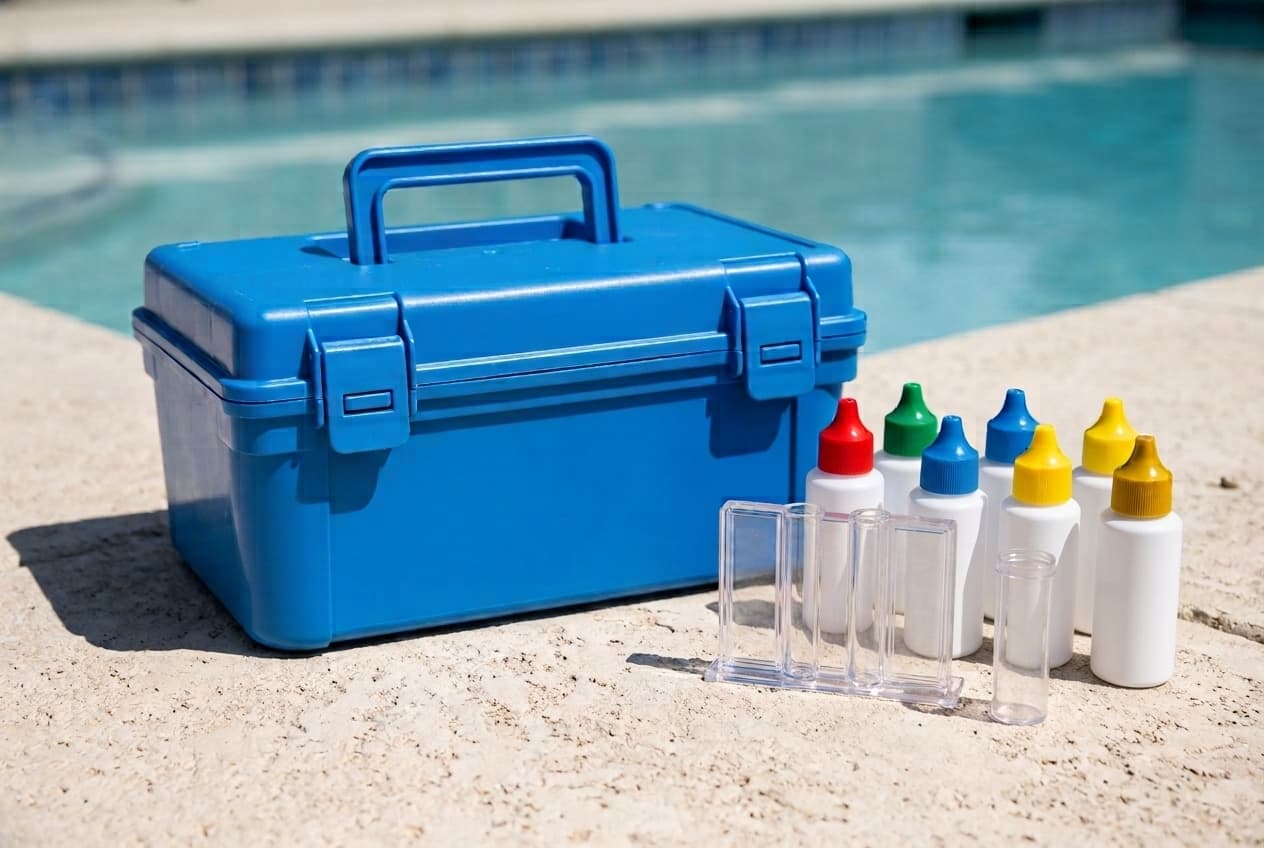
The K-2006C is Taylor's drop test kit for pools and spas, and the letters matter. FAS-DPD means free and combined chlorine are measured by counting drops rather than matching a color. The C is the larger of the two sizes Taylor sells, with 2 oz reagent bottles where the K-2006 has .75 oz. Taylor's own store lists it at $250.20. Retailers sell it for less: Poolweb had it at $149.23 on 12 September 2026.
What it tests
Taylor's product page and its instruction card, number 5165, give the method for each test:
- Free and combined chlorine: FAS-DPD titration. 1 drop = 0.2 ppm with a 25 mL sample, or 0.5 ppm with 10 mL.
- pH: phenol red, matched against the comparator from 7.0 to 8.0, with acid demand and base demand tests that count drops toward the pH you want.
- Total alkalinity: titration, 1 drop = 10 ppm with a 25 mL sample. When high alkalinity is expected, a 10 mL sample makes each drop 25 ppm.
- Calcium hardness: EDTA titration, 1 drop = 10 ppm, or 25 ppm with a 10 mL sample.
- Cyanuric acid: a turbidity test that reads 30 to 100 ppm. You mix 7 mL of pool water with reagent to the 14 mL mark, then pour the cloudy mixture into the comparator's tube until a black dot at the bottom just disappears.
Taylor gives the accuracy of any of its drop tests as plus or minus one drop, and of a color match as half the gap between two color standards. So pH and CYA are the two readings here that still depend on your eyes.
Taylor's product photograph of the K-2006C shows what comes in the blue case: fourteen 2 oz dropper bottles (R-0003, R-0004 through R-0013, three of them the cyanuric acid reagent R-0013, and R-0871), two 10 g bottles of DPD powder with dippers, the pH and CYA comparator, a calibrated bottle for the CYA test, a dropper, and Taylor's Watergram water balance wheel.
The chlorine test, step by step
From Taylor's card, number 5165:
- Take the sample 18 inches below the surface. Rinse the tube, then fill the large tube to 25 mL for 0.2 ppm a drop, or 10 mL for 0.5 ppm.
- Add 2 dippers of R-0870 DPD powder and swirl until it dissolves. The sample turns pink if free chlorine is present. If no pink develops, or the pink fades, add more powder until it stays pink.
- Add R-0871 one drop at a time, swirling and counting after each drop, until the pink turns colorless.
- Multiply the drops by 0.2 or 0.5. That is your free chlorine.
- For combined chlorine, add 5 drops of R-0003 to the same sample. It turns pink again if combined chlorine is present.
- Titrate with R-0871 again, counting the new drops only, until colorless. Multiply by the same figure. That is your combined chlorine, and free plus combined is your total.
To confirm a true endpoint, Taylor suggests adding one more drop: if the color does not change, do not count it.
Where the chlorine range stops
Taylor's card gives the FAS-DPD test a range of 0 to 20 ppm, against 0 to 10 ppm for the DPD color-matching test in its other kits. Above 10 ppm, Taylor says, a DPD color sample can bleach out and read falsely low. That doubled range is the practical case for FAS-DPD during a shock.
Twenty ppm is still a ceiling. Shocking a pool to 40% of its cyanuric acid level means targets above 20 ppm once CYA passes 50. Taylor's FAQ says a drop test's equivalence can only be changed by changing the sample size in proportion, and asks you to contact its support team before changing it, so this page does not give a dilution for readings above the range.
High chlorine affects the other tests too. Above about 10 ppm, Taylor says, it turns the pH test blue or purple and the alkalinity test blue, then yellow. For pH, add one drop of R-0007 to the sample first and retest. For alkalinity, add one drop more than the procedure calls for.
K-2006C or K-2006
The two kits run the same tests. The K-2006 lists at $142.71 on Taylor's store against $250.20, and at Poolweb the gap was $93.63 against $149.23.
Taylor publishes test counts for its K-2005 and K-2005C, and says the only difference between the K-2005 and K-2006 is the chlorine test. The rest use the same reagents, so Taylor's figures for the other tests carry across:
- pH: 110 tests in the .75 oz kit, 300 in the 2 oz kit.
- Total alkalinity, at 100 ppm: 52 tests, or 150.
- Calcium hardness, at 200 ppm: 26 tests, or 75.
- Cyanuric acid: 8 tests, or 20.
Taylor gives no count for the FAS-DPD chlorine test, because the drops it takes depend on the chlorine. As arithmetic from Taylor's own figures: at 25 drops per mL, a 2 oz (60 mL) bottle of R-0871 is about 1,500 drops, and a 3 ppm reading at 0.2 ppm a drop takes 15.
The kits it gets mixed up with
- K-2005: Taylor's FAQ says the only difference from the K-2006 is the chlorine test. The K-2005 matches DPD color for free and total chlorine against standards from 1 to 10 ppm, and adds a bromine test.
- K-2006-SALT and K-2006C-SALT: the same FAS-DPD kit with a salt titration added, at 200 ppm a drop. Taylor lists them at $207.35 and $433.46.
- K-1000: an OTO kit for total chlorine, bromine and pH.
- K-1001: a DPD kit for free chlorine, bromine and pH.
Readings that look wrong
- Alkalinity reads high. Taylor says cyanuric acid above 30 ppm titrates as alkalinity. Subtract one third of your CYA reading from the alkalinity result.
- Combined chlorine reads high after a non-chlorine shock. Monopersulfate reacts with R-0003. Taylor's K-2042 reagent pack removes the interference for kits with 2 oz reagents.
- Free chlorine reads wrong. Leftover R-0003 in the tube from an earlier combined chlorine test will throw it off. Taylor's card says to rinse the tubes before and after every test.
- The hardness endpoint is purple. Metals, most likely copper or iron. Add five or six drops of R-0012 before the buffer and indicator, and count them.
- Colors are hard to match. Taylor says to test in natural daylight with the comparator at eye level and your back to the sun, and not through sunglasses. Its card adds: facing north.
Keeping the reagents good
Taylor's storage rules: keep reagents between 36°F and 85°F, out of direct sunlight, away from pool treatment chemicals, with the caps screwed back on tightly. A pool shed or garage in summer can easily run hotter than that.
Taylor's card says to replace reagents once each year, and every bottle carries a best-by date and lot number. Replace them on that schedule even if a bottle is not empty. At Taylor's own list prices, one of each of the kit's thirteen reagents comes to about $146. The kit itself sells well below Taylor's list price, so compare prices on refills too.
Use Taylor reagents only. Taylor says its comparator color standards are made for its own reagent concentrations, and even its two phenol red solutions are not interchangeable: R-0004 is for 2000 Series comparators like this one, and R-0014 for Residential comparators.
Taylor recommends replacing the comparator itself every two to three years.
Where Taylor's documents disagree, or are unclear
- How often to replace reagents. The instruction card says once each year. The FAQ says seasonally, and to replace any reagent past its best-by date.
- What "2 oz" means. The size describes the dropper bottles, not one bottle of each reagent: Taylor's photograph shows three bottles of the cyanuric acid reagent, and the DPD powder comes in 10 g bottles.
- The syringe method. Taylor's K-2006 page also links instruction 5056, a syringe method for free and combined chlorine at 1 mL = 5 ppm, which Taylor classes NSF L1 for pools. Its component list uses .75 oz reagents and a syringe, and Taylor's photograph of the K-2006C shows no syringe.
- The phone number. Taylor's FAQ gives 877-837-8548; instruction 5056 prints 800-837-8548.
- Test counts. Taylor publishes counts for the K-2005 pair, not the K-2006. The figures above rely on Taylor's statement that the kits differ only in the chlorine test.
Buying it
Taylor's site publishes no warranty for its test kits. Its return policy covers orders from Taylor's own store: returns within 30 days of shipment, unused and resalable, with an RMA number, and a 20% restocking fee unless Taylor shipped the wrong item.
Taylor's FAQ gives its support line as 877-837-8548, 8 a.m. to 5 p.m. Eastern, Monday to Friday. Have the kit number, which starts with K- and is on the case label, and the reagent names and lot codes ready.
Which model do you have?
The model number is on the test kit label. Everything else in the range is shared — these are the parts that change with it.
| Model | SKU | Note |
|---|---|---|
| K-2006C, English instructions | K-2006C | The 2 oz size. Taylor's own store lists it at $250.20; Poolweb, the retailer the test kit roundup links, had it at $149.23 on 12 September 2026. |
| K-2006CS, Spanish instructions | K-2006CS | The same 2 oz kit with Spanish instructions, at the same $250.20 on Taylor's store. |
Taylor K-2006C refills and supplies, and what goes wrong
Read off the manufacturer’s own documents and checked before it ships. Open a row for what the problem looks like and what the maker says to do — or start from the symptom and work down.
What is it doing?
The reagent you count in the chlorine test, and the one whose use rises with the chlorine level, since every 0.2 ppm is another drop. Taylor's card says to replace reagents once each year and its FAQ says to go by the best-by date on each label. Hold the bottle vertically: Taylor's standard drop is 25 drops per mL, and drops that gradually shrink can be static on the tip, which Taylor clears by wiping around, not over, the tip with a damp cloth.
Live pricing arrives when the retailer programs are approved.
Two dippers go into the chlorine sample. Taylor's card says that if no pink develops, or the pink disappears, keep adding powder until the sample turns pink, then titrate. The K-2006C comes with two 10 g bottles.
Live pricing arrives when the retailer programs are approved.
Both come from chlorine above about 10 ppm, which Taylor says interferes with the pH and alkalinity indicators. For pH in a 2000 Series comparator, add one drop of R-0007 to the sample first and retest. For alkalinity, add one extra drop beyond the two the procedure already calls for.
Live pricing arrives when the retailer programs are approved.
Taylor puts a purple endpoint down to metals, most likely copper or iron, from algaecides, pipes or the fill water. Add five or six drops of R-0012 to the sample before the buffer and indicator, run the test as normal, and count those first drops in the total. Purple dots in the sample are magnesium hydroxide and do not affect the endpoint.
Live pricing arrives when the retailer programs are approved.
A non-chlorine shock containing monopersulfate reacts with DPD reagent #3 and gives false total and combined chlorine readings. Taylor sells this reagent pack to remove the interference in 2000 Series kits with 2 oz reagents; K-2041 is the version for .75 oz kits.
Live pricing arrives when the retailer programs are approved.
The pH and cyanuric acid readings are made against this block. To clean the cell, Taylor says to fill it with water, add a couple of drops of R-0009, scrub with a bristle brush, rinse, and throw the brush away. It recommends replacing the comparator every two to three years, depending on how often it is used.
Live pricing arrives when the retailer programs are approved.
Taylor K-2006C manuals and documentation
Hosted by the manufacturer. These open on Taylor’s own servers, so they stay current.
- K-2006 and K-2006C product page — tests, methods, sizes and pricesspec
- Instructions 5165 — the test procedures, range limits and NSF classesmanual
- Instructions 5056 — the syringe method for free and combined chlorinemanual
- Taylor technical and support FAQs — accuracy, storage, interferences and test countsspec
Taylor K-2006C refills and supplies
Every reagent, refill and accessory number the manufacturer lists for this kit, from its own documents. Marked rows are the ones covered above with a symptom and a diagnosis.
24 items
| Item | Description | Note |
|---|---|---|
| R-0871-C | FAS-DPD titrating reagent, 2 oz what goes wrong | Also sold as R-0871-A (.75 oz), R-0871-E (16 oz) and R-0871-F (32 oz) |
| R-0870-I | DPD powder, 10 g what goes wrong | Also sold as R-0870-J (.25 lb) |
| R-0003-C | DPD reagent #3, 2 oz | For combined chlorine |
| R-0004-C | pH indicator solution, phenol red, for 2000 Series, 2 oz | Not interchangeable with R-0014, which is for Residential comparators |
| R-0005-C | Acid demand reagent, for 2000 Series, 2 oz | |
| R-0006-C | Base demand reagent, for 2000 Series, 2 oz | |
| R-0007-C | Thiosulfate N/10, 2 oz what goes wrong | Used in the alkalinity test, and to clear high-chlorine interference |
| R-0008-C | Total alkalinity indicator, 2 oz | |
| R-0009-C | Sulfuric acid .12N, 2 oz | The alkalinity titrant; also cleans the comparator cell |
| R-0010-C | Calcium buffer, 2 oz | |
| R-0011L-C | Calcium indicator liquid, 2 oz | |
| R-0012-C | Hardness reagent, 2 oz what goes wrong | |
| R-0013-C | Cyanuric acid reagent, 2 oz | The K-2006C comes with three |
| 9058 | 2000 Series comparator, FAS-DPD/pH, 7.0 to 8.0 what goes wrong | |
| 9191 | Calibrated bottle, 7 and 14 mL, for the CYA test | |
| 9198 | Graduated sample tube, 25 mL, with cap | Taylor's syringe instructions use this tube or the comparator's large tube |
| 3312 | Large cell cap, for 2000 Series comparators | |
| 3313 | Small cell cap, for 2000 Series comparators | |
| 3030 | Comparator cap, black, for 9056, 9057 and 9058 | |
| 6190 | SampleSizer, 10 and 25 mL | An accessory, not in the kit |
| 6191 | SampleSizer, 44 mL | An accessory, not in the kit |
| 2004B | Pool & Spa Water Chemistry booklet, English | The guidebook Taylor's instructions refer to for treatment tables |
| K-2042 | Monopersulfate interference remover, for 2000 Series kits with 2 oz reagents what goes wrong | An add-on, not in the kit |
| 9199 | Daylight comparator lamp, with adapter | An accessory, for color matching without daylight |
Buy the test kit
One retailer for now. More get added here as their programs are approved, and this becomes a comparison rather than a link.