Low pH is less common than high pH. Most pools spend their summers drifting up, and most owners buy a lot more acid than soda ash.
So when pH does come in low, it's worth asking why before you fix it. The answer decides which of three fixes you want, and one of them costs nothing.
Key takeaways
- Alkalinity picks the product: baking soda when it's low, soda ash or aeration when it's fine.
- Aeration raises pH without adding any alkalinity, and it costs nothing but pump time.
- Soda ash takes more the higher your alkalinity runs, and far more once pH is below 7.0.
- A test kit reading of 7.0 means 7.0 or lower. Phenol red can't read any further down.
- pH that keeps sinking is usually trichlor tablets or low alkalinity, not a soda ash shortage.
First, make sure the reading is real
The target is 7.4 to 7.6. The Pool & Hot Tub Alliance puts the minimum at 7.2 and the maximum at 7.8. The CDC's model code for public pools allows 7.0 to 7.8, so a reading of 7.2 isn't an emergency. Below 7.2 is worth correcting.
Before you add anything, check three things about the test itself.
The bottom of the scale isn't a number. A phenol red kit reads from 7.0 to 8.0; Taylor prints that range in its instructions. If your sample matches the lightest yellow, the pH is 7.0 or lower. It might be 6.8. It might be 6.4. That difference changes the dose a lot, as you'll see below.
High chlorine ruins the reading. Taylor says a blue or purple pH color means the sanitizer is above 10 ppm and is interfering. That happens right after shocking. Don't dose from it. Wait for chlorine to drop, or follow Taylor's fix and add a drop of its thiosulfate reagent to the sample first.
Test alkalinity too. It picks the fix. Once cyanuric acid is above 30 ppm, Taylor says to subtract a third of the CYA reading from the alkalinity result, because CYA shows up in that test. A pool reading 90 ppm alkalinity with 60 ppm CYA really has about 70.
What low pH does
Acidic water dissolves things, and the list of things in a pool is expensive.
- Plaster and grout. Water below balance pulls calcium out of them. The saturation index is how you measure that, and pH is the easiest number in it to move.
- Heaters. Pentair's ETi 400 manual sets pH at 7.2 to 7.8. It says water outside its ranges can cause early heat exchanger failure and will void the warranty.
- Vinyl liners. Latham, the liner maker, says low pH and higher calcium can cause liner wrinkles.
- Stains. Copper eaten out of a heat exchanger ends up on the plaster as blue-green stains.
Pick the fix from your alkalinity
| Alkalinity | What to do |
|---|---|
| Under 80 ppm | Baking soda first. It lifts alkalinity and pulls pH up part of the way. Retest pH after it has mixed |
| 80 to 120 ppm | Aerate for free, or add soda ash if you want it fixed today |
| Over 120 ppm | Aerate. Adding anything alkaline makes the alkalinity worse |
That last row mostly happens the day after too much acid. The dose dropped pH a long way but only took a few ppm off alkalinity, and aeration brings pH back without adding to it.
Aeration, the free fix
Moving water gives up carbon dioxide at the surface, and losing carbon dioxide raises pH. It doesn't change alkalinity at all. That's why pH climbs on its own in pools with waterfalls and salt cells. You're borrowing the same effect on purpose.
Point the return eyeballs up so they break the surface. Run the waterfall, the spa spillover or a fountain if you have one. Then leave the pump on.
It's slow. Expect hours for a small move and a day or two for a big one. Check it the next morning, though, because aeration doesn't stop at 7.6. Left running for days, it will carry pH past 7.8.
Soda ash, when you want it done today
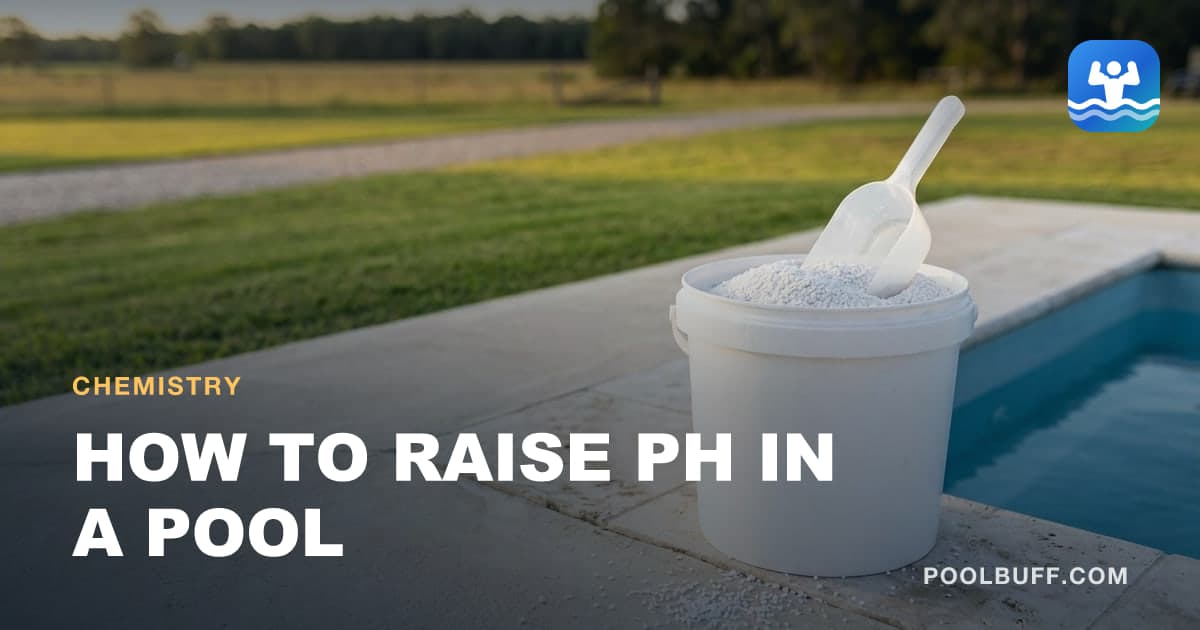
Soda ash is sodium carbonate. Pool stores sell it as pH increaser or pH Up; HTH's pH Up is 99% sodium carbonate. Laundry washing soda is the same compound, as long as the box says 100% sodium carbonate, which the chemicals worth keeping covers.
How much: about 6 oz per 10,000 gallons raises pH 0.2 at 100 ppm alkalinity.
Alkalinity is the buffer the soda ash has to push against, so the dose goes up with it. HTH's own chart shows that. For 10,000 gallons with pH between 6.8 and 7.2, it calls for 8 oz at 50 ppm alkalinity and 12 oz at 100 ppm.
A worked example. A 20,000 gallon pool at 100 ppm alkalinity reads 7.0, and you want 7.4. That's two steps of 0.2, so 6 oz × 2 × 2 = 24 oz for the whole move. Add 12 oz, wait, and retest.
Below 7.0, the rule of thumb falls apart. Water that acidic resists far harder. For 10,000 gallons at pH 6.4, HTH's chart calls for 48 oz at 50 ppm alkalinity and 144 oz, 9 lb, at 100 ppm. The 6 oz rule would put a move from 6.4 to 7.4 at about 30 oz. So for a very low pool, add in rounds and retest between them.
Two more numbers are worth knowing. One pH Up label caps a single dose at 40 oz per 10,000 gallons. And every 6 oz of soda ash also adds about 4 ppm of alkalinity. That's small once, but it adds up if you're fixing pH every week.
The pH and alkalinity calculator scales the dose to your volume and alkalinity.
How to add soda ash
- 1
Pump on, nobody swimming
—Soda ash is an eye and skin irritant. HTH's label calls for goggles and rubber gloves, and says not to mix it with other chemicals.
- 2
Measure it
2 minutesWeigh it if you can. The Pool Time label puts a cup at about 8 oz of product, which is close enough for a first dose.
- 3
Spread it across the surface
2 minutesBroadcast it over the deep end with the pump running, rather than dumping it in one spot. Then brush the area so undissolved granules don't sit on the floor.
- 4
Wait, then retest
12–24 hoursHTH says to retest after 12 to 24 hours. At the least, give it a full turnover. A reading from half-mixed water sends people back for a second dose they didn't need.
Don't chase it past 7.6. HTH warns that going over 7.8 can make the water cloudy and form scale. And a high pH means adding acid to bring it back down, which is how people end up correcting in both directions all week.
Baking soda, when alkalinity is low too
If alkalinity is under 80 ppm, start here. About 1.5 lb of baking soda per 10,000 gallons raises alkalinity 10 ppm, and PHTA's dosage table gives 1.4 lb for the same job.
Baking soda can only pull water toward about pH 8.3, and it does it gently. So it brings a low pool part of the way and then stops. Get alkalinity into range, let it mix for a full turnover, and look at pH again. Often it's close enough that aeration finishes the job. Baking soda in a pool has the full picture.
Don't add baking soda and soda ash on the same day. You won't know which one did the work.
Why it keeps dropping
If you're raising pH every week, something is pushing it down. The usual suspects:
Trichlor tablets. HTH's safety data sheet for its 3 inch tablets gives a pH of 2.6 for a 1% solution. A pool fed by tablets in a floater or feeder drifts down all season. Running alkalinity at 100 to 120 ppm gives it more buffer to absorb that, as alkalinity and pH explains. The other fix is switching some of your chlorine to liquid, which the chlorine types compared lays out.
Low alkalinity. With too little buffer, pH swings with every dose of anything. Fix alkalinity and pH settles.
Rain. It's mildly acidic and dilutes the buffer, so test after a storm.
Acid, overdone. In a pool that usually runs high, a low reading most often means the last acid dose was bigger than it needed to be.
Go deeperThe buffer behind every pH readingWhy alkalinity decides how far pH moves, and which number to fix first.Frequently asked questions
What raises pH in a pool?
Soda ash, which is sodium carbonate sold as pH increaser or pH Up, is the product for it. Aeration raises pH too, for free, by letting carbon dioxide escape from the surface. Baking soda raises it a little, but its real job is alkalinity. Borax also pushes pH up, and it adds borates to the water as it does.
How much soda ash does it take to raise pH?
About 6 oz per 10,000 gallons raises pH 0.2 in a pool at 100 ppm alkalinity. Lower alkalinity takes less and higher alkalinity takes more. Below 7.0 the rule breaks down: HTH's own chart calls for 144 oz, 9 lb, for 10,000 gallons at pH 6.4 and 100 ppm alkalinity. Add half your dose, circulate, and retest.
Will baking soda raise pH in a pool?
A little. Baking soda is sodium bicarbonate, and it can only pull water toward about pH 8.3, slowly. What it raises strongly is total alkalinity, about 10 ppm for every 1.5 lb in 10,000 gallons. Use it when alkalinity is low. If alkalinity is already fine and only pH is low, soda ash or aeration is the better move.
Can you swim after adding soda ash?
HTH's pH Up directions don't give a waiting period. Its tips do say never to add chemicals with people in the pool. Add it with nobody swimming, let the pump run until it has dissolved and mixed through, and swim once pH tests between 7.2 and 7.8.
Why does my pool pH keep dropping?
Trichlor tablets are the most common reason. HTH's safety data sheet for its 3 inch tablets gives a pH of 2.6 for a 1% solution, so a pool fed by tablets drifts down all season. Low alkalinity lets pH swing further, rain pulls it down, and so does acid added in bigger doses than the pool needed.