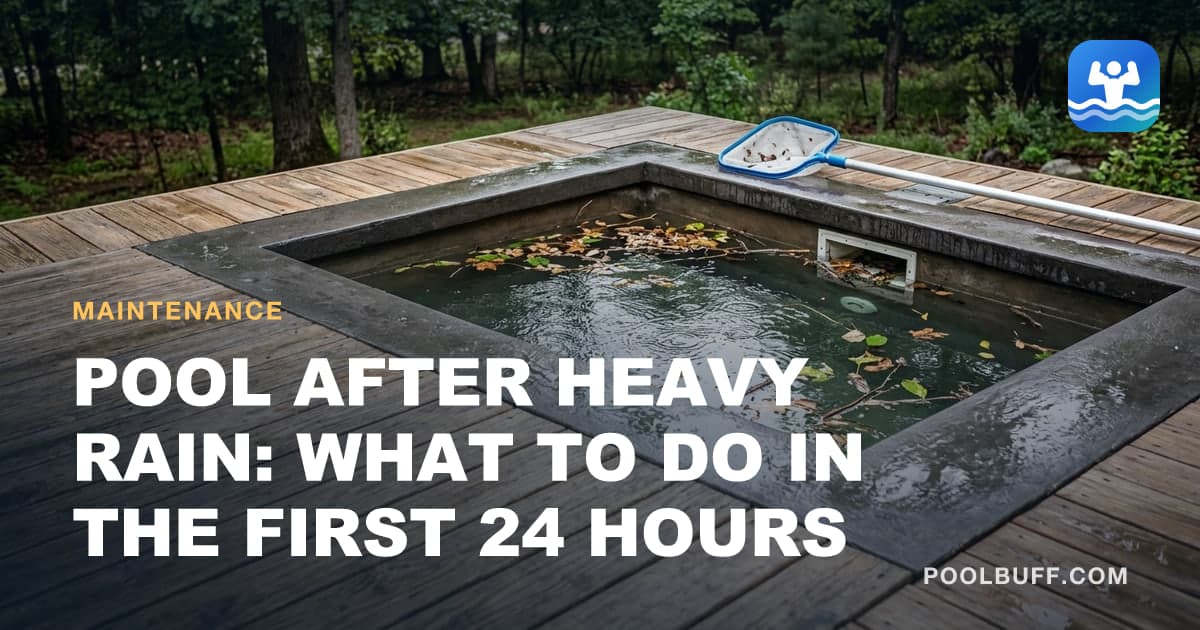
Heavy rain does two things to a pool at once, and they pull in opposite directions.
It dilutes everything you have carefully put in the water — chlorine, stabilizer, calcium, alkalinity, all of it lower than it was. And it adds organic load, because rain arrives with everything it washed off your roof, your trees and your lawn on the way in.
So you have less sanitizer and more for it to do, which is why a pool can look fine on Sunday evening and green by Tuesday.
Key takeaways
- Level first. Above the skimmer mouth, surface skimming stops entirely.
- Rain dilutes chlorine and stabilizer, and washes organic load in. Both at once.
- Rain is acidic, so expect pH and alkalinity to drop rather than rise.
- Run the pump longer than usual for a day. Filtration is what clears it.
- The pre-storm job that matters most is netting debris out, not adding chemicals.
What you need
- Check price
Taylor K-2006C test kit
Drop-count titration rather than color matching, and it tests CYA properly.
- Check price
liquid chlorine, 12.5% sodium hypochlorite
Adds no stabilizer and no calcium. Heavy to ship, so local is usually cheaper.
- Check price
leaf skimmer net
Debris lifted out today is not debris vacuumed off the floor next week.
Do this in order
- 1
Get the level down
30 minutesThis is first for a reason that surprises people. Once the water rises above the skimmer mouth, the skimmer stops working — there is no surface layer being drawn in, so all the debris floating on top stays there.
Back to halfway up the skimmer opening. Use the pump on waste if you have a multiport, or a submersible pump, or just siphon. Do not wait for evaporation to sort it out.
- 2
Net the surface
10 minutesBefore anything sinks. Debris on the surface is thirty seconds of work; the same debris on the floor is a vacuuming job, and once it starts breaking down it is a chlorine demand problem.
This is the highest-value ten minutes in the whole process.
- 3
Run the pump
—Continuously for the next day. Whatever is suspended has to reach the filter to leave, and turnover is what does that.
Check filter pressure afterward — a big debris load can push it up quickly, and a filter that needs cleaning will slow the recovery you are waiting for.
- 4
Then test
10 minutesNot before. Testing while the water is still mixing and full of debris gives you numbers you will only have to take again.
Expect: chlorine down, stabilizer down, pH and alkalinity down — rain is mildly acidic, so it pulls both rather than pushing them up. Calcium down slightly.
- 5
Rebalance in the usual order
—Chlorine first if it is unsafe, then alkalinity, then pH, in the normal sequence. Do not chase everything at once; alkalinity moves pH, so correcting them in the wrong order means doing it twice.
What actually causes trouble
Not the rain. The runoff.
Water crossing a lawn picks up fertilizer, and fertilizer is phosphate and nitrogen — food for exactly what you do not want. Water crossing soil brings the fine particles that cause the cloudiness people blame on the rain itself.
If your pool sits at the bottom of a slope and greens up after every storm, the durable fix is drainage rather than chemistry. Redirecting runoff away from the pool surround does more than any product will. Where runoff arrives as actual floodwater rather than rain, that is a different job — contamination first, chemistry second.
How much an inch of rain actually changes
Worth putting a number on it, because the instinct is to overestimate.
An inch of rain landing on a 16-by-32 pool — 512 square feet of surface — adds about 320 gallons. Against roughly 19,000 gallons already in the pool, that is a 1.7% dilution. Stabilizer at 50 ppm comes out at 49. Calcium at 300 comes out at 295. Neither is a number anybody would act on.
Five inches from a serious storm is about 8%, which takes stabilizer from 50 to 46 and alkalinity from 100 to 92. Real, but still not dramatic.
So where does the dilution people genuinely measure come from? Two places, and neither is the rain falling on the water.
Overflow. Once the pool is full, every further inch pushes an inch of balanced water over the coping and replaces it with rainwater. A pool left overflowing for a day loses far more chemistry than the rainfall figure suggests, which is the real reason step one is getting the level down rather than watching it.
Runoff. Water arriving across the deck and the lawn carries the volume your roof and yard collected, which can be many times what fell on the pool — along with everything it picked up on the way in.
That is the honest framing: rain dilutes a little and contaminates a lot.
On a salt pool the same arithmetic applies to salinity, which is why a cell starts complaining about low salt after a wet week. Check it with a test rather than trusting the controller, which infers salt from conductivity and will happily send you out for bags you do not need.
The job to do before, not after
If you know weather is coming, one thing matters more than anything you can add to the water: get the debris out first.
Leaves already on the surface when the rain starts get pushed under, waterlogged and sunk. Leaves netted out the evening before are simply gone. Ten minutes beforehand routinely saves an hour afterward.
Beyond that, secure the things that could end up in the pool. Furniture, umbrellas, toys and loose equipment do far more damage than water does — a patio chair in a vinyl pool is a liner repair, and one that lands in a fiberglass shell can crack the gelcoat.
Leave the pump on unless flooding threatens the equipment pad, in which case shut it off at the breaker rather than the timer. Circulation during and after a storm is helpful; a pump running dry or submerged is not. A named storm is a different job again — hurricane preparation covers the equipment and why draining first is the worst thing you can do.
When it is more than rain
Flooding is a different problem from rainfall. If water crosses the deck and enters the pool carrying mud, or if the pool overflows into surrounding ground, you are looking at a contaminated pool rather than a diluted one — and possibly at equipment that has been underwater.
In that case: do not run equipment that has been submerged until an electrician has looked at it, expect to need a heavy shock and an extended filtration run, and accept that a partial drain and refill is sometimes faster and cheaper than treating your way back.
Go deeperIf it stays cloudySix causes, and the order to check them when filtration alone has not cleared it.Frequently asked questions
What should I do to my pool after heavy rain?
Lower the water back to mid-skimmer, net the surface debris out, run the pump continuously for a day, then test and rebalance. Expect chlorine and stabilizer to have been diluted, and pH and alkalinity to have been pulled down by acidic rainfall. Only shock if the water is cloudy or the chlorine reads at or near zero.
Does rain ruin pool water?
It dilutes it rather than ruining it. Rainwater itself is quite pure, so the effect is to lower every concentration you had — chlorine, stabilizer, calcium, alkalinity. What causes actual problems is what comes in with it: leaves, soil, pollen and lawn runoff, all of which consume chlorine and feed algae.
Should I shock my pool after it rains?
Only if the water is cloudy, the chlorine has been driven to zero, or a lot of organic debris came in. A brief shower on a well-chlorinated pool needs nothing beyond a test. Shocking as a reflex after every rainfall is a habit that mostly wastes chemical and, if you use cal hypo, builds calcium.
Why is my pool cloudy after rain?
Usually fine suspended particles washed in as soil and dust, combined with chlorine that has been diluted below where it can keep up. Run the pump continuously, clean the filter if pressure has climbed, and bring chlorine back to target. Most rain cloudiness clears on filtration alone within a day or two.
Should I cover my pool before a storm?
Usually not a solar cover, which can be torn or blown away and will trap debris underneath. A properly anchored safety cover is different and can stay on. For a serious storm the priority is securing loose furniture and equipment rather than covering water, because objects in the pool cause far more damage than rain does.