Most storm damage to pools is self-inflicted, and it comes from two pieces of advice that circulate every season: drain the pool, and put the furniture in it. Both are wrong, and both cost more than the storm would have.
Here is what actually needs doing, in the order it needs doing.
Key takeaways
- Never drain a pool ahead of a storm. An empty shell can float out of the ground.
- Do not put patio furniture in the pool. It scratches, stains and sinks.
- Leave the cover off. Wind and debris destroy covers and covers trap debris.
- Shock before the storm — you may be without a pump for several days.
- Nothing gets switched back on until it is dry and inspected.
Leave the water in
The water in your pool weighs a great deal, and that weight is the only thing counteracting the groundwater pushing up underneath the shell.
After a hurricane, the water table rises sharply. An empty or near-empty pool in saturated ground can lift — a fiberglass shell most easily, a concrete one given enough water — and a floated pool is not a repair, it is a replacement. Vinyl liners fail differently and just as expensively: without water holding them against the wall, they shrink, wrinkle and pull out of the track.
The full explanation of why draining is dangerous applies here with the risk turned up, because a hurricane produces exactly the conditions that cause it.
What you need
- Check price
liquid chlorine, 12.5% sodium hypochlorite
Adds no stabilizer and no calcium. Heavy to ship, so local is usually cheaper.
- Check price
polyquat algaecide
Polyquat 60 does not foam and does not add copper the way cheaper algaecides do.
- Check price
leaf skimmer net
Debris lifted out today is not debris vacuumed off the floor next week.
- Check price
automatic cover pump
Water sitting on a cover is what stretches and tears it. This runs on its own.
Before the season, not before the storm
Everything below assumes two days of notice. Some of the most useful work has to happen in June, when there is nothing on the radar at all.
Know where your breaker is, and label it. In the dark, in the rain, with a storm coming in, is the wrong moment to work out which breaker kills the pad. Label it now, in a way that survives weather.
Photograph the pad while everything is intact and working. Valve positions, equipment nameplates, general condition. That set of pictures is worth a great deal to an adjuster later, and worth as much to you when you are reassembling something you last saw three weeks earlier.
Check the deck drainage while it is dry. A channel drain packed with last year's leaves does nothing during a storm, and the water it fails to take goes into the pool or under the deck.
Trim overhanging limbs in spring. A branch coming down on a pool does structural damage as well as filling the water, and tree work booked in April costs a fraction of the same job as an emergency in September.
Keep the chemicals in stock. Chlorine, algaecide and cover pumps sell out locally the moment a storm is named, and the shelves stay bare for a week afterward — which is exactly the week you need them.
Decide about a generator now, or accept the outage. A pool that was shocked properly needs very little to survive a few days without power. If you do intend to run the pump from a generator, work out the circuit and the starting load beforehand rather than in the driveway afterward, and never run a generator in or near an enclosed space.
Before the storm
- 1
Clear everything loose
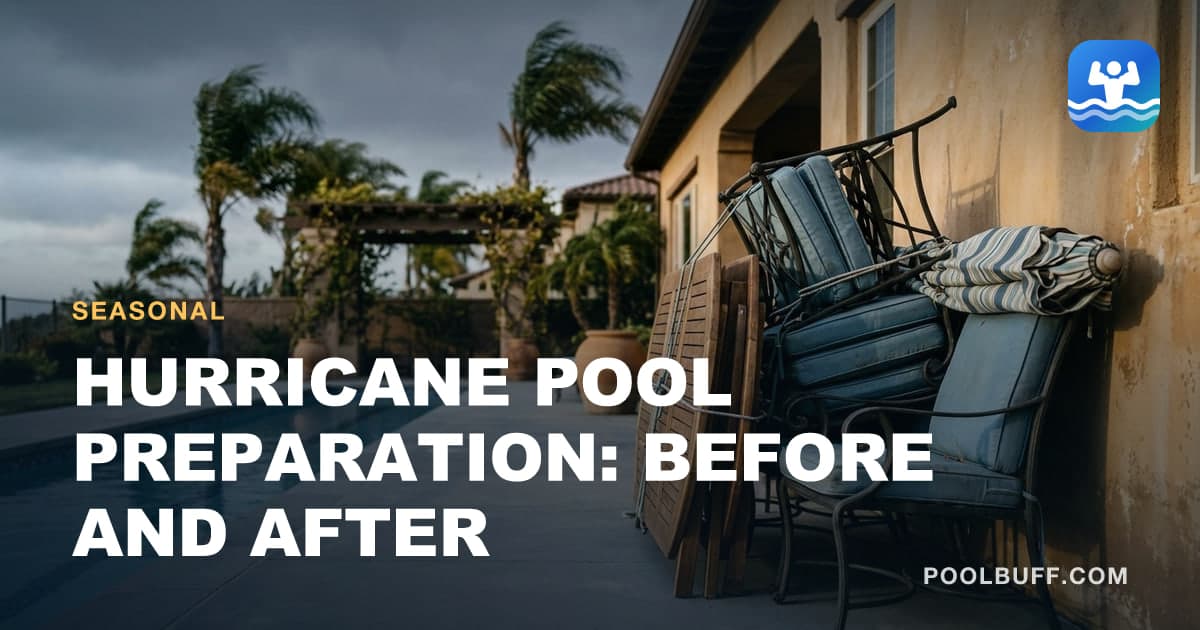
1 hourFurniture, toys, cleaner and hose, solar cover and reel, skimmer nets, planters, umbrella. Anything not bolted down is a projectile.
Indoors or in a garage is best. Lashed tight against a wall is acceptable. The pool is not an option — metal frames scratch and stain, cushions foul the water, and everything that sinks has to be fished back out through debris.
- 2
Shock the water
30 minutesYou may be without power for days, which means no circulation and no sanitizer feed while warm water sits full of organic debris.
Shock it hard the day before, and add a long-life algaecide as insurance. Chlorine you put in now is chlorine that carries the pool through the outage.
- 3
Kill the power at the breaker
5 minutesNot at the timer — at the breaker. Pump, heater, salt cell, lights, automation. You want the pad genuinely dead, so a returning grid does not start a motor that has been sitting in water.
- 4
Protect the equipment
30 minutesWrap the motor and any control panel in plastic sheeting, taped underneath so wind-driven rain cannot get in from below. Leave the wrapping loose enough to breathe.
If there is time and the pad floods routinely, unbolting the pump motor and taking it inside is better than any amount of sheeting.
- 5
Leave the cover off
—Both mesh and solid covers are lost in high wind, and while they are failing they hold branches and roof material hard against your surface. An open pool collects debris that you skim. A covered one collects the same debris plus a destroyed cover.
After the storm
The first job is skimming, and it is time-sensitive. Leaves, seed pods and shredded vegetation stain plaster within a day or two of sinking, and organic staining is far harder to remove than to prevent. Get the surface cleared before you worry about anything chemical.
Then, before you switch anything on:
- Look at the pad. Water inside the motor, silt in the control panel, a heater that has been submerged — none of that goes back into service without being checked.
- Check the bonding. Storm debris and moving water can pull bonding wire loose, and a pool without a functioning bond is a genuine hazard rather than a maintenance issue.
- If in doubt, call someone. Energizing a wet motor is how a repairable problem becomes a replacement, and how a person gets hurt.
If the yard took actual floodwater rather than rain, treat the pool as contaminated before anyone gets near it.
Once you are running again, the water is going to need work. Storm rain dilutes everything and adds a large organic load at the same time, which is the same problem as ordinary heavy rain at several times the scale. Expect a heavy shock, several days of continuous filtering, and more than one filter cleaning before it clears.
Go deeperGetting the water backWhat a big rainfall actually does to your chemistry, and the order to fix it in.Frequently asked questions
Should I drain my pool before a hurricane?
No. This is the single most damaging piece of storm advice in circulation. The water in the pool is what counteracts groundwater pressure underneath it, and a saturated water table after a hurricane can lift an empty shell out of the ground. Vinyl liners also shrink and pull loose without water behind them. Leave it full.
Should I lower the water level before a storm?
A little, if heavy rain is forecast. Dropping the level a foot or so gives the pool somewhere to put the rainfall and keeps the skimmer usable afterward. That is different from draining. Take it down to around a foot below the skimmer mouth at most, and stop there — the goal is headroom, not an empty pool.
Can I put patio furniture in the pool to stop it blowing away?
Please do not, though the advice circulates every season. Metal frames stain plaster and gouge liners, cushions foul the water, and anything that sinks has to come back out through debris-filled water. Store furniture indoors, in a garage, or lash it down against a wall. The pool is not a storage unit.
Should I cover the pool before a hurricane?
No. A cover in high wind either tears loose and becomes debris itself or holds branches and roof material against the surface. Solar covers in particular are lost. The pool will collect debris either way, and it is far easier to skim a storm out of open water than to unpick a shredded cover from it.
What do I do with the pool after a hurricane?
Skim floating debris before it sinks and stains, because that window is a day or two. Do not switch equipment on until the pad is dry and you have checked for water in the motor and damage to the bonding. Then expect a serious rebalance — storm water is dilute, dirty and organic, so it will take a heavy shock and several days of filtering.