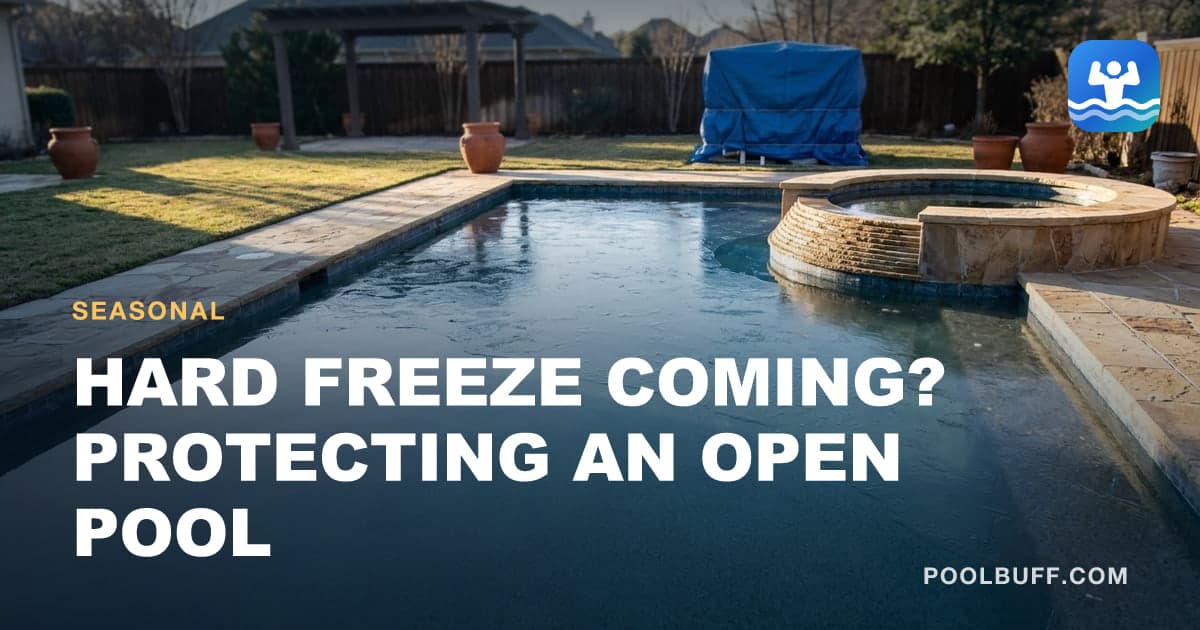
This is the pool that never closes, in the week the forecast does something unusual. Different problem from winterizing, because there is no time to blow lines and no intention of closing — you are getting through a few days.
The strategy is simple and the failure mode is specific.
Key takeaways
- Run the pump continuously, not on freeze-protection cycling, through a hard event.
- A power cut is the real emergency. Drain every piece of equipment immediately.
- Ice on the pool surface is harmless. Do not break it.
- Never start a pump you suspect is frozen. Let it thaw completely.
- Above-ground pools and exposed plumbing freeze hours before buried lines do.
Moving water is the whole plan
Water in motion is much harder to freeze than water sitting still. That is the entire basis of freeze protection, and it works well.
So run the pump continuously through the event. Not on the automation's freeze setting, which cycles on and off around a threshold and is designed for ordinary cold nights. Override the schedule and leave it running until the temperature is safely back up.
The pool itself is not what you are protecting. A full pool has enormous thermal mass and will not freeze solid in a residential cold snap. The pipes and the equipment are what break, and they break because water in them stopped moving.
Protecting a pool during a hard freeze
- 1
Pump on, continuous
2 minutesOverride the timer. Leave it running for the duration.
- 2
Wrap the pad
30 minutesMoving blankets, tarps, old towels over the pump, filter and heater. It is imperfect and it genuinely helps on a short event.
Leave gas heater vents and intakes clear. Wrapping a running gas appliance so it cannot breathe is a different kind of emergency.
- 3
Bottle in the skimmer
2 minutesA part-filled plastic bottle floating in the skimmer throat gives ice somewhere to expand other than the skimmer wall. Same idea as a winterizing gizmo, using what you have.
On a vinyl pool, a few more floating in the water take some of the surface expansion off the walls.
- 4
Know where the drain plugs are
10 minutesBefore you need them in the dark. Find the plugs on the pump, filter, heater and salt cell now, and put a screwdriver and a flashlight somewhere you will find them.
When the power fails
This is the actual emergency, and it is where pools get destroyed. The moment circulation stops, everything above ground is standing water in a cold box.
Move immediately:
- Open the pump lid and pull its drain plugs. Tip it if it will not empty.
- Drain the filter. Plug out, and open the air relief so it does not hold a vacuum.
- Drain the heater. It has its own plugs and a heat exchanger full of water — this is the most expensive single item on most pads.
- Drain the salt cell if you have one. It is a plastic housing full of water with electrode plates in it.
- Put every plug in one labeled bag and tape it somewhere obvious. You will be refitting them in a hurry.
The lines in the ground are more forgiving than the pad, and there is realistically nothing you can do about them without a compressor and time you do not have. Protect what you can reach.
Leave the ice alone
Surface ice on a full pool looks alarming and is fine. The water underneath stays liquid, the shell is not under threat, and it will go on its own.
Do not break it up. On a vinyl pool you risk puncturing the liner; on plaster you chip the finish; and either way the loose pieces scrape at the walls as they move around. There is nothing to be gained.
The one thing worth watching is the level. If heavy rain preceded the freeze and the water has risen over the skimmer mouth, the skimmer is the part at risk, and a bottle in the throat is the answer rather than a hammer.
Afterward, before you restart
Never start a pump you suspect is frozen. Ice in a volute breaks impellers and seals, and a motor that starts against a locked rotor does not last. Let everything thaw completely — genuinely completely, not "it looks fine" — before power goes anywhere near it.
Then:
- Refit every drain plug, lubricating o-rings with silicone.
- Fill the pump housing and prime it.
- Start it and watch it. Look for leaks at every plug and union, and listen for anything that sounds wrong.
- Walk the returns. A line that split in the ground shows up as reduced flow, air, or a level that keeps dropping.
If the pool will not hold prime or the water level falls steadily over the following days, you have a split somewhere, and that is a leak-detection job rather than a chemistry one.
The things people do that make it worse
A short list, because each of these is a reasonable-sounding instinct that causes damage.
Turning the pump off to save it. The pump is not what is at risk — the plumbing is, and the pump running is what protects it. A pump off in a freeze is a pipe with still water in it.
Breaking the ice on the surface. Covered in more detail above and worth repeating, because it is the most common one. Hitting ice transmits force straight into the shell, the tile and the liner.
Running the heater to melt it. A heater fired against restricted or frozen flow trips its high limit at best and cracks its exchanger at worst. The heater is downstream of the problem, not a solution to it.
Draining the pool "so it cannot freeze". Empty ground-saturated pools float, and freezing ground makes that worse rather than better. The water is what is holding the shell down.
Wrapping the equipment in plastic and leaving it. Trapping moisture against a motor overnight in a freeze does nothing useful. Insulation with airflow is the goal, not a sealed bag.
If this happens most years
Then the honest answer is that you are in a closing climate rather than a year-round one, and closing the pool properly — with the lines blown out and plugged — costs an afternoon and removes the whole category of risk.
Running year-round is the right call where freezes are brief and occasional. It stops being the right call when you spend a week a year watching a forecast.
Go deeperThe permanent versionClearing and plugging every line, which is what makes a freeze a non-event.Frequently asked questions
Should I run my pool pump during a freeze?
Yes, continuously, for the whole event rather than letting freeze protection cycle it on and off. Moving water is far harder to freeze than still water, and the thing you are protecting is the plumbing rather than the pool. A split return line under a deck is a four-figure repair; the electricity to run a pump for three days is not.
What do I do if the power goes out during a freeze?
Treat it as an emergency closing and move fast. Open the pump lid, pull the drain plugs from the pump, filter, heater and salt cell, and open the filter air relief so nothing holds water. Equipment is what fails first because it holds standing water above ground, and once the pump stops, the protection stops with it.
Is it bad if my pool freezes over?
A layer of surface ice on a full pool is not the problem people assume. The water below stays liquid, and the shell is not under threat. What breaks in a freeze is the equipment and the plumbing — anything holding still water in a pipe or a housing. Leave the surface ice alone rather than breaking it up.
Should I break the ice on my pool?
No. Breaking it risks puncturing a vinyl liner or chipping a plaster finish, and the loose pieces scrape as they move. If the level has risen and you are worried about the skimmer, float a part-filled bottle in the throat instead — that gives the ice somewhere to expand.
Can I use a pool heater to stop the pool freezing?
It is expensive and it addresses the wrong problem. Heating a whole pool to prevent surface ice costs a great deal, and surface ice was never the risk. Circulation is what protects the plumbing, and if the power fails the heater stops too — at which point it is one more thing full of standing water that needs draining.