Most of the spring opening sequence transfers straight across. The plugs, the o-rings, the balance, the 60°F rule — all the same. This page undoes closing an above-ground pool, so the plugs and pillow you put in there are what comes out here.
What changes is a short list, and two items on it will cost you real money if you skip them.
Key takeaways
- Inspect the wall and rails first. Frost heave moves above-ground pools every winter.
- Pump the cover dry before removing it. Dragging it across the rail is how liners tear.
- There's no main drain, so all circulation comes from the skimmer. Level matters more.
- Half the volume means double the dose response. Measure, then dose small.
- Get the pillow out and the water level up the same day if you can.
What you need
- Check price
automatic cover pump
Water sitting on a cover is what stretches and tears it. This runs on its own.
- Check price
Taylor K-2006C test kit
Drop-count titration rather than color matching, and it tests CYA properly.
- Check price
18-inch nylon pool brush
Nylon bristles, safe on vinyl, fiberglass and plaster alike. The default choice.
- Check price
silicone lubricant
Silicone, never petroleum. Petroleum swells the O-ring and ruins the seal.
Look at the pool before you look at the water
An inground pool is not going anywhere over winter. An above-ground can be.
Frost heave lifts the ground under the uprights unevenly, and a pool that has gone an inch or two out of level spends the season putting uneven load on a wall that was designed for even load. It shows up later as a bulge, a seam that weeps, or a wall that fails in August with 7,000 gallons behind it.
So before the cover comes off:
- Sight along the top rail for a dip or a rise. A long straight edge or a level across opposite rails is enough.
- Check every upright is sitting flat on its block or paver, with nothing washed out beneath it.
- Look at the wall itself for rust at the bottom, dents, or a seam that has opened.
- Press the ground around the base. Soft, hollow-feeling ground under a rail means water has been running there all winter.
Caught in April, most of this is resetting a paver. Caught in July, it is draining the pool to fix it.
Getting the cover off without wrecking the liner
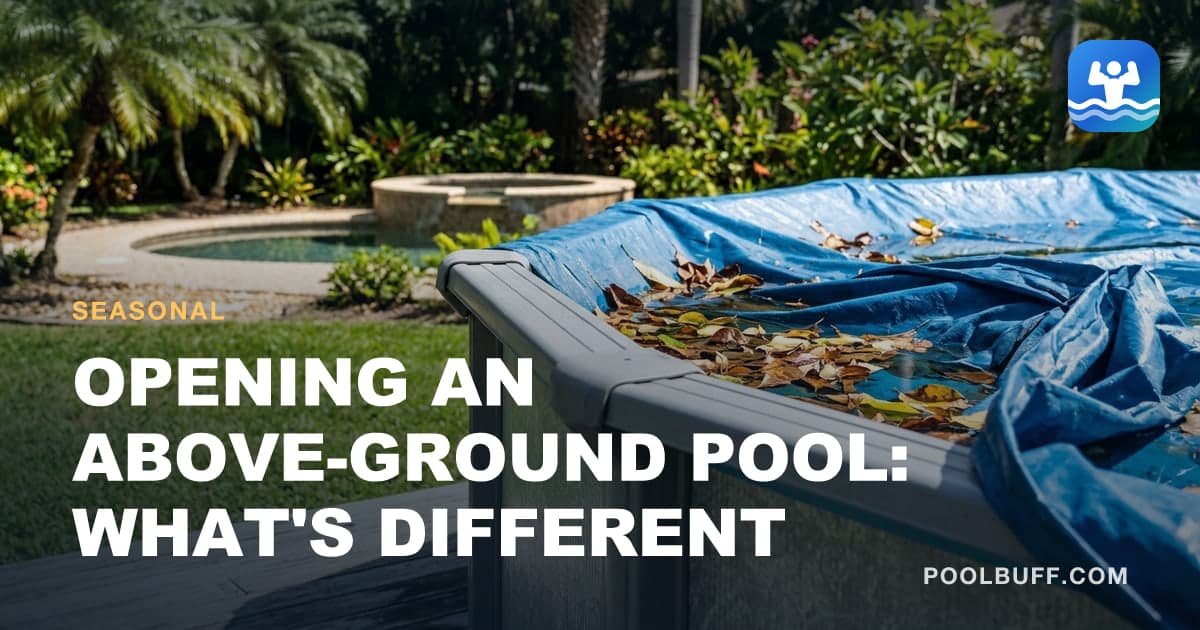
Above-ground covers sit over a rail edge, and that rail collects grit all winter. Dragging a loaded cover across it is one of the more common ways liners get scored at exactly the point that later splits.
Pump the standing water off first, sweep or blow the debris toward the edge and off, then lift the cover clear rather than sliding it. It is a two-person job on anything over 18 feet, and worth waiting for the second person.
Wash it, dry it fully, and store it somewhere a mouse will not spend the summer in it.
No main drain changes the water level
An inground has two suction points. An above-ground has one, and everything depends on it.
Fill to mid-skimmer and keep it there. Below the mouth the pump pulls air, loses prime, and — if you are not standing there — can run dry long enough to cook a seal. Above the mouth the skimmer stops taking the surface, which is the only place it takes anything from.
That single dependency is also why air in the returns is worth chasing down right away on an above-ground rather than living with it.
Priming the pump at opening
An above-ground pump sits on the ground beside the pool, below the water in the skimmer, so water runs down into it once the valves are open. Hayward builds its PowerFlo Matrix for exactly that, and says it isn't self-priming. It relies on the water above it.
The first startup of the season still has a few traps, and people tend to learn them expensively:
- Fill the pump basket by hand before the lid goes on. A jug of pool water into the strainer housing gives the impeller something to grab.
- Open the return side first, then the suction, so trapped air has somewhere to go.
- Watch the basket, not the clock. Water should appear within a minute or two. If it does not, shut it off — a pump running dry destroys the mechanical seal in minutes, and that seal is what keeps water out of the motor.
- Bleed the filter as soon as it primes. Air trapped in the tank holds pressure high and flow low, and on a sand filter it can channel the bed.
If it will not prime after two attempts, stop and go looking for the air leak instead of trying a third time. Everything on the suction-side list applies, and on an above-ground the skimmer o-ring and the hose clamps are the usual answers.
Dose for the pool you actually have
This is the one that catches experienced inground owners helping a neighbor.
A typical 18ft round pool holds around 7,000 gallons. Dosing instructions on the back of a bottle are written for something closer to 20,000. Follow them and you land at more than double the intended concentration, which is how above-ground pools end up with pH crashes and stabilizer at 100 ppm by June.
Work out your real volume once, write it on the inside of the pump lid, and dose against that number for the rest of the pool's life. The smaller-volume habits that follow from it — test more often, dose in smaller increments — are what make an above-ground easy rather than twitchy.
Your real volume, for the common sizes
Since the dosing depends entirely on this number, here it is for the sizes most people own. These are at a normal fill — mid-skimmer, a few inches below the top rail — rather than the brimming figure the box quotes.
| Pool | Approximate gallons |
|---|---|
| 12 ft round, 48 in wall | 2,950 |
| 15 ft round, 48 in wall | 4,600 |
| 15 ft round, 52 in wall | 5,050 |
| 18 ft round, 48 in wall | 6,650 |
| 18 ft round, 52 in wall | 7,300 |
| 21 ft round, 52 in wall | 9,900 |
| 24 ft round, 52 in wall | 12,950 |
| 12 x 24 oval, 52 in wall | 6,500 |
| 15 x 30 oval, 52 in wall | 10,100 |
If your pool is not on the list, the arithmetic is short: for a round pool, multiply the diameter by itself, then by the water depth in feet, then by 5.9. Ovals use the same constant with length times width in place of the diameter squared.
Go deeperThe rest of the seasonWhat changes week to week once the pool is open, including the wall and liner care nobody mentions.Frequently asked questions
How is opening an above-ground pool different from an inground?
Three things. There is no main drain, so all your circulation depends on the water level being at mid-skimmer. The wall and frame need inspecting for winter movement before you add water back. And the volume is roughly half an inground's, so every chemical dose lands about twice as hard.
Should I check whether my above-ground pool is still level?
Yes, every spring, and it is the step people skip. Frost heave lifts the ground under the uprights over winter, and a pool that has gone an inch or two out of level puts uneven load on the wall. Caught in April it is a matter of resetting a paver or two. Left until the pool is full it is a drain-and-re-level job.
Can I leave my above-ground pool cover on longer to save work?
It costs you rather than saves you. Water warms under a cover just as it does anywhere else, and algae wakes up around 60°F whether you can see it or not. Opening a warm green above-ground is worse than an inground because the volume is small enough to go dark fast.
Do I need to take the air pillow out first?
It comes out with the cover, and it is worth checking whether it survived. Its job is to take ice expansion instead of the wall, so a pillow that deflated in January means the wall carried the ice all winter — look closely at the wall and seams before you fill.
How much chlorine does an above-ground pool need at opening?
Far less than the bottle suggests, because the bottle assumes an inground. A dose that raises free chlorine 2 ppm in a 20,000 gallon pool raises it 5 ppm in an 8,000 gallon one. Calculate against your real volume, lean toward under-dosing, and retest before adding more.