Hayward · PowerFlo Matrix
Hayward PowerFlo Matrix
Hayward's above-ground pump: which of the four models to pick, why it isn't self-priming, the storable pools it isn't for, and how to change its seal.
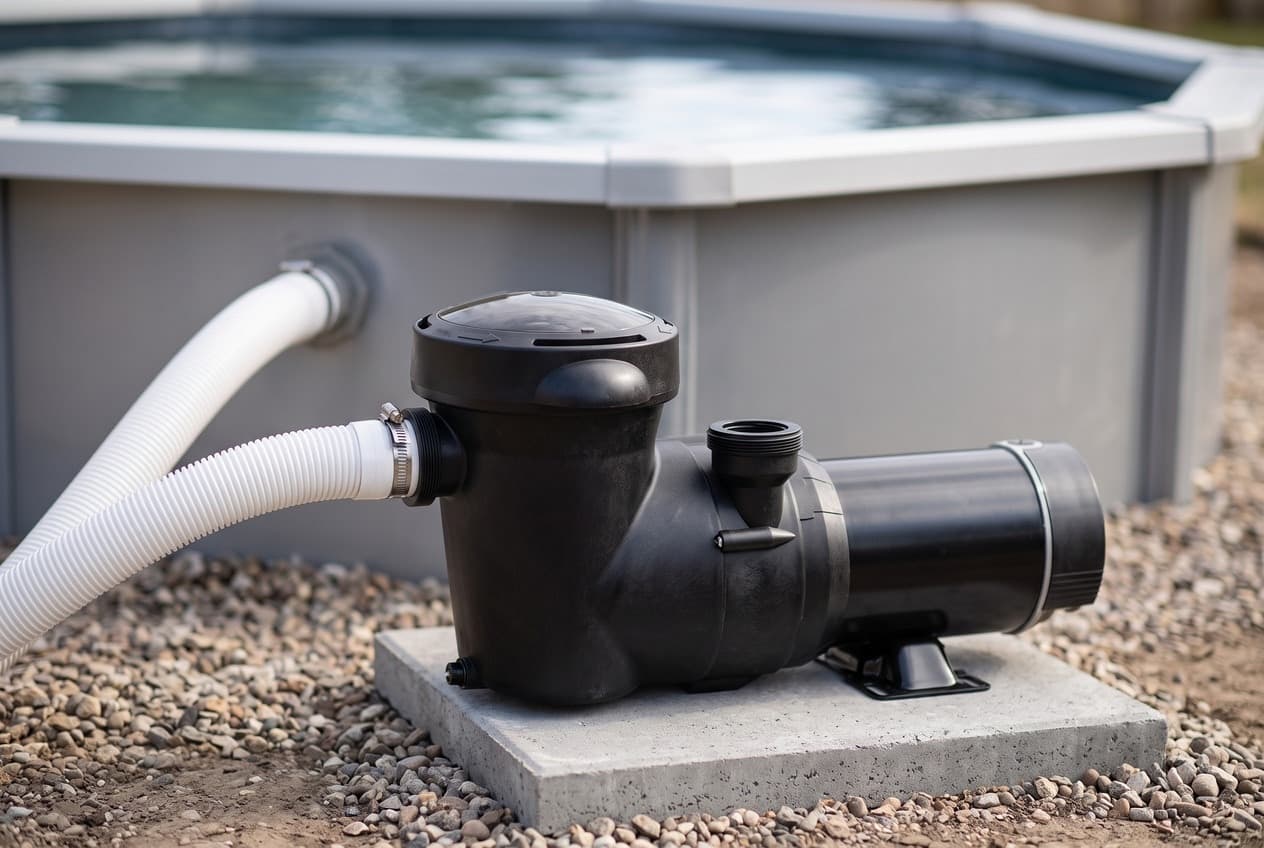
The PowerFlo Matrix is Hayward's pump for above-ground pools, a 115-volt pump on a 3-foot cord that sits on the ground beside the pool. It comes in four models: two single-speed and two two-speed. Each also comes with a twist-lock plug or as an Open Line version for online sale. Its strainer housing comes off the front with a single clip, and its discharge turns between horizontal and vertical with the press of a button.
It is not self-priming. Hayward Support says so plainly, and DOE's database lists every model as a non-self-priming pump. It's built to sit below the pool's water line, where the water runs into it on its own.
Which model
DOE's database and Hayward's performance chart:
- SP1592: single speed, 0.85 total horsepower, WEF 3.4. About 75 GPM against 30 feet of head.
- SP1593: single speed, 1.1 total horsepower, WEF 3.5. About 80 GPM against 30 feet.
- SP15932S: two speed, 1.0 total horsepower, WEF 5.7. On high, Hayward Support gives about 80 GPM against 30 feet, the SP1593's figure. Low speed is half that.
- SP15922S: also two speed, and DOE rates it exactly as it rates the SP15932S. Hayward publishes nothing that tells the two apart.
The two-speed models are the efficient ones: WEF 5.7 against 3.4 or 3.5. An above-ground pool rarely needs full flow for long, and a pump that can spend most of the day on low uses much less power.
On most above-ground pools the SP1592 is enough. The site's above-ground maintenance guide puts the useful range at 0.75 to 1 total horsepower, and more pump on small plumbing buys noise, not filtration. To check flow against your own pool, the pump and filter sizing calculator works it out from the volume.
The pools it's for, and the ones it isn't
Permanently installed pools. The manual says Hayward pumps are for pools built in or on the ground so they can't readily be taken apart. It rules out storable pools, the kind made to come down and go back up. That means a frame or soft-sided pool that gets packed away for the winter isn't one Hayward's manual allows this pump on.
Where it goes
- Below the pool's water line. The manual puts it there for best performance, and Hayward Support says the Matrix is designed for a flooded plumbing system. On an above-ground pool, a pump on the ground beside the wall already is.
- On a firm, level base, screwed or bolted down to cut vibration, with 18 inches of clearance around it for service.
- Somewhere that drains, so it can't flood in a storm, with air around the motor. The manual advises protecting the electrics from the weather even though the pump is rated for outdoors.
- Near a proper outlet. The circuit has to be GFCI-protected, and the manual says never to use an extension cord. It also names extension cords among the causes of a motor that keeps shutting off.
Fit unions on both ports, so the pump comes off easily for service and for winter storage indoors. On threaded fittings, use Teflon tape, one or two layers, never pipe dope, which the manual says can crack the plastic. Hand-tighten, then give it no more than one and a half turns with a tool.
Bond it with a solid copper No. 8 AWG wire from the lug on the outside of the motor. Hayward Support confirmed it's the external lug, not the ground screw behind the switch.
There's no timer built in. Hayward Support says it doesn't make one, and points to timer makers such as Intermatic.
Starting it
- Fill the strainer housing with water up to the suction pipe. Never run it dry: the water cools and lubricates the seal.
- Clean the cover's O-ring and lubricate it with Jack's 327, then turn the cover clockwise, by hand, a quarter turn.
- Open all the valves and bleed the air from the filter.
- Switch it on. With the water higher than the pump and flowing, it primes itself. If it hasn't primed in 10 minutes, stop it and find out why.
On the two-speed models, the high-low switch is on the back. Hayward Support pointed an owner there, and told another whose pump ran only on high to see a service center.
When it isn't working
The manual's troubleshooting, condensed:
- Motor won't start: loose wiring, open switches, a tripped breaker or GFCI. Check the shaft turns freely. If there's a timer, bypass it to test.
- Motor shuts off and restarts: the thermal overload is tripping. The manual's usual causes are undersized wiring, low voltage or an extension cord, or a binding shaft. It'll keep cycling until the cause is fixed.
- Hums but won't start: a centrifugal switch stuck open, or a binding shaft.
- Won't prime: a dry or unseated cover O-ring, closed valves, low pool water, or a stuck skimmer weir. The manual gives 5 to 6 inches of vacuum at the strainer cover as a working pump. After that, check for air leaks, clamps, voltage and a clogged impeller.
- Low flow: a clogged strainer or suction line, a dirty filter, a suction air leak, or a plugged or sheared impeller.
- Noisy: an air leak, cavitation from a restricted suction line or low water, poor mounting, debris in the housing, or worn motor bearings. The manual suggests a rubber pad under the motor's feet for vibration.
When an owner asked why the strainer wouldn't fill all the way, Hayward Support's answer started from the same point: the Matrix is designed for a flooded system, with the pump below the pool's water level.
Changing the seal
The manual's steps, for a qualified person:
- Shut off the water: close the valves, or plug the skimmer and return ports. Disconnect the hoses or pipes.
- Take off the strainer: remove its cover and basket, lift the C-clip, and slide the housing forward.
- Remove the eight screws holding the pump cover, which exposes the impeller.
- Take off the cover at the back of the motor. Hold the shaft by the slot in its end or the flats near it, and unscrew the impeller counterclockwise.
- Pull the old seal's spring half off the impeller. Loosen the four through bolts at the back of the motor, remove the housing and shroud, and press the ceramic half out.
- Lubricate only with a dilute liquid soap. The manual warns that petroleum or silicone lubricants can make the seal leak.
- Press the new seal's halves in, bolt the motor back, check the shaft turns freely, and screw the impeller back on clockwise, hand-tight.
Replace the housing O-ring if it's damaged, and fill the strainer before you restart it.
Winterizing
A frozen pump voids the warranty. Drain the pool below its inlets, pull the drain plug at the bottom of the strainer housing, and take the pump off its base. Store it somewhere dry, without wrapping it in plastic. If you blow out the lines, use a blower under 5 psi, never compressed air, and use only propylene glycol as antifreeze.
Warranty and where to buy
The Expert Line models, sold through dealers, carry two years parts and no labor. Hayward's 2026 terms give above-ground equipment three years parts through a dealer offering its extended coverage. The Open Line W3 models get one year parts.
Hayward also sells the Matrix with a filter as a system. For one owner replacing an SP1593 filter system, Hayward Support named the pump alone as the SP1593 and the whole system as the CC15093S.
Where Hayward's documents disagree, or are unclear
- Horsepower in the web addresses. Hayward's product page addresses call the SP1592 "1 hp" and the SP1593 "1.5 hp" with a "6 cord". The pages themselves say 0.85 and 1.1 total horsepower and a 3-foot cord, and so does DOE. This page uses the pages and DOE.
- Speeds. The product pages for both two-speed models list Number of Speeds: Single Speed. DOE rates both as two-speed, and Hayward Support describes the high-low switch.
- The two two-speeds. The SP15922S's page is titled "1.0 HP" while its address says 0.85, and DOE rates it the same as the SP15932S. Hayward's parts lookup returns nothing for the SP15922S.
- Motors and impellers. The manual lists motors by nameplate horsepower, including 2 and 2½ HP units, and leaves the impeller blank. Hayward's parts lookup lists two impellers and five motors. Neither says which model takes which.
- The 1½ HP two-speed motor. The manual calls it SPX1515Z2WS. The parts lookup calls it SPX1515Z2ES.
Which model do you have?
The model number is on the pump label. Everything else in the range is shared — these are the parts that change with it.
| Model | HP | SKU | Speeds | WEF | Flow at 30 ft of head | Note |
|---|---|---|---|---|---|---|
| SP1592 | 0.85 THP | SP1592 | Single speed | 3.4 | 75 GPM | Single speed. SP1592TL is the same pump with a twist-lock plug, and W3SP1592 is the Open Line version, approved for online sale. Hayward's performance chart gives it 86 GPM against 10 ft of head, 75 against 30 and 58 against 40. |
| SP1593 | 1.1 THP | SP1593 | Single speed | 3.5 | 80 GPM | Single speed. SP1593TL has the twist-lock plug, and W3SP1593 is the Open Line version. Hayward's chart gives it 91 GPM against 10 ft of head, 80 against 30 and 62 against 40. |
| SP15932S | 1.0 THP | SP15932S | Two, high and low | 5.7 | About 80 GPM on high, per Hayward Support | Two speed, with the high-low switch on the back. W3SP15932S is the Open Line version. Hayward Support gives it about 80 GPM against 30 ft of head and 62 against 40 on high, and half that on low: the same high-speed figures as the SP1593's chart. |
| SP15922S | 1.0 THP | SP15922S | Two, high and low | 5.7 | Not published | Also two speed. DOE's database rates it exactly as it rates the SP15932S, and Hayward publishes nothing that separates the two. Hayward Support says it's still built, and points to W3SP15922S as the online version. |
Hayward PowerFlo Matrix parts, and what goes wrong
Read off the manufacturer’s parts list and checked before it ships. Open a row for what a bad one actually does — or start from the symptom and work down, which is the cheaper order.
What is it doing?
Never run it dry: the water in the housing is what cools and lubricates this seal. To change it, per the manual: take the strainer housing off by lifting the C-clip, then remove the eight screws holding the pump cover. Hold the motor shaft by the slot in its back end, and unscrew the impeller counterclockwise. The four through bolts at the back of the motor release the housing and shroud. Lubricate the new seal only with a dilute liquid soap. The manual warns that petroleum or silicone lubricants can make the seal leak. Seals are wear items under Hayward's terms.
Live pricing arrives when the retailer programs are approved.
Clean it and lubricate it with Jack's 327 every time the cover comes off, the manual says. Then tighten the cover clockwise by hand, a quarter turn, never with a wrench. A dry or unseated O-ring is the manual's first suspect for a pump that won't prime. The whole cover, with its lock ring and O-ring, is SPX5500D.
Live pricing arrives when the retailer programs are approved.
Clean it regularly, and don't strike it to knock debris out. A dirty basket is on the manual's list for both low flow and a pump that won't prime. Hayward markets it as the largest strainer basket in above-ground pumps.
Live pricing arrives when the retailer programs are approved.
A plugged, restricted or sheared impeller means low flow, and the manual says to replace it with a new seal assembly at the same time. Hayward's diagram lists two, SPX1500L for 1 HP and SPX1500F for ¾ HP, without saying which model takes which. The manual says to go by the part number on the original, so read it off the old impeller before you order.
Live pricing arrives when the retailer programs are approved.
The manual gives two causes for a hum without a start: a centrifugal switch stuck open, or a binding motor shaft. A motor that shuts off and starts again on its own is the automatic thermal overload doing its job. The usual causes are undersized wiring, low voltage or an extension cord, so find the cause before you replace the motor. Hayward's diagram lists five motors, single and two-speed, by nameplate horsepower. Match yours by the label on the old motor.
Live pricing arrives when the retailer programs are approved.
Lift the C-clip and the strainer housing slides forward off the pump. You take it off to change the seal, and to turn the discharge between horizontal and vertical. For that, press the positioning button on the pump housing and rotate the discharge port a quarter turn, then put the strainer back and push the clip down onto the grooved coupling.
Live pricing arrives when the retailer programs are approved.
There's one, at the bottom of the strainer housing. Before freezing weather, drain the pool below its inlets and pull this plug. Take the pump off its base and store it dry, not wrapped in plastic, which traps condensation. The manual says a frozen pump voids the warranty. If you blow out the lines, use a blower under 5 psi, never compressed air.
Live pricing arrives when the retailer programs are approved.
The manual recommends unions on both ports, so the pump comes off easily for service and winter storage indoors. On threaded fittings, use one or two layers of Teflon tape, never pipe dope, which the manual says can crack the plastic. Hand-tighten, then no more than one and a half turns with a tool: the ports have molded thread stops.
Live pricing arrives when the retailer programs are approved.
If you are doing the job anyway
Every PowerFlo Matrix shares the same wet end on Hayward's diagram. Only the impeller and motor change, and Hayward doesn't map them to models.
The seal job
The seal, the housing O-ring and the strainer O-ring all come out when the pump is opened. Hayward lists a quick repair kit for the PowerFlo Matrix, but its parts lookup doesn't say what's in it.
- Shaft seal assemblySPX1500KA
- SPX0710XZ5SPX0710XZ5
- SPX5500KSPX5500K
- Strainer cover O-ringSPX5500H
Sold as a kit: SPXHKIT12MTX
Hayward PowerFlo Matrix manuals and documentation
Hosted by the manufacturer. These open on Hayward’s own servers, so they stay current.
- PowerFlo Matrix pump owner's manual (ISSP1591 Rev H)manual
- PowerFlo Matrix performance chart, SP1592 and SP1593curves
- PowerFlo Matrix line drawing, sidespec
- PowerFlo Matrix line drawing, frontspec
- SP1592 product page — specifications, the parts diagram and Hayward Support answersdiagram
- SP1593 product page — specifications, the parts diagram and Hayward Support answersdiagram
- SP15932S product page, two speed, with Hayward Support answersspec
- SP15922S product page, two speedspec
- SP1593TL product page, twist-lock plugspec
- W3SP1593 product page, Open Linespec
- DOE Compliance Certification Database, dedicated-purpose pool pumps — search SP159 for the certified ratingsspec
- Hayward 2026 Expert Line warranty termsspec
- Hayward 2026 Open Line warranty termsspec
Hayward PowerFlo Matrix warranty
2 years parts, None labor
Two years parts and no labor on the Expert Line models, per their product pages and Hayward's 2026 Expert Line terms, which give above-ground equipment two years parts, or three through a dealer offering Hayward's extended coverage, and no field labor either way. The Open Line W3 models get one year parts. The manual adds that freezing voids the warranty, and so does adding undiluted chemicals directly in front of the pump's suction. Basket-strainers, O-rings and pump seals are wear items, covered for manufacturing defects only. Hayward's warranty applies only to products bought from Hayward or an authorized seller.
Manufacturer’s termsHayward PowerFlo Matrix complete parts list
Every part on the manufacturer’s exploded diagram, in their numbering. Marked rows are the ones covered above with a symptom and a diagnosis.
25 parts
| No. | Part | Description | Note |
|---|---|---|---|
| 1 | SPX5500D | Strainer cover with lock ring and O-ring | |
| 2 | SPX5500H | Strainer cover O-ring what goes wrong | |
| 3 | SPX5500F | Strainer basket what goes wrong | |
| 4 | SPX5500G | Strainer retainer, C-clip what goes wrong | |
| 5 | SPX5500C | Strainer housing | |
| 6 | SPX1700FG | Drain plug with gasket what goes wrong | |
| 7 | SPX5500K | Strainer O-ring | |
| 8 | SPX0714Z48 | Screw, #14 x 1/4 in., type B pan head | 8 required |
| 9 | SPX5500B | Pump cover | |
| 10 | SPX0710XZ5 | Housing O-ring | |
| 11 | SPX1500F | Impeller assembly, ¾ HP | Hayward's parts lookup; the manual says to go by the number on the original |
| 11 | SPX1500L | Impeller assembly, 1 HP what goes wrong | Hayward's parts lookup; the manual says to go by the number on the original |
| 12 | SPX1500KA | Shaft seal assembly what goes wrong | |
| 13 | SPX5500A | Pump housing | |
| 14 | SPX5500E | Shroud assembly | |
| 15 | SPX1510Z1E | Motor with switch, ¾ HP, Flex-48 | |
| 15 | SPX1510Z1XE | Motor with switch, 1 HP, Flex-48 what goes wrong | |
| 15 | SPX1515Z1E | Motor with switch, 1½ HP, Flex-48 | |
| 15 | SPX1510Z24XE | Two-speed motor with switch, 1 HP, Flex-48 | |
| 15 | SPX1515Z2ES | Two-speed motor with switch, 1½ HP, Flex-48 | Hayward's parts lookup; the manual lists SPX1515Z2WS |
| 15 | SPX1515Z2WS | Two-speed motor with switch, 1½ HP, Flex-48 | The manual only |
| 15 | SPX1520Z1ESC | Motor with switch, 2 HP, Flex-48 | The manual only; not on Hayward's current parts lookup |
| 15 | SPX1524Z1ESC | Motor with switch, 2½ HP, Flex-48 | The manual only; not on Hayward's current parts lookup |
| 16 | SP1500UNPAK2 | Union connector assembly what goes wrong | 2 required |
| — | SPXHKIT12MTX | H-kit quick pump repair for PowerFlo Matrix | Hayward's parts lookup; contents not listed |