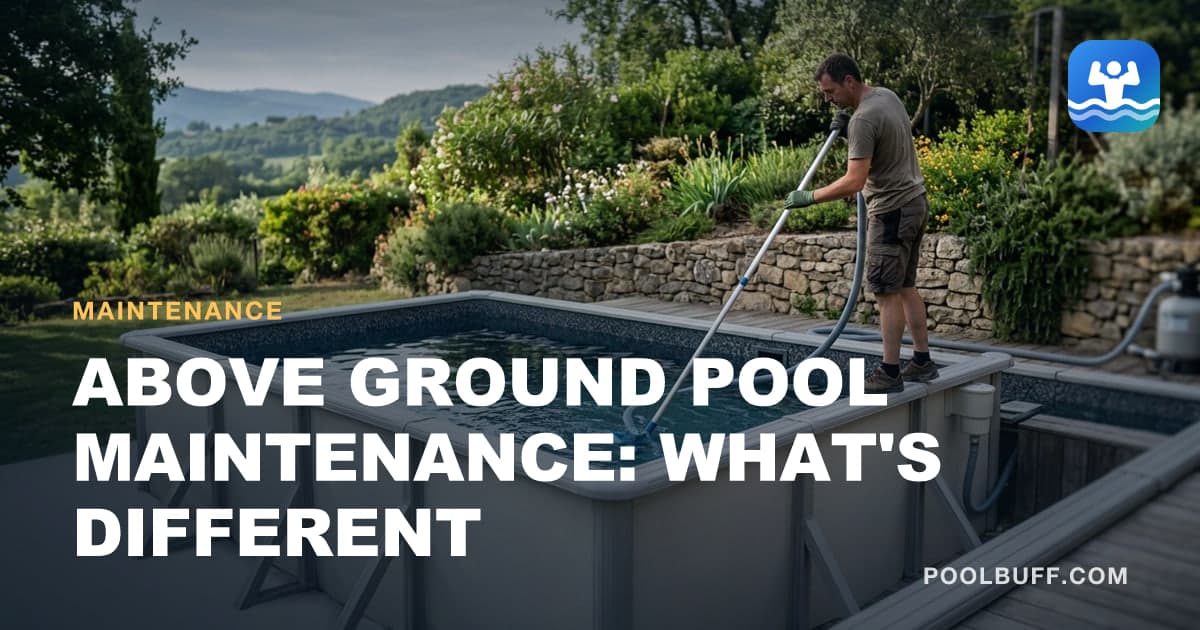
The fundamentals don't change. Circulation, filtration, sanitation, cleaning. Same four things.
What changes is the margin for error. An 8,000 gallon pool responds to a dose roughly twice as hard as a 16,000 gallon one, and it goes from fine to problematic in half the time.
Key takeaways
- Smaller volume means faster swings. Half the water, twice the sensitivity to a dose.
- Dose in smaller increments and retest sooner. Overshooting is easy on 8,000 gallons.
- Check the wall at ground level for corrosion. That's where above ground pools die.
- Never let the water drop far. The liner is held in place by water pressure.
- Most above ground failures trace back to the original leveling, not to maintenance.
Volume changes everything
The above-ground weekly kit
- Check price
Taylor K-2006C test kit
Drop-count titration rather than color matching, and it tests CYA properly.
- Check price
18-inch nylon pool brush
Nylon bristles, safe on vinyl, fiberglass and plaster alike. The default choice.
- Check price
leaf skimmer net
Debris lifted out today is not debris vacuumed off the floor next week.
- Check price
telescopic pole
Everything else attaches to this, so buy one that does not flex.
A typical 18ft round above ground pool holds around 6,600 to 7,300 gallons, depending on whether the wall is 48 or 52 inches — noticeably less than the box claims, because you fill below the top rail. A typical inground is 15,000–25,000. If you are still choosing one, our above ground pool picks cover the sizes and frame types worth having.
Practical consequences:
Dose smaller. A dose that raises free chlorine 2 ppm in a 20,000 gallon pool raises it nearly 6 ppm in a 7,000 gallon one. Calculate against your actual volume every time, and lean toward under-dosing and retesting.
Test more often. Three times a week rather than twice in peak season.
Heavy use hits harder. Six people in an 8,000 gallon pool on a Saturday is a serious bather load. Test Sunday morning and expect chlorine to be well down.
Rain matters more. An inch of rain into a small pool is a meaningful dilution of CYA and calcium.
Temperature swings faster. Less thermal mass means the water heats up and cools down quickly, which affects both comfort and chemistry.
Go deeperWork out your actual volumeRound, oval and variable-depth. Every dose depends on this number.Sun exposure
Most above ground pools sit in the open with no shade structure, which means maximum UV on the water all day.
Get cyanuric acid to 30–50 ppm and keep it there. Without it, chlorine in a small sunlit pool disappears within hours. This is the single change that makes the most difference for most above ground owners, and it's the reason so many of them feel like they're constantly adding chlorine.
A salt system changes that number. Hayward's AquaTrol, its salt system for above-ground pools, asks for 60 to 80 ppm, with 80 best.
Circulation without a main drain
An inground pool draws from a skimmer and a main drain, so water moves from the top and the bottom. An above-ground draws from the skimmer alone, which means nothing is pulling water across the floor. (If yours is also on salt, the saltwater routine layers on top of everything here rather than replacing it.)
Two consequences follow, and both are routine rather than alarming.
Dead zones form opposite the skimmer and directly under the return. Sanitizer reaches them slowly, so that is where algae starts. Aim the return jet to push water in a circle rather than straight across — angled slightly down and to one side sets up a rotation that eventually carries the whole surface past the skimmer.
Fine debris settles instead of circulating out. It is not going anywhere by itself, so brushing matters more here than on an inground pool. A weekly brush toward the center followed by a vacuum does the job a main drain would otherwise be doing continuously.
If your return swivels, spend a minute getting that angle right once. It is the cheapest circulation improvement available on an above-ground pool and most owners never touch it.
The two places that wear out first
Under the ladder or step. The weight of everyone who enters the pool lands on the same square foot of liner, over a base of sand or foam rather than concrete. It compacts, a hollow forms, and the liner stretches down into it until it splits.
A weight-bearing pad under the ladder feet spreads that load, and it belongs there from the start rather than after the repair. Check under the ladder each season for a depression starting.
At the waterline, the whole way around. Body oils, sunscreen and airborne dust collect at the surface and leave a band that hardens if left. On vinyl that band both looks bad and degrades the material, and unlike plaster you cannot attack it.
Wipe the waterline weekly with a dedicated sponge or soft cloth — no abrasives and no household cleaners, several of which strip the plasticizer out of vinyl. Two minutes on a fresh line; an hour once it has set.
The wall and frame
The part that's genuinely different from an inground, and the part people neglect.
Check the wall at ground level. Steel walls corrode where they meet damp soil, and the damage happens from the outside where you can't see it until it's advanced. Walk the perimeter each season, look at the bottom rail and the wall just above it, and clear away soil, mulch and vegetation that hold moisture against it.
Resin components — top rails, uprights, connectors — handle this far better than steel. If you're replacing parts, resin is worth the premium.
Check the uprights are still plumb and the top rails still tight. A frame that's shifted is telling you the base has moved.
Look for bulges in the wall. A bulge means the base has washed out or settled underneath, or there's water behind the liner. Neither fixes itself.
Liner care
The liner is the pool. There's no shell behind it.
Never let the level drop far. Water pressure is what holds the liner in place. A pool left low for a week on a hot day can let the liner shrink or pull out of the track.
Keep pH in range. Chronically low pH degrades vinyl. This is the biggest determinant of whether you get seven years or fourteen out of a liner.
Watch the waterline band for fading and brittleness. That's the UV-exposed strip and it goes first.
Patch small holes underwater rather than draining. A $15 kit works fine.
Winterizing
Whether it stays up depends on the pool, not only on the climate. Doughboy and Radiant steel-wall pools stay up, and both makers warn against ever emptying them. Intex lets its Ultra XTR, Prism Frame Premium and round Metal Frame pools stay up if you winterize them, but says its Easy Set and Small Rectangular Metal Frame pools must come down once it drops below 41°F. Bestway gives instructions for leaving up only its APX 365.
For a pool that stays up:
- Fix any leak first. Doughboy and Radiant both warn that ice left without water under it damages the wall.
- Set the water to your maker's level. They disagree, from Intex leaving it where it is to Doughboy's 6 inches below the return, but none of them say to drain it.
- Plug the return, close off the skimmer, and store the pump and filter inside
- Use an air pillow under the cover to take the expansion when the surface freezes
- Fit a winter cover, and deal with the water on it the way the cover's maker says
Closing an above-ground pool goes through each maker's instructions, including where they disagree. A pool left up does mean opening an above-ground starts with checking the wall rather than the water.
Equipment notes
Above ground pumps and filters are smaller and generally simpler. Two things worth knowing:
Don't oversize the pump. A 2 HP pump on an above ground pool with 1.25-inch plumbing achieves nothing except noise and a power bill. 0.75–1.0 THP is plenty.
The pump usually sits below water level, which means priming is easier but also means every fitting is under head. Check unions and drain plugs regularly for weeping.
Go deeperWhat it costs to ownRunning costs, liner replacement, and the cost per year that decides which pool is cheaper.Frequently asked questions
How do you maintain an above ground pool?
The same four fundamentals as any pool — circulation, filtration, sanitation and cleaning. Run the pump long enough for one turnover, keep the filter clean, hold free chlorine at the level your CYA demands, and brush and skim weekly. The difference is volume: smaller pools swing faster, so test more often and dose smaller.
How often should I test an above ground pool?
Three times a week in season rather than twice, because a smaller volume moves faster. A 20,000 gallon inground can absorb a hot weekend; an 8,000 gallon above ground can go from fine to problematic in three days of heavy use.
Why does my above ground pool lose chlorine so fast?
Usually low cyanuric acid combined with small volume and full sun exposure. Above ground pools often sit in the open with no shade and less water to buffer UV loss. Get CYA to 30-50 ppm and the difference is dramatic.
How long do above ground pools last?
Ten to twenty years for a quality pool that was properly leveled and is maintained, with the liner replaced every 6-12 years. Poor leveling is the main cause of early failure. Resin components handle ground-level moisture better than steel.
Can you leave an above ground pool up over winter?
It depends on the pool, not only on the climate. Doughboy and Radiant steel-wall pools stay up, and both makers warn against emptying them. Intex lets its Ultra XTR, Prism Frame Premium and round Metal Frame pools stay up if you winterize them, but says its Easy Set and Small Rectangular Metal Frame pools must be drained and stored once it drops below 41°F. Bestway gives instructions for leaving up only its APX 365. A pool that stays up needs any leak fixed, its fittings plugged, its pump and filter stored inside, and an air pillow under the cover.