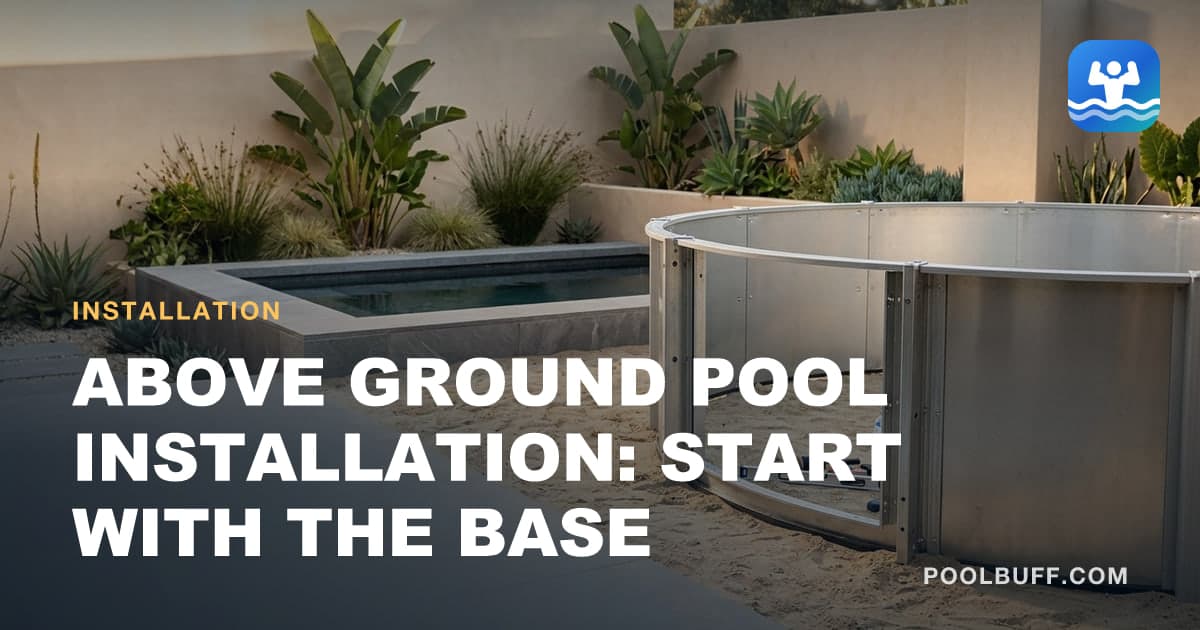
Above ground pools have a reputation for being flimsy and short-lived, and that reputation is mostly earned by bad installations rather than bad pools.
A properly installed quality above ground pool lasts fifteen or twenty years. A pool set on a base that's two inches out of level is on borrowed time from the day it fills, and nobody finds out until year three when a seam goes.
The base is the whole job. Everything else is assembly.
Key takeaways
- Level to within one inch across the full diameter. Two inches out and the wall is under permanent stress.
- Cut down to level, never build up. Fill settles and takes the wall with it.
- Never install on grass. Organics decompose and you get voids under the liner.
- A pool has to sit on undisturbed soil or properly compacted base. Period.
- Most above ground failures are site prep failures showing up two or three years later.
Picking the spot
Level ground. The flatter you start, the less you cut.
Full sun if you want the water warm. A pool in shade in a northern climate is a cold pool.
Away from trees. Leaves in the skimmer, roots under the liner, sap on the water. A pool under an oak is a skimmer basket you'll empty forever.
Away from overhead power lines. There are code clearances for this and they exist for obvious reasons.
Access. You need to get material in and spoil out.
Check setbacks. Property lines, septic fields, easements. Call your building department — above ground pools are not automatically exempt from permits and plenty of people find that out after the fact.
Call the utility locating service before any digging. Free, legally required in most places, and it prevents the sort of afternoon nobody wants.
Getting the base right
This is where installations succeed or fail.
Cut down. Never build up.
If one side is four inches high, you dig that side down. You do not bring the low side up with fill.
Fill settles. It settles unevenly and it settles under load, and the load is 15,000 gallons of water. When it goes, the wall goes with it.
Undisturbed soil doesn't settle. Cut into it and you've got a base that stays put.
Yes, that means more digging. Do it anyway.
One inch across the whole diameter
Use a transit level if you can borrow or rent one. Failing that, a long straight board with a good level on top, pivoted around a stake at the center.
Check it at eight points minimum around the ring. Then check it again.
- Within one inch: good.
- One to two inches: it'll work, with stress on the low side.
- Over two inches: don't fill it. You'll be redoing this in three years with a new liner.
Base material
Crushed stone compacts hard, drains well, and doesn't wash out. Best structural choice.
Masonry sand gives a smoother surface under the liner but holds moisture and can wash out over time.
A good compromise: compacted crushed stone base with a thin sand screed on top for smoothness.
Rent a plate compactor. It's $60 for a day and it's the difference between a base that stays and a base that doesn't.
Remove all organics
Every bit of sod, every root. Organic material under a liner decomposes, leaves voids, and attracts insects and burrowing animals. Voids under a liner become stretched spots, and stretched spots become leaks.
Assembly
Follow the manufacturer's sequence exactly. There's variation between brands and this isn't the moment to improvise.
Points that matter across all of them:
Get the bottom track truly circular before the wall goes up. Measure the diameter at several angles. Once the wall is in the track, an out-of-round track is very hard to correct.
Install the cove — the wedge around the inside perimeter where the wall meets the floor. It stops the liner being pulled into a sharp angle, which is where liners split. Skipping the cove is a classic shortcut with a predictable outcome.
Fit a ground cloth or foam pad. Cheap insurance against stones and roots.
Hang the liner on a warm day. Vinyl is far more flexible at 80°F than at 60°F. Cold liners fight you and are more likely to tear.
Fill in stages and chase wrinkles out as the water rises. Once there's more than a few inches of water in there, wrinkles are permanent.
Bonding and the electrical nobody budgets for
The part that surprises people who thought they were buying a pool in a carton.
An above-ground pool with a pump is an electrical installation, and it falls under the same bonding rules as an inground one. The metal wall, the frame, the ladder anchors and the pump motor all have to be tied together with a solid copper conductor and connected into an equipotential bonding grid. That grid is what stops a voltage difference existing between the water and the ground around it — the mechanism behind electric shock drowning — and it is indifferent to the fact that the pool arrived flat-packed.
Two further requirements catch people out:
The pump needs a proper outdoor circuit with GFCI protection, not an extension cord run from the garage. A cord is both a code violation and one of the more common reasons these motors burn out, because the voltage drop along a long thin lead makes the motor work harder every hour it runs.
Clearances from overhead conductors are specified, and the distances are larger than most people guess. If there are wires above or near the yard, confirm that before the base is dug rather than after the pool is standing in it.
Budget several hundred dollars for an electrician and treat it as part of the pool rather than an extra. It is the one line on this page where doing it yourself is not a question of ambition.
Costs, briefly
A decent 18ft round, professionally installed with basic prep, runs $5,000 to $10,000 before decking — and the kit is only $1,500 to $3,500 of that. Site prep, electrical and code-required fencing are what move the total, and decking on its own often costs more than the pool.
Go deeperThe full cost breakdownKit prices by type and size, the extras nobody quotes, running costs, and the cost per year that decides which pool is actually cheaper.Once it's in, above ground maintenance differs from an inground mainly in how fast the chemistry moves.
What actually shortens their life
Bad leveling. Number one, by a distance.
Winter neglect. Water left in the lines, no winter cover, ice load on the wall. Above ground pools are more vulnerable to freeze damage than inground ones because the wall is exposed on both sides.
Corrosion at ground level. Steel walls rust where they meet damp ground. Resin-framed pools handle this much better, and it's worth the extra cost if you're in a wet climate.
Chemistry. Same liner rules as inground vinyl. Chronically low pH eats liners. High chlorine held long fades and stiffens them.
Lowering the water too far. The liner is held by water pressure. Drop it too low and it shrinks or pulls out of the track.
Go deeperBarrier requirements for above ground poolsThe wall can count as the barrier, but the ladder rules catch people out.Frequently asked questions
How level does an above ground pool need to be?
Within one inch across the entire diameter, and closer is better. Beyond two inches out, the wall carries uneven load, the liner stretches unevenly, and you'll get seam failures within a few seasons. It's the single most important thing in the whole installation.
Can you put an above ground pool on grass?
No. Grass and roots decompose under the liner and leave voids, the surface is uneven, and organics attract insects and burrowing animals. Remove all sod and get down to firm soil or a proper compacted base.
What should you put under an above ground pool?
Compacted masonry sand or crushed stone over firm, undisturbed soil, then a ground cloth or foam pad. Crushed stone compacts and drains better; sand gives a smoother finish under the liner. Many good installs use a stone base with a thin sand screed on top.
How much does above ground pool installation cost?
The pool kit itself is $1,500-$6,000 depending on size and quality. Professional installation typically adds $1,500-$4,000, and site preparation can add anything from $500 to $3,000 if the ground needs serious work. Then fencing, electrical for the pump and decking on top.
How long does an above ground pool last?
10-20 years for a quality steel or resin-framed pool that's properly installed and maintained, with the liner replaced every 6-12 years. Badly leveled pools fail far sooner. Resin components resist corrosion better than steel around the fittings and at ground level.