The cheapest money in a pool project is the money you spend before anyone touches the ground.
I've watched builds go badly, and almost none of them went badly because of concrete. They went badly because of an allowance nobody checked, a site condition nobody priced, or a scope nobody wrote down.
Key takeaways
- Plan on a permit. The pool code requires one for any pool or spa, and the 24-inch rule you'll hear only exempts small kit pools.
- An allowance set low is a budget overrun already written into the contract. Fix them before signing.
- Tie payments to completed milestones, not to a calendar.
- Get a written change order process, including how site conditions like rock are priced.
- Talk to customers from two or three years ago, not last month. Warranty behavior is what you're buying.
What pool permits you actually need
Plan on needing them. The International Residential Code sends pools and spas to the International Swimming Pool and Spa Code, and that code requires a permit to build any pool or spa. It sets no depth below which you don't need one. The only work it lets you do without a permit is replastering or resurfacing an existing pool. Above-ground pools included.
Your state, city or county adopts those codes and can amend them, so the local building department has the final word. Ask before you buy anything.
Where the 24-inch figure comes from. You'll hear that a permit starts at 24 inches of water. The number is real, but it isn't a national rule, and it turns up in three different places:
- A permit exemption for kit pools. The 2021 and 2024 editions of the International Residential Code both exempt "prefabricated swimming pools that are less than 24 inches deep." That covers a pool out of a box, below that depth. It doesn't cover an inground pool at any depth.
- An old definition. The 2012 International Residential Code's Appendix G defined a swimming pool as anything for swimming or bathing holding more than 24 inches of water, above-ground pools, hot tubs and spas included. The appendix applied only where the local code adopted it by name. By 2015 it was gone, and the residential code sent pools to the pool code instead. The pool code that replaced it defines a residential pool by who uses it, not by how deep it is.
- State law. Florida's Residential Swimming Pool Safety Act defines a swimming pool the same way: water over 24 inches deep, hot tubs and above-ground pools included.
So treat 24 inches as the point where you stop assuming and call the building department, not as a line below which you're free.
Typically:
- Building permit for the pool structure
- Electrical permit for bonding and equipment
- Gas permit if you're fitting a gas heater
- Barrier approval, sometimes rolled into the building permit
- Grading or drainage permit on a sloped or sensitive site
Timelines range from two weeks to several months. Coastal zones, HOA approval, engineered plans for slope or soil, and environmental review all extend it.
Ask your builder what they're seeing right now in your jurisdiction, not what's typical. Backlogs vary enormously.
Building without one gets you a stop-work order, fines, and potentially breaking out finished work so an inspector can see what's underneath. It also creates real problems at resale and can leave insurance gaps.
Setbacks, easements and the survey
Before any of the contract discussion matters, the site has to allow the pool you are drawing. Three documents decide that, and they are worth reading yourself rather than trusting a sketch on a clipboard.
Setbacks are minimum distances from property lines, and they usually differ for the water's edge, the deck and the equipment pad. Your zoning code gives the numbers, and pool equipment may have its own, sometimes written for noise rather than for structure. A pool that fits the yard by the tape measure can fail on setbacks by two feet.
Easements are the ones people miss. A utility easement along a boundary, a drainage easement across the rear, or a shared access strip can be entirely invisible on the ground and absolute on paper. You generally cannot put a pool, a deck or any permanent structure inside one, and if you do, the utility may remove it without compensating you.
The plat and a current survey. Your closing documents include a plat, and a current staked survey costs a few hundred dollars and settles arguments before they start. A builder proposing to work off the fence line is guessing where your property ends, because a fence isn't always on the line.
Add 811 before anyone digs — the national call-before-you-dig number. It is free, it is required, and it gets buried gas, power and communications located and marked.
And if you are in an HOA, its approval runs separately from the municipality's and is usually slower, with its own submission windows and its own opinions about fencing.
Inspections you'll go through
Roughly, in order:
- Layout and excavation — before steel goes in
- Steel and bonding — the big one. The inspector checks the rebar cage and the equipotential bonding grid before it's buried
- Plumbing pressure test — lines under pressure, before backfill
- Deck and pre-plaster on some jobs
- Electrical final — equipment, GFCI, bonding continuity
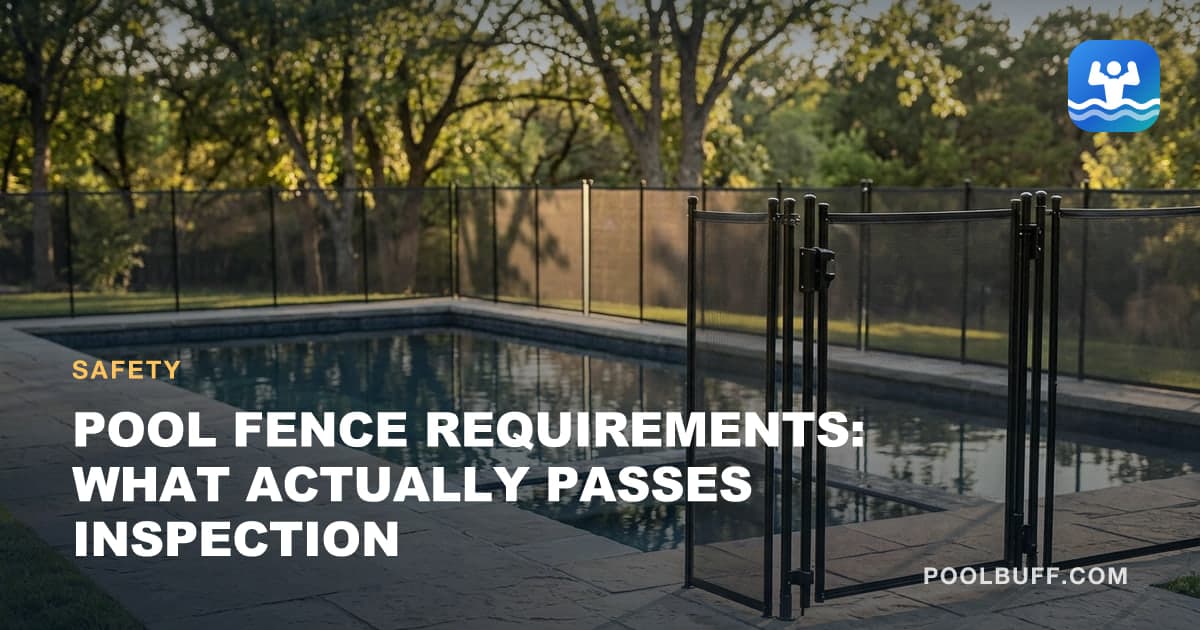
- Barrier and final — the fence and gate hardware, before you can legally fill
That barrier inspection catches people. You can have a finished pool you're not allowed to fill because the gate self-closer isn't right. Sort the fence early.
The contract
Get all of this in writing.
Full scope and a written exclusions list. What's in, and explicitly what's out. If a builder won't produce an exclusions list, that tells you something worth knowing.
Allowances you've actually priced. This is where budgets die. An allowance is a placeholder — "tile allowance $8/sq ft" — and then everything you like at the showroom is $22.
Go to the showroom before you sign. Pick your actual tile, coping, decking and interior finish. Get the allowances rewritten to those real numbers. It's the single most effective thing you can do.
A change order process. In writing. Including how site conditions are priced — specifically, what the rate is if they hit rock. Get a dollar figure per cubic yard or per hour, agreed in advance. Discovering rock on day three with no agreed rate is a bad negotiating position.
Payment tied to milestones. Money follows completed work: excavation done, steel and plumbing inspected, shell shot, decking poured, finish applied, final. Be wary of large deposits before anything happens, and of schedules that front-load payment.
Timeline with consequences. A start window, a duration, and what happens if it slips materially. Pool builds run over routinely — you want it acknowledged in writing, not hand-waved.
Warranty terms, separated. Shell, equipment and workmanship are usually different periods from different parties. Ask specifically who honors what, and what the process is.
License and insurance verified. Not from their brochure. From the state licensing board, and a certificate of insurance sent directly from their insurer.
Comparing quotes
Three quotes will arrive looking wildly different. Normalize them:
- Identical specs to every builder. Same dimensions, same finish, same equipment makes and models. Otherwise you're comparing nothing.
- Line up the exclusion lists. This is usually where the gap actually lives.
- Line up the allowances. A quote $10,000 lower with allowances $12,000 lighter is the more expensive pool.
- Compare equipment. A cheap single-speed pump versus a quality variable-speed one is a $400 difference on the quote and thousands over the life of the pool.
- Compare payment schedules.
Once you've done that, the three quotes are usually much closer than they looked. And the cheapest is rarely the cheapest.
Questions worth asking
- How many pools like mine has this crew built in the last two years?
- Who is my point of contact, and who is on site daily?
- What's your current permitting timeline in my jurisdiction?
- What happens if you hit rock, and at what rate?
- Who does the electrical and bonding, and are they separately licensed?
- What's the startup procedure and who performs it?
- What's excluded? (Ask it plainly, and get the list.)
- Can I speak to three customers from two or three years ago?
That last one is the most useful. Recent customers describe the sales process. Older customers describe what happened when something went wrong, which is the actual product you're buying.
Go deeperWhat it all actually costsReal ranges by type, plus the items that never appear in a quote. Go deeperChoosing who actually builds itVerifying the license, reading three quotes that disagree, and the contract terms that matter.Frequently asked questions
Do I need a permit to build a pool?
Plan on it. The International Swimming Pool and Spa Code requires a permit to build any pool or spa, and the International Residential Code exempts only prefabricated pools less than 24 inches deep. Your state, city or county adopts and amends those codes, so the local building department decides. You'll usually need a building permit for the pool itself, a separate electrical permit for bonding and equipment, and a gas permit if you're installing a gas heater. Above ground pools are not automatically exempt.
How long does it take to get a pool permit?
Two weeks in a straightforward jurisdiction, several months in a slow or complex one. Coastal zones, HOA approval, engineered plans for slopes or poor soils, and environmental review all add time. Ask your builder what they're currently seeing in your specific jurisdiction, not what's typical.
What happens if you build a pool without a permit?
A stop-work order, fines, and a requirement to expose completed work for inspection — potentially including breaking out decking. It also causes real problems at resale, since unpermitted work shows up in title and inspection, and it can void homeowners insurance coverage for anything related.
What should be in a pool construction contract?
Seven things. Full scope with a written exclusions list. Real allowances you have priced at a showroom, not placeholders. A payment schedule tied to completed work. A written change order process that says what rock costs if they hit it. A completion timeline, and what happens if it slips. Warranty terms listed separately for the shell, the equipment and the workmanship. And proof of license and insurance, sent to you by the insurer.
How do I compare pool builder quotes?
Give every builder identical specifications — same size, same finish, same equipment models. Then compare exclusion lists and allowances side by side rather than headline numbers. Three quotes that look $15,000 apart are often much closer once you normalize what each includes.