The question every buyer asks is "how long will it take," and the answer they get is usually optimistic and measured from the wrong starting point.
Ask specifically: how long from permit issue to water in the pool. And then ask how long permitting is currently taking in your jurisdiction, because that's frequently the longest single phase and it's the one nobody counts.
Key takeaways
- The clock starts at permit issue, not at contract signing. Ask which one your timeline refers to.
- Gunite is slow because curing and sequencing can't be compressed, not because crews are idle.
- The gap between shell and deck is normal and it's where people get anxious.
- Weather and inspection scheduling cause most delays, and neither is the builder's fault.
- Your yard will be destroyed. Landscaping repair is almost never included.
Gunite, week by week
The longest build and the one worth understanding in detail.
Weeks 0–8+ — permitting. Plans drawn, engineering if required, submitted, reviewed, revised, issued. Nothing happens in your yard. This is where most of the frustration lives, and it's largely out of the builder's hands.
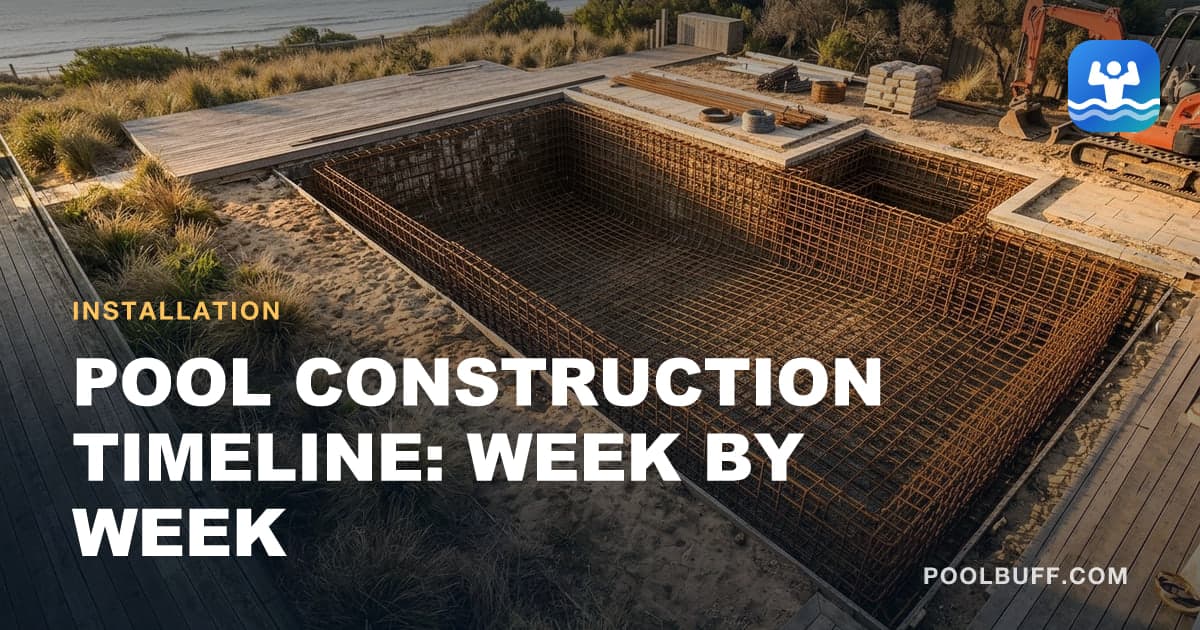
Week 1 — layout and excavation. Stakes go in, the shape is marked, and the machine arrives. One to three days of digging, longer if there's rock or difficult access. Your yard now has a hole and a very large pile of dirt.
Week 2 — steel and plumbing. The rebar cage is tied and the plumbing lines are run. Then it stops for inspection — the steel and bonding inspection is one of the important ones, because everything gets buried afterward.
Week 3 — shoot the shell. The gunite or shotcrete crew arrives and the shell goes up in a single day. It's the most dramatic day of the build and it's over quickly.
Weeks 3–5 — curing. The shell has to cure, and it needs to be kept wet — usually hosed down daily. This is the phase where owners get anxious because nothing visible is happening. It isn't idle time; concrete strength develops over weeks and building on it early causes problems later.
Weeks 5–7 — tile and coping. A different crew, a different trade. Detail work, and it takes longer than people expect.
Weeks 7–10 — decking. Forms, pour or paving, cure. Weather-dependent.
Weeks 8–11 — equipment set and electrical. Pad built, equipment plumbed and wired, bonding completed, electrical inspection.
Weeks 10–13 — interior finish. Plaster, quartz or pebble applied, then the pool is filled immediately — a new finish shouldn't sit dry.
Weeks 11–14 — startup. Daily brushing and careful chemistry for the first 28 days. This period materially affects how long your finish lasts, so find out who's doing it.
Then fencing and final inspection. Note that you often can't legally fill until the barrier passes, so sort the fence early rather than treating it as the last item.
Fiberglass
Much shorter, because the shell arrives finished.
Week 1 — excavation, gravel base set and leveled.
Week 1–2 — shell delivered and set, either craned or rolled in. Plumbing connected.
Week 2 — backfill and fill simultaneously. This matters: the pool is filled with water as it's backfilled so pressure stays balanced on both sides of the shell. A shell backfilled without water in it can bulge.
Weeks 2–4 — decking, equipment, electrical.
Weeks 3–5 — fencing, final inspection, startup.
Two to five weeks on site. The trade-off is that you're limited to the manufacturer's shapes, and the crane can add $8,000–$15,000 if access is tight.
Vinyl liner
Week 1 — excavation.
Week 1–2 — wall panels set, braced, footings poured.
Week 2–3 — plumbing, floor installed (vermiculite or grouted sand), which needs to cure.
Week 3–4 — liner hung and vacuumed in, fill begins.
Weeks 3–5 — decking, equipment, electrical.
Weeks 4–6 — fencing, final.
Three to six weeks.
Where delays actually come from
Permitting. The biggest single variable and rarely the builder's fault. Ask what they're currently seeing, not what's typical.
Weather. Concrete and plaster work stops for rain and for cold. A wet two weeks in the wrong phase pushes everything.
Inspections. You're on the inspector's calendar, not yours. A failed inspection means a re-book, which in a busy jurisdiction can be a week.
Site conditions. Rock, a high water table, unstable soil, buried debris from a previous structure. None of it is knowable until the machine is in the ground, which is exactly why you want the rock rate agreed in the contract beforehand.
Trade scheduling. Six or seven different crews, each with their own calendar. A gap between the tile crew finishing and the deck crew starting is normal.
What you can actually do to keep it moving
Most of this timeline is out of your hands. A few parts are not, and they are worth knowing, because they are the ones owners routinely delay without realizing they sit on the critical path.
Make your selections before the build starts. Tile, coping, interior finish, decking, light color — all of it. A build that reaches the tile phase while the owner is still visiting showrooms simply stops, and the tile crew goes to another job and returns when it can. Selections are the most common owner-caused delay by a wide margin.
Sort the barrier early. In many jurisdictions the pool cannot be filled, or the final cannot pass, until the fence does. Treating fencing as the last item on the list is how a finished pool sits empty for three weeks in August.
Answer quickly. Builds pause on questions waiting for replies — a return relocated, a step reconsidered, a variation approved. A same-day answer keeps a crew on site. A three-day answer loses that crew to another job for a week.
Do not add scope mid-build. A change that sounds small — moving a light, adding a bubbler, extending the deck by two feet — usually means a new drawing, sometimes a revised permit, and always a re-sequencing of trades. Add it before ground breaks, or accept it after everything else is done.
Be reachable during excavation week. That is when the surprises surface: rock, water, buried debris from whatever was there before. A decision made within an hour costs a fraction of the same decision made in three days with a machine standing idle in your yard.
What your yard looks like
Nobody warns people about this properly.
For the duration of the build your yard is a construction site. Spoil piles, machinery tracks across the lawn, materials stored wherever there's room, dust, and noise on working days.
Your irrigation will get cut. Every time. Mark the lines if you know where they are, and expect to repair some anyway.
Landscaping repair is almost never included. Get it in writing either way, and budget $2,000–$10,000 to put the yard back depending on how much you had.
Access route matters. Whatever the machines drive over is going to need repair afterward. If that's a driveway or a decorative path, discuss protection before day one.
Go deeperPermits, contracts and the questions to askThe paperwork side, and the contract terms that cause disputes. Go deeperBefore any of this startsVetting the builder, the payment schedule, and lien waivers.Frequently asked questions
How long does it take to build an inground pool?
Fiberglass is 2-5 weeks on site, vinyl liner 3-6 weeks, and gunite 8-16 weeks. Add permitting, which runs from two weeks to several months depending on your jurisdiction. Most homeowners should plan for three to five months from signing to swimming on a gunite build.
Why does gunite pool construction take so long?
The shell has to cure before anything can be built on it, and the finish trades — tile, coping, decking, plaster — have to happen in sequence with inspections between several of them. Each stage also needs a different crew, so scheduling gaps stack up. It's not idle time so much as unavoidable sequencing.
What causes pool construction delays?
Permitting backlogs, weather that stops concrete work, inspection scheduling, unexpected site conditions like rock or a high water table, and material or crew availability. Weather and inspections are the two most common and neither is within the builder's control.
Can you build a pool in winter?
In mild climates, yes, and it's often the best time — builders are less busy and pricing is better. In freeze climates, concrete and plaster work is weather-dependent, so a winter start usually means a slow build with weather holds. Many people sign in the fall for a spring start.
What does the yard look like during pool construction?
Like a construction site, for the whole build. Excavation spoil, machinery tracks, materials stored on the lawn, and cut irrigation lines. Landscaping repair is almost never in the contract, so budget separately for putting the yard back.