Landscaping around a pool is where design and maintenance meet, and the maintenance side usually loses the argument at the design stage.
Then somebody spends the next fifteen years emptying a skimmer basket twice a week because a beautiful tree went in eight feet from the water.
Key takeaways
- Every tree within leaf-fall distance of the pool is a weekly job you signed up for.
- Prevailing wind matters more than distance. Plant heavy shedders downwind.
- Invasive roots will find the pool shell and the plumbing. Check mature root behavior, not mature height.
- Bee-attracting flowers at the waterline is a genuinely bad combination with bare feet.
- Deck surface temperature is the one spec people forget until August.
The three tests
Before any plant goes near the pool, ask:
1. What does it shed, and when? Everything sheds something. The question is whether it's a few large leaves in the fall — easy to skim — or a constant drizzle of fine litter that goes straight through the skimmer basket and into the pump.
Fine litter is the enemy. Pine needles, small flowers, seed fluff, catkins.
2. Where do the roots go? Mature root behavior, not mature height. Aggressive roots will find their way to the shell, the plumbing and the deck, and lifting a deck to deal with them is expensive.
3. Does it attract bees? Flowering plants right at the waterline plus bare feet is a bad combination, and it's one people don't think about until somebody gets stung.
Plants that work
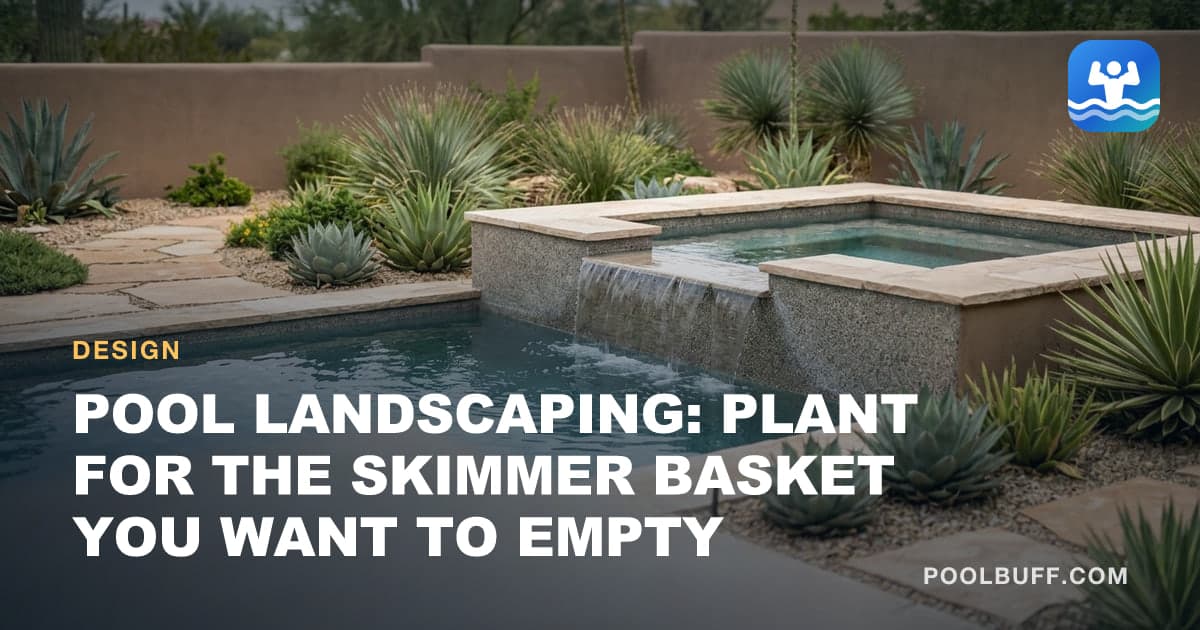
Ornamental grasses — miscanthus, muhly grass, fountain grass. Movement, texture, minimal shedding, no root problems.
Agave, yucca, aloe — architectural, drought tolerant, essentially zero litter. Keep spiky varieties away from traffic paths.
Olive (fruitless varieties) — beautiful silvery foliage, well-behaved roots, minimal drop.
Dwarf yaupon holly, boxwood — clean evergreen structure, easy to keep tidy.
Clumping bamboo — screening without the running roots. Emphasis on clumping. Running bamboo near a pool is a decade-long regret.
Canna, bird of paradise — tropical look, large leaves that are easy to skim rather than fine litter.
Succulents and sedums in beds and containers — no litter at all.
Plants to avoid
Bougainvillea — constant papery bract drop, and thorns. It looks incredible and it will fill your skimmer.
Mulberry — fruit stains everything it touches, including plaster and decking.
Cottonwood, willow — seed fluff clogs filters, aggressive water-seeking roots.
Pine — needles are the classic skimmer basket problem. They mat, they block, and they're acidic.
Sweetgum — spiky seed balls, everywhere, forever.
Jacaranda — beautiful for two weeks and a purple mess for the rest of it.
Most fruit trees — fruit drop and the wasps it attracts.
Palms — case by case. Clean self-shedding varieties are fine. Others drop fronds, fruit and flower spikes constantly.
How far from the water
The three tests tell you what to plant. This tells you where to put it.
Trees: at least half the mature canopy width back from the pool edge, and further for anything with a reputation as an aggressive rooter. A tree whose canopy will reach twenty feet across wants to be ten feet back at minimum, which is more room than most plans allow for. Planting to the size of the specimen in the pot is the most common landscaping mistake around a pool, and it stays invisible for about six years.
Roots travel further than canopies. A workable assumption is one and a half to three times the canopy radius, and they grow toward water. A pool is a large body of water that will eventually develop a slow leak somewhere in its plumbing, and roots find those.
Root barriers work if they go deep enough. A vertical barrier 24 to 36 inches down, set between the tree and the pool, turns roots downward. Anything shallower simply gets gone under. They cost very little at planting time and are a project afterward.
Shrubs and grasses: three feet back from the deck edge, for access as much as for roots. Somebody has to walk the perimeter with a pole every week, and a bed planted right up to the coping either gets trampled or means the pool gets brushed badly.
Existing mature trees are a design constraint, not an obstacle. If a tree is already there and worth keeping, put the pool where the tree is not. Excavating inside the root zone of an established tree tends to kill it a few years later, which means paying for the pool and then paying again to take the dead tree out.
Wind matters more than distance
The thing people miss.
A heavy shedder thirty feet away on the upwind side will put more into your pool than a moderate shedder twelve feet away downwind.
Work out your prevailing wind direction, then put anything that sheds on the downwind side. And look at where your skimmer is — debris blows toward one end of a pool, which is exactly why skimmers are positioned where they are.
Irrigation
Overspray into the pool is a real problem people underestimate.
Sprinkler water carries whatever's in your soil and whatever fertilizer you've applied. Phosphates from fertilizer are algae food. Iron and manganese from well water stain surfaces.
Use drip irrigation in beds near the pool, and if you must use spray heads, aim them away and check the actual spray pattern on a windy day.
Keep fertilizer away from the pool edge. Granular fertilizer scattered near the deck ends up in the water, and phosphate spikes are annoying to deal with.
Decking
The material decision people get wrong is temperature — deck materials compared properly here.
| Underfoot in full sun | Wet grip | Cost per sq ft | |
|---|---|---|---|
| Travertine | Coolest. Genuinely comfortable | Excellent | $15-$30 |
| Shell-blend pavers | Very cool | Excellent | $14-$28 |
| Broom-finish concrete | Warm but tolerable if light | Good | $8-$15 |
| Concrete pavers | Depends heavily on color | Good | $12-$25 |
| Porcelain tile | Hot in dark colors | Varies — check the rating | $18-$35 |
| Composite decking | Very hot in dark colors | Good | $20-$40 |
| Natural stone (dark) | Painful | Good | $20-$45 |
The grass question. Grass right to the water's edge looks lovely and is a permanent nuisance. Clippings blow in, the mower throws debris, irrigation affects chemistry, and the edge erodes. A hard border of at least three feet between turf and water saves a lot of grief.
Lighting
The most underrated part of pool landscaping.
Good lighting roughly doubles the hours you use the space. Uplighting a few specimen plants, low path lights, and a warm wash on a boundary wall turn a pool that's used until dusk into one used until eleven.
Keep it low-voltage, keep it warm-toned, and light objects rather than open areas. And it needs to be installed to pool-area electrical requirements, which is a licensed job.
Screening the equipment
The pad is loud-ish, unattractive and needs airflow. Screen it, don't box it in.
- Airflow matters, especially for a heat pump. A sealed enclosure will cook electronics.
- Access matters. You'll be at that pad regularly, and so will a technician.
- Slatted screens or a hedge work better than a solid wall.
- Don't plant anything with roots that will find the plumbing.
Frequently asked questions
What plants are best around a pool?
Low-shedding, non-invasive plants that tolerate splash. Ornamental grasses, agave and yucca, olive, dwarf yaupon holly, boxwood, clumping bamboo, canna and bird of paradise all work well. Anything that keeps its leaves and doesn't drop fine litter constantly is a good starting filter.
What trees should you not plant near a pool?
Mulberry, cottonwood, willow, pine, sweetgum, bougainvillea, jacaranda and most fruit trees. They shed heavily, drop fine litter that clogs skimmers, stain surfaces, or have aggressive roots. Palms are a mixed case — clean ones are fine, but some shed fronds and fruit constantly.
How far should trees be from a pool?
Far enough that the mature canopy doesn't overhang the water, and far enough that mature roots won't reach the shell or plumbing. As a rough guide, at least as far as the mature canopy radius, and further for anything with known aggressive roots.
What is the coolest pool deck material?
Travertine and shell-blend pavers stay noticeably cooler underfoot than most alternatives. Light-colored concrete is decent. Dark porcelain, dark composite decking and dark natural stone all get genuinely painful in direct sun — check surface temperature on a hot afternoon before committing.
Can you have grass right up to a pool?
You can, and most people regret it. Grass clippings blow into the water, mowing throws debris in, irrigation overspray affects chemistry, and the edge erodes. A hard border of at least three feet between grass and water saves a lot of ongoing annoyance.