Almost nobody regrets adding a tanning ledge. A good number regret the depth they chose.
It is the one dimension on the drawing that gets picked by eye, usually late in a long design meeting, and it is the one that decides whether the finished thing is the most used part of the pool or a shallow patch people walk across on the way in.
Key takeaways
- Depth is the whole decision. In-pool furniture is designed around roughly 9 inches.
- A ledge is a circulation dead zone unless it gets a return of its own.
- Umbrella sleeve at build time. Retrofitting one means coring the shell.
- Shallow water heats fast — lovely in May, unpleasant by August in a hot climate.
- On a fiberglass pool the shape is molded in. You choose it or you do not have it.
The names are all the same thing
Tanning ledge, sun shelf, Baja shelf, tanning shelf — one feature, four names, mostly regional. A quote using one term is not offering you something different from a quote using another, and it is worth saying so plainly because the vocabulary makes the market look more complicated than it is.
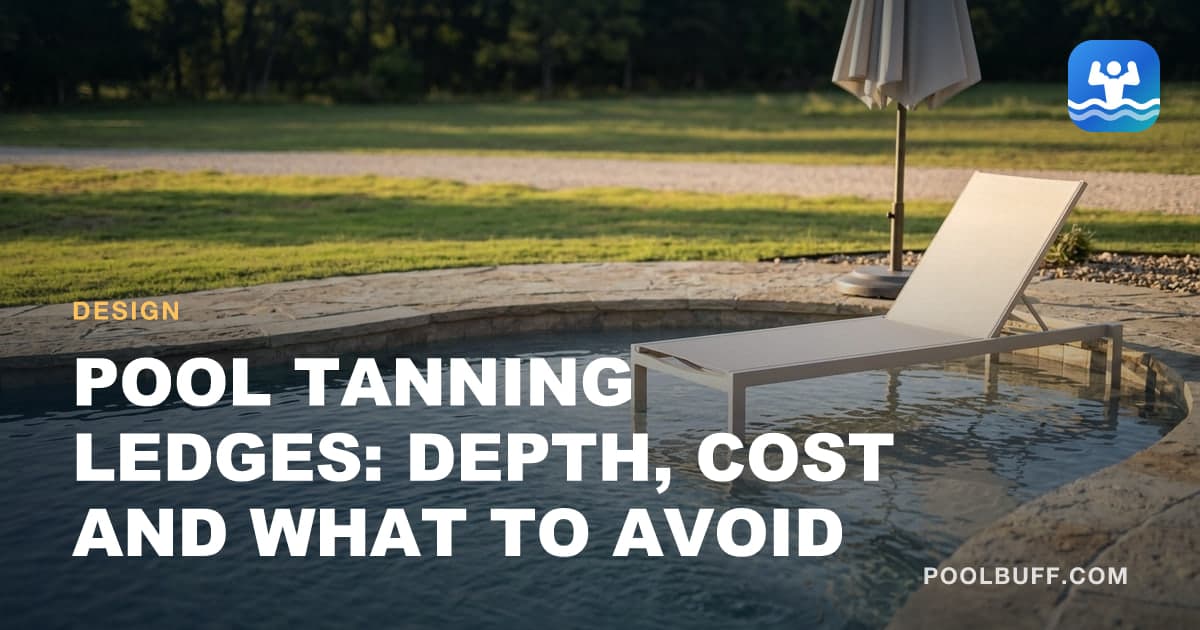
What they all describe: a broad, shallow shelf inside the pool, usually spanning one end, deep enough to lie down in and shallow enough to stand furniture on.
Depth is the whole decision
Nine to twelve inches. If you take one number from this page, take that one.
The reason is furniture. In-pool loungers are designed around roughly nine inches of water. Go much deeper and they lift, drift and tip when somebody sits down — the chair is displacing more water than it was built to. Go much shallower and two things go wrong at once: the chair sits proud with its legs half dry, and the water starts behaving badly.
That second part is the one people do not anticipate. Four inches of water in full sun gets hot. Not pleasantly warm — genuinely unpleasant by mid-afternoon in July, because there is so little volume that the sun wins easily. A shelf that was lovely in May becomes the part of the pool nobody uses in August.
You will see shelves built anywhere from four to eighteen inches. Both ends of that range are somebody's specific decision rather than a default, and the middle of it is where the feature actually works.
Size, and how much you need
Two loungers side by side want roughly six to eight feet of width and five to six feet front to back. Less than that and you have a step people sit on rather than a shelf people lie on.
The two common layouts:
Full width at one end. The most usual, and it reads as part of the pool's shape rather than as an add-on. It also eats length, which matters on a small pool — though on a genuinely small yard a ledge often buys more usable time in the water than the extra length would have.
A corner. Cheaper, fits an awkward plan, and tends to feel like a large step. Fine if the alternative is nothing.
What it costs
On a new gunite build, roughly $2,000 to $6,000 for a straightforward shelf. That climbs with size and with anything you put in it.
The extras worth pricing separately:
- Umbrella sleeve — a socket cast into the shelf so a shade umbrella stands in the water. Cheap at build time and the single most requested addition.
- Bubblers — jets that push a plume of water upward. Popular, photogenic, and they have a running cost discussed below.
- A dedicated return — the one that is not optional, for reasons the next section covers.
Set against the total cost of the pool, a ledge is one of the cheaper ways to change how the pool actually gets used, which is why it has become close to standard on new builds.
The circulation problem nobody mentions
Here is the part that separates a shelf that stays clean from one that becomes a chore.
A tanning ledge sits outside the pool's main flow. Water circulates between the returns and the skimmer, and a broad shallow shelf at one end is largely bypassed by that loop. So sanitizer arrives slowly, warm still water sits there, and anything that lands on it stays.
The consequences are predictable and they all show up on the ledge first: it is where algae starts, where the water goes cloudy first, and where a fine layer of debris settles between cleans.
The fix is a return of its own, aimed across the shelf rather than into it, so the surface actually moves. It costs very little at build time and it is a plumbing job afterward. Ask for it explicitly — it does not always appear on a standard drawing.
After that, it is a brushing habit. The ledge goes on the weekly round along with the steps and the corners, and takes about thirty seconds.
Surface and color
Two decisions on the ledge specifically, both easy to get wrong by copying the rest of the pool.
Texture. A ledge needs grip — it is shallow, wet and walked on — but it is also the one surface people lie directly on. An aggressive pebble finish that is perfectly comfortable underfoot in the deep end is unpleasant against a shoulder blade. A smoother finish on the shelf, or a quartz rather than a coarse pebble, is worth asking about.
Color. Dark finishes look superb in photographs and absorb heat. On a shelf holding four inches of water over a dark surface, that is a genuine comfort issue in a hot climate. Lighter on the ledge than in the main pool is a reasonable and fairly common choice.
Chairs also drag. A ledge takes more surface wear than anywhere else in the pool, so it is usually the first area to look tired — worth knowing when you are budgeting for resurfacing later.
Retrofitting one
Honestly: it depends entirely on what your pool is made of.
Gunite. Possible, and it is real construction — drain, cut into the shell, tie in new steel, shoot the new section, then refinish the whole interior so the new work does not show as a patch. Most people who do this are already resurfacing and are adding the ledge while the pool is empty, which is the sensible way to do it.
Vinyl. Means new wall panels and a new liner. Again, it pairs naturally with a liner replacement you were due anyway.
Fiberglass. No. The shell is a single molded piece and the shape it left the factory with is the shape it has. Choosing the right type up front matters more here than almost anywhere else — if a tanning ledge is on your list, it has to be on the model you pick.
Who it genuinely suits
Families with small children. This is the strongest case. A shelf gives young children somewhere they can be in the water safely and adults can sit within arm's reach. It is not a substitute for supervision or a barrier, but it changes how a pool works for a family with toddlers more than any other feature at this price.
Anyone who uses a pool to cool off rather than to swim. Which, honestly, is most people.
Hot climates, where sitting in shade in a few inches of water is the point, and the umbrella sleeve is doing most of the work.
Less compelling on a pool built for lengths, in a cool climate where the shallow water is cold rather than pleasant, or on a small pool where the length it consumes is length you will miss.
Go deeperFitting features into a small yardWhat earns its space when there is not much of it, and the layout mistake that wastes a third of a small plot.Frequently asked questions
How deep should a pool tanning ledge be?
Nine to twelve inches for most people. That is deep enough to cover you lying down and shallow enough that in-pool loungers stay put, since most are designed for roughly nine inches. Shallower than about six inches and the water heats uncomfortably fast and chairs become unstable. Deeper than about fifteen and the furniture starts to float and small children cannot stand.
How much does a tanning ledge cost to add?
Roughly $2,000 to $6,000 on a new gunite build for a straightforward shelf, with the range running higher once you add an umbrella sleeve, bubblers or a separate return. It is far more expensive as a retrofit because it means cutting into an existing shell, and on a fiberglass pool it is not possible at all — the shape is molded at the factory.
What is the difference between a tanning ledge, a sun shelf and a Baja shelf?
Nothing. They are three names for the same feature: a broad, shallow shelf inside the pool, usually at one end, deep enough to lie in and shallow enough to sit furniture on. Builders in different regions favor different terms, and a quote using one word is not offering anything different from a quote using another.
Do tanning ledges get algae?
They are the most likely part of the pool to, and the reason is circulation rather than the shelf itself. A shallow shelf sits outside the main flow, so sanitizer reaches it slowly and debris settles on it. A dedicated return aimed across the ledge fixes it at build time, and brushing it weekly fixes it afterward.
Can you add a tanning ledge to an existing pool?
On gunite, yes, but it is real construction — draining, cutting the shell, tying in steel, shooting new material and refinishing the whole interior so the patch does not show. Most people who do it are already resurfacing. On fiberglass it cannot be done. On vinyl it means new wall panels and a new liner, so again it pairs with work you were already doing.