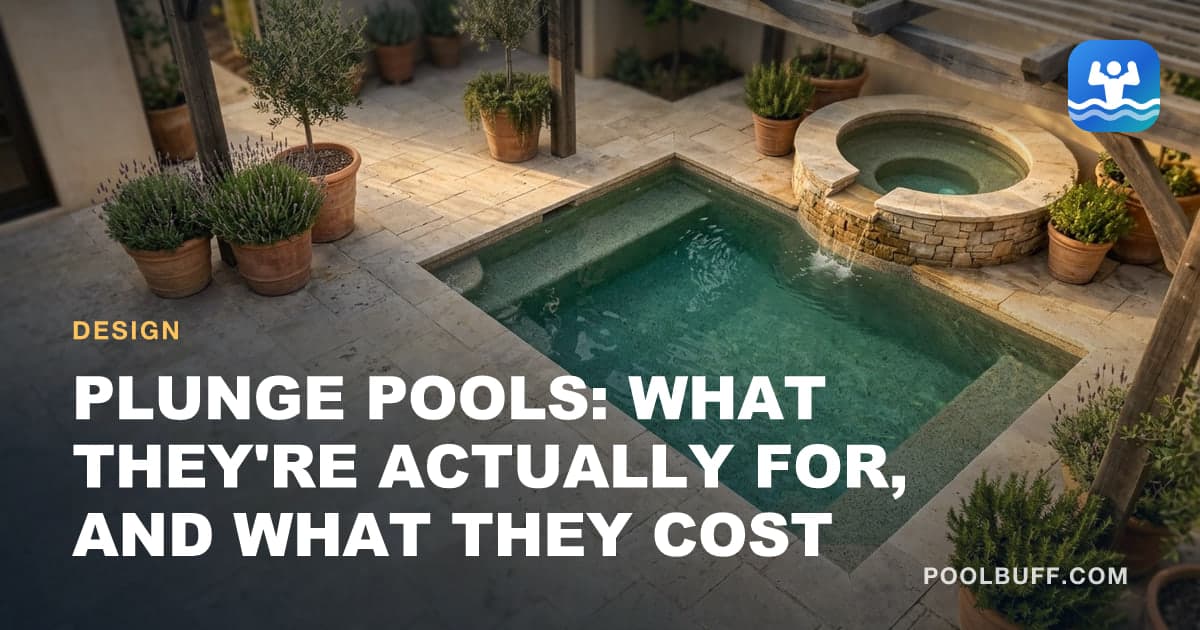
The one thing to be honest with yourself about before you spend the money: a plunge pool is not a small swimming pool. It's a different thing that happens to hold water.
Bought for what it is, it's one of the better decisions available on a tight lot. Bought as a compromise swimming pool, it disappoints within a season.
Key takeaways
- It's for cooling off, floating and sitting, not for laps. Buy it knowing that.
- The shells on sale run 4 to 5½ feet deep, and nearly all list one depth rather than a shallow and a deep end.
- It isn't proportionally cheaper to build. The digging, plumbing, wiring and permit come with any size of pool.
- About a quarter of a full pool's surface means a fraction of the heat loss. Heating one is affordable.
- That same small volume makes chemistry move fast. Test more, dose less.
What a plunge pool is
A small pool you stand, float and sit in. It sits between a spa and a full pool in size, and it's built for cooling off rather than for swimming.
That means standing in cool water on a hot afternoon. Floating. Sitting on a bench with a drink in reach. Getting kids in and out of the water without a project.
What it doesn't do is laps. At 16 feet you push off and you're at the other wall, and no layout trick changes that. River Pools, which sells an 8-foot-4 by 16-foot plunge model, lists wanting to swim laps as a sign it's the wrong pool for you.
Other names for a small pool
- Dipping pool. HomeGuide treats it as another name for a plunge pool. Latham says the two get used interchangeably but draws a line: a dipping pool is the shallower one.
- Cocktail pool. Shallower than a plunge pool, and built for sitting with friends rather than cooling off. It can have benches and jets. HomeGuide puts one at $15,000 to $35,000 installed.
- Spool. Latham uses it for a cocktail pool, from "small" and "pool." The word also gets used for a small pool with spa jets and a heater, which is how the small backyard ideas page uses it.
- Dunk pool. Latham lists it too.
In a hotel or villa listing, a private plunge pool means the same thing: a small pool for your room alone, for cooling off rather than swimming.
Plunge pool sizes and depth
Latham puts plunge pools at 8 to 12 feet wide and 12 to 24 feet long. HomeGuide says most are 6 to 12 feet wide and 12 to 21 feet long.
Fiberglass shells are the easiest place to see real numbers, because a shell comes in fixed sizes. Here's what Latham and Blue Anchor list for theirs:
| Model | Size | Depth | Gallons |
|---|---|---|---|
| Blue Anchor Capri Plunge | 6'11" × 9'11" | 4'11" | Not listed |
| Latham Milan 8.14 | 8' × 14' | 4' | 1,200 |
| Blue Anchor Captiva Plunge | 8' × 16' | 4'2" | Not listed |
| Blue Anchor Sanibel Plunge | 8'6" × 17' | 4'6" | Not listed |
| Latham Enchantment 9.17 | 9'1" × 17'5" | 4'9" | 3,200 |
| Latham Milan 10.16 | 10' × 16' | 4' | 2,450 |
| Blue Anchor Jupiter Plunge | 10' × 16' | 4'4" to 5'5" | Not listed |
| Latham Milan 10.20 | 10' × 20' | 4'10" | 3,900 |
| Latham Enchantment 9.21 | 9'1" × 20'7" | 4'9" | 4,000 |
| Latham Enchantment 9.24 | 9'1" × 23'10" | 4'9" | 4,800 |
Don't work out a shell's volume from its size. Latham lists the Milan 8.14 at 1,200 gallons, where a plain box 8 by 14 by 4 feet would hold about 3,350. Latham's sizes are outside dimensions, and the Milan's wading area and seats take up room. Once you've chosen a shell or a plan, run it through the pool volume calculator or ask the builder.
Depth: the guides and the shells disagree. Latham and HomeGuide both say most plunge pools are 4 to 8 feet deep, and HomeGuide says some makers go to 10. The shells above run 4 feet to 5 feet 5 inches. Anything deeper is a custom build, and a concrete pool can be dug to whatever depth you ask for.
My advice: pick one depth between 4 and 5 feet and hold it. Nine of the ten shells above do: they list one depth rather than a shallow end and a deep end. At this size a shallow end is wasted, and a deep end is too short to be useful for anything. One depth also means you can stand anywhere, which is most of what makes a plunge pool pleasant.
Latham's rule of thumb helps with the number. Waist-deep is 3½ to 4 feet for most people, so go deeper only if you want to sink to your shoulders or exercise in it.
What a plunge pool costs
HomeGuide's plunge pool guide, updated July 16, 2025, puts the average at $15,000 to $40,000 installed, with a national average of $27,500. An inground plunge pool runs $10,000 to $70,000 or more. An above-ground one runs $3,000 to $30,000 installed. Latham says installation typically starts around $35,000.
By material, from the same guide:
| Material | Installed |
|---|---|
| Vinyl liner | $10,000–$25,000 |
| Fiberglass | $20,000–$50,000 |
| Concrete | $25,000–$70,000 |
| Steel shipping container | $27,000–$46,000 |
HomeGuide gives two figures for fiberglass: $20,000 to $50,000 in its table, and $45,000 to $100,000 in the paragraph under it. The table's figure fits its own inground range and the paragraph's doesn't, so the table's is the one above. Get quotes before trusting either.
It isn't proportionally cheaper than a full pool. HomeGuide lists the chance it costs as much as a standard-sized pool among the drawbacks. The digging, plumbing, electrical work, permit and equipment pad come with any size of pool. A plunge pool saves on shell and finish, not on the whole job.
Lines to expect on the quote, with HomeGuide's installed figures:
- Heater: $1,600 to $5,200.
- Pump and filter: $1,000 to $2,000.
- Cover: $4,500 to $7,000 for a manual one, $9,500 to $11,000 for an electric one.
- Fence: $20 to $60 a linear foot.
- Permits: $500 to $2,000.
A heated plunge pool
This is the part that doesn't get sold properly, and it's the strongest argument for the whole idea.
Heat leaves a pool mostly through its surface. The Department of Energy calls evaporation "by far the largest source of energy loss" in a pool. Latham compares its 10 by 16 Milan, 160 square feet, with a typical full-size pool of about 16 by 38 feet, 600 square feet. That's a little over a quarter of the surface. Holding a plunge pool warm costs a fraction of holding a full pool warm.
Heat-up time comes from volume instead. Water takes 8.34 BTU per gallon per degree, so warming 4,000 gallons by 20°F takes 4,000 × 8.34 × 20 = 667,200 BTU. A 140,000 BTU heat pump delivers that in under five hours with nothing escaping, where a 20,000-gallon pool takes nearer 24.
You don't need one that big. Hayward sells the HP50HA2 as a 50,000 BTU heat pump and describes it as optimized for smaller pools. Its manual rates it at 47,000 BTU in 80°F air, so it would need about 14 hours for the same job. Put your own pool through the heater sizing calculator, which sizes by surface and times by volume, and see how the heater types compare.
Then cover it. The same Department of Energy sheet says a cover saves 50 to 70 percent of pool heating costs. On a pool this size a solar cover is small enough for one person to handle, and every Latham shell in the table is listed as ready for an automatic cover.
One disagreement worth knowing about. Latham's blog describes plunge pools as generally unheated and dipping pools as the heated kind. Nothing about a plunge pool stops you heating it, and the numbers above are the reason to.
The small volume cuts both ways
Everything that makes it cheap to heat makes it quick to swing.
A dose that raises 16,000 gallons by 2 ppm raises 4,000 gallons by 8 ppm. Four people in 4,000 gallons put the same load on each gallon as sixteen people in 16,000. pH moves faster, chlorine gets used up faster with the same people in it, and a hot week shows within days.
None of that is difficult, but the habits are closer to hot tub chemistry than to pool chemistry. Test more often, dose in small amounts, and work out your real volume once rather than following the back of a bottle.
If you want to swim in it
You can, with a counter-current unit: a pump or propeller that pushes a current you swim against. Endless Pools' Fastlane Swim, for one, attaches to the deck of an existing pool or is built into the wall of a new one.
Two honest points. It's a big line on the quote, and Endless Pools doesn't publish a price for it, so get it quoted with the pool rather than after. And it gives you a treadmill rather than a lap pool: good exercise, a different thing from swimming lengths, and worth trying before you buy.
If real swimming is the priority, price a swim spa too. It's a manufactured unit with the current built in, and it needs no excavation.
Cold plunge, and whether one pool can do both
HomeGuide lists cold plunge units among the alternatives, at $2,800 to $9,500 or more for the unit alone. So the question comes up: can a plunge pool be one?
Cold means cold. The studies in a 2025 review of cold-water immersion in PLOS ONE used water at 15°C, 59°F, or colder. No heater gets a pool there on a summer afternoon. That takes a chiller, or a heat pump with a cooling mode.
Hayward's HP50HA2 has a cooling mode, and its manual lists an operating water range down to 48.2°F. Neither the manual nor the sell sheet gives a cooling capacity, so neither can tell you how long it would take to pull a sunlit 4,000 gallons down to 59°F. Get that figure in writing before you buy one for the job.
What works better is deciding which one the pool is. Set up warm, it's a heated plunge pool held at temperature by a small heat pump. Set up as a cold plunge, it wants to be small, insulated and covered, which is what the purpose-made tubs are.
Where the two meet is winter in a mild climate. An unheated plunge pool cools with the weather at no running cost, and a floating thermometer will tell you whether yours gets to 59°F.
Are plunge pools worth it?
Against a full pool on a small lot: it fits, it leaves yard behind, it costs much less to heat, and it does the cooling off and sitting well.
Against a spa: far more room to move, and it works as a cooling-off pool in summer rather than only as a hot soak.
Against a swim spa: it looks like part of the garden rather than an appliance, and it runs on ordinary pool equipment. The swim spa wins if you want to swim.
HomeGuide's list of drawbacks is fair, and it's the list to read before you sign. A plunge pool isn't for large groups, laps or most pool games. It can't take a diving board or a slide. And it can cost as much as a standard pool.
Permits and a fence
A plunge pool 4 or 5 feet deep is deep enough to drown in. HomeGuide notes that most cities require a barrier around pools past a certain depth. Ask your building department what yours requires before you choose the spot, because a fence and a setback both take room on a small lot.
Pool fence requirements covers what passes inspection, permits and planning covers the paperwork, and the layers of drowning prevention covers the rest.
The small backyard layout guide covers where to put the pool, which matters more than the size on a tight lot. And access will decide what can be built there at all.
Go deeperWhere it goesLayout, setbacks and the mistake of centering a pool in a small yard.Frequently asked questions
What is a plunge pool?
A small pool built for cooling off, floating and sitting rather than swimming laps. Latham, which makes them, puts them at 8 to 12 feet wide and 12 to 24 feet long. It sits between a spa and a full pool in size. It's also called a dipping pool, though Latham keeps that name for a shallower pool.
How deep is a plunge pool?
The fiberglass plunge shells Latham and Blue Anchor list run from 4 feet to 5 feet 5 inches, and nine of the ten list a single depth rather than a shallow and a deep end. Latham and HomeGuide both quote 4 to 8 feet for plunge pools in general, and the deeper ones are custom builds. I'd build 4 to 5 feet, held across the whole pool.
How much does a plunge pool cost?
HomeGuide puts the average at $15,000 to $40,000 installed, an inground plunge pool at $10,000 to $70,000 or more, and an above-ground one at $3,000 to $30,000. Latham says installation typically starts around $35,000. It isn't proportionally cheaper than a full pool, because the digging, plumbing, wiring and permit come with any size.
Can you swim in a plunge pool?
Not laps. You can cool off, float, stand and sit on a bench, and it's excellent at all of those. To swim you need a counter-current unit, which gives you a treadmill rather than a lap pool and is a large extra line on the quote.
Is a heated plunge pool expensive to run?
Not compared with a full pool, and heating is where the difference shows. Most heat leaves through the surface, and a 10x16 plunge pool has about a quarter of the surface of a 16x38 pool. A 140,000 BTU heat pump warms 4,000 gallons by 20°F in under five hours with nothing escaping. The Department of Energy puts a cover's saving at 50 to 70 percent of heating costs on top of that.
Are plunge pools worth it?
On a small lot, or if you'd rather keep most of the yard, yes, as long as you want to cool off and sit rather than swim or host. HomeGuide's list of drawbacks is fair: not for groups, laps or most pool games, no diving board or slide, and it can cost as much as a standard pool.
What is the difference between a plunge pool and a swim spa?
A plunge pool is built in place like any other pool, dug and plumbed on site. A swim spa is a manufactured unit that arrives with its own heater and current, and it can sit above ground or partly sunk. The swim spa lets you swim in place. The plunge pool looks like part of the garden and runs on ordinary pool equipment.