Four different things get sold as a pool cover, and they do four different jobs. Only one of those jobs is keeping a child out of the water, and the cover that does it has to meet a standard the others don't.
Everything below comes from the cover makers' own manuals, warranties and price lists, or from CPSC, DOE and EPA. Where they disagree, I say so.
Key takeaways
- A safety cover meets ASTM F1346. CPSC says the standard asks it to hold two adults and a child and to get rid of water quickly.
- Robelle and Blue Wave say in print that their winter covers are not safety covers, and Blue Wave and Intex say the same of solar covers.
- DOE's archived page puts the heating savings from a cover at 50 to 70 percent. That only counts while the cover is on.
- Mesh drains on its own. A solid safety cover needs a pump or a drain panel to count as a safety cover at all.
- An automatic cover is a barrier only when it is certified, closed all the way, and has its pump on it.
| What it does | Holds a person? | Makers' warranties | |
|---|---|---|---|
| Solar cover (bubble) | Holds heat in and cuts evaporation | No | 3 to 10 years, prorated |
| Liquid solar cover | Slows evaporation, by less than a sheet | No | None, it is a chemical |
| Winter cover | Keeps debris out over the winter | No | 5 to 20 years, prorated |
| Mesh safety cover | A barrier that drains through | Yes, to ASTM F1346 | 12 to 30 years, prorated |
| Solid safety cover | A barrier that blocks all light | Yes, with its pump or drain panel | 10 to 20 years, prorated |
| Automatic cover | Barrier, heat and debris at a key switch | Yes, if certified, closed and pumped | Fabric 5 or 7 years; mechanism 10 years to life |
The warranty column is what the makers will stand behind, from the documents listed at the bottom of this page. Every one of them is prorated after a short full-coverage period, so it is not a promise of how long yours will last.
What makes a cover a safety cover
The standard is ASTM F1346. Its scope says it is meant to reduce the risk of drowning by keeping children under five out of the water, and it also sets labeling requirements for every cover, safety or not.
CPSC sums up what it asks of a cover in two lines. It has to hold the weight of two adults and a child, so someone who falls onto it can be rescued. And it has to get rid of water quickly, because, as CPSC puts it, "A young child can drown in just inches of water."
That second rule is why Loop-Loc says no cover can call itself a safety cover if it doesn't provide for water removal. It is also where the deaths were. Reviewing records from 1973 to 1985, CPSC's staff counted 11 children who appear to have walked onto a secured cover and fallen into the water collected on it. All but one were under two.
Meyco, Latham and GLI each show the label their safety covers carry, naming ASTM F1346, and Latham's says not to remove it. My rule is simple: no F1346 label, no safety cover.
Go deeperWhere a cover fits in the safety pictureWhat each layer catches, and what it misses.Solar covers
CPSC described one in 1980 as "a buoyant, translucent plastic cover designed to be cut to fit the shape of an individual swimming pool." It floats on the water. Blue Wave and Sun2Solar both say the bubbles face down and the smooth side faces up.
What it saves. DOE's Energy Saver page on pool covers called evaporation "by far the largest source of energy loss" in a pool. It said that covering a pool when it isn't in use can save 50 to 70 percent of heating costs. It also put the cut in make-up water at 30 to 50 percent, and in chemical use at 35 to 60 percent. DOE has since taken that page down, so those figures come from the archived copy of March 2026.
How much is evaporation? The one direct measurement I found is two overnight tests on an unused, heated pool in Fort Collins, Colorado, in 1992. They put the heat loss at 56 percent evaporation, 26 percent radiation and 18 percent convection.
How much evaporation it stops. Cal Poly measured a bubble cover cutting evaporation by 94.9 percent in 2015, in a study paid for by the National Plasterers Council. Nobody swam and the cover never came off, so the author calls that the maximum possible.
How much heat it adds. The makers claim more than the independent figures. Blue Wave says up to 15°F. The Florida Solar Energy Center said to expect about 5°F with the cover on 12 hours a day, and 10°F at 20 hours.
Clear or blue. DOE said a transparent bubble cover cuts the sun's heating of the pool by 5 to 15 percent, and a completely opaque cover by 20 to 40. The Florida Solar Energy Center said transparent or lightly translucent covers work best.
It only works when it's on. EPA's WaterSense pool guide cites a 2016 study that found only 15 percent of pool owners have a cover and use it regularly. DOE's page put it plainly: "A cover doesn't save any energy if you never use it." It suggested a reel to roll the cover up, and buying the reel with the cover is my habit.
What it costs. On 2 October 2026, Blue Wave's own store listed a 12-mil blue cover for a 16×32 pool at $169.99, and a 14-mil clear one at $209.99. SolarCovers.com listed its Sun2Solar covers in the same size from $109.99 for 8 mil to $174.99 for 16 mil, and its 16-foot reels at $179.99 and $199.99. Those reels are rated for covers up to 12 mil.
How long it's warranted. Blue Wave warrants its 8-mil cover for 3 years, its 12-mil for 5 and its 14-mil clear for 6, and covers only delamination and seam failure. Sun2Solar's run from 3 years for 8 mil to 10 for its 16-mil clear. Both are prorated. The Florida Solar Energy Center put a solar cover's life at three to five years.
A solar cover is not a safety cover
Its makers say so. Blue Wave's instructions warn that it won't support a person, that it is possible to drown on top of it, and that it is possible to get caught under it. FeherGuard's and Intex's reel manuals both say never to swim in a pool partly covered by one.
That rule goes back to a CPSC alert in 1980. A woman and her two sons, five and two, drowned when they apparently became trapped under a solar cover. CPSC's staff later reviewed 31 cover incidents, 13 of them with solar covers, and concluded the records did not clearly show that the solar covers contributed.
The rule costs nothing to follow anyway. The cover comes all the way off before anyone gets in.
Go deeperGetting a solar cover rightWhich side goes down, how much heat it adds, and the safety point that matters.Liquid solar covers
A liquid cover is a thin film poured onto the water. Heatsavr's safety data sheet lists it as 90 percent isopropanol. HTH says its version contains a water-soluble polymer. HTH and Natural Chemistry dose theirs weekly, and Heatsavr's site gives a daily dose on one page and a weekly one on another.
The makers claim more than has been measured. Heatsavr's maker suggests approximately 30 to 50 percent less evaporation, and HTH up to 40 percent. Cal Poly measured two unnamed liquid products at about 15 percent, on pools nobody swam in, during a windier stretch of weather than its other tests. EPA's pool guide uses 15 percent.
Both makers name the limits. HTH says it is not as effective as a physical cover for heat retention in very cold weather, and Heatsavr's maker says high wind pushes it to one side of a pool that isn't sheltered.
It holds no weight at all. It is a choice for a pool where a sheet won't work, not a replacement for one.
Winter covers
A winter cover is a solid or mesh tarp that sits over the pool through the off-season. On an in-ground pool it is held down by water tubes in loops along its edge, which Robelle and Blue Wave both describe. On an above-ground pool, a cable and winch hold it.
It is not a safety cover. Robelle's guide warns that it is not a safety cover and will not support weight. Blue Wave says its winter cover "is not designed or intended as a safety cover." Meyco says a regular cover "is really just a tarp" that doesn't have to meet any criteria for weight.
Water on top is the hazard. That is the second scenario in CPSC's records. Robelle's guide says to remove standing water, because a child can drown on top of the cover, and a cover pump sitting on the cover does that job. Blue Wave is the exception for above-ground pools in the fall, and closing an above-ground pool explains why.
Warranty and price. Robelle's winter covers carry 5 to 20 years and Blue Wave's 8 to 20, prorated after a full-coverage period of one to five years. Both exclude wind damage. On 2 October 2026, Blue Wave listed in-ground winter covers for a 16×32 pool from $79.99 for its 8-year cover to $201.95 for its 20-year one.
Safety covers: mesh or solid
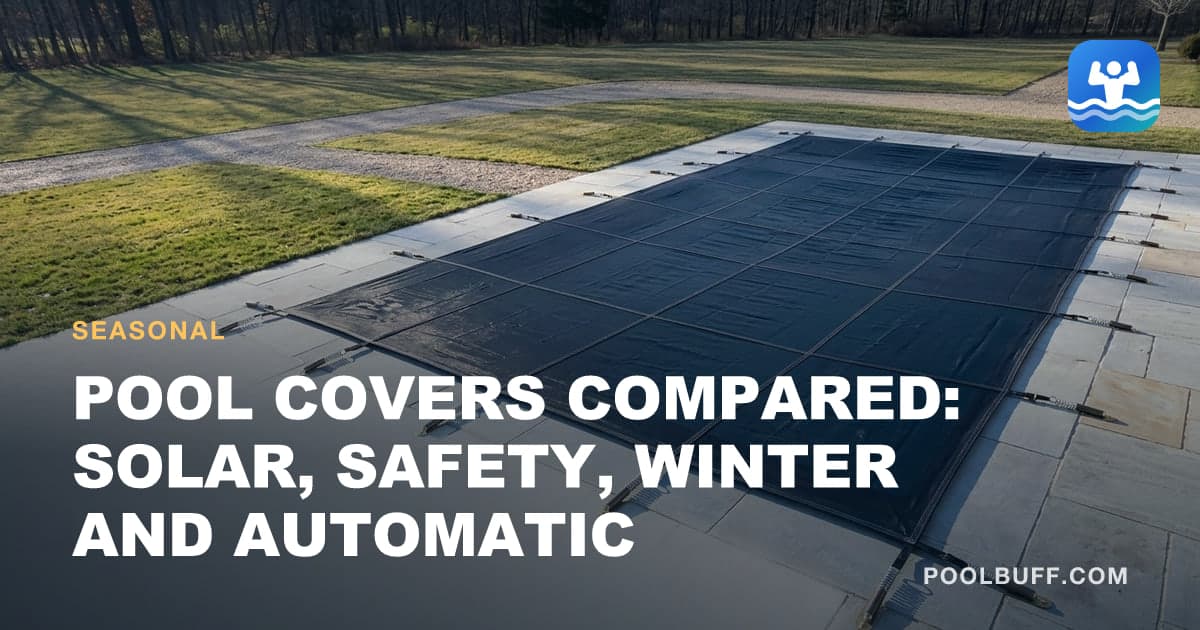
Both kinds anchor into the deck. Straps with stainless steel springs hook onto brass anchors, which sit flush with the deck when the cover is off, as Loop-Loc and Meyco describe.
Mesh lets rain and snowmelt drain through, so water can't collect on it. Loop-Loc calls that mesh's one safety advantage. How much sunlight it blocks depends on the grade:
- Latham: 91 percent for its 5000M, 99 percent for its 7000MS.
- Meyco: 95 percent for MeycoLite, 99 percent for RuggedMesh.
- Anchor: 98 percent for Defender Mesh.
- GLI: nearly 100 percent for Max Shade.
- Merlin: 100 percent shade for SmartMesh.
Latham says its 91 percent mesh "may be less effective in minimizing algae growth in certain installations." Merlin says its Dura-Mesh lets some fine silt and dust into the pool.
Solid blocks all of the light: Meyco, Anchor and GLI each say 100 percent. But water can't drain through it, so a solid safety cover needs another way to get rid of water.
- A pump. Meyco says one must be used at all times. Loop-Loc sells its all-solid cover only with an automatic pump. Anchor says that without one, its solid cover will present a hazard and won't meet safety cover criteria.
- A drain panel. A strip of mesh sewn into the solid cover. Latham fits one as standard on its solid covers, and GLI and Loop-Loc offer them.
In between, the denser meshes trade drainage for shade. Meyco says RuggedMesh drains more slowly than its standard mesh and sometimes needs winter attention in heavy rain. Merlin's new SolidMesh is light like a mesh but still needs a pump or drain panel, the same as a solid.
What one costs. Seven of the eight safety cover makers I read publish no prices. Loop-Loc and Meyco say their covers are sold and priced through pool professionals, who measure the pool first. Blue Wave, which sells its Arctic Armor covers direct, is the exception. On 2 October 2026 it listed a stock 16×32 mesh cover at $965.95 to $1,299.99, depending on grade and color, and its solid cover at $975.95. That is the cover alone, with no installation.
Warranties run 12 to 30 years for mesh and 10 to 20 for solid. Loop-Loc and Meyco give mesh and solid the same years (15 and 12). Merlin, Anchor and Yard Guard give mesh longer than solid.
Automatic covers
A motor reels the cover out along tracks on two sides of the pool, and back in again. Coverstar says: "In less than a minute your pool is opened or closed."
When it is a safety cover. Coverstar, Cover-Pools, Pool Cover Specialists, APC and Aquamatic all say their safety models meet ASTM F1346. CPSC says a power safety cover, properly in place, "provides a high level of safety for children under 5 years old." Each maker attaches conditions:
- The pump stays on the cover. Coverstar: "The cover is not a safety cover unless the pump is in place." Pool Cover Specialists says the same.
- It is closed all the way. Coverstar says never to leave the pool partially covered, and Cover-Pools and APC both warn that entrapment is possible.
- You can see the pool from the key switch. Coverstar says mounting it where 100% of the pool is visible is a mandatory requirement of the ASTM standard.
- The model is a safety model. Aquamatic calls its HydraLux slat cover "solely an energy pool cover and not a safety cover."
The shape. Pool Cover Specialists' rule is that if two straight lines can go one on each side of the pool, it can be covered. Cover-Pools says the same about tracks running parallel on opposite sides. On a freeform or existing pool, that means tracks on top of the deck. Tracks hidden under the coping need provisions made before construction, Cover-Pools says.
Living with one. Coverstar and Pool Cover Specialists say to keep the water at mid-skimmer, and Cover-Pools says the cover may not support itself over a low pool. Cover only water you would swim in: Coverstar and Cover-Pools both say some chlorine shocks need 12 to 24 hours to come back down. Coverstar also advises against floating chlorinators under the cover.
What it costs. Coverstar's site says $10,000 to $20,000, nearer the top for a large freeform pool. It doesn't say whether that includes installation. Latham says a replacement cover can start at around $2,000. None of the other makers I read publishes a price.
Warranties. Fabric is warranted for 7 years by Coverstar, Cover-Pools, Pool Cover Specialists and Aquamatic, and for 5 by APC. Latham's price guide says owners may need to replace the fabric every five to eight years. Mechanisms run from 10 years (Coverstar's CS3000, APC) to the life of the mechanism (Cover-Pools, Pool Cover Specialists).
Go deeperAutomatic covers in detailHow the tracks and ropes work, and what wears out.Getting the size right
Solar covers are cut to fit at home. Blue Wave says to float the cover for 2 to 4 days to let the packing creases relax, cut it larger than you need, then trim it to an exact fit after a day or two. It also warns that scissors can damage a liner.
Safety covers are made to your pool and can't be returned: Loop-Loc and Meyco both say so. For anything but a stock rectangle, the maker wants A-B measurements. You set two fixed points on one side of the pool, then measure from each to marks every three feet or so around the edge, as GLI's form and Anchor's instructions explain. Merlin says a rectangular cover should not go on anything but a rectangular pool.
Deck space decides where the anchors go. Meyco puts them about 32 to 38 inches back from the pool edge, and Latham wants at least three feet of deck. With less, there are options:
- Reduced deck hardware. Latham's works with as little as 18 inches of deck, by its brochure. The drawing in its manual shows 20.
- Lawn tubes go into soil where there is no deck.
- Wall anchors attach the cover to a raised wall, spaced so no gap is 4 inches or more (GLI, Latham).
Replacing a safety cover doesn't mean starting over. Latham will take the old cover back as a template, and Anchor says it can copy a competitor's cover with little or no new drilling.
Automatic covers are sized to their tracks, which is why the shape question above comes first.
Cover care
Solar covers:
- Take it off when chlorine goes above 3 ppm. Blue Wave and Sun2Solar both set that limit. Sun2Solar says to take it off before you shock the pool, and keep it off "for an extended period of time."
- Take it off if the water goes above 90°F, Blue Wave says.
- Keep it in the shade when it's off the pool, and never where it can reach 120°F. Blue Wave voids the warranty for sun damage off the pool, and FeherGuard says to put a protective cover over a rolled-up cover on the reel.
- Keep chemicals off it. Intex warns that copper sulfate makes the material brittle.
- Don't leave it on through the winter. Blue Wave says it is not a winter cover.
Safety covers:
- Flush the anchor casings with a hose in spring and fall (Loop-Loc, Meyco, Latham). Meyco says to use silicone or Teflon spray on the anchors and "Do not use oil or grease!"
- Keep the springs tensioned. The makers disagree on how far, and the closing guide lists them.
- Store it in its bag, hung off the floor. Loop-Loc warns that mice like to nest in a cover on the ground, and Meyco, Merlin and Anchor all exclude animal damage from their warranties.
- Don't drag it over concrete. Meyco and GLI both exclude that damage.
Winter covers: Robelle says to store it clean and dry, and to leave any ice on the cover until it melts.
Automatic covers: hose out the tracks. Coverstar says as often as needed, Cover-Pools twice a season and with nothing but water. Never run the cover with water, snow or ice on it (Coverstar, Pool Cover Specialists).
Where the makers disagree
- Algae under a solid cover. GLI says its 100 percent sunlight blockage means "NO spring time algae growth." Merlin says shade is "only one part of having a clean and algae free pool", and Loop-Loc says to keep the chemicals right whatever cover you own. I'd go with Merlin and Loop-Loc.
- Drying before storage. Merlin says its covers don't need drying. Robelle, Yard Guard and Latham's blog say dry first, and so does Meyco for its solid and RuggedMesh covers. My habit is to dry it first anyway.
- Snow on a mesh cover. Loop-Loc says there is never a reason to clear it. Latham's blog says large accumulations should be carefully removed. Thursday Pools says to clear it as soon as possible.
- How long a solid cover lasts. A Latham blog says solid covers generally last 7 to 11 years. Latham's own warranty on its 1000HS solid cover is 15.
- An automatic cover in deep cold. Coverstar, Cover-Pools, Pool Cover Specialists and Aquamatic say the pump can stay on the cover through the freeze. APC says to pull it off in a severe winter and keep it somewhere warm. APC and Aquamatic also say not to run the cover below 40°F.
- An automatic cover after chemicals. Coverstar and Cover-Pools say some chlorine shocks need 12 to 24 hours. APC's manual says to leave the cover open up to 60 minutes after adding chemicals. Wait for the water to test swimmable.
- The 70 percent figure. Heatsavr's maker and Natural Chemistry both credit DOE with saying evaporation is about 70 percent of a pool's heat loss. The DOE page they point to gave no percentage in any of the copies I read, from 2010, 2012 and 2026. The Fort Collins measurement was 56 percent.
Frequently asked questions
What is the best type of pool cover?
It depends on the job. For heat and evaporation, a solar cover. For leaves over the winter, a winter cover. For a barrier that keeps a child out of the water, only a safety cover that meets ASTM F1346: a mesh or solid one anchored to the deck, or a certified automatic one. A solar or winter cover is never a substitute for that.
How much does a solar pool cover save?
DOE's Energy Saver page, now only in archived copies, said covering a pool when it isn't in use can save 50 to 70 percent of heating costs. It put the cut in make-up water at 30 to 50 percent, and in chemicals at 35 to 60 percent. The savings only happen while it's on. EPA cites a 2016 study that found only 15 percent of pool owners have a cover and use it regularly.
Is a winter cover a safety cover?
No. Robelle's winter cover guide warns that it is not a safety cover, and Blue Wave says its winter cover is not designed or intended as one. A safety cover has to meet ASTM F1346, which CPSC says means holding two adults and a child and getting rid of standing water quickly.
Mesh or solid safety cover?
Mesh lets rain and snowmelt through, so it needs no pump. The makers put the sunlight their meshes block at anywhere from 91 to 100 percent, depending on the grade. Solid blocks all of it, but it has to have a pump or a mesh drain panel, because a safety cover must get rid of standing water. Latham says its 91 percent mesh may do less to hold back algae.
How long does a pool cover last?
Makers publish warranties, not lifespans, and every one I read is prorated after a short full-coverage period. Solar covers run 3 to 10 years depending on thickness, winter covers 5 to 20, safety covers 10 to 30, and automatic cover fabric 5 or 7. The Florida Solar Energy Center put a solar cover's real life at three to five years.
How much does an automatic pool cover cost?
Coverstar's site says $10,000 to $20,000, nearer the top for a large freeform pool. It doesn't say whether that includes installation. Latham says a replacement cover can start at around $2,000. None of the other automatic cover makers I read publishes a price.