Heating is the biggest discretionary cost in pool ownership, and it's the one where the equipment choice matters less than people think and the cover matters far more.
Key takeaways
- A cover cuts heat loss by more than half. Nothing else on this list comes close for the money.
- Gas heats fast and costs the most. Heat pumps cost far less to run and heat slowly.
- Heat pump output falls as the air cools, to roughly 60 to 70 percent at 50°F, and around there they stop to defrost.
- Solar is nearly free to run and needs roof area equal to 50-100% of your pool surface.
- Every degree above about 84°F costs meaningfully more than the one before it.
Running costs side by side
Figures for a 20,000 gallon pool held at 82°F, in a moderate climate, without a cover.
| Gas heater | Heat pumpMy default | Solar | |
|---|---|---|---|
| Cost to run per month | $200-$600 | $80-$250 | $5-$20 (pump only) |
| Purchase + install | $3,500-$7,000 | $4,500-$9,000 | $3,000-$8,000 |
| Time to raise 10°F | 8-14 hrs | 24-72 hrs | Days, weather permitting |
| Works when cold outside | Yes, any temperature | Loses output as air cools; defrost stops near 50°F | No |
| Lifespan | 8-12 yrs | 10-15 yrs | 10-20 yrs |
| Best for | On-demand heat, spas, cold climates | Steady season-long heating | Extending the season cheaply |
Why a cover matters more than the heater
Most of the heat leaving your pool goes out through the surface, and most of that is evaporation. Every gallon that evaporates takes a lot of energy with it.
A cover stops that directly. Typical saving is 50–70% of heat loss.
A $150–$300 solar cover on a heated pool routinely pays for itself in one season. Nothing else in pool ownership has that return.
The catch is that they're annoying. A manual solar cover on a 16×32 pool is a two-person job and it lives somewhere on your deck being unattractive. A reel helps a lot. An automatic cover solves it entirely, but Coverstar puts one at $10,000 to $20,000, which makes it its own decision.
But if you're paying $400 a month to heat an uncovered pool, you're heating the sky.
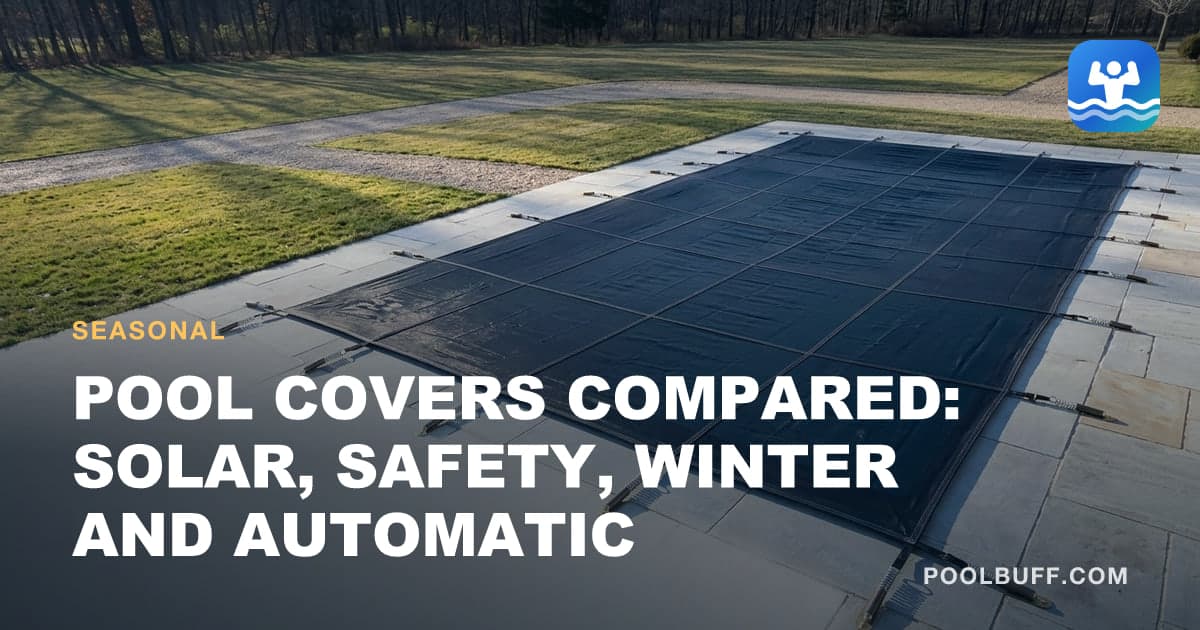
Go deeperWhich pool cover to buySolar, safety, winter and automatic compared on cost, heat retention and hassle.The temperature question
Every degree costs more than the one below it, because heat loss scales with the difference between the water and the air.
- 78°F — brisk, fine for lap swimming, cheapest
- 80–82°F — the sweet spot for most families
- 84°F — noticeably warm, costs maybe 20% more than 80
- 86°F+ — lovely, and roughly 40% more than 80 to maintain
Dropping from 86°F to 82°F is usually the single easiest saving available to someone with a high heating bill.
Working out your own number
The ranges above are averages, and heating is the one area where local rates make an average nearly useless. The arithmetic is short enough to do once.
What a degree costs you. Water takes 8.34 BTU per gallon per degree, so a 20,000-gallon pool needs about 167,000 BTU of delivered heat for each degree of rise.
What delivered heat costs. For gas, a therm is 100,000 BTU of fuel and a modern pool heater turns roughly 84% of that into water temperature — so a therm delivers about 84,000 BTU. At $1.50 a therm, delivered heat works out near $18 per million BTU.
For a heat pump, a kilowatt-hour is 3,412 BTU of electricity multiplied by the unit's COP. At a COP of 5 that is about 17,000 BTU delivered per kilowatt-hour, so at $0.17 per kWh you are paying about $10 per million BTU.
Or let the heater calculator do it, which takes your own fuel price and heater size and returns the hours and the cost together.
Put the two together. Raising that 20,000-gallon pool by ten degrees needs 1.67 million BTU: roughly $30 on natural gas at those rates, roughly $17 on the heat pump. Substitute your own numbers and the gap moves a long way. At the EIA's recent averages, propane costs a little under twice what natural gas does for the same heat, before any tax on the propane. That is where the largest heat pump savings actually come from, rather than from the heat pump being dramatically better than it is.
None of that counts standing losses, which is what the cover section above is really about.
Wind costs more than air temperature
Worth separating out, because people size and budget against temperature and then lose the heat to something else entirely.
Evaporation is the dominant loss from an open pool, and evaporation is driven by air moving across the surface far more than by how cold that air happens to be. A pool in a sheltered courtyard and the same pool on an exposed lot with a steady breeze do not have comparable heating bills, whatever their thermometers agree on.
That is a large part of why a cover pays back so hard: it does not merely insulate, it stops evaporation outright while it is on. It is also why solid fencing, hedging or a windbreak on the prevailing side is a heating investment rather than a landscaping one — and a considerably cheaper one than a bigger heater.
If your costs run well above the ranges here and the pool is covered, look at exposure before you start suspecting the equipment.
Regional reality
Florida, Gulf Coast, southern California: heat pumps are excellent. Warm air most of the year means they run efficiently, and a heat pump plus a cover extends you to near year-round swimming for modest money.
Arizona, Nevada: you may need cooling more than heating in July. Solar works brilliantly in shoulder seasons. Heat pumps with a chiller mode are worth pricing.
Northeast, Midwest: gas is often the practical choice because you're heating in genuinely cold air where a heat pump struggles. Expect high bills, and consider whether extending the season by six weeks justifies it.
Pacific Northwest: heat pumps work but mild-and-cloudy limits solar. A cover is close to mandatory to get any use from a heated pool.
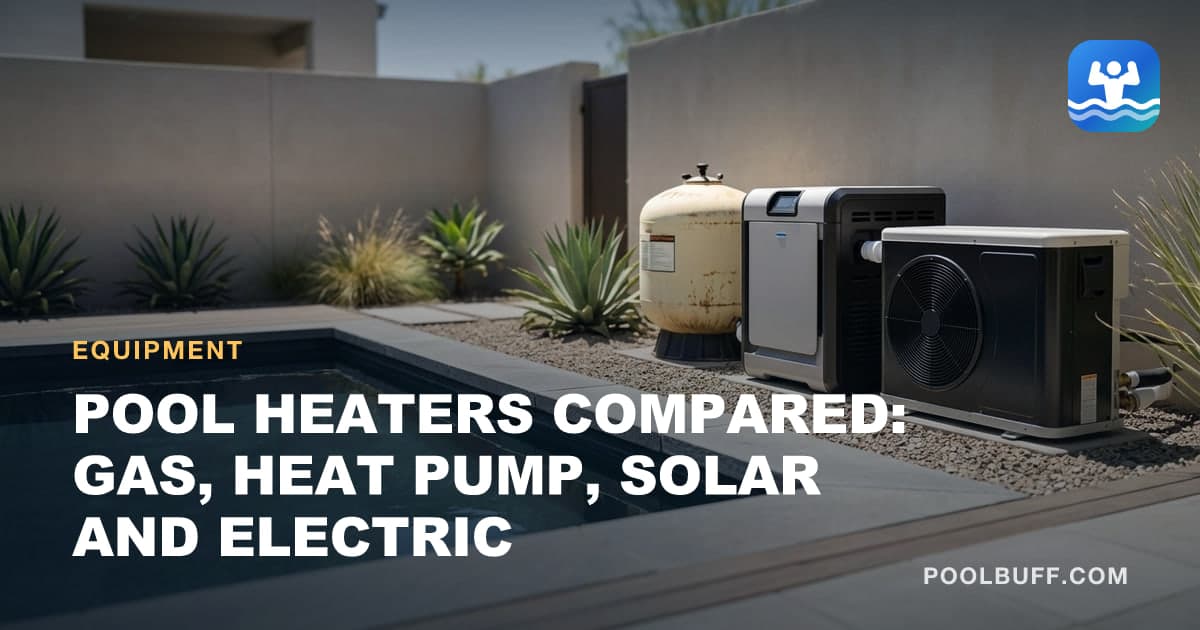
For how each type is sized and where the marketing figures fall apart, see pool heaters compared.
Gas specifics
Gas heaters are rated in BTU — typically 250,000 to 400,000 for residential.
Rough math: a 400,000 BTU heater at the 84% efficiency used above running 10 hours uses about 4 therms per hour, so 40 therms. At $1.50 a therm that's about $60 for a heating session.
If you heat a few times a month for weekends, that's $150–$250. If you're maintaining temperature all season, you're at the top of the range.
Propane costs meaningfully more than natural gas. Check which you have before budgeting.
Heat pump specifics
Heat pumps move heat from the air rather than making it, which is why they're so much cheaper per degree.
The catch is that output drops as the air gets colder. The headline figure is quoted at 80°F air, 80% humidity and 80°F water. Hayward and Pentair both publish a second rating at 50°F air, and on their current heat pumps it comes to roughly 60 to 70 percent of the headline number, at a COP of 4 rather than 5.5 to 6.1.
The harder limit is frost. Around 50°F the air coil has to defrost, and the heat pump stops heating while it does. Pentair's UltraTemp stops its compressor for about 15 minutes and shuts down with a Low Ambient Temp alarm if that does not clear the coil; Hayward's HeatPro manual puts a defrost at anything from 15 minutes to several hours. In genuinely cold air, that is where the time goes.
Which means the manufacturer's headline BTU number is optimistic for how you'll actually use it in April and October — exactly the months you bought it for.
Size generously and check the output curve at your realistic shoulder-season temperatures, not at 80°F.
Solar specifics
Panels on a roof, water pumped through them, sun does the work. Running cost is the extra pump energy to push water up there, which is small.
You need area. Roughly 50–100% of your pool's surface area in panels, on a roof with decent sun exposure and the right orientation. That's the constraint that rules it out for a lot of houses.
It's weather-dependent. No sun, no heat. So it extends your season rather than giving you heat on demand.
Best as a pairing. Solar plus a small heat pump, or solar plus a cover, gets you most of the way to a long season at very low running cost.
Go deeperThe cheapest heating upgrade there isA solar cover works every night, whether or not you remember to think about it. Go deeperAnd what a hot tub costsElectricity, chemicals and the repair reserve nobody budgets for.Frequently asked questions
How much does it cost to heat a pool per month?
A gas heater used regularly runs $200-$600 a month depending on gas prices, pool size and how warm you keep it. A heat pump is typically $80-$250. Solar is essentially free once installed. Using a cover cuts any of these by roughly half.
Is a heat pump cheaper than a gas pool heater?
Much cheaper to run — usually a third to a half the cost per degree — because it moves heat rather than making it. The trade-offs are slower heating, higher purchase price, and output that falls as the air cools. Hayward and Pentair rate their current heat pumps at roughly 60 to 70 percent of full output in 50°F air, and around that temperature the coil starts needing to defrost, which stops heating while it runs.
How much does a pool cover save on heating?
Typically 50-70% of heat loss. Most heat leaves a pool through evaporation from the surface, and a cover stops that directly. On a heated pool a $200 solar cover often pays for itself within a single season, which makes it the best-value heating purchase available.
What temperature should I keep my pool?
78-82°F suits most swimmers. Every degree above that costs noticeably more than the one before, because heat loss rises with the gap between water and air. 86°F feels lovely and can cost 40% more to maintain than 80°F.
Is solar pool heating worth it?
In a sunny climate with suitable roof space, yes — running cost is essentially the extra pump energy. You need panel area of roughly 50-100% of your pool surface, and it only works when the sun is out, so it extends your season rather than giving you on-demand heat.