This question gets two dishonest answers.
One comes from people selling pools, and it is that a pool is an investment in your home. The other comes from people who like being contrarian, and it is that a pool destroys your resale value. Neither is true, and both are more confident than the evidence supports.
The real answer is that it depends on four things, all of which you can assess before you spend anything.
Key takeaways
- Expect to recover a fraction of what you spend, not the whole thing. Anything approaching half is a good outcome.
- Climate and neighborhood comps decide most of it. The same pool helps in Phoenix and hurts in Michigan.
- A pool narrows your buyer pool. That can mean longer on the market even when the price holds.
- A neglected pool is a straight deduction. Buyers price in what it costs to fix or remove.
- Above ground pools generally add nothing to appraised value, and can be treated as something to remove.
The short version on resale
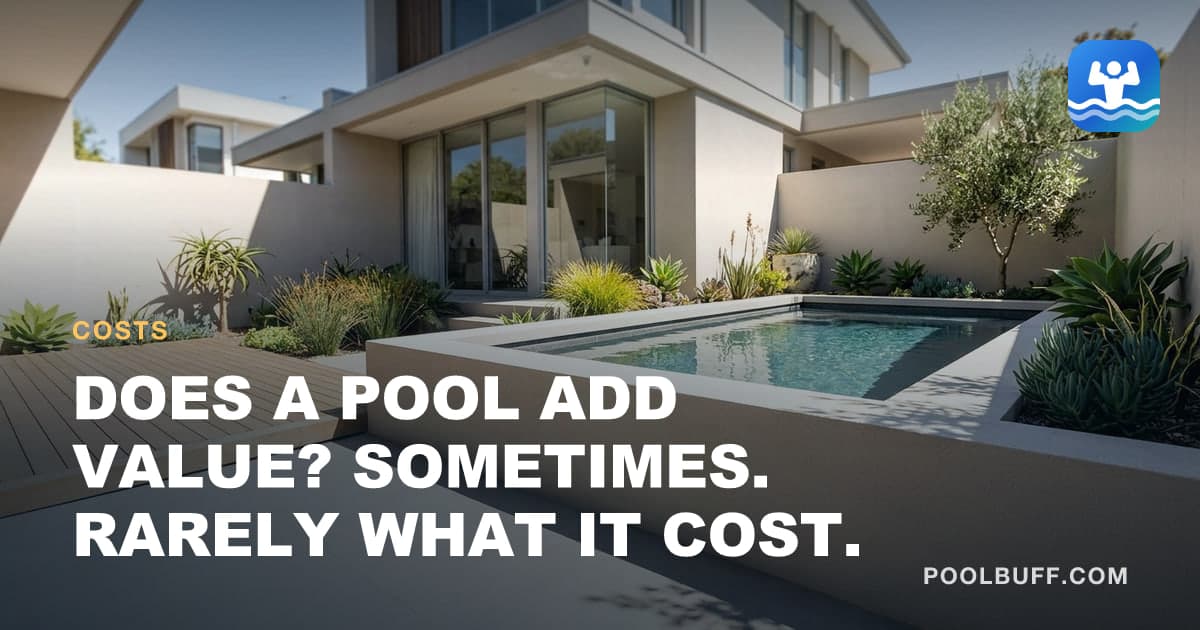
Published figures vary enormously and none of them should be treated as precise. What is consistent is the direction: pools sit near the bottom of home improvements for cost recovery, well behind kitchens, bathrooms and anything that adds square footage.
Depending on the market you might see a small single-digit percentage added to home value, or something approaching half the pool's cost in the strongest markets. You will very rarely see all of it.
So if the pool is going to be justified, it has to be justified by using it.
The four things that decide it
1. Climate
The single biggest factor.
In Phoenix, Houston, Orlando or inland Southern California, a pool is close to expected on a family home. Buyers looking there frequently want one, and a house without one loses candidates.
In Minneapolis, Buffalo or Portland Maine, the same pool is usable for a few months and needs closing, covering and reopening for the rest. Buyers see a short season and a long maintenance calendar, and it shows in what they will pay.
The pool did not change. The market did.
2. What the neighbors have
Appraisals lean on comparable sales, so what matters is not whether a pool is nice but whether comparable homes near you have one.
If most do, yours is normal and the absence of one would be the deduction. If almost none do, there is nothing to compare against and an appraiser has little basis for adding much.
Walk your street on a mapping app with satellite view. Ten minutes tells you more than any national statistic.
3. Your home's price tier
A pool can over-improve a property. Sixty thousand dollars of pool on a home in a modest price band does not lift the house into a higher band — it produces an unusually well-equipped house that still sells within its neighborhood's range.
At the top of a market the reverse applies. On a high-end home a pool may be simply expected, and its absence is what costs you.
4. How much of the yard it takes
This one gets missed constantly.
A pool that leaves usable lawn reads as an amenity. A pool that consumes the entire back yard reads as a trade-off, and it filters out exactly the buyers most likely to want a family home — the ones with small children who want somewhere to kick a ball that is not water.
The pool being smaller than you wanted may make the house easier to sell than the pool being as big as you wanted.
What it does to your buyer pool
Worth separating from price, because they are different problems.
A pool narrows the field. Out go families with toddlers who see a hazard, older buyers who see maintenance, and anyone who does not want the running cost. In come people who specifically want one, and they may want it badly.
In a hot market where pools are common, that trade is roughly neutral. In a market where they are unusual, it can mean longer on the market at the same price — which costs you in carrying costs and negotiating position even when the headline number holds.
The costs that belong in the equation
If you are weighing value, weigh the ongoing side too.
Property taxes. A permanent inground pool typically raises assessed value, and the bill follows. Above ground pools often do not, because many jurisdictions treat them as removable personal property. Rules vary by state and county — worth a call to your assessor rather than an assumption.
Insurance. Expect your homeowners premium to rise, and expect your insurer to have opinions about fencing and diving boards. It is also the point at which raising your liability coverage stops being optional in any sensible reading.
Maintenance, forever. A pool costs money every month it exists, whether or not anyone swims.
Go deeperWhat that actually runsMonthly costs by line item, DIY versus service, and where owners quietly overspend.Above ground is a different question
Almost always: no added appraised value.
Most above ground pools are treated as personal property rather than a permanent improvement. They do not typically raise your assessment, and they do not typically raise an appraisal either.
They can actively subtract, if the buyer does not want one. Then it is a thing to remove, along with the dead circle of grass underneath it, and that comes off their offer.
None of which is an argument against buying one. It is an argument against buying one for value.
Go deeperWhat an above ground actually costsKit, install, the extras nobody quotes, and the cost per year of ownership.When a pool genuinely helps
- Hot climate, long season, pools common on comparable homes
- Well maintained, with a surface and equipment that do not read as a pending bill
- Modern, efficient equipment — a variable-speed pump and a sane filter say "cheap to run" to a buyer who is doing the arithmetic
- Code-compliant barrier already in place, so it is not the buyer's problem to solve
- Yard left over, so the house still works for people who want both
When it genuinely hurts
- Cold climate with a short season and a long closing routine
- Visibly neglected — stained plaster, a tired liner, dated equipment
- No compliant fence, which a buyer reads as an immediate cost and a hassle
- Over-improved relative to the neighborhood
- The pool is the yard, with nothing left over
The honest way to think about it
Build a pool if you want to swim in it.
That sounds glib and it is the entire point. The people who are happy with their pools are the ones who wanted a pool. The people who resent them are usually the ones who were told it was an investment, and then met the maintenance, the running costs and the appraisal.
Work out what it costs to build, add what it costs to run for the years you plan to stay, then subtract whatever you think you will recover. That number is what the swimming costs. If it is worth it to you, it is worth it — and that is a legitimate way to spend money on your own house.
If it only makes sense as an investment, it does not make sense.
Go deeperStart with what it costs to buildReal installed costs by type, what sits inside a quote, and the allowances that blow budgets. Go deeperOr getting rid of itPartial versus full removal, and the resale problem that comes with the cheaper one.Frequently asked questions
How much value does a pool add to a house?
Figures vary enormously by market, and the range commonly cited runs from a small single-digit percentage of home value up to roughly half the pool's cost in the strongest markets. What is consistent across sources is that pools sit near the bottom of home improvements for cost recovery, well behind kitchens and bathrooms.
Does a pool increase property taxes?
In most places, yes, for a permanent inground pool — it raises assessed value and the bill follows. Above ground pools frequently do not, because many jurisdictions treat them as removable personal property rather than a permanent improvement. Rules vary by state and county, so check your local assessor.
Do pools make a house harder to sell?
They narrow the buyer pool. Families with toddlers, older buyers and anyone who does not want the upkeep will filter your listing out. In a market where pools are expected that barely matters. In a market where they are unusual, it can mean a longer time on market even if you get your price.
Is an old pool a liability when selling?
It can be. A pool with failing plaster, an old liner, dated equipment or no code-compliant barrier reads as a bill to the buyer, and they will price it in — often for more than the repair would actually cost you. Fixing the obvious problems before listing is usually money well spent.
Should I build a pool to increase my home's value?
No. If resale is the goal there are better places to put the money. Build a pool because you want to swim in it for the years you live there, and treat whatever you recover at sale as a partial refund rather than a return.