I've worked on gunite and fiberglass builds, and the honest answer to "which inground pool type is best" is that it depends on your yard, your budget and how long you plan to stay in the house.
What I can do is compare the three types on what each is actually like to build and to own, including the parts salespeople skip. Builders throw a lot of jargon around — gunite, shotcrete, gelcoat, bond beam — and the glossary has all of it.
Key takeaways
- Fiberglass: 2-5 weeks on site, smoothest surface, lowest chemical use, no shape freedom.
- Vinyl: cheapest to build, structure lasts decades, and the liner is a $3,000-$8,000 consumable.
- Gunite: any shape you want, 8-16 weeks, and resurfacing every 10-15 years at $6,000-$20,000.
- Fiberglass shells are size-limited by what can legally travel on a road. Roughly 16 feet wide.
- In a high water table, a fiberglass or vinyl pool needs more care around draining. Get that in writing.
The quick version
| FiberglassMy default | Vinyl liner | Gunite | |
|---|---|---|---|
| Installed cost | $55,000-$95,000 | $45,000-$70,000 | $65,000-$110,000+ |
| Time on site | 2-5 weeks | 3-6 weeks | 8-16 weeks |
| Shape freedom | Catalog only | Rectangles and common shapes | Anything |
| Max size | ~16ft × 40ft (road limits) | Large, but rectangular bias | No practical limit |
| Surface | Smooth gelcoat | Smooth vinyl | Plaster or aggregate, textured |
| Chemical use | Lowest | Low | Highest (porous surface) |
| Big recurring cost | None until gelcoat work | Liner, $4k-$8k every 8-12 yrs | Resurface, $6k-$20k every 10-15 yrs |
| Structure lifespan | 30+ years | Walls 30+ years | 50 years with maintenance |
| Salt system friendly | Excellent | Good, watch metal walls | Good, watch plaster and stone |
Fiberglass
How it's built. The shell arrives on a truck as one molded piece, which is why site access rules this type out before any other. Excavate, set a gravel base, crane or roll the shell in, level it, plumb it, backfill while filling with water so pressure stays balanced, pour the deck. Two to five weeks on site.
What's genuinely good. It's the lowest-hassle pool to own. The gelcoat surface is non-porous, so algae struggles to get a grip and you use noticeably less chlorine than an equivalent plaster pool. Nothing to resurface. Smooth underfoot — no scraped feet on the steps, which matters more with kids than people expect. And it's fast, which means less time with your yard as a construction site.
What's genuinely limiting. You're picking from a catalog. If the manufacturer doesn't make the shape, you don't get the shape. And road transport caps them at roughly 16 feet wide — anything wider needs permits and escorts that most builders won't touch.
What people don't tell you. Installation quality matters enormously and it's invisible afterward. The base has to be right, the backfill has to be done in lifts as the pool fills, and plumbing connections happen before the deck goes on. A badly set fiberglass shell can bulge a wall or settle unevenly, and fixing it means digging the whole thing back out.
Ask specifically how many fiberglass pools the crew has set. Not the company — the crew.
Gelcoat. It fades. A dark blue shell in Arizona sun will lose depth of color over ten to fifteen years. It can be refinished but it's a specialist job. Not a dealbreaker, just don't let anyone tell you it's permanent.
Vinyl liner
How it's built. Excavate, set steel or polymer wall panels, brace and concrete the footings, install the floor (usually vermiculite or grouted sand), hang the liner, vacuum it into place, fill. Three to six weeks.
What's genuinely good. Cheapest way into an inground pool by a decent margin. Shape flexibility is better than fiberglass — rectangles, L-shapes, custom sizes within reason. The surface is smooth and easy on skin. And the structure lasts a very long time; the walls aren't what wears out.
What's genuinely limiting. The liner. It's a consumable. Eight to twelve years, then $3,000–$8,000 for a replacement. Some people find that manageable, some find it grating.
Liners are also puncturable. A dropped ladder, a dog's claws, a sharp toy. Patches work and cost about $15 to do yourself, but you'll be doing it occasionally.
What people don't tell you. Liner life is largely a chemistry story. Chronically low pH eats liners. High chlorine held for long stretches fades the pattern and stiffens the material. A liner in a well-managed pool goes twelve to fourteen years; a liner in a neglected pool goes seven. That's a real $6,000 difference driven entirely by whether you test your water.
Also: don't drain a vinyl pool. The liner is held in place by water pressure. Empty it and it can shrink, wrinkle or pull out of the track, and the fix is a new liner.
Gunite and shotcrete
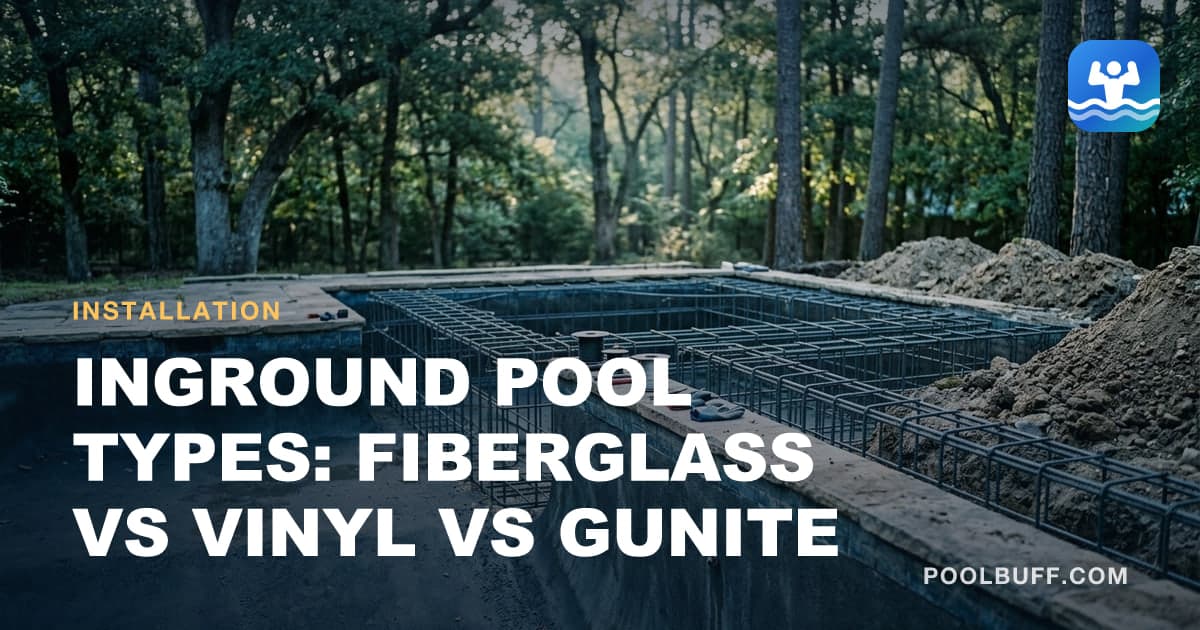
How it's built. Excavate, tie a steel rebar cage, spray concrete over it, cure, tile and coping, plaster or aggregate finish, deck. Eight to sixteen weeks, because the shell has to cure and the trades stack in sequence.
What's genuinely good. Total freedom. Any shape, any depth, any size. Beach entries, tanning ledges, vanishing edges, integrated spas, grottos, custom steps. If you've seen a pool you like in a photo, gunite can build it.
It's also the longest-lasting structure — a well-built shell can go fifty years, and it can be re-finished, re-tiled and re-plumbed rather than replaced.
What's genuinely limiting. Cost and time. It's the most expensive to build and the most expensive to maintain. The plaster surface is porous, which means algae gets a foothold more easily and you'll use more chlorine. It's also textured, and a rough plaster surface will take skin off a child's feet.
The recurring cost people underestimate. Resurfacing. Standard white plaster lasts 7–12 years, quartz and pebble 15–20. That's $6,000–$20,000, and it isn't optional — a failed plaster surface gets rougher, harder to keep clean, and eventually exposes the shell.
What people don't tell you. The first year of a new plaster pool is genuinely annoying. It leaches calcium hydroxide, pH climbs constantly, and you'll be adding acid far more often than you will from year two onward. There's also a startup procedure — brushing daily, careful chemistry — that materially affects how long the finish lasts. Get it in writing and follow it.
Go deeperWhat an inground pool actually costsFull breakdown, plus the items that aren't in your quote.Which one for which situation
Family, standard yard, wants low hassle: fiberglass, if a catalog shape fits. This is the right answer for a lot of people.
Tight budget, want a pool this year: vinyl liner. Just budget mentally for the liner replacement so it isn't a shock in year ten.
Unusual yard, specific vision, or you want a beach entry or vanishing edge: gunite. It's the only option that can do it, and it's worth the cost if the design genuinely needs it.
Small yard or plunge pool: fiberglass usually wins. Small shells are cheap, quick, and the shape constraint matters less at small sizes.
You plan to sell in five years: fiberglass or vinyl. Faster build, lower risk, and you won't have hit a resurfacing cycle.
Not sure inground is the right call at all? An above ground pool properly installed on a good base is a genuinely reasonable option at a third of the price.
Very hard water region: fiberglass. A non-porous surface deals with scale far better than plaster, and you avoid the porous-surface chemistry battle entirely.
The decisions you can't undo
Worth deciding carefully, because these are permanent:
- Depth. Too deep is the most common regret. Most people use 3.5–5 feet and rarely go in the deep end. A 8-foot deep end adds cost, chemical volume, heating cost and swimmable-space loss.
- Location in the yard. Sun exposure, tree cover and prevailing wind all matter for a decade. A pool under an oak is a skimmer basket you'll empty forever.
- Plumbing size. 2-inch instead of 1.5-inch costs almost nothing during a build and doubles your hydraulic headroom forever. Ask for it.
- Conduit runs. Extra empty conduit to the equipment pad and around the deck costs a few hundred dollars during construction and thousands to add later. Put in more than you think.
- Whether you're pre-plumbing for a heater or solar even if you're not buying one now.
How long it takes
Fiberglass is 2–5 weeks on site, vinyl 3–6, gunite 8–16 — the full week-by-week sequence is here, including where the delays actually come from.
What to ask a builder
- How many of this specific pool type has this crew built?
- What's your written exclusions list?
- What happens if you hit rock, and what's the rate?
- Who does the electrical and bonding, and are they licensed separately?
- What's the payment schedule against completed milestones?
- What's the startup procedure and who does it?
- What does the warranty actually cover, and for how long, on shell versus equipment versus workmanship?
Then go and talk to three of their customers from two or three years ago. Recent customers will tell you about the sales process. Older customers will tell you how the warranty went, which is the part that matters.
Go deeperPicked a type? Now pick a builderWhat to verify before you sign, and the equipment line in the spec nobody reads. Go deeperStill weighing above ground?The full cost picture, and an honest comparison against going in the ground. Go deeperBefore you commit to any of themWhat a pool does to resale, your buyer pool, and your tax bill. Go deeperThe fiberglass numbers in detailWhere the money goes, the size ceiling, and when it is not the cheaper answer.Frequently asked questions
Which inground pool type is best?
Fiberglass for most families who want low maintenance and one of the standard shapes fits their yard. Gunite if you need a specific shape, a beach entry, a vanishing edge or an unusual size. Vinyl liner if the budget is tight up front and you're comfortable replacing the liner every decade.
How long does each pool type last?
A gunite shell can go 50 years with resurfacing every 10-15. Fiberglass shells routinely last 30+ years with no resurfacing, though gelcoat can fade. Vinyl liner pools have the longest-lived structure of all — steel or polymer walls last decades — but need a new liner every 8-12 years.
Is a fiberglass pool cheaper than gunite?
Usually to build, and almost always to own. Fiberglass typically runs $55,000-$95,000 installed against $65,000-$110,000 for a comparable gunite pool, and the smoother non-porous surface uses noticeably less chlorine and never needs resurfacing.
What is the cheapest inground pool to install?
Vinyl liner, typically $45,000-$70,000 finished. Over 20 years, though, the liner replacements narrow the gap against fiberglass considerably. Compare total cost of ownership, not just the install.
Can you change the shape of a fiberglass pool?
No. The shell arrives as a single molded piece from the manufacturer's mold, so you're choosing from a catalog. Road transport limits also cap them at roughly 16 feet wide and 40 feet long in most of the US. If you need a custom shape, gunite is your only route.