More small-lot pool projects die on access than on space. It is the thing people establish last and should establish first, because it does not just change the price — it changes what can be built at all.
Key takeaways
- Measure the narrowest point on the route, including the meter box nobody counts.
- 36 inches is roughly the floor for the smallest tracked excavator.
- Spoil is the other half — a small pool still makes five or six truck loads.
- Access decides pool type. Vinyl and gunite tolerate what fiberglass cannot.
- Get a builder to walk the site before you fall in love with a design.
Measure the route, not the gate
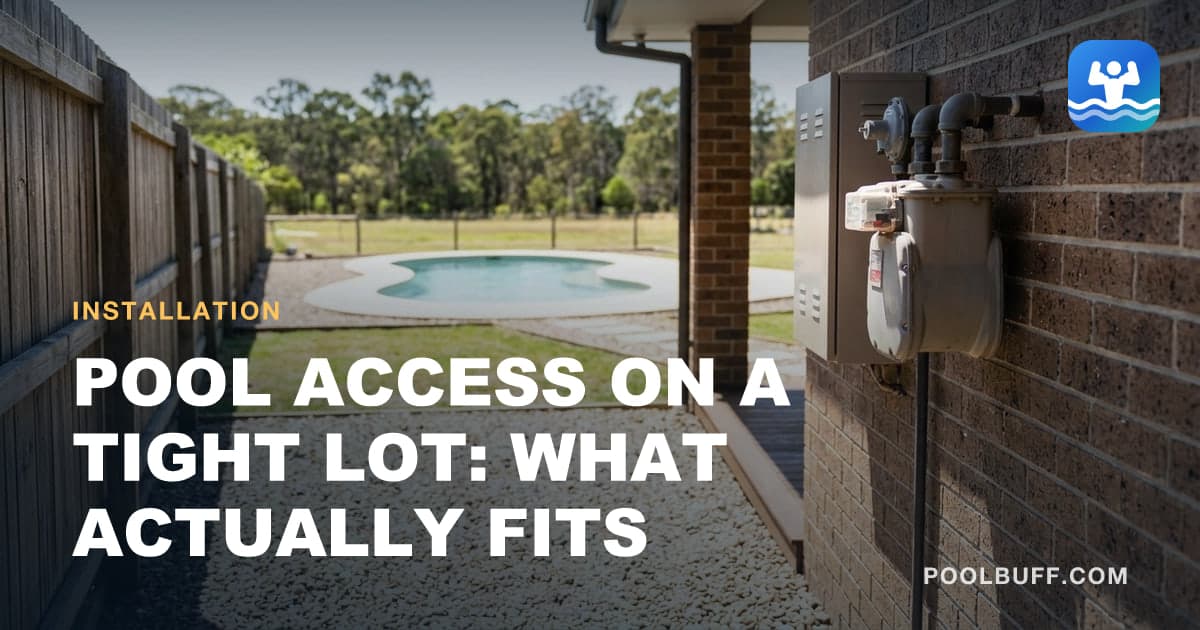
The gate is rarely the narrowest point. Walk the whole path from where a truck can park to where the hole goes, with a tape measure, and write down the tightest dimension you find.
Things that turn out to be the constraint:
- The gas meter or electric box bolted to the wall of the side passage, eating six inches nobody counted.
- An air conditioning condenser on a pad in the side yard.
- A downpipe and its shoe, which sticks out further than the pipe.
- The neighbor's fence, if it was built inside the line and the passage is narrower than the plan says.
- A step or a level change — machines need to drive, not climb.
Then look up. Overhead clearance stops as many jobs as width does: eaves, a carport roof, low branches, and above all service lines. There are code clearances between a pool and overhead conductors that no design will negotiate around, so find out about those before anyone draws anything.
What each machine needs
| Route width | What that gets you |
|---|---|
| Under 30 in | Hand digging, or a crane over the house |
| 30–36 in | The smallest tracked mini excavators, slowly |
| 36–60 in | Compact mini ex. Workable, longer schedule |
| 5–6 ft | Standard mini excavator. Normal build |
| 8 ft+ | Full-size machine and truck access. No constraint |
Between 30 and 36 inches you are in specialist territory — the machines exist, but fewer builders own one, and the dig takes noticeably longer because you are moving less per pass.
The honest way to find out is to have a builder walk the site with a tape. Ten minutes, and it saves designing something that cannot be delivered.
Spoil is the other half of the problem
The hole is only half the job. The dirt that came out of it has to leave.
A modest 12×24 pool produces something in the region of 50 cubic yards of material once you account for the swell as compacted soil is broken up — that is five or six truck loads. On a normal lot it gets stockpiled and loaded at leisure. On a tight lot there is nowhere to put it, so it has to be moved as it comes out, which means trucks scheduled against the dig and a real coordination cost.
Where a machine cannot get through but a person can, a conveyor is often the answer: spoil goes into it in the back yard and comes out into a truck on the street. It is slower than a machine and much cheaper than a crane.
The options ladder when nothing fits
- 1
Smaller machine
Adds daysThe cheapest fix. A compact tracked mini ex through a 36-inch gap costs schedule rather than money.
- 2
Temporary removal
Adds daysTake out a fence section, a gate post, a length of hedge, sometimes an AC condenser. Often the difference between 32 inches and 44, and it goes back afterward.
- 3
Conveyor
Adds a weekMachine digs, conveyor moves spoil out through the gap. Solves the dirt problem without solving the machine problem, so it pairs with a small machine or hand digging.
- 4
Crane over the house
One day, high costLifts a machine in, or a fiberglass shell straight into the hole. Typically $8,000 to $15,000, plus street closure and permits in some places.
Needs a place to set up the crane, clear airspace, and neighbors who have been spoken to.
- 5
Hand digging
WeeksAlways possible, rarely cheap. Days of machine work become weeks of labor and it is priced as labor. Reserve it for genuinely landlocked sites.
Access decides the pool type
This is the part that catches people who have already chosen a pool.
Fiberglass arrives as one rigid shell that has to physically reach the hole. If it cannot come down the side, it comes over the house on a crane or it does not come at all. Access rules this type out first.
Vinyl liner goes in as components — wall panels carried by hand through a gap a person fits through. It is the most access-tolerant build there is, and on a genuinely landlocked lot it is often the only realistic inground option.
Gunite is pumped. Concrete goes through a hose that can run a long way from a truck parked on the street, and rebar and forms are carried in. You still have to dig the hole, but the materials side is far more forgiving than a shell.
So the sequence runs backward from how most people do it: establish access, then pick the pool type that suits it, then design within that. Choosing a fiberglass pool and then discovering the side passage is 34 inches wide is an expensive way round.
Do this before anything else
Access, setbacks and permits are all constraints that exist before the first drawing, and all three are cheap to check and expensive to discover.
Walk the route with a tape. Call the building department. Call the utility if there is anything overhead. Then get a builder on site to confirm it, and design the pool that fits rather than the one in the photograph.
Go deeperWhich type, thenFiberglass, vinyl and gunite compared on cost, lifespan and what each one demands of a site.Frequently asked questions
How much access does a pool build need?
About 36 inches at the narrowest point for the smallest tracked mini excavator, and 5 to 6 feet for a standard one that will dig a pool in a reasonable time. Overhead matters as much as width — low branches, eaves, a carport roof or a service line will stop a machine that fits horizontally. Measure the whole route, because the narrowest point is rarely the gate.
Can you build a pool with no side access?
Yes, and it costs. The options in ascending order are a conveyor to move spoil out through a narrow gap, craning a machine or a shell over the house, or hand digging. Craning a fiberglass shell over a house typically runs $8,000 to $15,000. Hand digging is possible but turns days of excavation into weeks of labor, priced accordingly.
Which pool type works best with poor access?
Vinyl liner and gunite both tolerate tight access far better than fiberglass. Vinyl panels and gunite materials go in as components — panels carried by hand, concrete pumped through a hose that can run a long way from a truck parked on the street. A fiberglass pool arrives as one rigid shell that has to physically reach the hole, which is why it is the type access rules out first.
Where does all the excavated dirt go?
Off site, on trucks, and it is more than people expect. A modest 12x24 pool produces roughly 50 cubic yards of soil once you account for the swell as it is dug out, which is five or six truck loads. On a tight lot with nowhere to stage it, the dirt has to be loaded and moved as it comes out, and that coordination is a real part of the cost.
Do power lines affect a pool build?
They can stop it outright. Overhead service lines limit what can be craned or reached over, and there are code clearances between a pool and any overhead conductor that no amount of design will get around. Utilities will sometimes sleeve or temporarily de-energize a line for a fee. Establish this before you spend money on drawings.