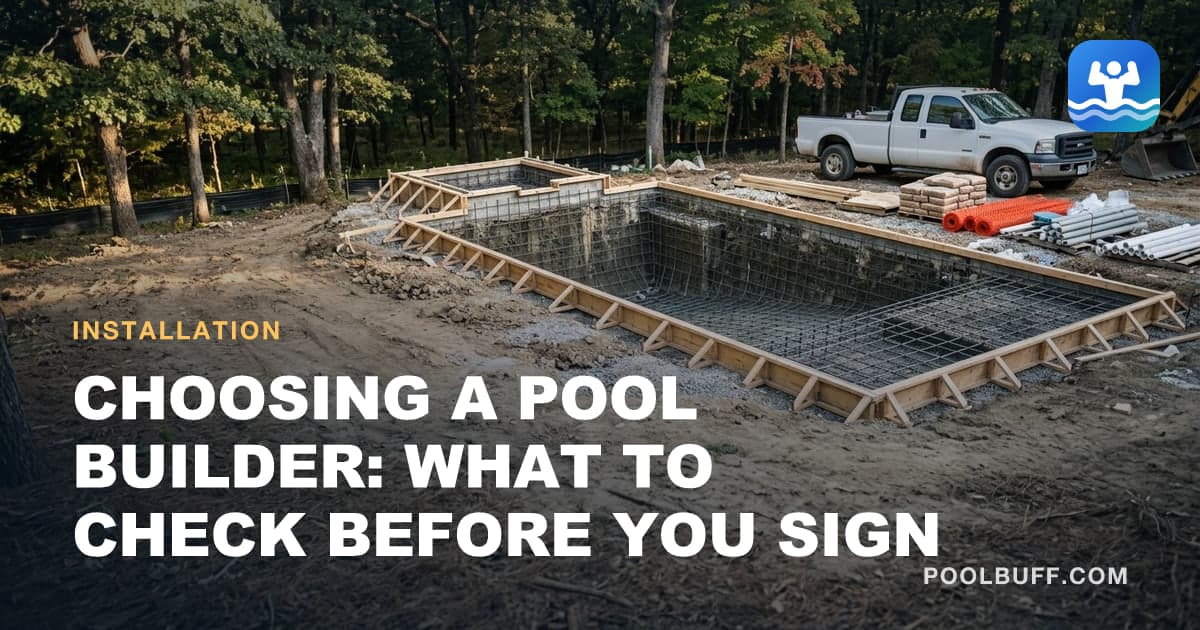
This is the most expensive decision in pool ownership and the one people spend the least time on.
They will research pump brands for two weeks and then pick the builder who seemed nice and could start soonest. Then they spend the next ten years living with choices that were made in a document they skimmed.
Here is what to actually check.
Key takeaways
- Check the license number with your state board yourself. It takes two minutes and it is the one check nobody does.
- Ask to see a pool built five years ago. Anyone can hand over a pool that looks good in week one.
- The lowest bid is usually the one with the most excluded from it. Compare exclusions, not totals.
- Get the exact equipment makes and models written into the contract. That line decides your running costs for a decade.
- Never pay a large sum up front. Tie payments to completed milestones, and get lien waivers as you go.
Verify the license yourself
Not "are you licensed?" — they will say yes. Get the number, then look it up on your state's contractor licensing board yourself.
What you are looking for:
- The license is current, not expired or suspended
- It covers pool construction specifically, not just general contracting
- The name on the license matches the name that will be on your contract
That last one catches more than you would think. Contractors sometimes trade under a marketing name while the legal entity is something else, and occasionally the entity is new because the previous one was dissolved owing people money. If the contract entity was formed four months ago and the website says "serving the area since 1998," ask about it directly.
Licensing rules and what a license actually covers vary by state, so check your own board rather than assuming.
Insurance, and why workers' comp is the one that matters
Ask for certificates, not assurances. Two policies:
General liability covers damage to your property. If a machine goes through your sewer line, this is what pays.
Workers' compensation covers their people if someone is hurt on your property. This is the one that can land on you. In many states, if a builder carries no comp and a worker is injured in your yard, you can end up carrying that exposure yourself. It is the least glamorous line on the certificate and the one with the worst downside.
References that actually tell you something
Every builder can produce three delighted customers from last month. A new pool looks good. That is not the question.
Ask to see a pool they built five or more years ago. That is where you find out whether the plaster has held, whether the deck has moved, whether the equipment pad was laid out sensibly, and whether they came back when something went wrong.
When you speak to that owner, ask better questions than "were you happy?":
- What went wrong during the build, and how did they handle it?
- Did the final price match the contract? If not, what changed?
- How long after completion did it take to get someone back for a warranty issue?
- Would you use them again, knowing what you know now?
That third question is the revealing one. Plenty of builders build well and vanish afterward.
Reading three quotes that all say different things
You have been told to get three quotes. Nobody tells you they will be unreadable side by side, because they are not quoting the same pool.
Line up the exclusions first. The usual suspects, and any of them can be five figures:
- Decking beyond a minimum band around the shell
- Electrical hookup and bonding
- Gas line for a heater
- Fencing to meet code
- Landscaping and site restoration
- Water to fill it
- Permits and engineering
Then line up the allowances. An allowance is a placeholder for something not yet chosen — tile, coping, interior finish, decking material. A builder can look cheaper simply by writing a smaller number in the allowance column, and you will pay the difference later when you pick something that costs what things actually cost.
Ask what each allowance buys in practice. "What does the tile allowance get me, and can you show me a pool with that tile on it?"
Go deeperWhat the whole thing actually costsReal installed costs, what sits inside a quote versus outside it, and the allowances that blow budgets.The equipment line nobody reads
Here is the part I would push hardest on, because it is where a buyer's attention is lowest and the ten-year consequences are highest.
Most contracts specify equipment loosely. "Variable speed pump." "Cartridge filter." "Salt system." That vagueness is not always malicious — it gives the builder flexibility on supply — but it means the cheapest qualifying item can arrive and still satisfy the contract.
Get exact makes and model numbers written in. Not "variable-speed pump" but the specific model. Not "filter" but the model and its square footage.
Two things to insist on, because they cost nothing extra at build time and a great deal afterward:
A properly sized filter, and then one size up. Filters work the opposite way to pumps — oversizing is a benefit, and the price gap between adjacent sizes is small at build time and impossible to change cheaply later.
Two-inch plumbing where it is practical. It carries about 65% more flow than inch-and-a-half at the same water velocity, which is what makes low-speed running on a variable-speed pump actually work. Pipe is cheap while the ground is open and ruinously expensive afterward.
Go deeperHow to size the filter in your contractSize it to the pump's flow, not the pool, and why one size up is always right.A builder who engages happily with these questions is telling you something good. One who brushes them off as over-thinking is telling you something too.
Payment schedule and lien waivers
Never pay a large sum up front. Many states cap what a contractor can take as a deposit, and a builder pushing hard for a big number before anything happens is the most common warning sign in this trade.
Payments should be tied to completed milestones — excavation, steel, gunite or shell set, tile and coping, equipment set, plaster or finish, final. Each payment happens after that stage is done, not before it starts.
Hold back a meaningful final payment until the punch list is complete. It is the only thing keeping their attention at the point where you most need it.
Ask for lien waivers at each stage. A lien waiver is a signed confirmation from a subcontractor or supplier that they have been paid. This matters because in most states an unpaid sub can place a lien on your property even though you paid the builder in full — the sub's dispute is with the builder, but the lien lands on your house. Lien law varies by state, so check how it works where you live.
Red flags
None of these is proof of anything on its own. Two or more together is a pattern.
- A large deposit demanded before any work
- A discount for paying cash, or reluctance to work under a written contract
- Pressure to sign today, or a price that expires this week
- No physical business address
- Reluctance to give a license number
- A bid well below the others with no explanation for the gap
- Vague equipment spec, and irritation when you ask to pin it down
- Cannot or will not name the subcontractors doing gunite, plumbing and electrical
The questions, in one place
Take this to every meeting.
Ask every builder
One thing worth remembering
The builder you pick is not just building a pool. They are choosing the equipment you will run for a decade, the plumbing you cannot change, and the shell you cannot move.
A good one will be happy to be asked all of this. That reaction, more than any single answer, is the signal.
Go deeperPermits, and what happens before the digWhat you need in place, how long it takes, and the contract terms that cause disputes. Go deeperStill deciding whether to build at all?The honest answer on resale value, and why the investment framing is the wrong one.Frequently asked questions
What should I ask a pool builder before signing?
Ask for the state license number and the insurance certificates. Ask who actually performs the gunite, plumbing and electrical work. Then ask what is excluded from the price, what the allowances cover, the exact equipment makes and models, and the change order rate. Finally, ask to see a pool they built five or more years ago. A builder who answers all of those easily is usually the one to hire.
How much deposit should a pool builder ask for?
As little as possible, and many states cap what a contractor may take up front. A large deposit demand is the most common warning sign in this trade. Payments should be tied to completed milestones — excavation, steel, gunite, tile, equipment set, plaster — with a meaningful amount held back until the punch list is finished.
Why are pool quotes so different from each other?
Almost always because they are not quoting the same pool. One includes the deck and one does not. One has a $4,000 tile allowance and one has $1,500. One specs a variable-speed pump and one a single-speed. Until you line up the exclusions and allowances side by side, the totals tell you nothing.
What are lien waivers and do I need them?
A lien waiver is a signed document from a subcontractor or supplier confirming they have been paid. It matters because in most states an unpaid sub can place a lien against your property even if you already paid the builder in full. Ask for waivers at each payment stage. Lien law varies by state, so check how it works where you live.
Should I choose the cheapest pool builder?
Rarely, and not on price alone. A bid noticeably below the others usually means something is excluded, an allowance is unrealistically low, or the equipment specified is cheaper than what the others quoted. Find out which before you decide — sometimes it is a genuine saving and often it is a bill arriving later.