Barrier codes get written after incidents. That's worth sitting with for a second, because it changes how you read them.
Every dimension on this page exists because a specific gap, or a specific height, or a specific piece of gate hardware, turned out to be the thing that let a child reach water. They're not arbitrary bureaucracy.
Key takeaways
- 48 inches high, 4-inch maximum gaps, latch at 54 inches. Those three numbers cover most of the code.
- The climbable-surface rule fails more inspections than anything else. Horizontal rails go on the pool side.
- Using the house as a barrier side means every door to the pool needs an alarm or self-latching hardware.
- Gate hardware fails silently. Test the self-close and self-latch monthly, not annually.
- Codes vary by jurisdiction. The version that matters is the one your inspector enforces.

The core numbers
Most US jurisdictions base their rules on the International Swimming Pool and Spa Code. The essentials:
Height: 48 inches minimum, measured from the finished grade on the outside of the barrier. Some states require 60. Measure on the outside — a fence that's 48 inches from the pool side but only 40 from a raised planting bed outside it is not compliant, and that catches people out constantly.
Gaps: nothing that passes a 4-inch sphere. Between verticals, under the bottom rail, at the gate hinge, at the latch side. Buy a 4-inch ball and walk your fence with it. It's the same test the inspector does.
Under the fence: maximum 4 inches over a solid surface like concrete, 2 inches over grass or gravel, and 1 inch for a removable mesh fence. That is the reverse of what most people assume, and erosion is the reason — soft ground can be dug out or wash away, so it gets the tighter tolerance, while a concrete apron cannot change. Mesh is tightest of all because the panels lift, and a gap you can lift is not a gap you can measure once.
No climbable surfaces on the outside. This one fails more inspections than anything else, and it has a specific code basis: the 48-inch height has to hold for 3 feet measured horizontally out from the barrier, so anything inside that band effectively lowers your fence. See below.
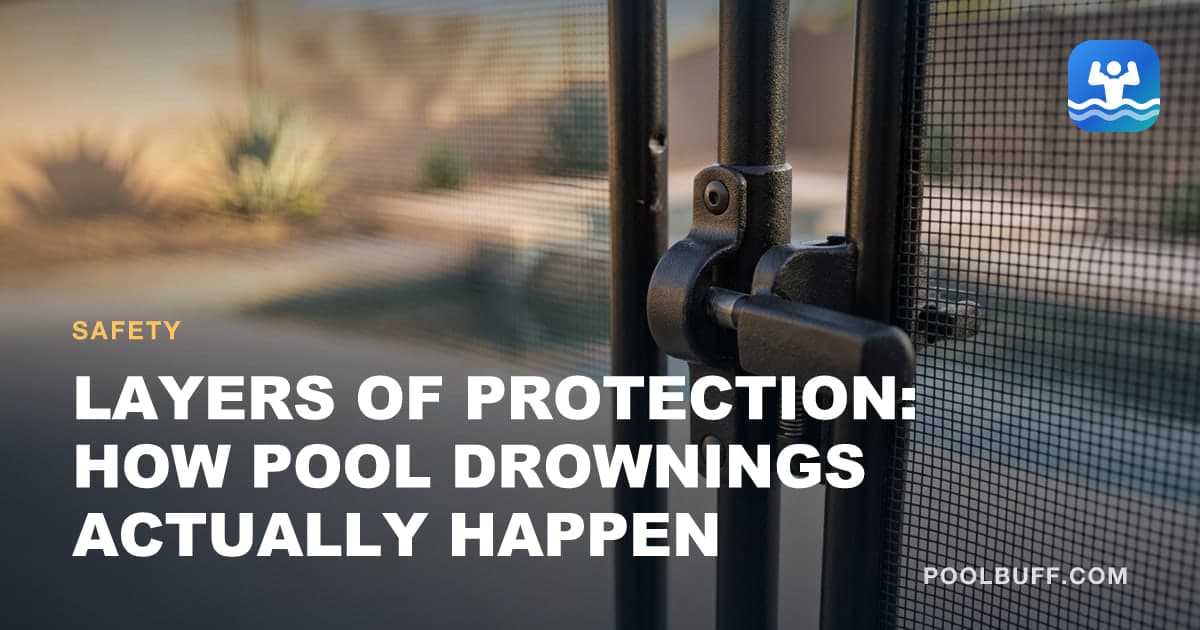
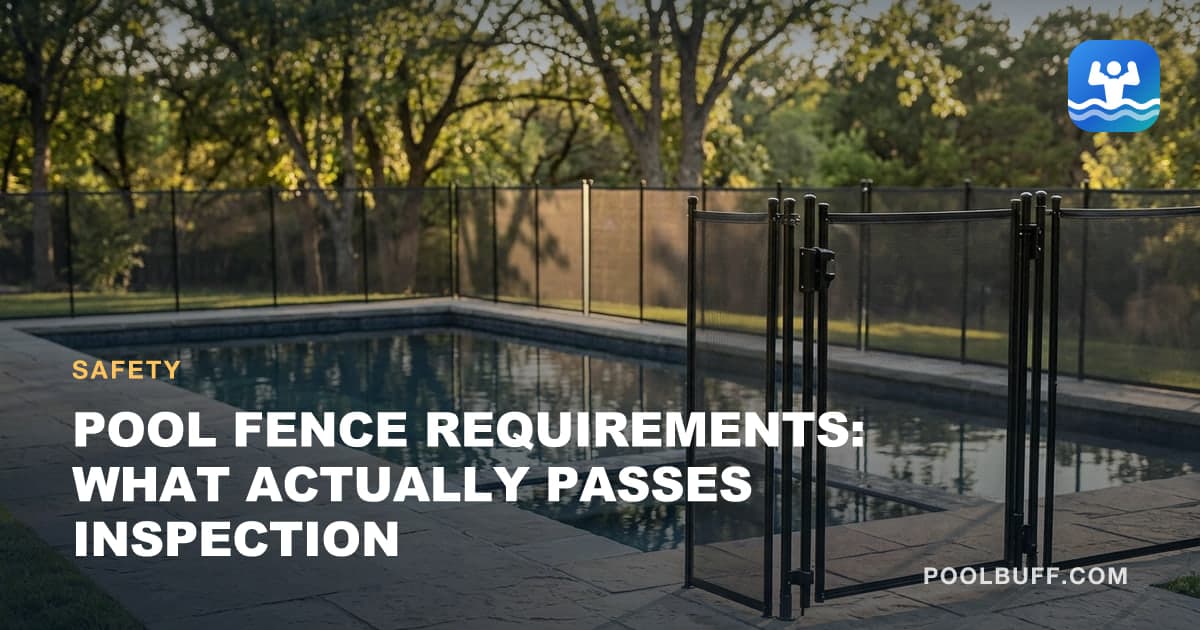
Gate: self-closing, self-latching, swinging away from the pool, with the release at least 54 inches above grade. If the release is lower, it has to be on the pool side, at least 3 inches below the gate top, and with no opening over half an inch within 18 inches of the release.
The climbable surface rule
This is where good intentions go wrong.
If a barrier has horizontal members less than 45 inches apart, they must be on the pool side, so the outside face gives no foothold. Vertical spacing then tightens to 1.75 inches.
Which means:
- Standard wood privacy fence with rails on the outside — fails. Turn it around.
- Chain link — the diamond mesh is a ladder. The ISPSC caps the opening at 1¾ inches, with or without slats. CPSC's guidelines are tighter still at 1¼ inches, so if you are buying new, buy to the CPSC number.
- Ranch rail, split rail, anything with horizontal boards — fails.
- Ornamental aluminum with rails at top and bottom only — passes, provided they're more than 45 inches apart.
Equipment gets its own rule. Pumps, filters and heaters sitting outside the barrier have to be at least 36 inches from it. An equipment pad tight against the fence is a step, and it is a step that never moves.
And it's not just the fence. Look at what's near it: an air conditioning unit, a woodpile, a raised planter, a bench, a trampoline, a trash can enclosure, a tree with a low branch. Anything a four-year-old can climb within a few feet of the fence effectively lowers your barrier to the height of that object.
I've seen a fence pass inspection and then fail its purpose entirely because somebody put a garden bench against it the following spring.
Using the house as a barrier
Common, allowed in many jurisdictions, and it comes with conditions.
If a house wall forms one side of the barrier, every door from the house to the pool area typically needs one of:
- An alarm that sounds for at least 30 seconds within 7 seconds of the door opening, audible throughout the house, with a deactivation switch at least 54 inches above the threshold. The CPSC guidelines point at UL 2017 for these, so buy one that names the standard
- A self-closing, self-latching device on the door
- A powered safety cover on the pool
Windows count too. An operable window with a sill less than 48 inches above the floor needs the same alarm as a door. That one gets missed on almost every retrofit.
Sliding doors count. So do pet doors — a pet door large enough for a child is a gap in your barrier, and this genuinely gets missed.
Some jurisdictions don't permit house-as-barrier at all. Check before you design around it.
If the house is one of your barrier sides
- Check price
Poolguard DAPT-2 door alarm
For the house door onto the pool deck. Sounds 7 seconds after the door opens unless an adult presses the switch.
- Check price
Poolguard GAPT-2 gate alarm
Sounds 7 seconds after the gate opens, even if it closes again, unless an adult presses the pass-through switch.
Worth being clear about what those are for. A door alarm here is not a substitute for the barrier — it is part of the barrier, because the code treats an unalarmed door from the house as a gap in it. On a pool with a compliant fence all the way around, the same alarm is a useful extra layer rather than a requirement.
Above-ground pools
If the pool wall itself is 48 inches or more, it can serve as the barrier. But:
- The ladder or steps must be removable, lockable, or enclosed by a compliant barrier
- Any deck attached to the pool needs its own barrier
- The wall has to be non-climbable — no supports or bracing that form a foothold
A fixed ladder on an unfenced above-ground pool fails essentially everywhere, and it's the most common above-ground violation.
Material choice
| Installed cost | Life | Notes | |
|---|---|---|---|
| Removable mesh | $15-$25/ft | 10-15 yrs | Cheapest compliant option, takes down for parties, looks temporary |
| Aluminum ornamental | $30-$60/ft | 25+ yrs | The default. Low maintenance, salt-tolerant if quality, good sightlines |
| Glass panel | $100-$300/ft | 25+ yrs | Best views, needs constant cleaning, expensive |
| Wood privacy | $25-$50/ft | 10-20 yrs | Rails must face the pool. Needs maintenance |
| Vinyl privacy | $30-$55/ft | 20+ yrs | Low maintenance, can look plasticky, check rail placement |
Mesh gets dismissed as the cheap option and it shouldn't be. It's compliant, it's effective, it's removable for an evening, and for a family with young children it's the fastest route to a safe pool.
Older pools, and what triggers compliance
A question that comes up constantly: does an existing pool have to meet current code?
The general answer is that codes apply at the time of permitting, so a barrier that was compliant in 1994 is usually allowed to stay — until something changes that. Three things commonly do.
Any permitted work on the pool. Resurfacing, a new deck, equipment replacement that needs an electrical permit. A permit application frequently pulls the barrier into scope, and a plan reviewer with your file open will notice a gate that no longer complies.
A sale. Many jurisdictions require barrier compliance at transfer, and buyers' inspectors look for it whether or not the jurisdiction does. It surfaces late in a transaction, which is the most expensive possible moment for it to surface.
Your insurer. Carriers can require a compliant barrier as a condition of coverage regardless of what the building code permits, and they can apply that at renewal on a pool that has been there for thirty years.
None of which is cause for alarm about an older fence. It is a reason to bring it up to current standards on your own schedule and at your own price, rather than in the two weeks before a closing.
The maintenance nobody does
Gate hardware fails silently. Self-closing hinges lose tension, latches get sticky, alignment shifts as posts settle.
Test monthly. Open the gate fully, let go, and watch. It should swing shut and latch on its own from any position, including from just an inch open — which is the hardest test and the one that catches worn hinges.
Also check:
- Gaps that have opened as the ground has settled
- Anything new placed near the fence that could be climbed
- Door alarms still working, still with batteries, still not muted
- Bottom gaps where soil has eroded
Put it on the same monthly loop as your calcium hardness test. It takes two minutes.
Go deeperLayers of protectionThe barrier is one layer. Here's what each of the others catches, and what it misses.Frequently asked questions
How tall does a pool fence need to be?
At least 48 inches measured from the outside grade, under the model code most US jurisdictions follow. Some states and municipalities require 60 inches. Measure from the ground on the outside — a fence on a raised bed or a slope can be compliant on one side and not the other.
What are the gap requirements for a pool fence?
No opening may allow a 4-inch sphere to pass. That applies to gaps between verticals, the gap under the fence, and gaps at the gate. For chain link the mesh opening limit is tighter, generally 1.75 inches unless slats reduce it.
Does a pool gate have to self-close?
Yes. It has to be self-closing and self-latching, open outward away from the pool, and have the release mechanism at least 54 inches above grade. If the release is lower than 54 inches it must be on the pool side, at least 3 inches below the top of the gate, with no opening larger than half an inch within 18 inches of it.
Can my house wall count as one side of the pool barrier?
In many jurisdictions yes, but with conditions. Doors from the house to the pool area typically need an alarm that sounds for at least 30 seconds, or a self-closing self-latching device, or a powered safety cover. Some jurisdictions don't allow it at all. Check locally before you plan around it.
Do above ground pools need a fence?
Usually. If the pool wall itself is at least 48 inches high it can serve as the barrier, but the ladder or steps have to be removable, lockable, or enclosed by a compliant barrier. A fixed ladder on an unfenced above-ground pool fails almost everywhere.
Is a pool alarm a substitute for a fence?
No, and no jurisdiction I'm aware of treats it as one. Alarms are a useful additional layer but a poor primary defense — they fail, they get muted, and they only tell you after someone is already in the water. A compliant barrier is the foundation.