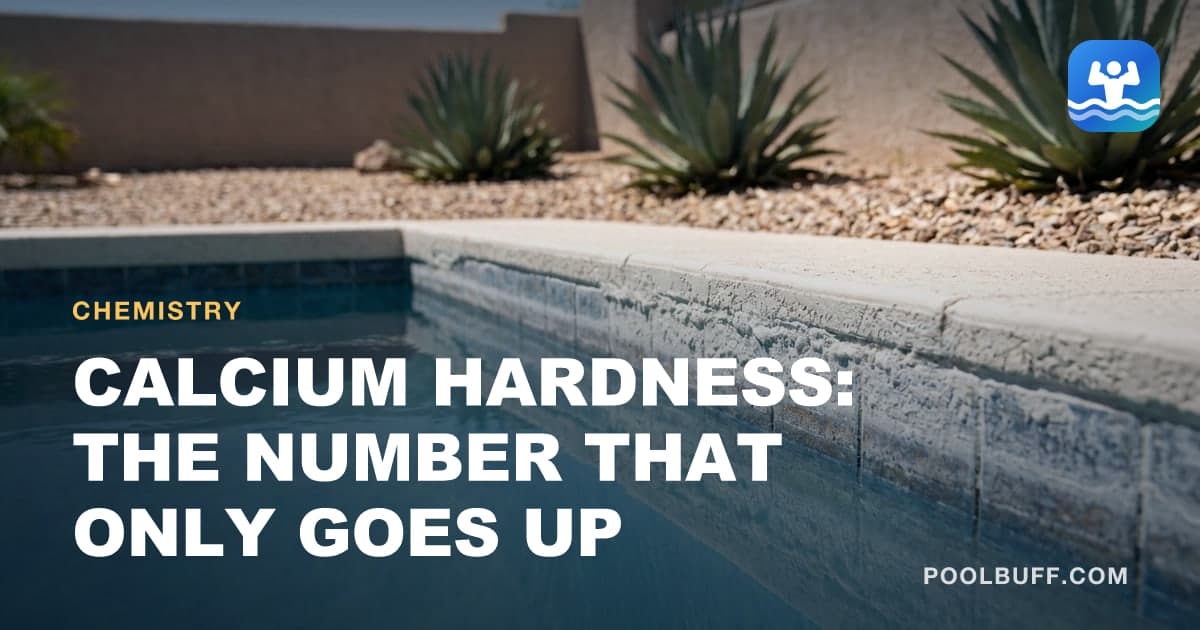
Calcium hardness is the pool number people ignore longest, because nothing dramatic happens when it drifts. Chlorine failing gives you a green pool by Sunday. Calcium out of range gives you a slightly rougher plaster surface in three years.
That delay is the whole problem. By the time low calcium is visibly damaging a pool, the damage is structural rather than chemical, and the repair is a resurfacing bill rather than a bag of something.
Key takeaways
- Low calcium is not harmless. Water below range takes calcium from your plaster.
- Calcium only leaves a pool by dilution. Everything you add stays.
- Vinyl and fiberglass still want some — bare metal and grout are still in there.
- The number that matters is the saturation index, not calcium hardness alone.
- Fill water varies enormously by region. Test the hose before blaming the pool.
Water takes what it is missing
Water wants a certain amount of dissolved mineral in it. Give it less than it wants and it will go and find some, from whatever calcium-bearing surface is available.
In a plaster or gunite pool, that surface is the pool. Plaster is calcium-based, so soft water slowly dissolves it — first as a roughening you notice underfoot, then as visible etching and pitting, then as exposed aggregate where the smooth layer has gone entirely.
This is the part that surprises people: low calcium is not the safe end of the range. It feels safer, because scale is visible and etching is not. But scale sits on your surface and can be removed. Etching removes the surface, and nothing puts it back.
Calcium hardness levels by pool surface
| Surface | Range | Why |
|---|---|---|
| Plaster, gunite, pebble | 250-400 ppm | The surface is calcium. Keep the water satisfied. |
| Vinyl liner | 175-275 ppm | Protects fittings, heater and grout without pushing toward scale. |
| Fiberglass | 175-275 ppm | Same reasoning as vinyl. |
Those are working ranges rather than hard limits, and the reason they are ranges is that hardness never acts alone.
The number that actually decides
Here is the thing that makes calcium hardness confusing on its own: whether water etches or scales is not decided by calcium alone. It is decided by calcium, pH, alkalinity and temperature together.
That combination is the saturation index, and it is what a pool professional manages rather than the individual numbers. A pool at 200 ppm calcium with high pH can be scaling. A pool at 400 ppm with low pH can be etching. The raw hardness number tells you one input, not the outcome.
Practically, this means: get calcium into its range and then stop thinking about it weekly, because pH and alkalinity are the numbers that move day to day and they are the ones doing most of the work.
What your test is actually measuring
A wrinkle worth knowing, because it decides whether your number means what you think it means.
Many hardness tests measure total hardness — calcium plus magnesium — rather than calcium on its own. Magnesium is present in most fill water and is not what you are managing here; it does not take part in the scale-and-etch chemistry the way calcium does. A total hardness reading therefore sits above the calcium hardness that belongs in an LSI calculation.
The gap is usually modest — magnesium often contributes 20 to 30 ppm — but it is systematic, and it always runs the same direction. A kit that specifies calcium hardness uses a reagent that suppresses magnesium. One that says total hardness does not, and strips report total almost universally.
Two other things skew a hardness reading. Metals in the water interfere with the endpoint color on some kits, which is one more reason to test for metals on a well fill. And a very hard sample can pass its endpoint before you notice the change, so dilute 50/50 with distilled water and double the result rather than squinting at the tube.
Raising it
Calcium chloride, sold as calcium hardness increaser and cheaper as plain calcium chloride if you check the label reads 94% or better.
It dissolves fast and generates heat doing it, so dissolve it in a bucket of water rather than broadcasting it dry, and add the calcium to the water rather than water to the calcium. Expect the water to cloud briefly — that is the calcium going into solution, not a problem.
Add in stages across a few days on a large correction, testing between. You cannot take it back out, which is the entire reason to be unhurried about putting it in.
Lowering it
You replace water. That is the option.
No chemical removes calcium from a pool at any sensible cost. Sequestrants hold it in solution so it does not deposit, which manages the symptom and does nothing about the concentration. Reverse osmosis treatment exists as a mobile service in some hard-water regions, and it is worth pricing where water is expensive or a full drain is risky.
Otherwise: partial drain, refill with softer water, retest. And check the hose water first, because in a genuinely hard-water region a refill can arrive at 400 ppm and you will have achieved nothing.
Why it climbs on its own
Two mechanisms, and neither involves you deciding to add calcium.
Evaporation. Water leaves, calcium stays, and every top-up brings more in. An uncovered pool in a hot dry climate concentrates hardness measurably across a season.
Cal hypo. Calcium hypochlorite shock adds roughly 0.7 ppm of hardness for every 1 ppm of chlorine it delivers. Shock a pool regularly all summer and that adds up, which is one reason the chlorine you choose matters beyond the chlorine itself.
Test monthly, expect it to rise slowly, and plan a partial drain when it approaches the top of range rather than after scale has already formed on the tile.
Go deeperThe index that ties it togetherHow calcium, pH, alkalinity and temperature combine into the one number that predicts scale or etching.Frequently asked questions
What should calcium hardness be in a pool?
Roughly 250 to 400 ppm for a plaster or gunite pool, and 175 to 275 ppm for vinyl or fiberglass. The plaster range is higher because plaster is calcium-based, and water below range will dissolve calcium out of it to satisfy itself. The lower range for vinyl still matters, because heaters, grout and metal fittings are still exposed to the water.
How do I lower calcium hardness in a pool?
You replace water, and that is essentially the only option. No chemical removes calcium at a sensible price. Partial drain and refill with softer water is the standard approach, and reverse osmosis mobile treatment exists in some regions where draining is impractical or water is expensive. Nothing you pour in will take it back out.
Is low calcium hardness bad for a vinyl pool?
It is not neutral, though it matters less than on plaster. Vinyl liners are not calcium-based, but the pool still contains a heater exchanger, metal fittings, and often tile grout — all of which aggressive low-calcium water works on. A modest level protects those without any real downside.
Why does my calcium hardness keep rising?
Because calcium does not leave. Evaporation removes water and leaves the calcium behind, so every top-up adds more. Cal hypo shock adds calcium too, at roughly 0.7 ppm for every 1 ppm of chlorine at 73% strength. In a hard-water region with an uncovered pool, hardness climbs every season without you adding anything deliberately.
Can I ignore calcium hardness if my other numbers are fine?
No, because it is one of the inputs that decides whether your water is aggressive or scale-forming. pH and alkalinity in range with calcium far out of range still produces etching or scale. It is worth testing monthly rather than weekly, but it is not a number to ignore.