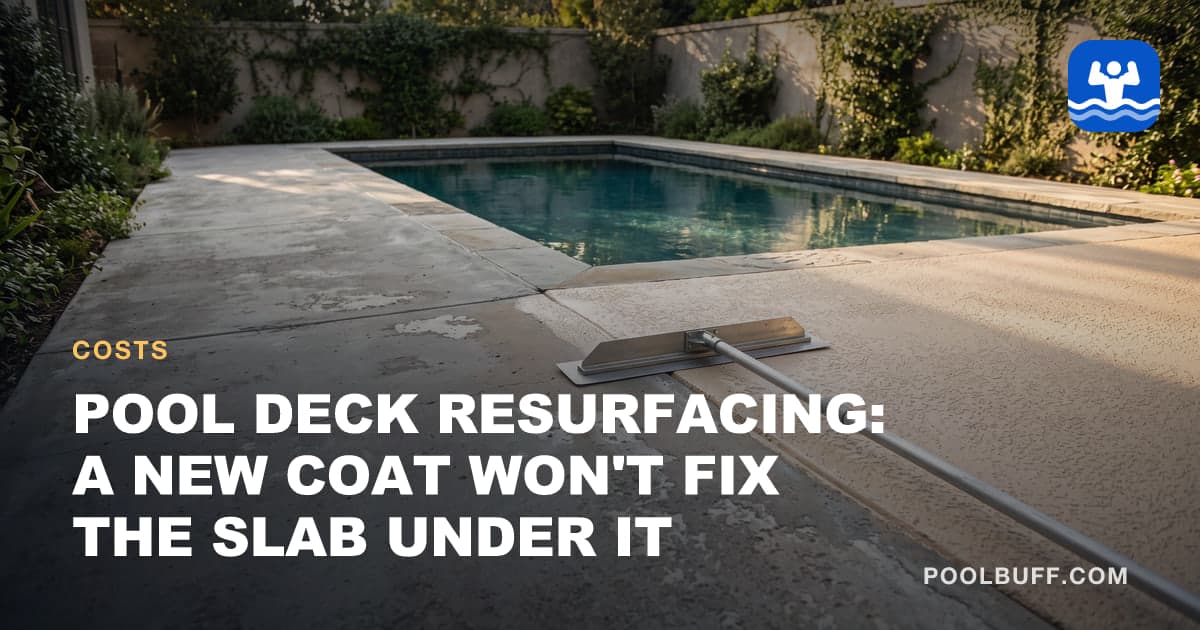
A tired deck is the cheapest-looking thing in a backyard, and a new coat makes it look new in a weekend. That's the appeal. The catch is that most coatings are an eighth to a quarter of an inch thick, and they sit on whatever was there before.
I didn't install deck coatings. I serviced pools, so what I know firsthand is how decks looked on service stops. I saw coatings peeling and Kool Deck worn out, and owners complained to me about decks that were too hot or too slick. On the resurfaced decks I saw, some held up well for years. Others peeled early, and on some the old cracks came back through the new surface. Most of what decides which one you get happens before the coating goes on.
Key takeaways
- A coating covers the slab; it doesn't fix it. Every coating maker that addresses old cracks says they can come back through, and Miracote tells installers to expect it.
- The old coating has to come off first. Mortex and Sundek won't go over paint, and the peeling I could explain on service stops was a new coat over an old one, or pool chemicals.
- Light colors stay cooler, but only two makers publish numbers. Laticrete warns that its own resin coatings run hot in full sun.
- Pavers over the old slab need a sound, flat base, and they raise the deck about an inch or more. Check the doors, drains and coping first.
- Budget for the joint at the coping. Two pool services list $9 to $11.50 a foot to dig out and replace it.
What each option costs
No agency publishes pool deck prices, so these are the sellers' own. They vary by region, and by what each price leaves out.
| Sellers' prices | Who and where | |
|---|---|---|
| Acrylic spray texture ("cool deck") over sound concrete | $3-$8 a sq ft (Austin, South Florida); $6-$12 (Los Angeles); $8-$14 (Phoenix) | SUNDEK Austin; Concrete Solutions; Moda Outdoor Living; AE Outdoor Living |
| Recoat of a sound coated deck | $2,200-$4,500 for 300-500 sq ft (Phoenix) | AE Outdoor Living |
| Stamped overlay | $8-$15+ a sq ft (Austin); $10-$14 (South Florida); $10-$18 (Los Angeles) | SUNDEK Austin; Concrete Solutions; Moda Outdoor Living |
| Epoxy or polyaspartic coating | $5-$10 a sq ft epoxy; $7-$12 polyaspartic (South Florida) | Concrete Solutions |
| Pavers over the old slab | $8 a sq ft (Tampa); from $18 (Ventura County); $18-$30 (Los Angeles) | Tampa Bay Pavers; Paver Exchange; Moda Outdoor Living |
| Tear out, pour new concrete | $10-$18 a sq ft (South Florida) | Concrete Solutions |
| Tear out, lay new pavers | $18-$28 a sq ft (Phoenix); $22-$35 (Ventura County); $22-$45 (Los Angeles) | AE Outdoor Living; Paver Exchange; Moda Outdoor Living |
| Foam lifting a sunken deck | About $2,025 for one side, up to $5,940 for the whole deck (Midwest) | A-1 Concrete Leveling |
| Deck-to-coping joint, dug out and replaced | $9 a foot (Houston); $10-$11.50 (Pennsylvania) | Houston Mobile Blasters; DS Pool Service |
Most of these prices assume a sound slab. AE Outdoor Living's $8 to $14 assumes a simple recoat over concrete that's already sound, and it says heavy prep adds $1 to $4 a square foot. That covers chasing cracks, repairing spalls and grinding off a failed coating. SUNDEK Austin and Concrete Solutions both price crack repair separately. So the first thing to compare in two quotes is what each one does about the cracks.
The paver prices are far apart. Tampa Bay Pavers lists pavers over an existing concrete deck at $8 a square foot. Two California companies start at $18. Same job, different markets, and the Tampa list has no date on it. Get local quotes before you plan around either number.
For a whole deck, SUNDEK Austin puts a typical 300 to 600 square foot job at $1,500 to $5,000. AE puts 600 to 900 square feet around Phoenix at $5,000 to $12,000. Measure your own deck before you compare, because a quote is a price per square foot times a measurement, and the measurement is often where two quotes differ. The same goes for resurfacing the pool itself.
Resurface or replace: check the slab first
A coating can't fix a weak or moving slab, so the slab decides. The concrete trade's own guidance is blunt about it. NRMCA, the ready-mixed concrete makers' association, says a repair is only as strong as the surface it's bonded to.
Walk the deck with a hammer and listen. A surface layer that's come loose sounds hollow when you tap it, NRMCA says, and its fix for widespread loosening is grinding and a new overlay. The Bureau of Reclamation's repair guide adds a warning: a deep loose layer won't always sound hollow.
Then look at the cracks.
- Fine, random hairline cracks are common, and NRMCA says they rarely affect the concrete's strength or life.
- Cracks that are still opening, or edges that don't line up, mean the slab is moving. The Bureau's guide and Super-Krete's crack guide both say to work out whether a crack is moving or dormant before choosing a repair.
- Scaling, where the top flakes off, can be repaired when it's light to moderate. NRMCA says repairing slabs with heavy, worsening scaling may not be practical.
- A sunken or heaved section is a base problem. More on lifting it below.
If the deck is sound apart from fine cracks and worn color, resurface it. If big sections are loose, sinking or breaking up, the money is better spent on new concrete or pavers. Concrete Solutions puts the difference at $4 to $8 a square foot to coat versus $10 to $18 to replace, in South Florida.
Old cracks come back through
This is the part most quotes skip. A thin coating bonded to a cracked slab moves when the slab moves.
The Bureau of Reclamation's repair guide says cracks in the old concrete may reflect through an overlay, and calls it common in bonded overlays. It also says the joints have to be kept, because a repair bonded across a joint will crack. The makers agree. Miracote's data sheet tells installers to "Expect reflection of dynamic cracks and control joints in substrate." Quikrete says reflective cracking can't be completely prevented. Westcoat says there's no guarantee cracks won't reappear, and SureCrete says never to run its overlay across a joint.
Sundek is the most candid about what happens next. Its FAQ says that despite treatment, cracks may recur, usually as hairlines mostly hidden in the texture, and that it will re-repair one that bothers you.
That matches what I saw. On some resurfaced decks, the old cracks were right back in the new surface.
There's a way to work with it. Instead of filling every crack and hoping, some installers cut the cracks into a pattern and seal them with a flexible sealant. The crack becomes a joint. Sundek sells this as its Custom Scoreline. Westcoat's spec offers a freehand flagstone pattern cut along the cracks. Either way, ask each contractor how they'll treat each crack, and whether the existing joints stay open.
Why coatings peel
Every maker I read wants the old coating off before theirs goes on. Mortex's Kool Deck instructions say to strip old paints and toppings with a scarifier and a pressure washer. Sundek won't go over painted concrete. Super-Krete wants the surface free of all coatings and sealers.
That fits the peeling I saw. Where I could see a cause, it was a new coat put over an old one, or pool chemicals. Sometimes I couldn't tell.
Can Kool Deck go over an old deck? Mortex says yes. It publishes instructions for Kool Deck on existing concrete, over its own bonding coat. Sundek's FAQ says Kool Deck only bonds to freshly poured concrete, within the first five hours. That's a competitor's claim, and Mortex's own documents contradict it.
How rough the slab has to be varies a lot. The industry measures it on a scale called CSP, for concrete surface profile, from 1 for nearly flat to 10 for very rough. Sundek's system diagram asks for CSP 1 to 2. Increte's Spray-Deck asks for CSP 4 to 6, which takes grinding or blasting. Follow the maker of the product actually going down.
The makers disagree about acid. Mortex's instructions etch old concrete with muriatic acid. The Bureau of Reclamation's guide says acid etching generally isn't allowed for creating a surface profile, and that concrete weakened by acid and left in place causes the repair to fail. Both are telling the truth about their own systems. If your installer etches with acid, ask how they rinse it and test the surface afterward.
Moisture under a coating pushes it off. Super-Krete, Westcoat and Laticrete all require a moisture test before their coatings go down. Mortex's and Sundek's documents don't mention one.
Keep pool chemicals off it. Mortex says to rinse spilled pool chemicals off a Kool Deck right away. The paver makers' association says acid spills do far more damage to pavers than salt water does. Keep acid off the deck, and hose off any splash right away.
Heat and grip
Those owner complaints about hot and slick decks are worth settling before you pick a finish. Resurfacing can fix either one, or make it worse.
Color decides most of the heat. EPA says how much sunlight a surface reflects is the main thing that decides its peak temperature. The coating industry rates that with SRI, the solar reflectance index, where higher means cooler in the sun. Only two makers I found publish numbers. Sundek gives its Oyster White an SRI of 75 and its Smoke Gray 21, without naming a test method. Westcoat's solar reflective topcoat rates 84 in gray and 91 in tan, both third-party tested.
Mortex says Kool Deck is cooler than plain concrete, but none of the documents I read include a temperature. It also says its own Systex deck paint gives no cooling, and that painting it over a Kool Deck makes the deck hotter and slicker.
Resin coatings run hot. Laticrete, which makes the Spartacote epoxy and polyaspartic coatings, says they may not suit outdoor pool decks because they get hotter than average in full sun. That's a maker warning against its own product, and worth weighing before an epoxy quote. The pool deck materials guide covers heat across materials.
Grip is mostly unmeasured. Mortex is the only maker I found that publishes a slip test, pendulum friction readings of 68 to 72. The others call their surfaces slip-resistant without naming a test. Westcoat says plainly that sealers make the surface slippery, and recommends a grit additive. Ask for grit in the sealer coat, and keep the texture. The CDC's model code for public pools wants more slope for drainage on heavily textured decks, 3/8 inch a foot, against 1/8 inch for smooth ones.
Pavers over the old slab
Laying pavers over concrete skips the tear-out, and the paver industry publishes a spec for it on pool decks. CMHA, the Concrete Masonry & Hardscapes Association, writes it for thin pavers 3/4 inch to 2 inches thick, for foot traffic only.
The spec asks a lot of the old slab:
- It has to be sound and free of cracks, scaling and spalling.
- The sand bed can't be used to fill low spots, so a wavy slab stays wavy.
- Deck drains have to be raised to the new surface.
- Water has to drain out from under the pavers, through weep holes at the low points.
CMHA's application guide says cracks 3/8 inch or wider should be patched before an overlay, and the joint against the coping gets a flexible urethane or neoprene sealant over a backer rod.
Watch the height. Even thin pavers add about an inch or more. If the door onto the deck is the house's required exit door, the residential code limits how far the landing can sit below the threshold: an inch and a half in Indiana's version of that section. The new surface also has to meet the coping. Find out what happens at the doors and the coping before you sign.
Sunken sections and the coping joint
Lifting a sunken section is cheaper than replacing it. A-1 Concrete Leveling, which lifts slabs with foam, puts one side of a pool deck at about $2,025 and a whole deck with large voids at about $5,940 or more. Two cautions come from highway work rather than decks. Missouri's transportation department says badly cracked or broken slabs can't be raised effectively. Kentucky researchers found foam-lifted highway panels had settled again after two years, one almost back to where it started.
The joint between the deck and the coping protects the coping. The CDC's model code for public pools requires a continuous watertight joint there, and the deck materials guide explains why. A resurfacing job is the time to replace it. Houston Mobile Blasters charges $9 a foot to dig it out and replace it, with a 75-foot minimum, and puts the average pool at $800 to $900. DS Pool Service lists $10 a foot where there's no sealant, and $11.50 to remove and replace it.
Living with it afterward
Cure time. Mortex's sheet for Kool Deck on existing concrete says to stay off it for 48 hours, then light walking after 3 days, normal walking after 14 and heavy furniture after 28. Its care sheet is stricter: light use only after a week, walking after two weeks, no furniture for four. Plan the job so that month isn't the middle of swim season.
Reseal on schedule. Westcoat says to inspect its texture system every 2 to 4 years and reseal every 3 to 5. Its 5-year warranty requires the reseals and written inspections. Moda, the Los Angeles builder, gives an acrylic coating 5 to 8 years before it needs recoating.
Pressure washing limits disagree. Miracote says under 1,000 psi. Sundek allows 2,000 to 2,500 psi with a fan tip held 10 to 12 inches away. Mortex's care sheet leaves mineral deposits to experienced contractors, with a surface cleaner on a 3,000 psi or stronger washer. Use the number from the maker of your coating, not the neighbor's.
Acid washing disagrees too. Mortex says a deck owner shouldn't acid wash a Kool Deck at all. Sundek's maintenance guide gives a 10-to-1 muriatic acid recipe for hard water deposits. Again, follow your own maker.
Salt pools. Mortex says to rinse and clean the deck often if you have a salt chlorinator. The saltwater pool maintenance guide covers the rest of the routine.
Getting quotes
Maker warranties cover the material, not the work. Westcoat's covers 5 years of material, conditional on the reseals. Mortex's documents offer none. Sundek's FAQ says the local dealer stands behind the workmanship. So the warranty that matters is the installer's, and you want it in writing.
Ask each contractor:
- Which product, by name, and will they follow its maker's instructions?
- How will they treat each crack, and do the existing joints stay?
- How does the old coating come off, and will they test for moisture?
- Is crack repair, drainage and the coping joint in the price, or extra?
- Is there grit in the sealer?
Compare the answers, not just the totals. A cheaper quote that skips the crack work is cheaper for a reason. If the deck is part of a bigger plan, the inground pool cost guide puts it in context.
Go deeperReplacing the deck instead?Concrete, pavers, travertine and wood compared on heat, grip and cost. Go deeperThe pool needs work tooWhat plaster, quartz and pebble cost, and how long each lasts. Go deeperRunning a salt pool?The routine that keeps salt off the deck and the cell clean.Frequently asked questions
How much does it cost to resurface a pool deck?
It depends on the finish and the region, and no agency publishes a figure. Sellers' own prices for an acrylic spray texture over sound concrete run $3 to $8 a square foot in Austin and South Florida, $6 to $12 in Los Angeles and $8 to $14 around Phoenix. Sundek's Austin dealer puts a typical 300 to 600 square foot deck at $1,500 to $5,000. Most of these prices leave out crack repair and drainage work.
Is it cheaper to resurface or replace a pool deck?
Resurfacing is cheaper when the slab is sound. A South Florida contractor lists $4 to $8 a square foot for an acrylic spray texture and $10 to $18 to remove the deck and pour new. But a coating can't fix a slab that's heaving, sinking or badly cracked, and the old cracks can come back through it. The slab's condition decides it, not the price.
Can you resurface a cracked pool deck?
Hairline cracks, yes. Cracks that are still moving, or a slab that's settling, are another matter. The Bureau of Reclamation's repair guide says cracks in old concrete may reflect through an overlay, and every coating maker that addresses it says they can come back. Ask how each crack will be treated. Some installers cut the cracks into a pattern and seal them so they become joints.
Can you put pavers over an existing pool deck?
Yes, if the slab is sound. The paver industry's guide for thin pavers over concrete pool decks wants a base free of cracks, scaling and spalling, and says the sand bed can't be used to fill low spots. Drains have to be raised to the new height, and the deck gets about an inch or more taller, so check the doors and the coping first.
How long does a pool deck coating last?
The makers mostly publish upkeep, not a lifespan. Westcoat says to reseal its texture system every 3 to 5 years and makes that a condition of its 5-year material warranty. Moda Outdoor Living, a Los Angeles builder, says an acrylic coating lasts 5 to 8 years before it needs recoating. Mortex publishes no lifespan for Kool Deck.