I've watched people burn out a $1,200 variable-speed pump because they never cleaned the filter properly.
Not because they never touched it. They backwashed religiously. But backwashing isn't cleaning, and the difference is why their pressure crept up year over year until the pump was working against a wall.
Key takeaways
- Backwashing is not cleaning. It moves the loose stuff and leaves the oils and minerals behind.
- Write your clean starting pressure on the filter tank with a marker. Without it you're guessing.
- A hose rinse gets the debris out of a cartridge, not the oil. The chemical soak is what gets the oil.
- Unicel recommends alternating two sets of cartridges. Swap and clean at your leisure.
- Replace sand when backwashing stops working, DE grids when cleaning stops working, and cartridges when they show Unicel's three signs, not by the calendar.
The number that tells you when
Write your clean pressure on the filter tank. Right on it, with a permanent marker, the day you finish a proper clean.
That's your baseline. Everything after is measured against it.
8–10 psi above baseline = clean it now. Not monthly, not when it looks bad, not when the water goes hazy. At the pressure.
High filter pressure means restricted flow. It's worth learning to read that gauge properly.
Restricted flow costs you four things: poorer filtration, uneven chlorine distribution, and a pump drawing more power than it should. On a heated pool it also trips the heater on high limit, because water isn't moving through the exchanger fast enough to carry the heat away.
Go deeperSand vs cartridge vs DE, settledWhat each type actually filters down to, and which one suits which pool.Cartridge filters
The easiest to get wrong, because the hose rinse feels like it did the job.
Before you start
- Time
- 1 hr
- Difficulty
- Easy
- Cost
- $15-$30 in cleaner
Tools
- Garden hose with straight nozzle
- Filter comb or spray wand
- Tub or trash can for soaking
- Gloves and eye protection
Supplies
- Cartridge cleaner or TSP
- Muriatic acid if scaled
- Silicone o-ring lubricant
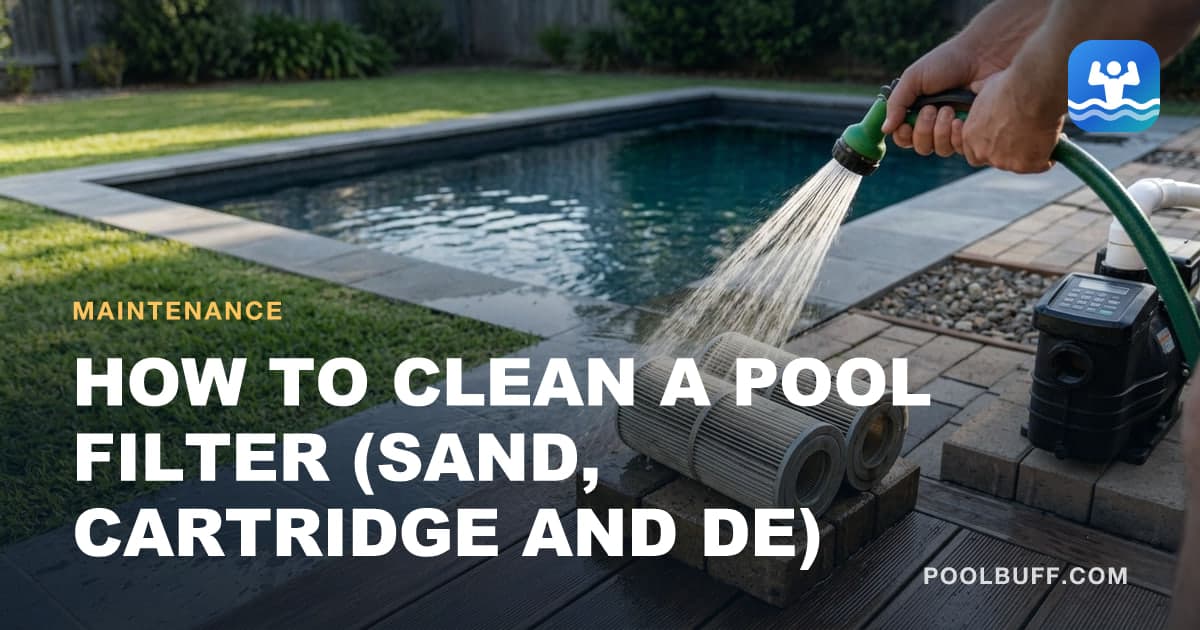
Rinse properly. Top down, one pleat at a time, with the nozzle at the 45-degree angle Pentair's guide shows rather than straight at it. Take your time; the dirt is between the pleats.
A filter comb or a dedicated spray wand helps open the pleats.
On a four-cartridge filter, replace the whole set rather than the one that looks worst — three good elements and one collapsed one just sends the dirt through the weak spot. The Pentair Clean & Clear Plus, Hayward SwimClear and Jandy CV and CL pages have the cartridge number for each model, along with how each manufacturer wants the lid clamped back on. Pentair and Hayward give torque figures that differ, and Jandy gives none, closing its clamp to a gap instead, so use the instruction for the tank you own.
The cleaning point varies by maker too. The 8–10 psi rule is the general one, but for their cartridge filters Hayward says 7 to 10 psi over the clean pressure in its SwimClear and StarClear Plus manuals, Pentair 10, and Jandy 10 to 12.
Then degrease. A rinse doesn't touch the oil.
What actually clogs a cartridge isn't dirt — it's sunscreen, body oil, hair product and lotion. Water won't move any of it. You need a surfactant.
Soak overnight in a cartridge cleaner or a TSP solution in a clean trash can, then rinse thoroughly. The water you pour out will be genuinely grim, and that's the stuff that was restricting your flow.
Pentair's cartridge guide and Unicel both list three soaks that work: a commercial cartridge cleaner, one cup of TSP in five gallons of water, or one cup of dishwasher detergent in five gallons. Both say at least an hour, and Unicel says overnight is more effective.
Acid only if scaled, and only after degreasing. If the pleats still feel gritty after a degrease, you've got mineral scale — common in hard water. A brief soak in dilute muriatic acid dissolves it.
Never acid first. Pentair's guide says acid soaking a cartridge that still has oil or cleaner in it causes a permanent restriction of flow and early cartridge failure, and Unicel says never to acid wash without degreasing first.
Hot tub cartridges follow the same rules at a smaller size, with a few exceptions the spa makers spell out. How to clean a hot tub filter covers them.
Sand filters
Backwash when pressure is 8–10 psi over baseline. Pump off, valve to backwash, pump on, run until the sight glass runs clear, which takes a few minutes. Pump off, valve to rinse, pump on for the time your manual gives to resettle the bed. That is about 30 seconds on Pentair, half a minute to a minute on Hayward, one to two minutes on Jandy's top-mount SFTM and one minute on its side-mount SFSM. Pump off, valve back to filter.
Always turn the pump off before moving that multiport handle. Moving it under pressure tears the spider gasket inside, and that's a genuine repair.
Deep clean once or twice a season. Backwashing doesn't touch oils and minerals. A sand filter cleaner poured into the skimmer, left to sit overnight with the pump off, then backwashed out, will drop your baseline pressure noticeably.
Replace the sand when backwashing stops working. No manufacturer's manual puts a number of years on it. Hayward's support team, answering an owner, said generally every 3 to 5 years, longer if the water stays clear. The grains wear down, mineral deposits clog the top of the bed, and too much flow can cut channels — paths where water runs through without contacting the media.
Signs it's time: short cycles between backwashes, which Pentair lists, or pressure a backwash can no longer bring down, which is Jandy's test. Try replacing the top inch of sand first. Sand on the pool floor is a different fault, usually a broken lateral, and new sand will not fix it. When the whole bed does need replacing, the sand change guide has the procedure and the amount each filter takes.
Glass media is worth considering at replacement time. Filters slightly finer, lasts longer, and you need about 20% less by weight. Costs more up front.
DE filters
The most work and the clearest water.
Backwash, then recharge with fresh DE through the skimmer. The amount is on the filter label, and it is not the same across brands: a 48 square foot Hayward ProGrid takes 6 lb, a 48 square foot Pentair FNS Plus takes 4.8, and a Jandy DEV48 takes 5. Under-charging leaves grids exposed and they'll clog with debris directly, which is how grids get damaged.
Once or twice a season, open the filter completely, pull the grid assembly, and hose every grid down. Check for tears, holes and separated seams while you're in there. A hole in a grid puts DE straight back into the pool, and you'll see it as a fine white dust on the floor. Pentair's Quad D.E. has four cartridges instead of grids, lifted out and hosed down like a cartridge filter's.
Chemical soak annually in the same way as cartridges — degrease first, acid only if scaled.
Replace grids when cleaning stops working. Neither Hayward nor Pentair puts a number of years on them. Hayward says to replace them when cleaning no longer brings the pressure back, and Pentair's order is backwash, hose, soak, and only then new elements. A torn grid is one of four reasons Hayward gives for DE in the pool. The others are too much DE, a cracked top manifold and a bad o-ring on the standpipe.
Check your local rules on DE disposal before backwashing. Some municipalities restrict discharging DE into storm drains and you may need a separation tank.
For a proper clean
- Check price
filter cleaner
A hose rinse leaves the oils behind. This is what gets the greasy film.
- Check price
DE powder
For DE filters, recharged through the skimmer after every backwash.
What each type actually costs to keep running
| Sand | CartridgeMy default | DE | |
|---|---|---|---|
| Routine cleaning | Backwash, ~5 min | Hose rinse, 30-60 min | Backwash + recharge, 15 min |
| Deep clean frequency | 1-2× per season | 1-2× per season | 1-2× per season |
| Water used per clean | 100+ gallons, per Jandy | Almost none | 100+ gallons, per Jandy |
| Media replacement | $60-$150 when backwashing stops working | When Unicel's three signs show | $200-$400 grids, when cleaning stops working |
| Consumables | None | Cleaner, ~$20/yr | DE powder, ~$40/yr |
The mistakes that cost real money
Backwashing instead of cleaning. Pressure creeps up over years. The pump works harder. Eventually something fails.
Never writing down the baseline. Without it you have no idea whether 22 psi is fine or a problem.
Acid before degreaser on a cartridge. Ruins the element.
Petroleum jelly on o-rings. Swells and degrades the rubber. Silicone lubricant only, and it's about $8 a tube.
Running with a torn cartridge. You're filtering nothing and wondering why the water stays hazy — a filter fault is one of the six causes of cloudy pool water and the one people check last.
Backwashing a sand filter for ten minutes. Hayward's manual says about two minutes or less, Pentair's about three, and Jandy's SFSM three to five, in each case until the water runs clear. Past that point you're just dumping water and, in a drought-restricted area, money.
Go deeperMultiport positions, explainedBackwash, rinse, waste and why skipping rinse clouds your water. Go deeperBackwashing, step by stepThe full sequence, when pressure says it is time, and why rinse is not optional.Worth keeping in the shed
- Check price
filter cleaner
A hose rinse leaves the oils behind. This is what gets the greasy film.
- Check price
DE powder
For DE filters, recharged through the skimmer after every backwash.
Frequently asked questions
How often should I clean my pool filter?
When pressure rises 8-10 psi above the clean baseline, whatever the calendar says. The makers' own cartridge figures differ a little: Hayward says 7 to 10 psi over the clean pressure, Pentair 10, Jandy 10 to 12, and Unicel 8. Sand and DE filters get backwashed at the pressure too, with a deep chemical clean once or twice a season.
Is backwashing the same as cleaning a filter?
No, and this trips a lot of people up. Backwashing reverses flow and flushes out loose debris. It does nothing about the oils, sunscreen residue and mineral scale bound to the media, which is what actually restricts flow long-term. Sand and DE filters still need a chemical clean once or twice a season.
How long do pool filter cartridges last?
There is no set number of years. Unicel, which makes replacement cartridges, says they have no defined end point and gives three signs one is exhausted: shorter runs between cleanings, low flow with high pressure, or a failure such as torn media or a collapsed core. It also says loose or missing bands are often a sign of a worn-out cartridge. To make one last, Unicel says to clean it by the instructions, never scrub it with a stiff brush, keep the water balanced, clean it before the pressure rises 8 psi, and alternate two sets.
Can I clean pool filter cartridges in a dishwasher?
Not a pool cartridge. The only maker I've found that allows a dishwasher for any filter is Hot Spring, and only for its Tri-X hot tub filter, with no soap and no dry cycle. Dishwasher detergent is a different matter: Pentair's cartridge cleaning guide and Unicel both list one cup in five gallons of water as a soak, as long as you rinse the cartridge thoroughly afterward.
How do I know when to replace pool filter sand?
When it stops responding to backwashing. No manufacturer's manual gives a number of years, though Hayward's support team told one owner generally every 3 to 5. Pentair lists worn sand as a cause of short filter cycles, and Jandy says to replace it when a backwash can no longer bring the pressure down. Try removing the top inch first, which Hayward and Pentair both suggest, because that is where deposits collect. Sand coming back into the pool is a different problem: the manuals point to a broken lateral, not old sand.