Black algae is the one that makes people think their chlorine has stopped working.
They shock the pool, hold it for days, watch the water go crystal clear — and the dark spots are still there, exactly as they were. Nothing is wrong with the chlorine. It simply never reached the thing you are trying to kill.
Key takeaways
- It is cyanobacteria, not algae, which is why algaecides sold for green algae fail.
- Every spot has roots into the surface and a shell over the top. Both have to be broken.
- Brushing is the treatment. Chlorine only finishes what the brush opens up.
- Stainless brush on plaster and gunite only — it will cut a vinyl liner.
- It is a porous-surface problem, so a worn plaster pool will keep getting it.
It is not algae, and that is the whole problem
Black algae is cyanobacteria. The name is a holdover from when anything green or dark in water got called algae, and it matters here because the differences are what defeat the usual treatment.
Three of them:
It has a root structure. Not roots in the botanical sense, but anchoring growth that pushes down into the pore structure of plaster and gunite. Brush the surface clean and the anchor is still in the wall.
It builds a protective layer. Each spot secretes a waxy coating that is genuinely effective at keeping chlorine out. This is the part people underestimate. Water at 30 ppm free chlorine will sit against that coating indefinitely and do very little.
It grows in layers. Kill the outer cells and the ones underneath carry on, protected by their own dead outer layer.
Put those together and you get the behavior everybody reports: the water tests perfect, the pool looks clean, and the spots do not move.
How to know it is black algae
Worth confirming, because two other things get mistaken for it and neither needs this treatment.
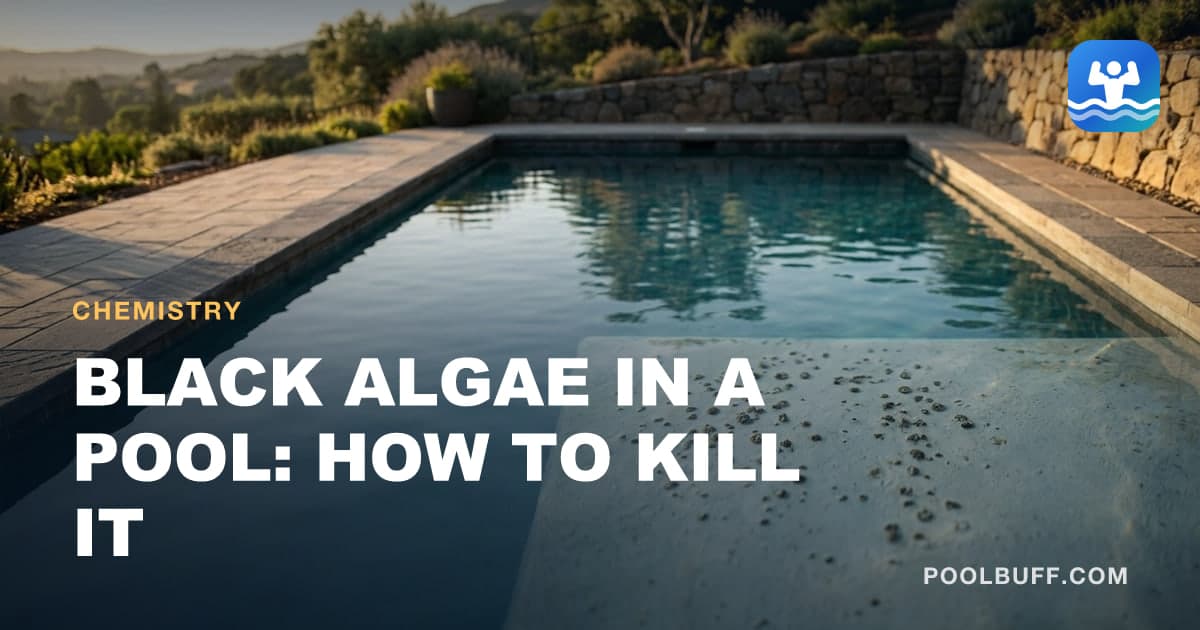
Black algae is dark blue-green to black, appears as distinct raised spots rather than a film, and has a rough, almost crusty texture. It clings hard — a fingernail resists it. It favors shaded areas, corners, steps, around fittings and along grout lines, and it is nearly always on plaster or gunite.
A stain is flat, not raised, and does not come away at all with a brush. Hold a chlorine tablet against it for thirty seconds — an organic stain lightens, black algae does not care. Identifying stains properly is a different job with different chemistry.
Dirt or debris in a corner wipes away with almost no pressure.
If it is raised, rough, and brushing takes real effort, it is black algae.
The treatment
The order matters more than anything else here, and the mechanical half is the part that works.
- 1
Balance pH first
20 minutesDrop pH to around 7.2. Chlorine's killing power falls off sharply as pH rises, and against something this well defended you want every advantage. This costs a little acid and buys real effectiveness.
- 2
Brush every spot, hard
30–60 minutesA stainless steel brush on plaster or gunite. This is not the gentle weekly pass — you are physically tearing open a protective coating, and a soft brush polishes it rather than breaking it.
On vinyl or fiberglass, use nylon. Stainless will cut a liner and scratch gelcoat, and the damage is not repairable.
Work each spot until the surface looks visibly disturbed. Missing spots is the main reason treatments fail.
- 3
Shock, and hold it
4–7 daysImmediately after brushing, take free chlorine to shock level for your stabilizer — about 40% of your CYA reading — and keep it there.
"Hold it" is the operative phrase. Test twice a day and top it back up. Chlorine that hits shock level each afternoon and falls to nothing overnight will not clear this.
- 4
Brush again. Every day.
1–2 weeksThis is the actual treatment and the step people abandon. Each day's brushing reopens spots that have started to re-seal, and lets that day's chlorine reach a little deeper.
Skip two days and the coating re-forms. You are not behind — you are back at the start.
- 5
Spot-treat what is left
—A few stubborn spots usually survive the general treatment. Press a trichlor tablet directly onto each one, or rub it into the spot.
It works because it is chlorine at a concentration the water cannot reach. It will also leave a pale etched mark on plaster where it sat, which is a fair trade on a handful of spots and not something to do across a whole wall. Never on vinyl.
- 6
Confirm with the overnight test
1 nightClear water is not the finish line. Test free chlorine at dusk and again at dawn — a loss under 1 ppm means nothing is still feeding on your chlorine.
Why it chose your pool
Black algae is a surface problem before it is a chemistry problem, which is why some pools get it repeatedly and others never do.
Porous or worn plaster is the main invitation. A new, smooth interior gives the root structure very little to grip; a fifteen-year-old surface that has gone rough and slightly chalky gives it a great deal. If you are clearing black algae for the second or third time, the honest read is often that the finish is near the end of its life and resurfacing would solve the problem permanently.
Poor circulation does the rest. It establishes where water moves least — behind ladders, in corners, on shaded steps, around light niches. Those are also the spots people brush least, which is not a coincidence.
Chlorine that ran low for a long stretch is what let it establish in the first place. Black algae does not appear in a well-sanitized pool overnight; it moves in during a season of neglect, a bad winter close, or a stretch where stabilizer climbed and nobody raised the chlorine target to match.
Keeping it gone
Once it is out, three habits keep it out, and none of them is a product.
Brush the places you never brush. Corners, steps, behind the ladder rails, around fittings. Weekly, and deliberately — the spots black algae likes are precisely the spots a lazy pass misses.
Hold chlorine at target for your CYA, not at a fixed number. This is the single thing that prevents it.
Fix the circulation dead zones if you have them, by adjusting return angles so water actually moves through the corners.
Algaecide is worth a sentence, and the sentence is that it does very little here. The polyquat products that help against green algae are prevention, not cure, and the copper-based ones bring their own staining problem to a pool that already has a surface issue. Brushing and chlorine is the treatment. Everything else is optional.
Go deeperThe other kinds, and how to tell them apartGreen, mustard, black and pink, what each one takes to clear, and why algaecide is rarely the answer.Frequently asked questions
What kills black algae in a pool?
Mechanical brushing followed by chlorine, in that order and repeated daily. Each spot carries a waxy protective layer that chlorine cannot penetrate, so brushing to break that layer open is what lets the chlorine reach the living cells underneath. Shock level held for four to seven days with daily brushing clears most cases in one to two weeks.
Why does black algae keep coming back?
Because the roots survive. Black algae anchors into the pore structure of plaster and gunite, and a spot brushed off at the surface regrows from what is left behind. That is also why it favors older, rougher surfaces — a worn interior gives it far more to hold onto, and a pool that keeps getting it may be telling you the finish is due for replacement.
Is black algae dangerous to swim in?
The organism itself is not considered a direct hazard at the levels found in a residential pool, but its presence is a reliable sign that sanitizer has been inadequate for a long time — and that does matter. Treat a pool with an active black algae problem as one to stay out of until chlorine has been held at target and the water is clear.
Does a trichlor tablet held on black algae work?
Yes, and it is a genuine trade trick. Pressing a tablet onto a spot delivers extremely concentrated chlorine directly onto the root structure. Two cautions: it will bleach and etch plaster where it sits, so expect a pale mark, and never do it on vinyl. Use it on stubborn isolated spots after brushing, not as the main treatment.
Can you get black algae in a vinyl or fiberglass pool?
It is far less common, because both surfaces are non-porous and give the root structure almost nothing to anchor into. Where it does appear on vinyl or fiberglass it is usually in a seam, behind a fitting or on a rough patch of repair. Treat it the same way but with a nylon brush — a stainless one will damage both surfaces.